Jan 30, 2020, 9:10 AM (very important) (summary) (Warning: This is the most important subject of our age, but it might trigger (offend) you so please move on if having your sacred cows slaughtered by science is unacceptable.) Pre-marine-trade Europeans like all other peoples didn’t have writing – few people did. Writing requires the evolution of debt-trade and taxation. The population density of territorial regions, the rate of production of territorial areas, and the cost of political control, all inhibit it, which is why the river valleys and the coasts developed writing. The europeans like all people, had oral history. Although it is most interesting that the europeans seem to have invented history as we understand it. The Atlantics, the Mediterraneans, the indo europeans, the beaker people, the Germanics, and certainly the Celts had oral history and had an industry for training their priesthood. The jews had history, and didn’t write it down, because of the prestige of memorizing it (just like europeans), and only wrote it down under advice, question, or command of the greeks. Like the dictionary froze english spelling, writing froze jewish, then christian, then islamic dogma. This isn’t the same for european, Indian, or Chines thought which was advice (wisdom literature) not command (authoritarian literature). Besides the universal lying and face before truth of the semitic tribal peoples, and this authoritarian literature, the middle east developed jewish pilpul and critique (lying) and muslim recitation and stagnation (avoidance of adaptation). The Chinese pursued harmony of their wisdom literature which limited their adaptation, and they followed sun tzu in war by delay and deceit, and their culture followed. The Iranic branch in India (Hindus) could not (as is happening to Americans) rule such a vast population of lower classes, and so chose a corporeal organization of class roles – a military organization familiar to the iranics, replicating the class structure of warriors, priests, and workers, each with different responsibilities. The Chinese had chosen hierarchical family, and europeans had chosen a hierarchical military. The Jewish-Palestinian-Arab semites chose universal resistance to all forms of aristocracy including the Egyptian by the adoption of universal slave resistance as a strategy. This failure to produce a durable military still plagues the jewish- Palestinian and less so Arab (raiding) peoples today. The jews in particular because they have neither the ethical tradition of land holders (and cant hold land) nor the ethical tradition of a working class (who fight) or an ethical tradition of a market between the elites. Which is why we wanted to move all jews to Israel, making a Netherlands of the middle east that may drag the primitive peoples out of authoritarian monopoly slave-resistance into market modernity – AND insulate us from jewish and muslim undermining at the same time. The Chinese strategy of course is to eradicate islam by incremental domestication of the muslim people and prohibiting entry of the jewish people. There is no force in Asia that can compete with Chinese domestication of other peoples. They have been doing it for thousands of years. The Europeans, having conquered the continent by military and technological means, had the pressure of a small population using maneuver, adaptation, technology, and a universal voluntary and therefore entrepreneurial military to produce a hierarchy – and produced as a consequence an entrepreneurial wisdom literature of markets including technology(science), law, philosophy, theology that competed with one another under their only immutable strategy – the sovereignty of the entrepreneurial warrior. Europeans maneuver, adapt, and invent with small number , Chinese resist and defeat by delay and deceive using numbers, semites deceive seduce with false promise and undermine and weaken – and the muslims consume and destroy, and Indians ignore because they are unconquerable by other than a cancer like islam – and get temporarily conquered by every passing malcontent even if they have the most beautiful of cultures and religions for the average person (except for the filth and irresponsibility for the commons). So as usual, when comparing civilizations we don’t disambiguate the truth-telling-empirical races, from the delay and deceive races, from the lying races – which is the entire purpose of my work. Ending abrahamic method of lying by jewish, christian, muslim generation-one theology, and marxism, cultural marxism, postmodern, feminism, denialism, by abrahamic generation-two pseudoscience and sophism. Because lying – especially baiting into hazard and undermining, are (empirically) easier and more profitable, as we can see from financial, insurance, gambling, advertising, media, entertainment, pornography, ad education – all of which allow undermining host peoples by false promise, absent warranty, under claims of plausible deniability of innocence. Which is where the Ashkenazi Jews have specialized: in every single form of profiting by false promise, baiting into hazard, – because that is the group strategy, just like every other group strategy I’ve mentioned above. And this is why the Ashkenazi were the most literate people in Europe but contributed absolutely nothing to thought, politics, law, technology, medicine, science, or arts until baited into the franchise in exchange for adopting european Aristotelian if not christian ethics – and failed. And its why they were kicked out of Egypt and every other host civilization; why they lost their territory and were dispersed, and why they have been systematically removed from every host population once they become intolerable by achieving critical mass of influence on the people and can no longer deny their strategy. This is the scientific basis of the conflict of civilizations including the conflict between jewish and muslim civilizations and EVERY OTHER civlization on this earth. Yet no matter what opportunity every people give the jews and muslims the outcome is the same – neither jews nor muslims adapt. Because that is the nature of their authoritarian monopoly parasitic group strategy: slave resistance that preys on the social and economic orders of aristocratic meritocratic people until they are reduced to genetic, institutional, political, cultural, normative, economic and military ruin – it is the strategy of uncontrolled dysgenic growth used by cancers. And the only ‘cure’ for this method of deceit is the light of truth and the law to punish it in a via-negativa market for the continuous suppression of profit by plausible deniability of accountability. The worst you can say about europeans is that we dragged humanity out of tyranny, rent seeking, free riding, deceit, ignorance, superstition, hard labor, starvation, disease, suffering, child mortality, early death, and the vicissitudes of an uncaring nature – but could have done it better. That’s the worst you can say. That is not the worst we can say for the semitic dark ages and 1billion dead in the ancient world, and 100M dead in just this past century and a half, and we still are not ‘cured’ of this second attempt at another semitic dark age. We have domesticated and Germanicized Christianity – but we must make it impossible for the Jews and Muslims to create another dark age for mankind. My hope is that we cure both physical and informational cancers in this century. And I’m doing my part for the latter by extending the law to prohibit these forms of crime. That is the sole purpose of my work. To prohibit, reverse, and perform restitution for the crimes against civilization by the use of abrahamic methods of deceit- so that we may continue mankind’s transcendence into the gods we imagined. People have very little agency. We are trial and error gene computers with firmware that imitates others, evolving software for no purpose other than negotiation with others – and what little agency we have is determined by the limits of whatever it is we learn by imitation and negotiation. Very, very, few of us transcend the animal from semi-consciousness to consciousness. The result of doing so – is love for man like we love our domesticated animals, pets, and children. “all we can do is help them. we are too few to do much else.”
Form: Mini Essay
-
Tri-Partism and The Tri-Functional Hypothesis of Our Natural Gods, and Our Natural Religion
Jan 30, 2020, 11:36 AM (mandatory understanding on IE origins of Market Gods) (compare with the Monopoly of semitic underclass gods)The Trifunctional Hypothesis of prehistoric Proto-Indo-European society postulates a tripartite ideology (“idéologie tripartite”) reflected in the existence of three classes or castes—priests, warriors, and commoners (farmers or tradesmen)—corresponding to the three functions of the sacral, the martial and the economic, respectively. The trifunctional thesis is primarily associated with the French mythographer Georges Dumézil, who proposed it in 1929 in the book Flamen-Brahman, and later in Mitra-Varuna. According to Dumézil (1898–1986), Proto-Indo-European society comprised three main groups corresponding to three distinct functions:
- Sovereignty, which fell into two distinct and complementary sub-parts:
… 1.1 one formal, juridical and priestly but worldly;
… 1.2 the other powerful, unpredictable, and also priestly but rooted in the supernatural world. - Military, connected with force, the military and war.
- Productivity, herding, farming and crafts; ruled by the other two.
In the Proto-Indo-European mythology each social group had its own god or family of gods to represent it and the function of the god or gods matched the function of the group. Many such divisions occur in the history of Indo-European societies: Southern Russia: Bernard Sergent associates the Indo-European language family with certain archaeological cultures in Southern Russia and reconstructs an Indo-European religion based upon the tripartite functions. Early Germanic society: The supposed division between the king, nobility and regular freemen in early Germanic society. Norse mythology: Odin (sovereignty), Týr (law and justice), the Vanir (fertility). Odin is assigned one of the core functions in the Indo-European pantheon as a representative of the first function (sovereignty) corresponding to the Hindu Varuṇa (fury and magic) as opposed to Týr, who corresponds to the Hindu Mitrá (law and justice); while the Vanir represent the third function (fertility). Odin has been also been interpreted as a death-god (“Psychopomp”: transporting us to the afterlife) and connected to cremations, and has also been associated with ecstatic practices. Classic Greece: The three divisions of the ideal society as described by Socrates in Plato’s The Republic. Bernard Sergent examined the trifunctional hypothesis in Greek epic, lyric and dramatic poetry. India: The three Hindu castes, the Brahmins or priests; the Kshatriya, the warriors and military; and the Vaishya, the agriculturalists, cattle rearers and traders. The Shudra, a fourth Indian caste, is a peasant or serf. A 2001 study found that the genetic affinity of Indians to Europeans is proportionate to caste rank, the upper castes being most similar to Europeans whereas lower castes are more like Asians. The researchers believe that the Indo-European speakers entered India from the Northwest, mixing with or displacing proto-Dravidian speakers, and may have established a caste system with themselves primarily in higher castes. TRIPLE (TRIPARTITE) DIETIES A triple deity (sometimes referred to as threefold, tripled, triplicate, tripartite, triune or triadic, or as a trinity) is three deities that are worshipped as one. Such deities are common throughout world mythology; the number three has a long history of mythical associations. Carl Jung considered the arrangement of deities into triplets an archetype in the history of religion. In classical religious iconography or mythological art, three separate beings may represent either a triad who always appear as a group (Greek Moirai, Charites, Erinyes; Norse Norns; or the Irish Morrígan) or a single deity known from literary sources as having three aspects (Greek Hecate, Roman Diana). THE INDO EUROPEAN ORIGINS OF TRIPARTISM, TRIFUNCTIONALISM, TRIPLE GODS, AND TERNARY LOGIC Georges Dumézil’s trifunctional hypothesis proposed that ancient Indo-European society conceived itself as structured around three activities: worship, war, and toil. In later times, when slave labor became common, the three functions came to be seen as separate “classes”, represented each by its own god. Dumézil understood this mythology as reflecting and validating social structures in its content: such a tripartite class system is found in ancient Indian, Iranian, Greek and Celtic texts. In 1970, Dumézil proposed that some goddesses represented these three qualities as different aspects or epithets and identified examples in his interpretation of various deities including the Iranian Anāhitā, the Vedic Sarasvatī and the Roman Juno. Vesna Petreska posits that myths including trinities of female mythical beings from Central and Eastern European cultures may be evidence for an Indo-European belief in trimutive female “spinners” of destiny. But according to the linguist M. L. West, various female deities and mythological figures in Europe show the influence of pre-Indo-European goddess-worship, and triple female fate divinities, typically “spinners” of destiny, are attested all over Europe and in Bronze Age Anatolia. POST BRONZE AGE COLLAPSE CULTURES Ancient Celtic cultures The Matres or Matronae are usually represented as a group of three but sometimes with as many as 27 (3 × 3 × 3) inscriptions. They were associated with motherhood and fertility. Inscriptions to these deities have been found in Gaul, Spain, Italy, the Rhineland and Britain, as their worship was carried by Roman soldiery dating from the mid 1st century to the 3rd century AD.[24] Miranda Green observes that “triplism” reflects a way of “expressing the divine rather than presentation of specific god-types. Triads or triple beings are ubiquitous in the Welsh and Irish mythic imagery” (she gives examples including the Irish battle-furies, Macha, and Brigit). “The religious iconographic repertoire of Gaul and Britain during the Roman period includes a wide range of triple forms: the most common triadic depiction is that of the triple mother goddess” (she lists numerous examples).[25] In the case of the Irish Brigid it can be ambiguous whether she is a single goddess or three sisters, all named Brigid.[26] The Morrígan also appears sometimes as one being, and at other times as three sisters,[27][28][29][30] as do the three Irish goddesses of sovereignty, Ériu, Fódla and Banba.[31] Hinduism In Hinduism, the supreme divinity Para Brahman can take the form of the Trimurti, in which the cosmic functions of creation, preservation, and destruction of the universe are performed by the three deities of Brahma (the creator), Vishnu (the preserver), and Shiva (the destroyer), who are at the same time three forms of the one Para Brahman.[32] The divine being Dattatreya is a representation of all three of these deities incarnated as a single being.[33] Christianity (the trinity) Christians profess “one God in three divine persons” (God the Father, God the Son and God the Holy Ghost). This is not to be understood as a belief in (or worship of) three Gods, nor as a belief that there are three subjectively-perceived “aspects” in one God, both of which the Catholic Church condemns as heresy. The Catholic Church also rejects the notions that God is “composed” of its three persons and that “God” is a genus containing the three persons. The Gnostic text Trimorphic Protennoia presents a threefold discourse of the three forms of Divine Thought: the Father, the Son, and the Mother (Sophia). Many Christian saints, especially martyrs, are trios who share a feast day or other remembrance. (See Category:Saints trios.) Whether they are subject to actual veneration and prayed to for supernatural aid, or simply honored, varies by Christian denomination. ESTATES OF THE REALM A 13th-century French representation of the tripartite social order of the Middle Ages – Oratores (“those who pray”), Bellatores (“those who fight”), and Laboratores (“those who work”). The estates of the realm, or three estates, were the broad orders of social hierarchy used in Christendom (Christian Europe) from the medieval period to early modern Europe. Different systems for dividing society members into estates developed and evolved over time. The best known system is the French Ancien Régime (Old Regime), a three-estate system used until the French Revolution (1789–1799). Monarchy was for the king and the queen and this system was made up of clergy (the First Estate), nobles (the Second Estate), and peasants and bourgeoisie (the Third Estate). In some regions, notably Scandinavia and Russia, burghers (the urban merchant class) and rural commoners were split into separate estates, creating a four-estate system with rural commoners ranking the lowest as the Fourth Estate. Furthermore, the non-landowning poor could be left outside the estates, leaving them without political rights. In England, a two-estate system evolved that combined nobility and clergy into one lordly estate with “commons” as the second estate. This system produced the two houses of parliament, the House of Commons and the House of Lords. In southern Germany, a three-estate system of nobility (princes and high clergy), knights, and burghers was used. In Scotland, the Three Estates were the Clergy (First Estate), Nobility (Second Estate), and Shire Commissioners, or “burghers” (Third Estate), representing the bourgeois, middle class, and lower class. The Estates made up a Scottish Parliament. TRIPARTISM (COOPERATIONISM, MARKETS) IN PROPERTARIANISM In P we begin with the three means of coercion: Force-Defense, Remuneration-Deprivation, and Inclusion-Undermining (ostracization) in a market preserved by the judiciary. We argue that the three classes developed three ‘market competitions’ for elites; martial-judicial, priestly-educational, and productive-labor and trade. These three sets of elites we recognize as Conservative-Capitalizing (force), Progressive-consuming(Undermining), and Libertarian-Productive (Trade). In P we restore the “cooperation between the compatible but unequal classes”: The Monarchy as judge of last resort, The Judiciary as preservation of sovereignty, the Senate (nobility) as territorial (tribal) interests, the Upper House as the Commercial Interests, and the Lower House as Family and Labor Interests. Under this interpretation, christianity is migrating to its natural place as the feminine (forgiveness, love), while we are restoring our traditional gods as we try to restore our civlization after the abrahamic dark ages of death and decline. LEARN MORE This info is collected from wikipedia, but read Dumezil or at least the spartk notes version. 😉 If you undestand Dumizel’s description of, Campbell’s Monomyth, and the nordic myths you can begin to reconstruct our natural religions in both northern second generation and southern european first generation forms.
- Sovereignty, which fell into two distinct and complementary sub-parts:
-
Tri-Partism and The Tri-Functional Hypothesis of Our Natural Gods, and Our Natural Religion
Jan 30, 2020, 11:36 AM (mandatory understanding on IE origins of Market Gods) (compare with the Monopoly of semitic underclass gods)The Trifunctional Hypothesis of prehistoric Proto-Indo-European society postulates a tripartite ideology (“idéologie tripartite”) reflected in the existence of three classes or castes—priests, warriors, and commoners (farmers or tradesmen)—corresponding to the three functions of the sacral, the martial and the economic, respectively. The trifunctional thesis is primarily associated with the French mythographer Georges Dumézil, who proposed it in 1929 in the book Flamen-Brahman, and later in Mitra-Varuna. According to Dumézil (1898–1986), Proto-Indo-European society comprised three main groups corresponding to three distinct functions:
- Sovereignty, which fell into two distinct and complementary sub-parts:
… 1.1 one formal, juridical and priestly but worldly;
… 1.2 the other powerful, unpredictable, and also priestly but rooted in the supernatural world. - Military, connected with force, the military and war.
- Productivity, herding, farming and crafts; ruled by the other two.
In the Proto-Indo-European mythology each social group had its own god or family of gods to represent it and the function of the god or gods matched the function of the group. Many such divisions occur in the history of Indo-European societies: Southern Russia: Bernard Sergent associates the Indo-European language family with certain archaeological cultures in Southern Russia and reconstructs an Indo-European religion based upon the tripartite functions. Early Germanic society: The supposed division between the king, nobility and regular freemen in early Germanic society. Norse mythology: Odin (sovereignty), Týr (law and justice), the Vanir (fertility). Odin is assigned one of the core functions in the Indo-European pantheon as a representative of the first function (sovereignty) corresponding to the Hindu Varuṇa (fury and magic) as opposed to Týr, who corresponds to the Hindu Mitrá (law and justice); while the Vanir represent the third function (fertility). Odin has been also been interpreted as a death-god (“Psychopomp”: transporting us to the afterlife) and connected to cremations, and has also been associated with ecstatic practices. Classic Greece: The three divisions of the ideal society as described by Socrates in Plato’s The Republic. Bernard Sergent examined the trifunctional hypothesis in Greek epic, lyric and dramatic poetry. India: The three Hindu castes, the Brahmins or priests; the Kshatriya, the warriors and military; and the Vaishya, the agriculturalists, cattle rearers and traders. The Shudra, a fourth Indian caste, is a peasant or serf. A 2001 study found that the genetic affinity of Indians to Europeans is proportionate to caste rank, the upper castes being most similar to Europeans whereas lower castes are more like Asians. The researchers believe that the Indo-European speakers entered India from the Northwest, mixing with or displacing proto-Dravidian speakers, and may have established a caste system with themselves primarily in higher castes. TRIPLE (TRIPARTITE) DIETIES A triple deity (sometimes referred to as threefold, tripled, triplicate, tripartite, triune or triadic, or as a trinity) is three deities that are worshipped as one. Such deities are common throughout world mythology; the number three has a long history of mythical associations. Carl Jung considered the arrangement of deities into triplets an archetype in the history of religion. In classical religious iconography or mythological art, three separate beings may represent either a triad who always appear as a group (Greek Moirai, Charites, Erinyes; Norse Norns; or the Irish Morrígan) or a single deity known from literary sources as having three aspects (Greek Hecate, Roman Diana). THE INDO EUROPEAN ORIGINS OF TRIPARTISM, TRIFUNCTIONALISM, TRIPLE GODS, AND TERNARY LOGIC Georges Dumézil’s trifunctional hypothesis proposed that ancient Indo-European society conceived itself as structured around three activities: worship, war, and toil. In later times, when slave labor became common, the three functions came to be seen as separate “classes”, represented each by its own god. Dumézil understood this mythology as reflecting and validating social structures in its content: such a tripartite class system is found in ancient Indian, Iranian, Greek and Celtic texts. In 1970, Dumézil proposed that some goddesses represented these three qualities as different aspects or epithets and identified examples in his interpretation of various deities including the Iranian Anāhitā, the Vedic Sarasvatī and the Roman Juno. Vesna Petreska posits that myths including trinities of female mythical beings from Central and Eastern European cultures may be evidence for an Indo-European belief in trimutive female “spinners” of destiny. But according to the linguist M. L. West, various female deities and mythological figures in Europe show the influence of pre-Indo-European goddess-worship, and triple female fate divinities, typically “spinners” of destiny, are attested all over Europe and in Bronze Age Anatolia. POST BRONZE AGE COLLAPSE CULTURES Ancient Celtic cultures The Matres or Matronae are usually represented as a group of three but sometimes with as many as 27 (3 × 3 × 3) inscriptions. They were associated with motherhood and fertility. Inscriptions to these deities have been found in Gaul, Spain, Italy, the Rhineland and Britain, as their worship was carried by Roman soldiery dating from the mid 1st century to the 3rd century AD.[24] Miranda Green observes that “triplism” reflects a way of “expressing the divine rather than presentation of specific god-types. Triads or triple beings are ubiquitous in the Welsh and Irish mythic imagery” (she gives examples including the Irish battle-furies, Macha, and Brigit). “The religious iconographic repertoire of Gaul and Britain during the Roman period includes a wide range of triple forms: the most common triadic depiction is that of the triple mother goddess” (she lists numerous examples).[25] In the case of the Irish Brigid it can be ambiguous whether she is a single goddess or three sisters, all named Brigid.[26] The Morrígan also appears sometimes as one being, and at other times as three sisters,[27][28][29][30] as do the three Irish goddesses of sovereignty, Ériu, Fódla and Banba.[31] Hinduism In Hinduism, the supreme divinity Para Brahman can take the form of the Trimurti, in which the cosmic functions of creation, preservation, and destruction of the universe are performed by the three deities of Brahma (the creator), Vishnu (the preserver), and Shiva (the destroyer), who are at the same time three forms of the one Para Brahman.[32] The divine being Dattatreya is a representation of all three of these deities incarnated as a single being.[33] Christianity (the trinity) Christians profess “one God in three divine persons” (God the Father, God the Son and God the Holy Ghost). This is not to be understood as a belief in (or worship of) three Gods, nor as a belief that there are three subjectively-perceived “aspects” in one God, both of which the Catholic Church condemns as heresy. The Catholic Church also rejects the notions that God is “composed” of its three persons and that “God” is a genus containing the three persons. The Gnostic text Trimorphic Protennoia presents a threefold discourse of the three forms of Divine Thought: the Father, the Son, and the Mother (Sophia). Many Christian saints, especially martyrs, are trios who share a feast day or other remembrance. (See Category:Saints trios.) Whether they are subject to actual veneration and prayed to for supernatural aid, or simply honored, varies by Christian denomination. ESTATES OF THE REALM A 13th-century French representation of the tripartite social order of the Middle Ages – Oratores (“those who pray”), Bellatores (“those who fight”), and Laboratores (“those who work”). The estates of the realm, or three estates, were the broad orders of social hierarchy used in Christendom (Christian Europe) from the medieval period to early modern Europe. Different systems for dividing society members into estates developed and evolved over time. The best known system is the French Ancien Régime (Old Regime), a three-estate system used until the French Revolution (1789–1799). Monarchy was for the king and the queen and this system was made up of clergy (the First Estate), nobles (the Second Estate), and peasants and bourgeoisie (the Third Estate). In some regions, notably Scandinavia and Russia, burghers (the urban merchant class) and rural commoners were split into separate estates, creating a four-estate system with rural commoners ranking the lowest as the Fourth Estate. Furthermore, the non-landowning poor could be left outside the estates, leaving them without political rights. In England, a two-estate system evolved that combined nobility and clergy into one lordly estate with “commons” as the second estate. This system produced the two houses of parliament, the House of Commons and the House of Lords. In southern Germany, a three-estate system of nobility (princes and high clergy), knights, and burghers was used. In Scotland, the Three Estates were the Clergy (First Estate), Nobility (Second Estate), and Shire Commissioners, or “burghers” (Third Estate), representing the bourgeois, middle class, and lower class. The Estates made up a Scottish Parliament. TRIPARTISM (COOPERATIONISM, MARKETS) IN PROPERTARIANISM In P we begin with the three means of coercion: Force-Defense, Remuneration-Deprivation, and Inclusion-Undermining (ostracization) in a market preserved by the judiciary. We argue that the three classes developed three ‘market competitions’ for elites; martial-judicial, priestly-educational, and productive-labor and trade. These three sets of elites we recognize as Conservative-Capitalizing (force), Progressive-consuming(Undermining), and Libertarian-Productive (Trade). In P we restore the “cooperation between the compatible but unequal classes”: The Monarchy as judge of last resort, The Judiciary as preservation of sovereignty, the Senate (nobility) as territorial (tribal) interests, the Upper House as the Commercial Interests, and the Lower House as Family and Labor Interests. Under this interpretation, christianity is migrating to its natural place as the feminine (forgiveness, love), while we are restoring our traditional gods as we try to restore our civlization after the abrahamic dark ages of death and decline. LEARN MORE This info is collected from wikipedia, but read Dumezil or at least the spartk notes version. 😉 If you undestand Dumizel’s description of, Campbell’s Monomyth, and the nordic myths you can begin to reconstruct our natural religions in both northern second generation and southern european first generation forms.
- Sovereignty, which fell into two distinct and complementary sub-parts:
-
Show Up
Jan 30, 2020, 12:19 PM by Bill Joslin and CD What we have learned from the past thirty years. Take a large number of men. Take all the resources you need to feed them. Move as fast as you can from region to region. Deplete the urban supply chain to feed the crew. Take out the power. Light some bonfires. Watch the catastrophe happen. The only dam holding back the ‘dependents’ is the financial system, power system, and road transport. That’s it. Break the dam and let the ‘water’ do its work. In a SHTF scenario everyone fears roaming gangs of men. So the silly folk hunker down and become victims. You cannot defend yourself from war. The only defense is offense. The solution is to BE the roaming gang of violent men intergenerational solution- become the roaming gang of violent men that win and own the peace. Rebels, Fighters and Soldiers…fight to win the war. Revolutionaries (i.e warriors) Fight to own the peace. in owning and maintaining the peace they walk the path of gods) So Show Up.
-
Show Up
Jan 30, 2020, 12:19 PM by Bill Joslin and CD What we have learned from the past thirty years. Take a large number of men. Take all the resources you need to feed them. Move as fast as you can from region to region. Deplete the urban supply chain to feed the crew. Take out the power. Light some bonfires. Watch the catastrophe happen. The only dam holding back the ‘dependents’ is the financial system, power system, and road transport. That’s it. Break the dam and let the ‘water’ do its work. In a SHTF scenario everyone fears roaming gangs of men. So the silly folk hunker down and become victims. You cannot defend yourself from war. The only defense is offense. The solution is to BE the roaming gang of violent men intergenerational solution- become the roaming gang of violent men that win and own the peace. Rebels, Fighters and Soldiers…fight to win the war. Revolutionaries (i.e warriors) Fight to own the peace. in owning and maintaining the peace they walk the path of gods) So Show Up.
-
The Copula: The First Step in Learning the Propertarian Method
This is one of those surprisingly difficult concepts. We avoid the verb to be in operational language because it allows you the pretense of knowledge (promising what you can’t promise) without articulating a causal relationship. The simple example being the difference between ‘the book is on the table’ and ‘I promise i recall seeing a book on the table in the hallway’ or ‘I promise i see a book on the table and if you observe the table in the hall you will see a book on it also.” While this is a simple example, this operationalizing of language into testimonial speech makes almost all sophistry and deceit impossible to construct (really). In fact, most sophomoric philosophically ‘profound’ questions cannot be constructed in operational and testimonial terms. If you want to know more, spend thirty minutes reading four wiki articles: THE COPULA (VERB TO BE) https://en.wikipedia.org/wiki/Copula_(linguistics) EPRIME (ELIMINATING THE COPULA) https://en.wikipedia.org/wiki/E-Prime PERFORMATIVE (EXISTENTIAL) TRUTH https://en.wikipedia.org/wiki/Truth#Performative (then read the rest of the article) OPERATIONALISM https://www.merriam-webster.com/dictionary/operationalism FALSIFIABILITY https://en.wikipedia.org/wiki/Falsifiability#Falsificationism By the use of performative statements, in ePrime, in Operational Vocabulary, we can falsify almost any claim to knowledge, understanding, consistency, coherence, and truth claims simply by the fact that it is almost impossible to state a falsehood in such gramamtical constraints, just as it is almost impossible to make well formed mathematical or programming statements in the grammatical constraints of mathematics in programming. DISAMBIGUATION BY SERIALIZATION AND OPERATIONALISM Most of P-Logic invovles learning how to disambiguate at term by creating an ordered list of terms (serialization) restating them in operational language, and adjusting their definitions so that they are each unique in meaning, yet represent a point on the spectrum of whatever constant relation you are making use of. THis is the first step in learning propertarian methods.
-
The Copula: The First Step in Learning the Propertarian Method
This is one of those surprisingly difficult concepts. We avoid the verb to be in operational language because it allows you the pretense of knowledge (promising what you can’t promise) without articulating a causal relationship. The simple example being the difference between ‘the book is on the table’ and ‘I promise i recall seeing a book on the table in the hallway’ or ‘I promise i see a book on the table and if you observe the table in the hall you will see a book on it also.” While this is a simple example, this operationalizing of language into testimonial speech makes almost all sophistry and deceit impossible to construct (really). In fact, most sophomoric philosophically ‘profound’ questions cannot be constructed in operational and testimonial terms. If you want to know more, spend thirty minutes reading four wiki articles: THE COPULA (VERB TO BE) https://en.wikipedia.org/wiki/Copula_(linguistics) EPRIME (ELIMINATING THE COPULA) https://en.wikipedia.org/wiki/E-Prime PERFORMATIVE (EXISTENTIAL) TRUTH https://en.wikipedia.org/wiki/Truth#Performative (then read the rest of the article) OPERATIONALISM https://www.merriam-webster.com/dictionary/operationalism FALSIFIABILITY https://en.wikipedia.org/wiki/Falsifiability#Falsificationism By the use of performative statements, in ePrime, in Operational Vocabulary, we can falsify almost any claim to knowledge, understanding, consistency, coherence, and truth claims simply by the fact that it is almost impossible to state a falsehood in such gramamtical constraints, just as it is almost impossible to make well formed mathematical or programming statements in the grammatical constraints of mathematics in programming. DISAMBIGUATION BY SERIALIZATION AND OPERATIONALISM Most of P-Logic invovles learning how to disambiguate at term by creating an ordered list of terms (serialization) restating them in operational language, and adjusting their definitions so that they are each unique in meaning, yet represent a point on the spectrum of whatever constant relation you are making use of. THis is the first step in learning propertarian methods.
-
Yes We Can Falsify All Human Speech in Court.
Jan 30, 2020, 10:11 PM We can, and do, falsify all human action in court. The question was, could we falsify all human speech in court. The answer is yes. The usual problem is that someone wants an ideology(political) philosophy (secular theological), or theology (supernatural theological) solution – which is impossible. Because Science (truthful testimony) is falsificationary. As far as I know, P is complete. And there are no false or ir-reciprocal statements that can survive its falsification. That fact that people can’t get their noggins around the fact that all science (testimony) like markets (competition) is falsificationary is a common problem. But it stems from a failure to understand that science is falsificationary, then demanding P, like philosophy, ideology, or religion be justificationary. It’s not. So they criticize P for not being a science on the one hand by false presumption science is justificationary, and then complain P isn’t justificationary. Kind of silly really, but you can see where they get it from. Most people are stuck in the error of “Mathiness” because they don’t grasp the constitution of, or limits of, mathematics. Math breaks down in all three directions: the very small, the very large, and the very-human (cognitive): economics. If you need a positive theology, philosophy, ideology, sophism, or pseudoscience, then I understand the via-positiva is necessary for simple minds. But grownups are not afraid of via-negativa (skepticism), because we know all non trivial non tautological propositions are contingent, because we may always or nearly always, discover some novel parsimony that allows us to reorganize our paradigms for greater consistency, correspondence, coherence, completeness and parsimony than before. Edit
-
On Spirituality (Try to grok it)
On Spirituality (Try to grok it)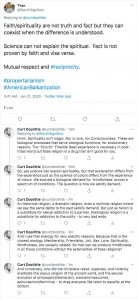 Hmm. Spirituality isn’t magic. Nor is love, nor Consciousness. These are biological processes that serve biological functions, for evolutionary reasons. The “Church” Fireside feast experience is necessary in post- tribal world but false religion is a drug that isn’t good for you.So, yes science can explain spirituality, but that explanation differs from the experience just as the science of colors differs from the experience of colors. We evolved a biological demand for ‘mindfulness’ across a spectrum of conditions. The question is how we satisfy demand. An historical religion, a dramatic religion, even a mythical religion where we pay the same debts to the past satisfy demand. But just as heroin is a substitute for sexual addiction to a partner, theological religion is a substitute for addiction to the polity – to very bad ends. And I use that analogy for very specific reasons. Because that is the closest analogy. Membership, Friendship, Joh, Sex, Love, Spirituality, Mindfulness, are causally related. 50 how can we produce mindfulness in all those conditions without the externalities of false religions? And conversely, why did the christians resist, suppress, and violently eradicate the joyous religion of the ancient world, and the secular evolution of philosophy (libertarian), stoicism (masculine), epicureanism(feminine) – to drag everyone like islam to equality at the bottom.
 -
People Just Need a Binding Narrative and Mindfulness
Jan 31, 2020, 7:12 AM People Just Need a Binding Narrative and Mindfulness. They do not have to come from the same sources. I just stick with (a) jesus’ teaching is reducible to five points, (b) the ten commandments are just the law of tort, ( c) and europeans don’t need to lie about either because we’ve always practiced sovereignty, reciprocity, truth, jury, tripartism, and aristocratic egalitarianism. It’s just that each of those ideas takes a standard deviation higher intelligence than the semitic religions to grasp. And that’s the net of it right there. There is no evidence people need faith. It’s a normative conclusion. People need a binding intergenerational narrative. It must have an embedded ambition. But most of the world did quite well before nonsense-religions. Ancestor worship and buddhism for the east, and ancestor worship and stoicism for the west are obvious examples. Jesus fits into the indo-european trinary religion just fine and if he had been included into the pantheon we wouldn’t have this problem – but the semites wanted to undermine the great, joyous, greco roman empire (and persian, and egyptian..) with a mandatory authoritarian universalist religion so that they could encourage (warring, lying, cheating, malicious, awful) middle eastern tribal people. But judaism succeeded by separatism, and christianity failed among tribal people, and islam evolved out of a christian sect into a conquering rather than undermining version of abrahamism.