Form: Mini Essay

  • The Vocabulary of Partisan Division

    May 13 at 10:06 AM · THE VOCABULARY OF PARTISAN DIVISION by Alan Post The polling data shows that the Democrats are responsible for the partisan divide. It happened due to changes in grammar. Peter Boghossian published an article last year on American Mind, Culture War 2.0, articulating the conflict as rotating around three axes: 1) the new rules of engagement, 2) the correspondence theory of truth, and 3) the role intersectionality ought to play in everyone’s worldview. Let’s examine each of these features to see how Culture War 2.0 has made allies out of former ideological enemies. Call this The Great Realignment. Truth Correspondence

    truth consists in a relation to reality, i.e., that truth is a relational property involving a characteristic relation (to be specified) to some portion of reality (to be specified). — https://plato.stanford.edu/entries/truth-correspondence/

    Intersectionality

    the complex, cumulative manner in which the effects of different forms of discrimination combine, overlap, or intersect — https://iwda.org.au/what-does-intersectional-feminism-actu…/ — https://philpapers.org/archive/CREDTI.pdf

    Rules of Engagement

    Those people who accept the correspondence theory of truth (even though they may not know it by name) agree on the traditional rules of engagement (discourse, debate, dialogue) and do not view intersectionality as a necessary model for getting to the truth. [Those people who view intersectionality as a necessary model for understanding the world] believe speech should be shut down if it’s hurtful or potentially harmful, and think intersectional, transformative approaches are necessary to refashion systems.

    (via https://americanmind.org/essays/welcome-to-culture-war-2-0/) The author, Peter Boghossian, doesn’t offer any resolution to the so-identified conflict. He closes with the term “cognitive liberty,” but I think the issue is use of language (grammar, vocabulary). What the article calls Culture War 2.0 they distinguish from Culture Wars 1.0 by the Supreme Court affirming same-sex marriage:

    That is the war that drifted to a whimpering end as recently as 2013, when the Supreme Court handed down culturally significant rulings bolstering the case for same-sex marriage — https://www.nytimes.com/…/p…/supreme-court-gay-marriage.html

    The observation that the nature of disagreement changed is broadly supported in polling data, even if the demarcation identified in the article is a contrivance. Pew did a poll in 2017 showing the “growing partisan gaps on government, race, immigration,” accelerated in 2011, largely from the Democratic party and presumptively as consequence of the 2012 elections (which eventually saw Obama elected to his second term.) from the article:

    Across 10 political values Pew Research Center has tracked since 1994, there is now an average 36-percentage-point gap between Republicans and Republican-leaning independents and Democrats and Democratic leaners. In 1994, it was only 15 points. The partisan gap is much larger than the differences between the opinions of blacks and whites, men and women and other groups in society. — https://www.pewresearch.org/…/takeaways-on-americans-growi…/

    and the full survey here: https://www.people-press.org/…/the-partisan-divide-on-poli…/ With the following graphs showing a marked change in sentiment since 2011:

    “Government should do more to help the needy” (54% – 71%) “Racial discrimination is the main reason why many black people can’t get ahead these days” (~29%-64%) “Immigrants strengthen the country with their hard work and talents” (~54%-84%)

    The change in 2011 was articulated, post-facto, by Thomas B. Edsall in his regular opinion column at the New York Times:

    For decades, Democrats have suffered continuous and increasingly severe losses among white voters. But preparations by Democratic operatives for the 2012 election make it clear for the first time that the party will explicitly abandon the white working class. — https://campaignstops.blogs.nytimes.com/…/the-future-of-t…/… — http://www.discriminations.us/…/now-its-official-democrats…/

    The change in vocabulary following the 2012 election on can be seen in cherry-picked word frequency charts of New York Times articles from 1970 – 2018, with the following words introduced in to the lexicon on or after 2011 (terms with a recently, steeply rising tail with no prior activity): mansplaining toxic masculinity male privilege systemic racism white privilege white nationalism transphobia non binary slut shaming fat shaming implicit bias cultural appropriation micro aggressions intersectionality safe space — https://twitter.com/DavidRozado/status/1134041329292460032 — https://media-analytics.op-bit.nz/ Any of these words could have begun being used only incidentally to the 2012 election, but this set serves as confirmatory of the phenomena at a vocabulary level. The conflict can be seen in the grammar and the polling data shows whose opinion was changed by it.

  • Slavery

    Slavery was made uneconomical by the industrial revolution. That’s why the brits were first – because they started the industrial revolution. American abolition was partly christian, partly feminists wanting to use africans as the first step to the female vote, and partly if not mostly, so that the south (that paid the taxes that paid for the government), would not control the rest of the continent leaving the northeast an industrial power ruled by an agrarian south. … So never attribute to moral conviction that which is merely an expression of economic self interest. People never advocate for paying higher cost.

    —“Most people do not know that the south paid 3/4 of all government taxes through excise fees and only received about one quarter back in government benefits.”–Walter Wojton —“Worth mentioning the abolitionists with foresight that argued the slave trade was a demographic time bomb”–Chris Jones —“As I understand it, most working class Americans opposed slavery for the same reasons they oppose immigration today: it undercut American wages and was really only of benefit to and pushed hard by the plantation owning elite who wanted the cheaper labor…just like today.”–Scott Strong —“Our current immigration crisis it’s just another form of slavery through using low-value workers to bolster profits.”—Robert Danis

  • Slavery

    Slavery was made uneconomical by the industrial revolution. That’s why the brits were first – because they started the industrial revolution. American abolition was partly christian, partly feminists wanting to use africans as the first step to the female vote, and partly if not mostly, so that the south (that paid the taxes that paid for the government), would not control the rest of the continent leaving the northeast an industrial power ruled by an agrarian south. … So never attribute to moral conviction that which is merely an expression of economic self interest. People never advocate for paying higher cost.

    —“Most people do not know that the south paid 3/4 of all government taxes through excise fees and only received about one quarter back in government benefits.”–Walter Wojton —“Worth mentioning the abolitionists with foresight that argued the slave trade was a demographic time bomb”–Chris Jones —“As I understand it, most working class Americans opposed slavery for the same reasons they oppose immigration today: it undercut American wages and was really only of benefit to and pushed hard by the plantation owning elite who wanted the cheaper labor…just like today.”–Scott Strong —“Our current immigration crisis it’s just another form of slavery through using low-value workers to bolster profits.”—Robert Danis

  • The Trooper

    BACKGROUND: The driver had been ‘stalking’ the Trooper while in pursuit of a speeding car. This put the Trooper in a position of being threatened. When stopped,the driver antagonized the officer. Single Troopers are dependent upon our submission to investigation for their safety. The Trooper verbally escalated so that he did not have to Physically escalate to violence in order to force the driver into submitting to investigation, or to throw the driver ‘into the system’ for failing to submit to investigation. Other countries use groups of police at all times but they are smaller countries with more dense population with fewer drivers, because those countries were not organized for cars like the USA. So either triple the cost of officers or submit to investigation to keep costs down. WHAT”S THE PROBLEM 1) educate the public (a) the police’s role in identifying risky behavior (insurer), and enforcing violations, and intervening in crimes, and resolving disputes, (b) in the citizen’s responsibilities when ‘pulled over’ or ‘questioned’. 2) explain to the public how the officers need to react in each case: (a)instruct to investigate, (b) command if necessary, (c) verbally escalate if necessary, (d) physically escalate if necessary (e) escalate to deadly force of necessary. 3) train officers to ensure that they can only escalate in response not initiate escalation, and that their primary function is (a) obtain control of the environment, and (b) de-escalation (c) investigation in that order. And that escalation is only necessary if they can’t get control of the environment. 4) explain to the public how cops and citizens are human beings, who don’t know each other, thrown into conflict. Be forgiving of one another. Most of what I find when investigating is simply not getting the training I got as a child by the police in how to interact with police and what police were trying to do and why. Explaining incentives is all that’s necessary for ordinary human beings. Most ‘bad’ police behavior is due to initiating the accusatory method ithat causes the citizen to escalate his behavior. Rather than just asking for his or her side of the story. And it’s this ‘cheap’ way of agitating the citizen so that he can put the citizen into the system, rather than de-escalate the situation. In other words, police are habituating the strategy of ‘don’t make me come here or you’ll be in the system’ rather than “I’m here to de-escalate conflict in the citizenry, to reduce your risky behavior, or to intervene in criminal behavior”.

  • The Trooper

    BACKGROUND: The driver had been ‘stalking’ the Trooper while in pursuit of a speeding car. This put the Trooper in a position of being threatened. When stopped,the driver antagonized the officer. Single Troopers are dependent upon our submission to investigation for their safety. The Trooper verbally escalated so that he did not have to Physically escalate to violence in order to force the driver into submitting to investigation, or to throw the driver ‘into the system’ for failing to submit to investigation. Other countries use groups of police at all times but they are smaller countries with more dense population with fewer drivers, because those countries were not organized for cars like the USA. So either triple the cost of officers or submit to investigation to keep costs down. WHAT”S THE PROBLEM 1) educate the public (a) the police’s role in identifying risky behavior (insurer), and enforcing violations, and intervening in crimes, and resolving disputes, (b) in the citizen’s responsibilities when ‘pulled over’ or ‘questioned’. 2) explain to the public how the officers need to react in each case: (a)instruct to investigate, (b) command if necessary, (c) verbally escalate if necessary, (d) physically escalate if necessary (e) escalate to deadly force of necessary. 3) train officers to ensure that they can only escalate in response not initiate escalation, and that their primary function is (a) obtain control of the environment, and (b) de-escalation (c) investigation in that order. And that escalation is only necessary if they can’t get control of the environment. 4) explain to the public how cops and citizens are human beings, who don’t know each other, thrown into conflict. Be forgiving of one another. Most of what I find when investigating is simply not getting the training I got as a child by the police in how to interact with police and what police were trying to do and why. Explaining incentives is all that’s necessary for ordinary human beings. Most ‘bad’ police behavior is due to initiating the accusatory method ithat causes the citizen to escalate his behavior. Rather than just asking for his or her side of the story. And it’s this ‘cheap’ way of agitating the citizen so that he can put the citizen into the system, rather than de-escalate the situation. In other words, police are habituating the strategy of ‘don’t make me come here or you’ll be in the system’ rather than “I’m here to de-escalate conflict in the citizenry, to reduce your risky behavior, or to intervene in criminal behavior”.

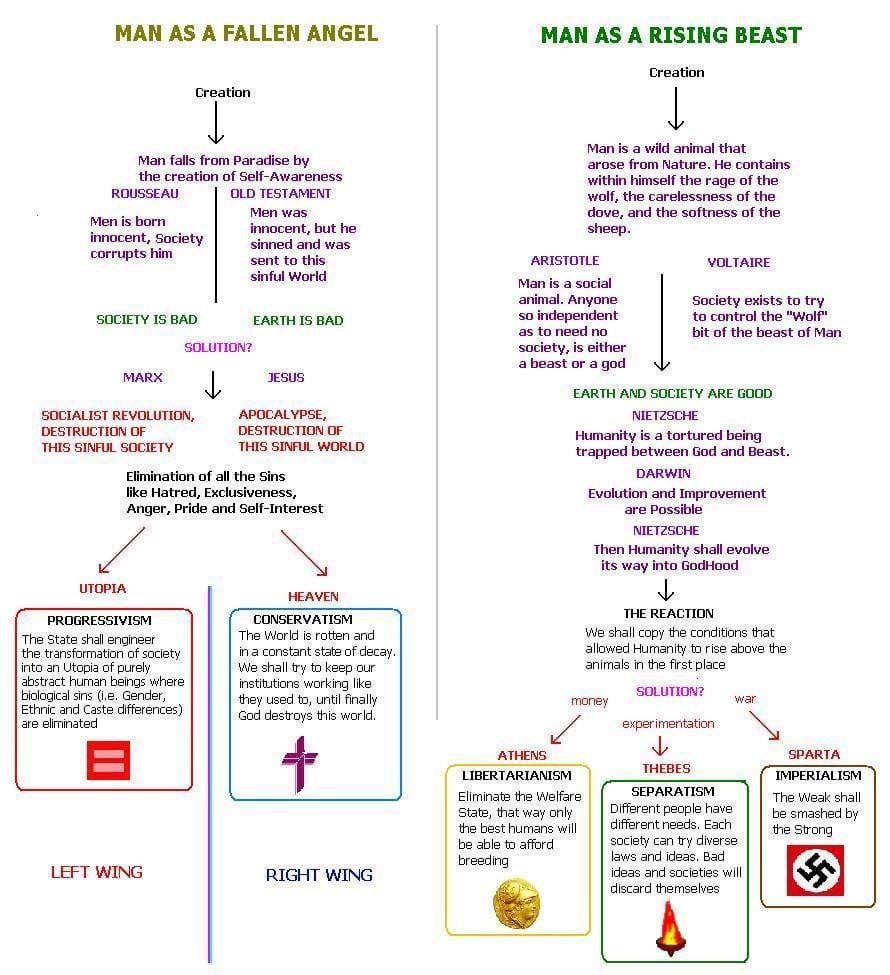
  • Fallen Angels vs Risen Beasts 😉

    90753518_596101140986780_769125924275748864_o

    [S]orry. Man is risen beast (hero) Not fallen angel (criminal). And he is risen by the the law: the physical laws of nature, the natural law of sovereignty and reciprocity, the evolutionary law of transcendence. And the priesthood we love is almost always the enemy of transcendence. And the scientists, judiciary, and entrepreneurs are almost always the advocates of transcendence. If you believe we are fallen angels and that man was oppressed, you’re counter to the evidence and will agree with the oppression and power narrative. If you believe we are risen beasts, and that the underclasses were consistently domesticated like all other animals, then you will be in concert with the evidence. The primary difference between races, sub-races, civilizations, and states is the size of the underclass The struggle for man, that only west and far east achieved at all, is the suppression of the reproduction of the unproductive classes by market means, so that the surpluses of production can be devoted to the production of the high returns on commons. There are various evolutionary reasons why those who are ‘insufficiently valuable for the privilege of reproduction” are unaware of their inadequacy. And there are reasons why elites make use of these useful idiots that don’t know better. Slavery in the european tradition mean’t that others took responsibility for your room and board, in exchange for you doing the work for them. In other words, it was a monetary economy. Only once we develop slavery by conquest (stealing people) does it become a negative institution -and even then slaves were protected from abuse by owners (employers). It’s getting difficult to find places in the world where people are uneducated. But that’s a recent phenomenon. Human beings are not very ‘nice’ to one another by nature. Were purely rational creatures and choose the cheapest means of survival. In advanced civs that happens to be cooperation most of the time. But in most of history war, murder, rape, pillaging, was the most profitable private and public industry. Your ancestors weren’t oppressed. They were domesticated.Humans have no intrinsic value.Your quality of life is more dependent on the smallness of the underclass in relation to the middle and upper classes than it is on your abilities.There is no freedom from physical (scarcity), natural (incentives), and evolutionary (eugenic) laws. None.

  • Conservatives = Happier Because Lower Neuroticism

    CONSERVATIVES = HAPPIER BECUSE LOWER NEUROTICISM (and higher disgust) Conservative states tend to have higher levels of life satisfaction because they have lower levels of neuroticism compared to liberal states, according to new research from a psychologist at Cape Breton University. The study, published in the journal Psychological Reports, helps explain why there is a correlation between higher conservatism and higher life satisfaction. “I have had longstanding interests in social, personality, and political psychology,” explained study author Stewart J. H. McCann. “My special interest in personality and its state-level correlates was sparked in 2008 when Dr. P. Jason Rentfrow of the University of Cambridge and his colleagues produced average scores for each of the 50 states on each of the five main personality dimensions—openness to experience, conscientiousness, extraversion, agreeableness, and neuroticism—based on the responses of 619,397 residents of the USA to a widely used 44-item personality questionnaire. “Since that time, I have published 17 research articles showing relations between state-levels of these personality variables and various other important differences between states such as political attitudes, work satisfaction, illness, mortality, residential mobility, creativity, volunteering, emotional health, smoking, and obesity.” “Previous research by others had shown that conservatives generally were happier and more satisfied with their lives than liberals. But why?” McCann told PsyPost. “Three different explanations had been put forward by others. However, I thought that there might be a fourth and more convincing explanation.” “Existing research demonstrated that there are associations not only between higher conservatism and higher life satisfaction but also between lower neuroticism and higher life satisfaction and between lower neuroticism and higher conservatism. Perhaps if neuroticism was statistically controlled or effectively held constant, the association between higher conservatism and higher life satisfaction would vanish.” “The relation between conservatism and life satisfaction might be dependent upon neuroticism levels. The present study was conducted to test this possibility in a state-level analysis.” McCann analyzed data from Rentfrow’s study, Gallup-Healthways Well-Being Index, U.S. Census Bureau, CBS News and the New York Times polls, and the presidential election results from 2000 to 2008. He found that differences in the levels of neuroticism in each state could account for the state-level association between higher conservatism and higher life satisfaction. Other factors he examined, including socioeconomic status, did not account for the association. “The results of the present study strongly suggest that there is nothing inherent in a conservative worldview as opposed to a liberal worldview that promotes greater happiness and life satisfaction,” McCann explained. “Rather it is the underlying higher neuroticism that tends to be more likely in liberals and the underlying lower neuroticism that tends to be more likely in conservatives that accounts for the greater happiness and life satisfaction in conservatives.” “For example, higher neuroticism is characterized by higher levels of vulnerability, self-consciousness, depression, tenseness, moodiness, angry hostility, impulsiveness, nervousness, anxiety, worry, emotional instability, and poor stress management. Clearly, such a constellation does not bode well for happiness and satisfaction with life.” The study used a cross-sectional methodology, meaning McCann cannot make inferences about cause and effect. He believes, based on previous research, that higher neuroticism fosters lower life satisfaction and that lower neuroticism promotes higher conservatism — but the reverse could also be true. His study has another caveat as well. “Readers must understand that this was a study carried out with the 50 states rather than a sample of individuals as the cases,” McCann explained. “What was found is that state levels of resident neuroticism can account for the relation between state levels of conservatism and state levels of life satisfaction. “I am assuming that the state-level relations are dependent upon parallel individual-level relations. Caution must be exercised in making such cross-level extrapolations. However, some comfort is taken from the fact that other researchers (Burton, Plaks, & Peterson, 2015) also have found the same dynamics in an individual-level analysis and reached the same conclusion regarding why conservatives tend to be happier and more satisfied with life.” The study was titled: “State Resident Neuroticism Accounts for Life Satisfaction Differences Between Conservative and Liberal States of the USA”. Source: https://www.psypost.org/…/study-suggests-lower-levels-neuro… DEFINING NEUROTICISM Neuroticism Neuroticism is one of the Big Five higher-order personality traits in the study of psychology. Individuals who score high on neuroticism are more likely than average to be moody and to experience such feelings as anxiety, worry, fear, anger, frustration, envy, jealousy, guilt, depressed mood, and loneliness. People who are neurotic respond worse to stressors and are more likely to interpret ordinary situations as threatening and minor frustrations as hopelessly difficult. They are often self-conscious and shy, and they may have trouble controlling urges and delaying gratification. Neuroticism is a trait in many models within personality theory, but there is a lot of disagreement on its definition. Some define it as a tendency for quick arousal when stimulated and slow relaxation from arousal, especially in concern to negative emotional arousal; others define it as emotional instability and negativity or maladjustment, in contrast to emotional stability and positivity, or good adjustment. Others yet define it as lack of self-control, poor ability to manage psychological stress, and a tendency to complain.[6] Various personality tests produce numerical scores, and these scores are mapped onto the concept of “neuroticism” in various ways, which has created some confusion in the scientific literature, especially with regard to sub-traits or “facets”.[6] Individuals who score low in neuroticism tend to be more emotionally stable and less reactive to stress. They tend to be calm, even-tempered, and less likely to feel tense or rattled. Although they are low in negative emotion, they are not necessarily high on positive emotion. Being high in scores of positive emotion is generally an element of the independent trait of extraversion. Neurotic extraverts, for example, would experience high levels of both positive and negative emotional states, a kind of “emotional roller coaster”.[7][8] (Impulsive) Neurotic <-> Calm (Agency) ======= STUDIES 1) State Resident Neuroticism Accounts for Life Satisfaction Differences Between Conservative and Liberal States of the USA Stewart J. H. McCannFirst Published August 11, 2017 Research Article Find in PubMed https://doi.org/10.1177/0033294117725072 https://journals.sagepub.com/doi/10.1177/0033294117725072 Abstract Past research indicates associations between higher conservatism and higher life satisfaction, lower neuroticism and higher life satisfaction, and higher conservatism and lower neuroticism. Qualified deduction led to the following hypothesis: Neuroticism can account for the association between higher conservatism and higher life satisfaction. The 50 American states served as the units of analysis. Responses of 619,397 residents to the 44-item Big Five Inventory in an internet survey conducted from 1999 to 2005 provided mean neuroticism scores for each state. Conservative-liberal leaning of over 84,000 respondents to CBS News/New York Times polls from 1999 to 2003 and the percent voting Republican in each state in the 2000 to 2008 presidential elections combined to form a conservatism score for each state. The Gallup-Healthways Well-Being Index provided life satisfaction scores for over 1,000,000 respondents, transforming to a 2008 to 2010 composite score for each state. In a sequential multiple regression equation with life satisfaction as the criterion, state socioeconomic status and white population percent entered first as a block, conservatism entered second, and neuroticism entered third, the demographic controls accounted for 45.7% of the variance, conservatism accounted for another 10.4%, and neuroticism accounted for an additional 10.6%. However, with the entry order of conservatism and neuroticism reversed, neuroticism accounted for another 19.6% but conservatism accounted for only an additional nonsignificant 1.4%. Therefore, the hypothesis was supported. Three alternative explanations suggested by other researchers were not supported in the state-level analysis. 2) Why Do Conservatives Report Being Happier Than Liberals? The Contribution of Neuroticism Caitlin M. Burton*a, Jason E. Plaksa, Jordan B. Petersona [a] Department of Psychology, University of Toronto, Toronto, Ontario, Canada. https://jspp.psychopen.eu/article/view/117/html Abstract Previous studies suggest that conservatives in the United States are happier than liberals. This difference has been attributed to factors including differences in socioeconomic status, group memberships, and system-justifying beliefs. We suggest that differences between liberals and conservatives in personality traits may provide an additional account for the “happiness gap”. Specifically, we investigated the role of neuroticism (or conversely, emotional stability) in explaining the conservative-liberal happiness gap. In Study 1 (N = 619), we assessed the correlation between political orientation (PO) and satisfaction with life (SWL), controlling for the Big Five traits, religiosity, income, and demographic variables. Neuroticism, conscientiousness, and religiosity each accounted for the PO-SWL correlation. In Study 2 (N = 700), neuroticism, system justification beliefs, conscientiousness, and income each accounted for PO-SWL correlation. In both studies, neuroticism negatively correlated with conservatism. We suggest that individual differences in neuroticism represent a previously under-examined contributor to the SWL disparity between conservatives and liberals.
  • Conservatives = Happier Because Lower Neuroticism

    CONSERVATIVES = HAPPIER BECUSE LOWER NEUROTICISM (and higher disgust) Conservative states tend to have higher levels of life satisfaction because they have lower levels of neuroticism compared to liberal states, according to new research from a psychologist at Cape Breton University. The study, published in the journal Psychological Reports, helps explain why there is a correlation between higher conservatism and higher life satisfaction. “I have had longstanding interests in social, personality, and political psychology,” explained study author Stewart J. H. McCann. “My special interest in personality and its state-level correlates was sparked in 2008 when Dr. P. Jason Rentfrow of the University of Cambridge and his colleagues produced average scores for each of the 50 states on each of the five main personality dimensions—openness to experience, conscientiousness, extraversion, agreeableness, and neuroticism—based on the responses of 619,397 residents of the USA to a widely used 44-item personality questionnaire. “Since that time, I have published 17 research articles showing relations between state-levels of these personality variables and various other important differences between states such as political attitudes, work satisfaction, illness, mortality, residential mobility, creativity, volunteering, emotional health, smoking, and obesity.” “Previous research by others had shown that conservatives generally were happier and more satisfied with their lives than liberals. But why?” McCann told PsyPost. “Three different explanations had been put forward by others. However, I thought that there might be a fourth and more convincing explanation.” “Existing research demonstrated that there are associations not only between higher conservatism and higher life satisfaction but also between lower neuroticism and higher life satisfaction and between lower neuroticism and higher conservatism. Perhaps if neuroticism was statistically controlled or effectively held constant, the association between higher conservatism and higher life satisfaction would vanish.” “The relation between conservatism and life satisfaction might be dependent upon neuroticism levels. The present study was conducted to test this possibility in a state-level analysis.” McCann analyzed data from Rentfrow’s study, Gallup-Healthways Well-Being Index, U.S. Census Bureau, CBS News and the New York Times polls, and the presidential election results from 2000 to 2008. He found that differences in the levels of neuroticism in each state could account for the state-level association between higher conservatism and higher life satisfaction. Other factors he examined, including socioeconomic status, did not account for the association. “The results of the present study strongly suggest that there is nothing inherent in a conservative worldview as opposed to a liberal worldview that promotes greater happiness and life satisfaction,” McCann explained. “Rather it is the underlying higher neuroticism that tends to be more likely in liberals and the underlying lower neuroticism that tends to be more likely in conservatives that accounts for the greater happiness and life satisfaction in conservatives.” “For example, higher neuroticism is characterized by higher levels of vulnerability, self-consciousness, depression, tenseness, moodiness, angry hostility, impulsiveness, nervousness, anxiety, worry, emotional instability, and poor stress management. Clearly, such a constellation does not bode well for happiness and satisfaction with life.” The study used a cross-sectional methodology, meaning McCann cannot make inferences about cause and effect. He believes, based on previous research, that higher neuroticism fosters lower life satisfaction and that lower neuroticism promotes higher conservatism — but the reverse could also be true. His study has another caveat as well. “Readers must understand that this was a study carried out with the 50 states rather than a sample of individuals as the cases,” McCann explained. “What was found is that state levels of resident neuroticism can account for the relation between state levels of conservatism and state levels of life satisfaction. “I am assuming that the state-level relations are dependent upon parallel individual-level relations. Caution must be exercised in making such cross-level extrapolations. However, some comfort is taken from the fact that other researchers (Burton, Plaks, & Peterson, 2015) also have found the same dynamics in an individual-level analysis and reached the same conclusion regarding why conservatives tend to be happier and more satisfied with life.” The study was titled: “State Resident Neuroticism Accounts for Life Satisfaction Differences Between Conservative and Liberal States of the USA”. Source: https://www.psypost.org/…/study-suggests-lower-levels-neuro… DEFINING NEUROTICISM Neuroticism Neuroticism is one of the Big Five higher-order personality traits in the study of psychology. Individuals who score high on neuroticism are more likely than average to be moody and to experience such feelings as anxiety, worry, fear, anger, frustration, envy, jealousy, guilt, depressed mood, and loneliness. People who are neurotic respond worse to stressors and are more likely to interpret ordinary situations as threatening and minor frustrations as hopelessly difficult. They are often self-conscious and shy, and they may have trouble controlling urges and delaying gratification. Neuroticism is a trait in many models within personality theory, but there is a lot of disagreement on its definition. Some define it as a tendency for quick arousal when stimulated and slow relaxation from arousal, especially in concern to negative emotional arousal; others define it as emotional instability and negativity or maladjustment, in contrast to emotional stability and positivity, or good adjustment. Others yet define it as lack of self-control, poor ability to manage psychological stress, and a tendency to complain.[6] Various personality tests produce numerical scores, and these scores are mapped onto the concept of “neuroticism” in various ways, which has created some confusion in the scientific literature, especially with regard to sub-traits or “facets”.[6] Individuals who score low in neuroticism tend to be more emotionally stable and less reactive to stress. They tend to be calm, even-tempered, and less likely to feel tense or rattled. Although they are low in negative emotion, they are not necessarily high on positive emotion. Being high in scores of positive emotion is generally an element of the independent trait of extraversion. Neurotic extraverts, for example, would experience high levels of both positive and negative emotional states, a kind of “emotional roller coaster”.[7][8] (Impulsive) Neurotic <-> Calm (Agency) ======= STUDIES 1) State Resident Neuroticism Accounts for Life Satisfaction Differences Between Conservative and Liberal States of the USA Stewart J. H. McCannFirst Published August 11, 2017 Research Article Find in PubMed https://doi.org/10.1177/0033294117725072 https://journals.sagepub.com/doi/10.1177/0033294117725072 Abstract Past research indicates associations between higher conservatism and higher life satisfaction, lower neuroticism and higher life satisfaction, and higher conservatism and lower neuroticism. Qualified deduction led to the following hypothesis: Neuroticism can account for the association between higher conservatism and higher life satisfaction. The 50 American states served as the units of analysis. Responses of 619,397 residents to the 44-item Big Five Inventory in an internet survey conducted from 1999 to 2005 provided mean neuroticism scores for each state. Conservative-liberal leaning of over 84,000 respondents to CBS News/New York Times polls from 1999 to 2003 and the percent voting Republican in each state in the 2000 to 2008 presidential elections combined to form a conservatism score for each state. The Gallup-Healthways Well-Being Index provided life satisfaction scores for over 1,000,000 respondents, transforming to a 2008 to 2010 composite score for each state. In a sequential multiple regression equation with life satisfaction as the criterion, state socioeconomic status and white population percent entered first as a block, conservatism entered second, and neuroticism entered third, the demographic controls accounted for 45.7% of the variance, conservatism accounted for another 10.4%, and neuroticism accounted for an additional 10.6%. However, with the entry order of conservatism and neuroticism reversed, neuroticism accounted for another 19.6% but conservatism accounted for only an additional nonsignificant 1.4%. Therefore, the hypothesis was supported. Three alternative explanations suggested by other researchers were not supported in the state-level analysis. 2) Why Do Conservatives Report Being Happier Than Liberals? The Contribution of Neuroticism Caitlin M. Burton*a, Jason E. Plaksa, Jordan B. Petersona [a] Department of Psychology, University of Toronto, Toronto, Ontario, Canada. https://jspp.psychopen.eu/article/view/117/html Abstract Previous studies suggest that conservatives in the United States are happier than liberals. This difference has been attributed to factors including differences in socioeconomic status, group memberships, and system-justifying beliefs. We suggest that differences between liberals and conservatives in personality traits may provide an additional account for the “happiness gap”. Specifically, we investigated the role of neuroticism (or conversely, emotional stability) in explaining the conservative-liberal happiness gap. In Study 1 (N = 619), we assessed the correlation between political orientation (PO) and satisfaction with life (SWL), controlling for the Big Five traits, religiosity, income, and demographic variables. Neuroticism, conscientiousness, and religiosity each accounted for the PO-SWL correlation. In Study 2 (N = 700), neuroticism, system justification beliefs, conscientiousness, and income each accounted for PO-SWL correlation. In both studies, neuroticism negatively correlated with conservatism. We suggest that individual differences in neuroticism represent a previously under-examined contributor to the SWL disparity between conservatives and liberals.

  • Pre and Postwar Europe – and The World Order that Is Coming Back Into Natural State

    Feb 1, 2020, 9:23 AM

    –“Anglos were against germans”–

    I disagree entirely. America prewar was 50% ethnically german and the heartland still is. America was on the german side in both wars until it couldn’t afford to be. Before 1914, Germany (manufacturing) and England (navy, market) had the same economic interdependency as china(manufacturing) and America (navy, market). The British empire wanted, as America until Trump has wanted, to restore the balance of powers – including the Russians and the ottomans. Otherwise they would not have prohibited the Russian reconquest of Istanbul, or the restoration of the german empire post napoleonic conquest. This is the problem with ‘overdoing’ capitalism (middle class government): we seek profits and stability of profits because of the expansion of economic risk under middle class government, when we should always seek the natural self interest of the great powers, and only interfere once the outcome is far enough along that we can choose sides – as we did by going after the communists. I would argue that yes, the British were swayed to jewish extractive financialism instead of Christian profiting from domestication under white mans burden, after ending the prohibition on jews in the state, and the rise of Disraeli’s government. The British problem with Germany was that in response to napoleon’s terrors in Europe, Germany unified, and began to defend her (huge) continental interests. Had we sided with Germany the empires would all still exist and the world would not have experienced communism, the failure to Complete the colonial program of world-modernization, loss of european confidence in the european program post war, jewish undermining of european, British, and american civilization post war, the immigration crisis that has almost achieved jewish cosmopolitan ends, and the coming civil war – and islam could have been transformed, because tribal boundaries would have been possible to install. The mistake was our misunderstanding of the heart of german civilization being in the north and particularly Prussian – but the french post-war wanted to ‘de-Prussify’ Germany by manipulating american morality (we’re wrong), and making it possible for France to conquer and rule the continent (as they are trying to do with the EU). Unfortunately, France chose more socialism and agrarianism than Germany, and Germany chose her traditional excellence in manufacturing, so between the german mark and german industry and german education and german culture, Germany economically rules by demonstrated superiority …. until …. there is a decline in auto sales … and germans revolt at a loss of (everything) and she re-asserts herself in defense, and they are stuck with France having confidence and the will to rule Europe, and Germans needing to restore their will to rule themselves and Europe. Yet it is France that maintains colonies in Africa, and is the origin of Jewish intellectual influence, and Muslim immigration and invasion into Europe. France has always been the enemy of Europe since she was more latinized and retained imperial ambitions and catholic church dominance, including her long standing attempt to relocate the papacy to France. It’s the Germanics that have tried to complete the transition back to SOVEREIGNTY while France continues the jewish christian (catholic) pursuit of monopoly authority. The countryside may be germanic. but France is Paris, and Paris might as well be Constantinople trying to conquer the western empire. Russia is, as I had hoped, taking over her natural position as the leader in the middle eastern sphere of influence. France is, as I had warned, still attempting her conquest of Europe and the destruction of germanic civilization – out of overconfidence and arrogance (both unwarranted). Germany is still indoctrinated by what they call their (special history) except they were in the right and need a generation to unlearn blaming themselves for what was a french, anglo, and Russian attack on their attempt to unify the germanic peoples and the lands which germanic excellence had influenced. If Germany gains independence and restores herself, then the slavic and baltic peoples will strategically, economically, align with them. The Anglosphere has time to unify again, draw ‘the rest’ of Canada into it’s sphere, and prevent the conquest of Australia by Chinese interests, thereby creating enough of a population to not be the victim of a hostile china, a powerful Russia-Islam, an islam, and a hostile french conquest of Europe. The balkans are screwed until the Russians or united eastern european Intermarium can save them by completing the removal of islam from old europe as thoroughly as the spanish have from iberia. These are not simple moral choices. They are choices necessary for western survival. All of this is made possible (a) by Brexit and (b) by american Red-Exit … or re-conquest. The latter I hope we will begin this year.

  • Pre and Postwar Europe – and The World Order that Is Coming Back Into Natural State

    Feb 1, 2020, 9:23 AM

    –“Anglos were against germans”–

    I disagree entirely. America prewar was 50% ethnically german and the heartland still is. America was on the german side in both wars until it couldn’t afford to be. Before 1914, Germany (manufacturing) and England (navy, market) had the same economic interdependency as china(manufacturing) and America (navy, market). The British empire wanted, as America until Trump has wanted, to restore the balance of powers – including the Russians and the ottomans. Otherwise they would not have prohibited the Russian reconquest of Istanbul, or the restoration of the german empire post napoleonic conquest. This is the problem with ‘overdoing’ capitalism (middle class government): we seek profits and stability of profits because of the expansion of economic risk under middle class government, when we should always seek the natural self interest of the great powers, and only interfere once the outcome is far enough along that we can choose sides – as we did by going after the communists. I would argue that yes, the British were swayed to jewish extractive financialism instead of Christian profiting from domestication under white mans burden, after ending the prohibition on jews in the state, and the rise of Disraeli’s government. The British problem with Germany was that in response to napoleon’s terrors in Europe, Germany unified, and began to defend her (huge) continental interests. Had we sided with Germany the empires would all still exist and the world would not have experienced communism, the failure to Complete the colonial program of world-modernization, loss of european confidence in the european program post war, jewish undermining of european, British, and american civilization post war, the immigration crisis that has almost achieved jewish cosmopolitan ends, and the coming civil war – and islam could have been transformed, because tribal boundaries would have been possible to install. The mistake was our misunderstanding of the heart of german civilization being in the north and particularly Prussian – but the french post-war wanted to ‘de-Prussify’ Germany by manipulating american morality (we’re wrong), and making it possible for France to conquer and rule the continent (as they are trying to do with the EU). Unfortunately, France chose more socialism and agrarianism than Germany, and Germany chose her traditional excellence in manufacturing, so between the german mark and german industry and german education and german culture, Germany economically rules by demonstrated superiority …. until …. there is a decline in auto sales … and germans revolt at a loss of (everything) and she re-asserts herself in defense, and they are stuck with France having confidence and the will to rule Europe, and Germans needing to restore their will to rule themselves and Europe. Yet it is France that maintains colonies in Africa, and is the origin of Jewish intellectual influence, and Muslim immigration and invasion into Europe. France has always been the enemy of Europe since she was more latinized and retained imperial ambitions and catholic church dominance, including her long standing attempt to relocate the papacy to France. It’s the Germanics that have tried to complete the transition back to SOVEREIGNTY while France continues the jewish christian (catholic) pursuit of monopoly authority. The countryside may be germanic. but France is Paris, and Paris might as well be Constantinople trying to conquer the western empire. Russia is, as I had hoped, taking over her natural position as the leader in the middle eastern sphere of influence. France is, as I had warned, still attempting her conquest of Europe and the destruction of germanic civilization – out of overconfidence and arrogance (both unwarranted). Germany is still indoctrinated by what they call their (special history) except they were in the right and need a generation to unlearn blaming themselves for what was a french, anglo, and Russian attack on their attempt to unify the germanic peoples and the lands which germanic excellence had influenced. If Germany gains independence and restores herself, then the slavic and baltic peoples will strategically, economically, align with them. The Anglosphere has time to unify again, draw ‘the rest’ of Canada into it’s sphere, and prevent the conquest of Australia by Chinese interests, thereby creating enough of a population to not be the victim of a hostile china, a powerful Russia-Islam, an islam, and a hostile french conquest of Europe. The balkans are screwed until the Russians or united eastern european Intermarium can save them by completing the removal of islam from old europe as thoroughly as the spanish have from iberia. These are not simple moral choices. They are choices necessary for western survival. All of this is made possible (a) by Brexit and (b) by american Red-Exit … or re-conquest. The latter I hope we will begin this year.