Very few of us seek truth. We all seek utility not truth. For some of us truth and utility are identical. for others it forces them into competition with Darwin – and truth is the enemy of false genes as much as false ideas.
WHAT I UNDERSTAND IS TERRIFYING. IT’S NOT ME THAT DOESN’T UNDERSTAND.
–“… (Doolittle) doesn’t understand language …”– A Right Wing Postmodernist
The truth is not amenable to man, unless the truth provides him with agency. Others confuse truth and utility. The truth may be useful but it is also true and reciprocal. Many statements are useful but either false, ir-reciprocal, or both.
AFAIK:
1) All words are names (referrers).
2) All Phrases Descriptions
3) All sentences transactions
4) All statements promises (This is not intuitive).
5) All narrations, stories.
6) All language measurement – that is reducible to analogy to experience – the question is, measurement of WHAT? (This is not intuitive)
7) All meaning transferred by description within experience, and analogy to experience beyond experience.
8) All meaning transferred by consent (understanding),
9) All due diligence limits meaning.
10) All paradigms of of communication deflationary(limited), descriptive(testimony), conflationary (loaded, framed), or inflationary(fictionally expanded), or fictionalism (sophism-idealism, pseudoscience-magic, supernatural-occult)
11) All communications ostracization (departure), cooperation (reciprocal), or coercive (dishonest).
12 ) (and here is the problem:) Audiences infantile, juvenile, ignorant, knowledgeable, skilled, or mastery.
13) audience composed of dominantly empathic, dominantly normative, and dominantly empirical distributions; and all populations distributed between female herd consensus (preference), and male, pack, advantage (truth).
14) and all attempts to organize those ranges of people by incentives either true or false, productive or parasitic, useful, not useful or harmful, and reciprocal, amoral, or irreciprocal,
15) and all persuasion addressed to:
i) an average of the audience,
ii) an average of the audience’s influencers,
iii) tailored to each audience’s influencers.
I can go on in even more painful detail. This is just an overview. If you take a peek at the chart of the grammars, you’ll find innovative explanations that no other has provided.
As I explained to someone else today, we may need supernatural theology, occult theology, secular theology, rational normative law, and empirical science to convince sufficient numbers of any given polity unless we follow the semitic strategy of infantilization of the cognition of the population, and the only slightly less infantilizing continental strategy – both seem to work. Just as rule of empirical law seems to work.
The question is which of the suite of methods do we use to provide decidability in matters of undecidability, difference, dispute, or conflict, between these cognitively dominant paradigms (narratives). Because we very clearly can provide a host of deflationary, descriptive, conflationary, inflationary, and fictionalisms as means of communication between group members given their levels of infancy or maturity, and femininity or masculinity, ignorance or mastery.
As to what I’m bringing to the history of thought – I’m bringing falsification to the abrahamic old world and abrahamic new world means of undermining our people with false promise, baiting into moral hazard, pipul and critique that we call islamism, jewish ethics, undermining our laws by design, undermining undermining the classes by marxism, undermining genders through feminism, undermining our identities, undermining truthful speech with postmodernism, and outright denial of individual gender, class, group and racial differences in order reverse our eugenic aesthetic cultural traditional civilizational institutional and technological achievements.
And I now perfectly well that it is easy for you and others to criticize that which is imperfect, and to seek attention by doing so when as far as I know there is nothing on the table by anyone living that is other than an admission of failure to provide a solution to the problem other than another retreat into one of the systems of lying that you prefer because lying is a cheap means of agency over the weak.
So as usual: “man up and show me something”, because ‘critique’ is just criticizing the real best vs the ideal perfect.
“Ya’ll got nothing.” So to speak. Except a bunch of young-uns wanting a daddy in theological, secular theological or sophomoric prose.
I have a simple message: “Here is a plan, this plan solves the problem regardless of which narrative you need given your cognitive dominances. It does not require we agree on how to go forward. It agrees on what we prohibit – the enemy. It preserves the western tradition of a competition between theological (lower classes), philosophical (middle classes), and empirical (upper classes). And prohibits a monopoly by any.”
So Man up. Show up. And we win the ABILITY to pursue supernatural, philosophical-normative, and empirical means of advancing our interests in markets where we only need to agree on material trades.
If that isn’t enough of an answer, every other possible answer will demonstrably fail given the existential classes and their frames, and their interests.
So as far as I know your criticism isn’t really a criticism. It’s a demand to serve your PREFERENCE, because you can’t produce an equally competitive solution with equal potential for implementation. If you could, you’d compete and pay no attention to me.
So your criticism is simply demonstration of the veracity of my work.
We just keep growing slowly, year by year. And If we don’t succeed in creating the answer to the Frankfurt School then maybe someone else will.
So while we might convey meaning by fictionalism, fiction, and idealism, we can only testify to the actionable material, costs, and reciprocity. Ergo, establish meaning by fiction, or ideal, then warranty against error, bias, deceit, and fraud by operational (real).
@MattPirkowski And the principle fraud insidious: pretension of knowledge and decidability one does not possess.
In practice, Legal requires both costs and reciprocity; Aristotelian requires the material; ideal and supernatural none. Why? To Testify with responsibility or to Lie without it.
@MattPirkowski And the principle fraud insidious: pretension of knowledge and decidability one does not possess.
In practice, Legal requires both costs and reciprocity; Aristotelian requires the material; ideal and supernatural none. Why? To Testify with responsibility or to Lie without it.
And the principle fraud insidious: pretension of knowledge and decidability one does not possess.
In practice, Legal requires both costs and reciprocity; Aristotelian requires the material; ideal and supernatural none. Why? To Testify with responsibility or to Lie without it.
@MattPirkowski The presumption of ignorance and error is a polite manifestation of western ethics of discourse, but it is not however evidenced in history. We err far less than we deceive, and the vast majority of thought is but elaborate deception to perpetuate one fraud, another, or many.
@MattPirkowski The presumption of ignorance and error is a polite manifestation of western ethics of discourse, but it is not however evidenced in history. We err far less than we deceive, and the vast majority of thought is but elaborate deception to perpetuate one fraud, another, or many.
Paradigmatic convergence to parsimony is demonstrable. We call it testimony. Which is what the sciences seek to replicate (operational language) – and the platonists seek circumvent. They must preserve pretense of knowledge – if only for self image. 😉 Which such prose exposes.
@curtdoolittle Perhaps they mix what you perceive as colloquial and technical, but I have no reason to assume that we prima facie share those categorical boundaries.
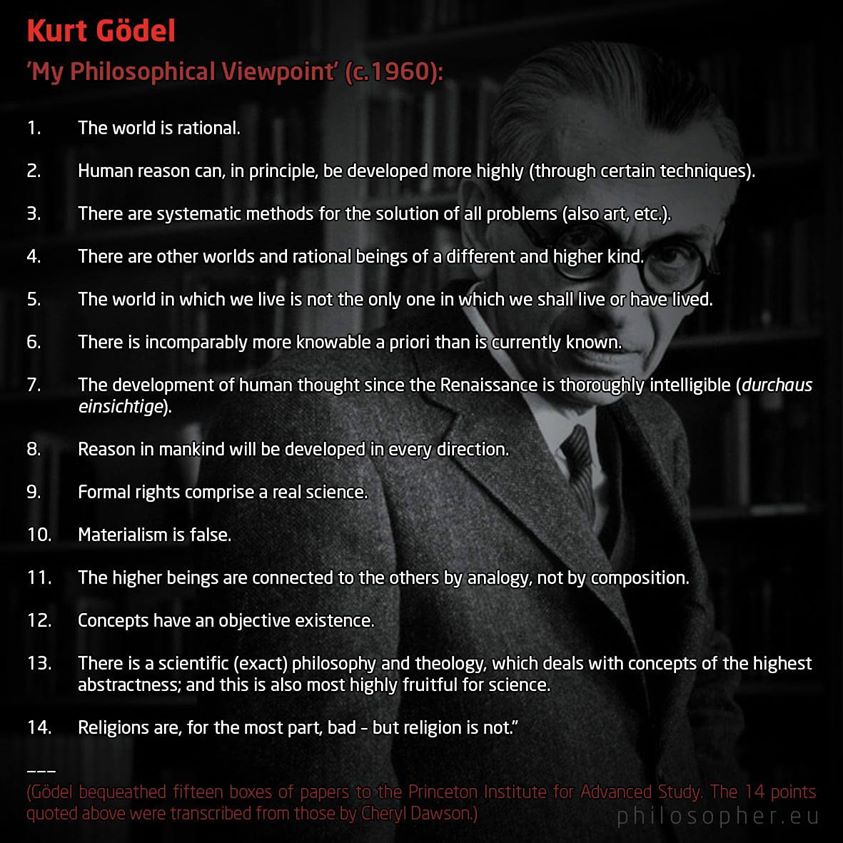
photos_and_videos/TimelinePhotos_dJ9jhts2Ng/72688499_485728855357343_7095469642973446144_o_485728848690677.jpg CONTRAST GOEDEL WITH P – REQUEST FROM KASH V.
(Godel is a Platonist, I’m an operationalist)
1. Man acts rationally, and by rationally amorally. But given the disproportionate value of cooperation, and the disproportionate risk of retaliation, it’s just in his interest to act morally much more often than immorally.
1a. We can incrementally reduce observations of the universe, using our senses, reason, and instrumentation to descriptions of invariant constant relations (paradigms)
1b + 3. We can describe (explain) all of experience as constant relations (a single paradigm)
2. While our ability to reason is constant, every increase convergence of our instruments and paradigms increases the explanatory power available to our reason.
4. The capacity to reason is a deterministic product of entropy at convenient temperatures in convenient conditions, for sufficient periods of time. It is likely that given the vastness of the universe, other creatures have evolved reason, and that while the logic of constant relations will exist, and mathematics as a logic of constant positional relations will exist in some form, that the composition of experience that results from different body structures will result in different techniques for employing reason. (think octopi). And that the ability of these creatures may vastly outperform ours.
5. Because we are able to use our powers of prediction using free association to construct a model of the world we exist in, and the worlds we might exist in, and the worlds we cannot exist in, we can experience, many candidate worlds.
5b. The set of demands we evolved and express daily is largely invariant. The set of paradigms we use to imagine opportunities for fulfilling those demands evolves (and devolves) constantly. So while we largely increase the coherence of paradigms, and approach a single paradigm for describing the universe, we have experienced the world differently in the past than in the present, and will so again experience it differently in the future.
6. If we can construct an operational grammar and paradigm for a given set of constant relations, we can produce an operational logic of that set of constant relations, and conduct experiments logically by trial and error as we do in mathematics. To do so we require convergence of paradigms to the point of marginal indifference of those logical constructions. But the Analytic program failed, and Godel and Frege et all were wrong – closure does not exist.
7. Yes the development of thought since Aristotle expanded on Democritus, has been consistent and rational with the exception of the semitic abrahamic dark ages of supernatural ignorance.
8. Reason is reason is reasoning and there is nothing to it. There are however endless permutations of reason especially as knowledge increases.
9. The via-negativa of Natural Law can be restated in the via-positiva as Natural rights, and this logic and empirical combination produces a science of cooperation, and law the institutional enforcement of cooperation under that law, and economics the measure of it’s success, and economics the language of analysis and measurement within that science.
10.The material(noun) and the Operational(verb) are true (exist, and are testifiable). The platonic (ideal) is false. All sets of constant relations are identified, retained, applied, reinforced, and revised by merging physical stimuli with physical organization of information in the brain, producing a hierarchy of changes in state over time we call ‘experience’. So while it is correct to say that the universe is deterministic (composed of constant relations), it is only correct to say that we can observe sets of constant relations, identify them (category), compare them, name them, and predict future states of of them, and in relation to them. These memories and predications like running consist of physical potential, that produce results in time. In other words, al of reality is constructed physically, from a hierarchy of changes in state over time we call experience.
12. Concepts do not exist. the potential for Concepts exists. Running only exists when one is running. We have the potential to run. We have the potential to identify sets of constant relations (concepts), but experience of contexts only exist when we are acting to recall them in time.
13. It appears we can know the most parsimonious paradigm, and host of parsimonious sub-paradigms of increasing complexity (permutations) allowing us to speak the truth using evidence – science; that we can know the same for choices using arguments – philosophy; and we can know the same for collective organization using stories – theology.
14. Existing religions are bad to terrible to suicidal – but human psychological, social, political, and strategic demand for the products of ‘religion’ (order) are endless. So we need to educate one another in mindfulness, ethics(interpersonal), morality (extrapersonal), political, and strategic (competitive), by means gracefully increasing and decreasing in accessibility: parable, story, history, reason and general rules, science and outcomes.CONTRAST GOEDEL WITH P – REQUEST FROM KASH V.
(Godel is a Platonist, I’m an operationalist)
1. Man acts rationally, and by rationally amorally. But given the disproportionate value of cooperation, and the disproportionate risk of retaliation, it’s just in his interest to act morally much more often than immorally.
1a. We can incrementally reduce observations of the universe, using our senses, reason, and instrumentation to descriptions of invariant constant relations (paradigms)
1b + 3. We can describe (explain) all of experience as constant relations (a single paradigm)
2. While our ability to reason is constant, every increase convergence of our instruments and paradigms increases the explanatory power available to our reason.
4. The capacity to reason is a deterministic product of entropy at convenient temperatures in convenient conditions, for sufficient periods of time. It is likely that given the vastness of the universe, other creatures have evolved reason, and that while the logic of constant relations will exist, and mathematics as a logic of constant positional relations will exist in some form, that the composition of experience that results from different body structures will result in different techniques for employing reason. (think octopi). And that the ability of these creatures may vastly outperform ours.
5. Because we are able to use our powers of prediction using free association to construct a model of the world we exist in, and the worlds we might exist in, and the worlds we cannot exist in, we can experience, many candidate worlds.
5b. The set of demands we evolved and express daily is largely invariant. The set of paradigms we use to imagine opportunities for fulfilling those demands evolves (and devolves) constantly. So while we largely increase the coherence of paradigms, and approach a single paradigm for describing the universe, we have experienced the world differently in the past than in the present, and will so again experience it differently in the future.
6. If we can construct an operational grammar and paradigm for a given set of constant relations, we can produce an operational logic of that set of constant relations, and conduct experiments logically by trial and error as we do in mathematics. To do so we require convergence of paradigms to the point of marginal indifference of those logical constructions. But the Analytic program failed, and Godel and Frege et all were wrong – closure does not exist.
7. Yes the development of thought since Aristotle expanded on Democritus, has been consistent and rational with the exception of the semitic abrahamic dark ages of supernatural ignorance.
8. Reason is reason is reasoning and there is nothing to it. There are however endless permutations of reason especially as knowledge increases.
9. The via-negativa of Natural Law can be restated in the via-positiva as Natural rights, and this logic and empirical combination produces a science of cooperation, and law the institutional enforcement of cooperation under that law, and economics the measure of it’s success, and economics the language of analysis and measurement within that science.
10.The material(noun) and the Operational(verb) are true (exist, and are testifiable). The platonic (ideal) is false. All sets of constant relations are identified, retained, applied, reinforced, and revised by merging physical stimuli with physical organization of information in the brain, producing a hierarchy of changes in state over time we call ‘experience’. So while it is correct to say that the universe is deterministic (composed of constant relations), it is only correct to say that we can observe sets of constant relations, identify them (category), compare them, name them, and predict future states of of them, and in relation to them. These memories and predications like running consist of physical potential, that produce results in time. In other words, al of reality is constructed physically, from a hierarchy of changes in state over time we call experience.
12. Concepts do not exist. the potential for Concepts exists. Running only exists when one is running. We have the potential to run. We have the potential to identify sets of constant relations (concepts), but experience of contexts only exist when we are acting to recall them in time.
13. It appears we can know the most parsimonious paradigm, and host of parsimonious sub-paradigms of increasing complexity (permutations) allowing us to speak the truth using evidence – science; that we can know the same for choices using arguments – philosophy; and we can know the same for collective organization using stories – theology.
14. Existing religions are bad to terrible to suicidal – but human psychological, social, political, and strategic demand for the products of ‘religion’ (order) are endless. So we need to educate one another in mindfulness, ethics(interpersonal), morality (extrapersonal), political, and strategic (competitive), by means gracefully increasing and decreasing in accessibility: parable, story, history, reason and general rules, science and outcomes.
—” might have done better by reading the summaries of the major philosophers first instead of going through their complete works one by one. Still, I’m going through them pretty fast.”—… https://www.facebook.com/permalink.php?story_fbid=483285215601707&id=100017606988153
—“Sophism is the common form of discourse now. It’s incredible to watch the stimulus (P) create the response (dissonance). It’s entirely appropriate.”—Benny Burke
“Equality” is a term that’s been repeatedly … gang-r@ped.
CONTEXT ONE: BOOLEAN ASSESSMENT OF CATEGORICAL MEMBERSHIP.
All players on the ice exist equally as “HOCKEY PLAYERS” bound by the same rules (membership). However, not all hockey players play hockey equally (qualitative assessment).
CONTEXT TWO: ISONOMY
State application of power will be applied to all by the same criteria (equality before the law)
CONNECTION BETWEEN THESE TWO CONTEXTS:
isonomy presumes that all who fall under the law exist, at the very minimum, as agents and thus, as agents, fall under the law.
“Created Equally” was a notion by Americans adopted from their French influencers… the French ruin everything.