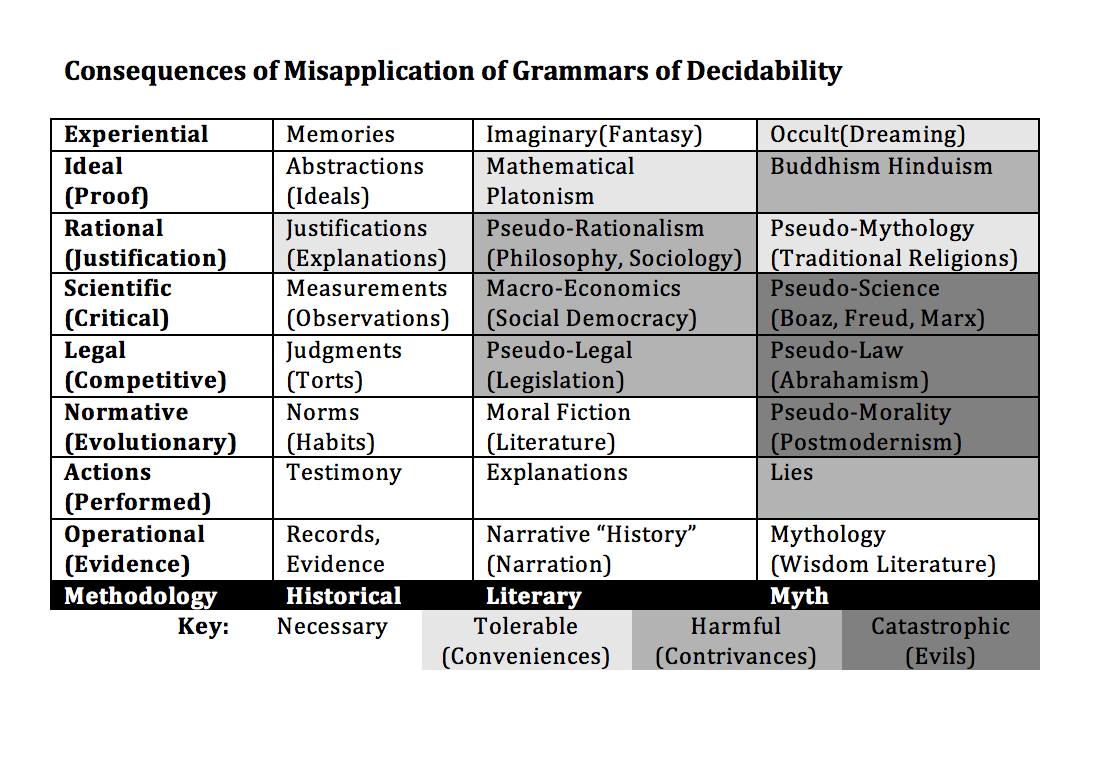
Theme: Grammar

  • photos_and_videos/TimelinePhotos_43196237263/21762741_10155736915752264_89432209

    photos_and_videos/TimelinePhotos_43196237263/21762741_10155736915752264_89432209

    photos_and_videos/TimelinePhotos_43196237263/21762741_10155736915752264_894322098281463268_o_10155736915752264.jpg Luke Thomas@[1059559839:2048:Philip Bunn] I think “misapplication of grammars” is most aptSep 21, 2017 10:25am


    Source date (UTC): 2017-09-20 16:37:00 UTC

  • The Grammars Of Decidability

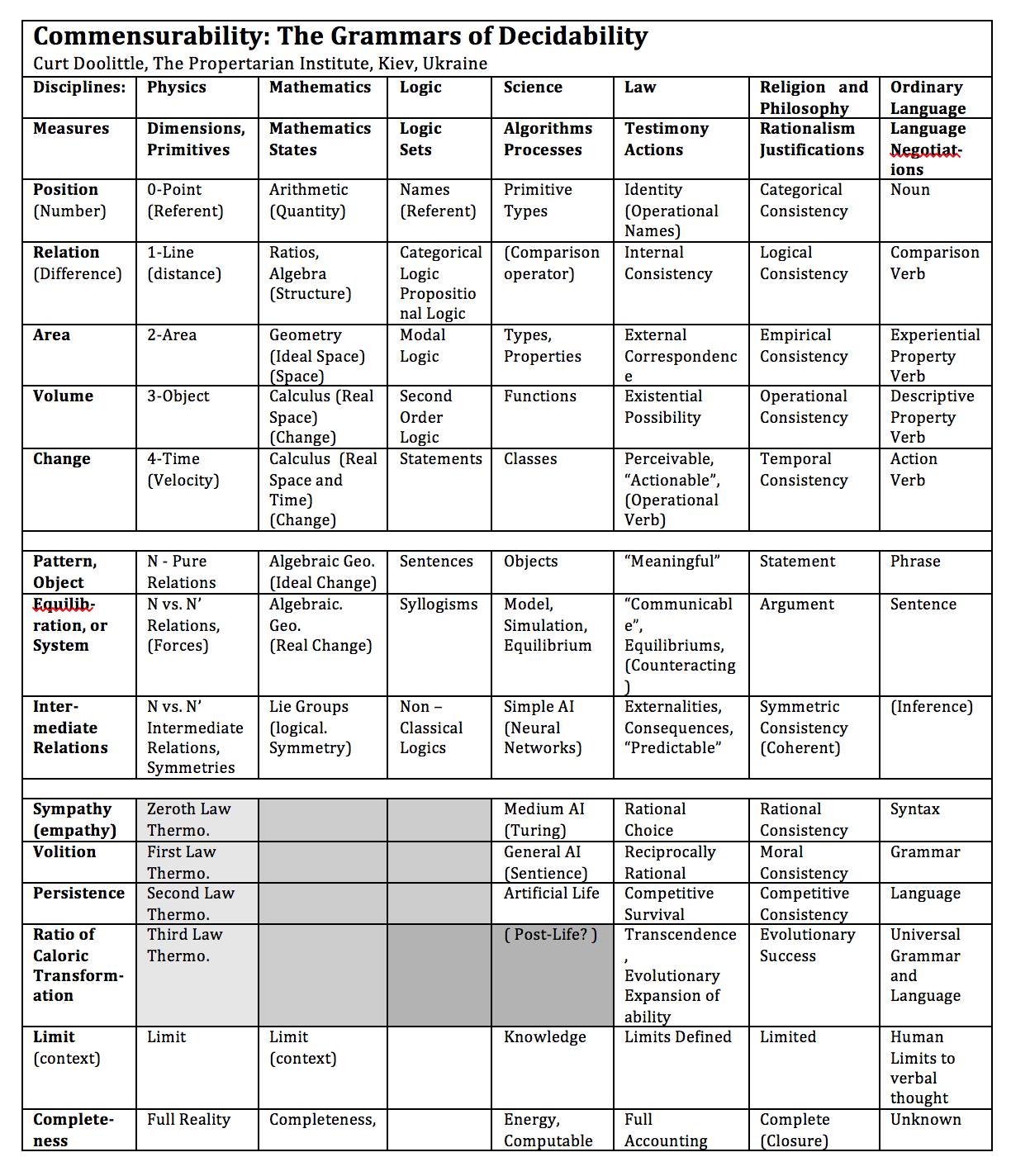
    Brain breaking, maybe, but informative if you grok it. Can I get feedback on this from fellow supergeeks? In order to show Testimonial grammar I’m trying to demonstrate the scope of each grammar (language) we have developed for making comparisons. I want to do this so that I can recategorize natural language from just ‘verbs’ to categories of verbs. And just names to names of types, functions, classes, objects, etc…. Lots to write about on this topic. Lots also to write about on axiomatic vs algorithmic vs rational, vs theoretic etc.
  • photos_and_videos/TimelinePhotos_43196237263/21686716_10155736641582264_25381813

    photos_and_videos/TimelinePhotos_43196237263/21686716_10155736641582264_25381813

    photos_and_videos/TimelinePhotos_43196237263/21686716_10155736641582264_2538181367473503859_o_10155736641582264.jpg Graham NearyComparison verb? “Is bigger than”?Sep 20, 2017 1:28pmCurt Doolittleany comparison whatsoever, but yes, bigger, smaller, etc…Sep 20, 2017 2:15pmGraham NearyComparative adjectivesSep 20, 2017 2:28pmCurt Doolittlethx ;)Sep 20, 2017 2:28pmCurt DoolittleI suppose I could add Fiction, Deception, and Fictionalism next to it, and then cover the entire spectrum.Sep 20, 2017 2:47pmLincoln ThurmanQuadrivum:

    Arithmetic = number in itself.

    Geometry = number in space.

    Music = number in time.

    And,

    Astronomy = number in time and space.

    Maybe some input.Sep 20, 2017 4:57pmMea CulbaCideSep 21, 2017 1:09amTHE GRAMMARS OF DECIDABILITY

    Brain breaking, maybe, but informative if you grok it.

    Can I get feedback on this from fellow supergeeks?

    In order to show Testimonial grammar I’m trying to demonstrate the scope of each grammar (language) we have developed for making comparisons.

    I want to do this so that I can recategorize natural language from just ‘verbs’ to categories of verbs. And just names to names of types, functions, classes, objects, etc….

    Lots to write about on this topic. Lots also to write about on axiomatic vs algorithmic vs rational, vs theoretic etc.


    Source date (UTC): 2017-09-20 13:13:00 UTC

  • The Grammars Of Decidability

    Brain breaking, maybe, but informative if you grok it. Can I get feedback on this from fellow supergeeks? In order to show Testimonial grammar I’m trying to demonstrate the scope of each grammar (language) we have developed for making comparisons. I want to do this so that I can recategorize natural language from just ‘verbs’ to categories of verbs. And just names to names of types, functions, classes, objects, etc…. Lots to write about on this topic. Lots also to write about on axiomatic vs algorithmic vs rational, vs theoretic etc.
  • “My question concerns technical and scientific language rather than colloquial l

    —“My question concerns technical and scientific language rather than colloquial language: I would like to ask if there is any inclination in English to give the words class and category more or less different meanings or shades of meaning, or are they completely interchangeable in all kinds of use?”— From Elsewhere

    You CLASSIFY things that exist (Science – referents that exist into a hierarchy) whose organization doesn’t change, and you CATEGORIZE ideas (Philosophy – referents that have meaning into a list) because they can change.

    So classify(things, hierarchy or order, relatively invariant), vs. categorize(concepts, terms, that might be categorized differently in different contexts).

    So just as english words have origins in german(commoners, farmers, craftsmen), french(nobility, ruling class, wealthy), Latin and Greek(scholarly or educated classes), English (like all european languages) uses specialized vocabulary for mathematical, philosophical, political/Legal, and scientific classes of vocabulary.

    English is very ‘precise’ in its use of sets of terms the same way that german is precise in its precisely descriptive terms.

    Now, do uneducated people conflate terms? All the time. In fact educated people do all the time as well. My favorite examples being the conflation of mathematic (axiomatic), philosophical(rational), and scientific (theoretic), terminology. It’s not uncommon to hear someone make an argument with terms from math, philosophy, and science without having the faintest idea that the terms in each limit the possible properties of argument. For example, True in math and logic is binary(Deductive and Necessary). In philosophy it can be binary(non contradictory), in law it’s ternary(True false and undecidable), in and in science it’s multivalued with False being the only certainty, and truth being little more than an ordinality by triangulation).

    If someone disagrees with you on usage you can correct them. 😉


    Source date (UTC): 2017-09-20 09:15:00 UTC
  • “My question concerns technical and scientific language rather than colloquial l

    —“My question concerns technical and scientific language rather than colloquial language: I would like to ask if there is any inclination in English to give the words class and category more or less different meanings or shades of meaning, or are they completely interchangeable in all kinds of use?”— From Elsewhere You CLASSIFY things that exist (Science – referents that exist into a hierarchy) whose organization doesn’t change, and you CATEGORIZE ideas (Philosophy – referents that have meaning into a list) because they can change. So classify(things, hierarchy or order, relatively invariant), vs. categorize(concepts, terms, that might be categorized differently in different contexts). So just as english words have origins in german(commoners, farmers, craftsmen), french(nobility, ruling class, wealthy), Latin and Greek(scholarly or educated classes), English (like all european languages) uses specialized vocabulary for mathematical, philosophical, political/Legal, and scientific classes of vocabulary. English is very ‘precise’ in its use of sets of terms the same way that german is precise in its precisely descriptive terms. Now, do uneducated people conflate terms? All the time. In fact educated people do all the time as well. My favorite examples being the conflation of mathematic (axiomatic), philosophical(rational), and scientific (theoretic), terminology. It’s not uncommon to hear someone make an argument with terms from math, philosophy, and science without having the faintest idea that the terms in each limit the possible properties of argument. For example, True in math and logic is binary(Deductive and Necessary). In philosophy it can be binary(non contradictory), in law it’s ternary(True false and undecidable), in and in science it’s multivalued with False being the only certainty, and truth being little more than an ordinality by triangulation). If someone disagrees with you on usage you can correct them. 😉
  • “My question concerns technical and scientific language rather than colloquial l

    —“My question concerns technical and scientific language rather than colloquial language: I would like to ask if there is any inclination in English to give the words class and category more or less different meanings or shades of meaning, or are they completely interchangeable in all kinds of use?”— From Elsewhere You CLASSIFY things that exist (Science – referents that exist into a hierarchy) whose organization doesn’t change, and you CATEGORIZE ideas (Philosophy – referents that have meaning into a list) because they can change. So classify(things, hierarchy or order, relatively invariant), vs. categorize(concepts, terms, that might be categorized differently in different contexts). So just as english words have origins in german(commoners, farmers, craftsmen), french(nobility, ruling class, wealthy), Latin and Greek(scholarly or educated classes), English (like all european languages) uses specialized vocabulary for mathematical, philosophical, political/Legal, and scientific classes of vocabulary. English is very ‘precise’ in its use of sets of terms the same way that german is precise in its precisely descriptive terms. Now, do uneducated people conflate terms? All the time. In fact educated people do all the time as well. My favorite examples being the conflation of mathematic (axiomatic), philosophical(rational), and scientific (theoretic), terminology. It’s not uncommon to hear someone make an argument with terms from math, philosophy, and science without having the faintest idea that the terms in each limit the possible properties of argument. For example, True in math and logic is binary(Deductive and Necessary). In philosophy it can be binary(non contradictory), in law it’s ternary(True false and undecidable), in and in science it’s multivalued with False being the only certainty, and truth being little more than an ordinality by triangulation). If someone disagrees with you on usage you can correct them. 😉
  • Experiences = Feels Sets(Words) = Ideals. Operations = Reals

    Experiences = Feels

    Sets(Words) = Ideals.

    Operations = Reals.


    Source date (UTC): 2017-09-14 08:58:00 UTC

  • Look. My work is reducible to a single thing: I completed the scientific method

    Look. My work is reducible to a single thing: I completed the scientific method such that we can test statements and arguments in every field by a single grammatical system. The rest of it is just the application of the completion of that method to the entire spectrum of human knowledge, from metaphysics through aesthetics.


    Source date (UTC): 2017-09-13 18:03:00 UTC

  • Look. My work is reducible to a single thing: I completed the scientific method

    Look. My work is reducible to a single thing: I completed the scientific method such that we can test statements and arguments in every field by a single grammatical system. The rest of it is just the application of the completion of that method to the entire spectrum of human knowledge, from metaphysics through aesthetics.