—“What do believe is the qualitative difference between human and animal language?”—Bob Robertson As far as I know animals do not possess language, it only exists within humans. All other creatures merely manage to communicate. Charles Hockett (1967) introduced a generally accepted check list for language, a set of features that all human languages possess. His seven key properties are: 1 – productivity (the ability to create and understand new utterances): system which makes it possible to construct an unlimited number of sentences from a limited set of rules. 2 – arbitrariness (when signs/words do not resemble the things they represent), 3 – displacement (the ability to refer to the past and to things not present), and 4 – duality of pattern (the combination of a phonological system and a grammatical system), 5 – interchangeability (the ability to transmit and to receive messages by exchanging roles), 6 – specialization (when the only function of speech is communication and the speaker does not act out his message), 7 – cultural transmission (the ability to teach/learn from other individuals, e.g. by imitation). As far as I know the reason humans can speak is simply brain size and complexity (long chains). But I won’t go into all of it here. But the ability to imagine futures, imagine stories, ‘self-observe’ and describe those stories in a series of symbols, using a series of rules’ takes a great deal of processing power. While we can see elements of these patterns in parrots, corvids, dolphins, and the apes, we must teach them, and they say very simple things – because they only think very simple things. Assuming we selected and trained enough chimpanzees to use sign language to build a self sustaining community of them, and assuming we could leave them on an island for a few centuries, it’s possible that sign language would persist. I suspect the problem is that it’s hard to produce a community of chimps with the intelligence necessary for perpetuation.
Theme: Grammar
-
Grammars
So it’s correct to call apriorism an ideal grammar, but not a formal grammar. Thankfully I finally know how to talk about the grammars of each incremental dimension… sigh.
- Mathematical grammars are not contingent because of constant relations. That’s their beauty. The problem is they’re non causal.
- Linguistic (Philosophical) grammars are contingent. That’s their weakness.
- Operational grammars are not contingent. And they’re causal. That’s their beauty.
Grammar A grammar defining formal language L is a quadruple (N,T,R,S), where N is a finite set of nonterminals, T is a finite set of terminal symbols, R is a finite set of productions, and S is an element of N. The set T of terminal symbols is L’s alphabet. Nonterminals are symbols representing language constructs. The sets N and T should not intersect. S is called the start symbol. Productions are rules of the form: alpha->beta, where both alpha and beta are strings of terminals and nonterminals, alpha contains at least one nonterminal. Sentential forms for grammar G=(N,T,R,S) are defined by the following rules: S is a sentential form and if alphabetagamma is a sentential form and production beta->delta belongs to R, then alphadeltagamma is a sentential form as well. L is the set of all strings which are sentential forms consisting entirely of terminal symbols. For a language defined by a grammar, recognition whether a given string (expression) belongs to that language is, in general, a non-trivial task. All languages defined by grammars are recursively enumerable sets. 1. A grammar G is called right linear if all its productions have the form A->alphaB or A->alpha, where A,B in N and alpha is a string of terminal symbols. 2. A grammar G is called context-free if all its productions have the form A->alpha, where A in N and alpha is a string of terminal and nonterminal symbols. 3. A grammar G is called context-sensitive if all its productions have the form alpha->beta, where both alpha and beta are strings of terminal and nonterminal symbols and the length of alpha is not more than the length of beta. 4. A grammar G is called unrestricted if it does not belong to categories 1 through 3. This hierarchy of grammars was introduced by N. Chomsky. The set of languages defined by grammars of every category is a proper superset of that for the previous category. The languages defined by grammars of categories 1 through 3 are recursive sets. A language can be defined by a grammar of category 1 iff it is defined by a regular expression.
-
Grammars
So it’s correct to call apriorism an ideal grammar, but not a formal grammar. Thankfully I finally know how to talk about the grammars of each incremental dimension… sigh.
- Mathematical grammars are not contingent because of constant relations. That’s their beauty. The problem is they’re non causal.
- Linguistic (Philosophical) grammars are contingent. That’s their weakness.
- Operational grammars are not contingent. And they’re causal. That’s their beauty.
Grammar A grammar defining formal language L is a quadruple (N,T,R,S), where N is a finite set of nonterminals, T is a finite set of terminal symbols, R is a finite set of productions, and S is an element of N. The set T of terminal symbols is L’s alphabet. Nonterminals are symbols representing language constructs. The sets N and T should not intersect. S is called the start symbol. Productions are rules of the form: alpha->beta, where both alpha and beta are strings of terminals and nonterminals, alpha contains at least one nonterminal. Sentential forms for grammar G=(N,T,R,S) are defined by the following rules: S is a sentential form and if alphabetagamma is a sentential form and production beta->delta belongs to R, then alphadeltagamma is a sentential form as well. L is the set of all strings which are sentential forms consisting entirely of terminal symbols. For a language defined by a grammar, recognition whether a given string (expression) belongs to that language is, in general, a non-trivial task. All languages defined by grammars are recursively enumerable sets. 1. A grammar G is called right linear if all its productions have the form A->alphaB or A->alpha, where A,B in N and alpha is a string of terminal symbols. 2. A grammar G is called context-free if all its productions have the form A->alpha, where A in N and alpha is a string of terminal and nonterminal symbols. 3. A grammar G is called context-sensitive if all its productions have the form alpha->beta, where both alpha and beta are strings of terminal and nonterminal symbols and the length of alpha is not more than the length of beta. 4. A grammar G is called unrestricted if it does not belong to categories 1 through 3. This hierarchy of grammars was introduced by N. Chomsky. The set of languages defined by grammars of every category is a proper superset of that for the previous category. The languages defined by grammars of categories 1 through 3 are recursive sets. A language can be defined by a grammar of category 1 iff it is defined by a regular expression.
-
Mind Blowing Version Two
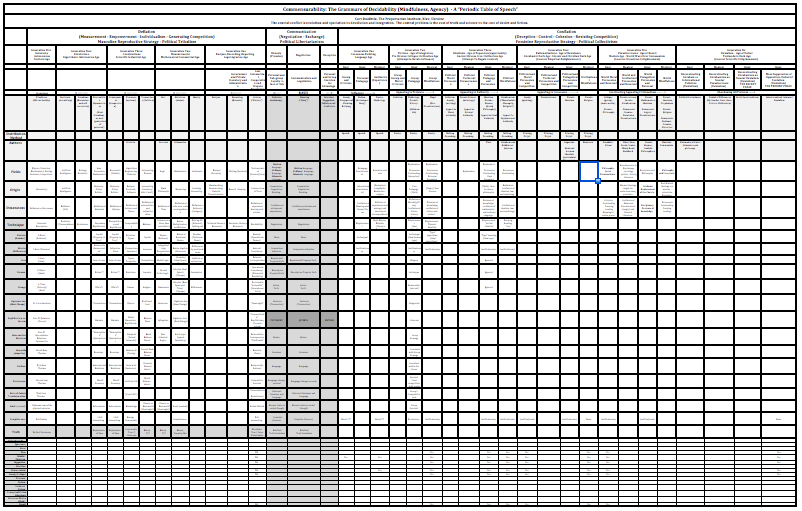
It’s really that simple. And yes, we can produce a periodic table of speech. I swear I could spend a whole year just documenting what this whole thing means, and adding variations to it. -
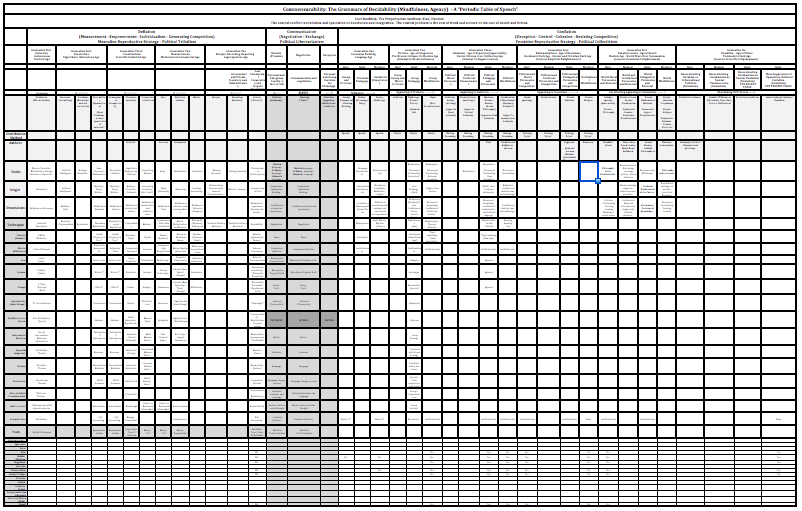
Mind Blowing Version Two
It’s really that simple. And yes, we can produce a periodic table of speech. I swear I could spend a whole year just documenting what this whole thing means, and adding variations to it. -
photos_and_videos/TimelinePhotos_43196237263/21768570_10155750234557264_37181375
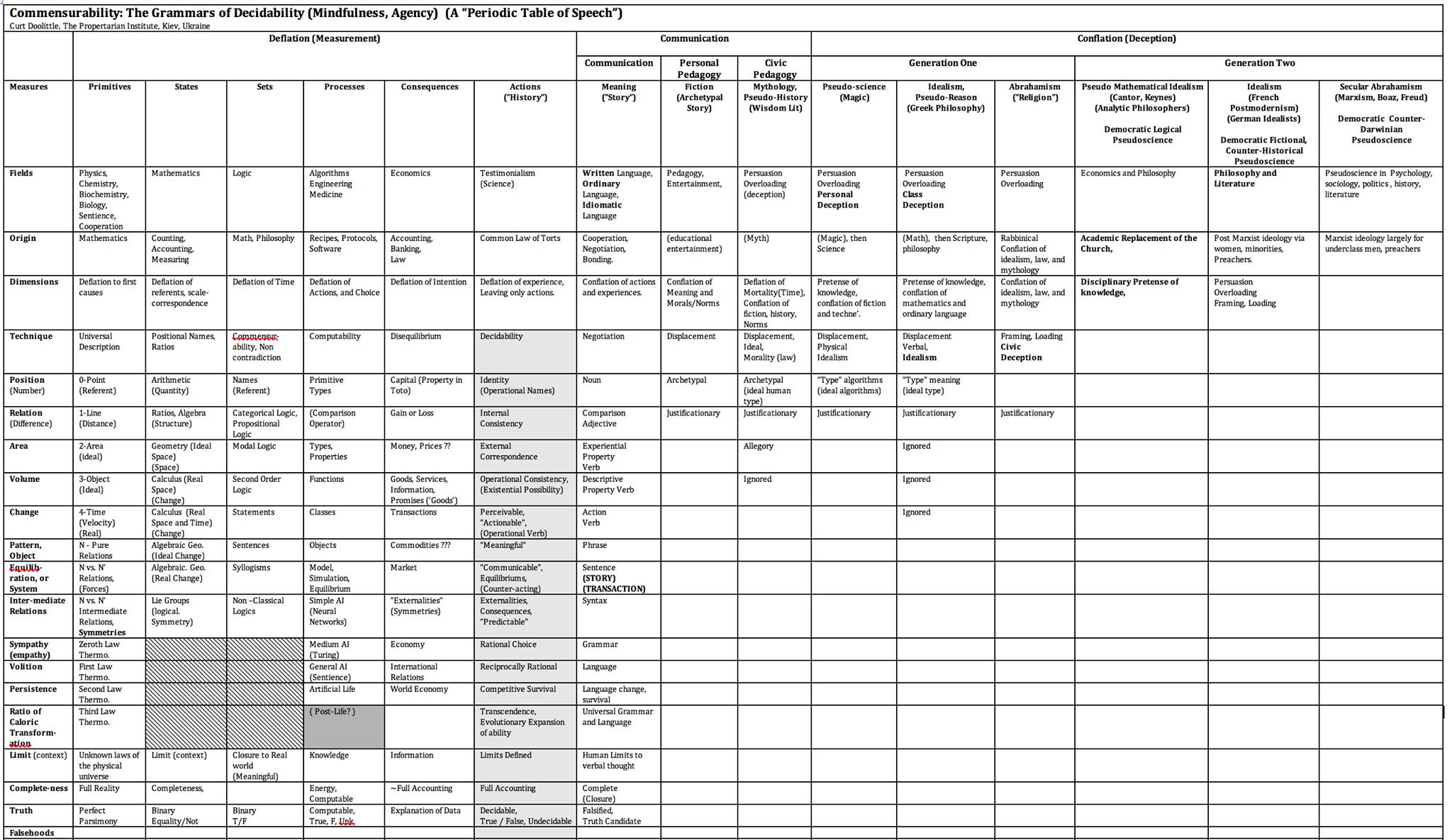
photos_and_videos/TimelinePhotos_43196237263/21768570_10155750234557264_3718137554012735853_o_10155750234557264.jpg MIND BLOWING VERSION TWO
It’s really that simple. And yes, we can produce a periodic table of speech.
I swear I could spend a whole year just documenting what this whole thing means, and adding variations to it.Mea CulbaI can’t read it!Sep 25, 2017 3:32pmCurt DoolittleNonsense. Do I need to educate you on basics? click to open the theater view. download the image. Open it your browser and zoom it. The image is fine.Sep 25, 2017 4:11pmMea CulbaIt’s just my cellphone then! SorrySep 25, 2017 4:16pmGünther Shroomacherwould be great to have higher resolutionSep 26, 2017 9:47amMIND BLOWING VERSION TWO
It’s really that simple. And yes, we can produce a periodic table of speech.
I swear I could spend a whole year just documenting what this whole thing means, and adding variations to it.
Source date (UTC): 2017-09-25 14:36:00 UTC
-
gram·mar /ˈɡramər/ noun The whole system and structure of a language or of langu
gram·mar /ˈɡramər/ noun The whole system and structure of a language or of languages in general, usually taken as consisting of syntax and morphology (including inflections) and sometimes also phonology and semantics. synonyms: syntax, sentence structure, rules of language, morphology; linguistics -
gram·mar /ˈɡramər/ noun The whole system and structure of a language or of langu
gram·mar /ˈɡramər/ noun The whole system and structure of a language or of languages in general, usually taken as consisting of syntax and morphology (including inflections) and sometimes also phonology and semantics. synonyms: syntax, sentence structure, rules of language, morphology; linguistics