Theme: Commons

  • Is Libertarianism A Failed Property Management Business Model?

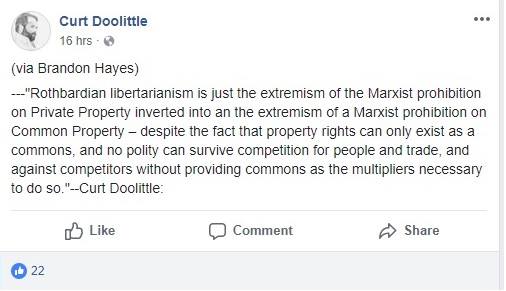
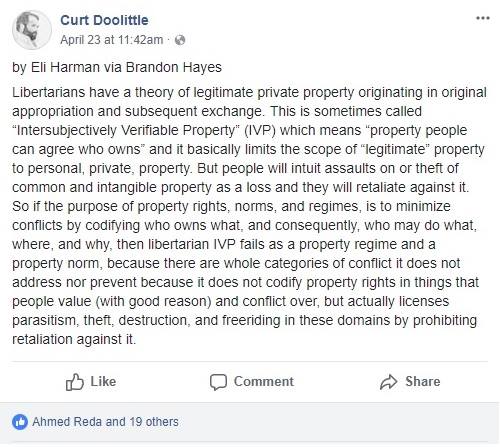
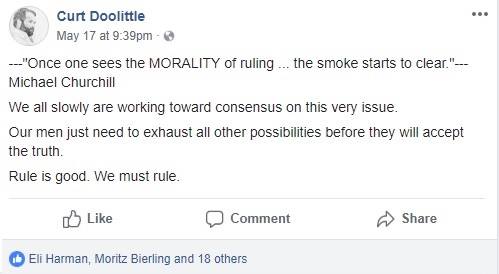
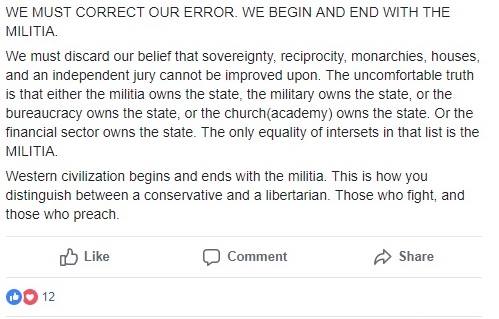
    by Dax Rayner —“Libertarianism is simply marxism for the commons instead of marxism for private property.” —Curt Doolittle https://propertarianinstitute.com/…/libertarian-pretense-of-payi…/ I’ve been thinking a lot about this statement the past few months and I see it more and more every day now that I’m paying attention to it, every time I’m in a libertarian thread or discussion. Coming from a libertarian-ish/Ayn Randian worldview myself for much of my life, I began to really heavily question libertarianism the past few years. Anyone who’s known me for awhile can probably tell my positions have shifted quite a bit on many things. It just became glaringly obvious to me that there were a lot of holes and discrepancies between libertarian theories and what we see happening in the real world. I know many others have felt the same way. I’ve just started scratching the surface of propertarianism as defined by the Propertarian Institute but so far it has given me incredible clarity on the problems I was seeing before with libertarianism that I lacked the operational language to describe. Simply put: It seems the core problem of libertarianism can be boiled down to mismanagement of the commons, and that is why marxism has run rampant through the education system, pop culture and liberal establishments. The irony here is that when libertarians talk about the tragedy of the commons it seems they have actually misinterpreted what that means and the REAL tragedy of the commons, at least in the modern West, is an inversion of their analysis. The solutions they propose are not only incorrect but simply not possible. Many libertarians seem to misunderstand or miscategorize what the commons is or in some cases, deny that it even exists at all. There’s a lot of things that made me begin challenging libertarianism from borders to foreign policy to trade but ultimately what really pushed me over the edge was libertarianism’s complete ineptness and total impotence at countering the societal cancer of social justice warriorism and marxist feminism. Not only has libertarianism been an abysmal failure at using individualism to effectively thwart leftist authoritarians and SJWs, but in many ways it’s directly contributed to the problem and is even actively working to suppress real solutions to the problem. I believe this comes down to, again, mismanagement of the commons, as well as gaping holes in the NAP which I’ve seen for a long time, but furthermore an incomplete understanding of what property actually is and inadequate property norms, which I didn’t begin to understand until coming across propertarianism. If you owned a 30 unit apartment complex and you hired a property management company to take care of it and they allowed the place to turn into a complete dump, with people crapping all over sidewalks, throwing trash on the lawn, etc would you continue to work with that property management company? That’s basically what libertarianism has given us. Luke Weinhagen also said it well: “The way it hit me was that libertarianism survives/exists by miscategorizing relations. Specifically libertarians interpret commons(cooperation) as commons(conflict) and use property rights(IVP) to attempt to resolve that conflict. In doing so they justify libertarianism’s parasitism of the commons(that can only be generated via cooperation) as defense and that justification requires it not suppress any parasitism of the commons(cooperation) as this would self destruct the ideology.” I’m writing a 4 Part series on this that I’m putting on minds.com to elaborate my thoughts on it. I’m still an amateur when it comes to political science and legal theory but having started, run and sold numerous companies in the digital publishing world over the last decade and a half I’ve dealt with my share of intellectual property issues, so I’m writing from that perspective in addition to my other research. I know this has been a particular sore spot for many other internet marketers as well. Just based on my own personal experience and observations, I would say a loose form of libertarianism is kind of the default political philosophy for a good amount of people in the sales and marketing world I come from. It just naturally appeals to our independent entreprenur/anti-corporate personality. But I think if a lot of people looked into it more they may find the propertarian definitions of property to be much more all encompassing, useful and applicable to the real world, as I have. Propertarianism has added a whole new dimension of understanding for me when it comes to asset classes, brand protection, diversification & portfolio management. If you’re a business owner or individual who’s using the ideology and school of libertarianism/AnCapism as your property management company, I might encourage you to consider reevaluating your relationship with them. They may not be caretaking your family’s future, your community, your assets and your retirement as well as you’ve been led to think.  

    43022919_10214775615638364_6726379545332547584_n.jpg
    43096691_10214775616598388_1295059160890605568_n.jpg
    42887257_10214775616998398_7726781474153693184_n.jpg
    42878412_10214775618878445_7481181384308948992_n.jpg
    42840299_10214775619158452_5871830080203784192_n.jpg
    43011287_10214775619398458_4493840310622748672_n.jpg
    42943239_10214775620558487_3648006571088150528_n.jpg
  • Is Libertarianism A Failed Property Management Business Model?

    by Dax Rayner —“Libertarianism is simply marxism for the commons instead of marxism for private property.” —Curt Doolittle https://propertarianinstitute.com/…/libertarian-pretense-of-payi…/ I’ve been thinking a lot about this statement the past few months and I see it more and more every day now that I’m paying attention to it, every time I’m in a libertarian thread or discussion. Coming from a libertarian-ish/Ayn Randian worldview myself for much of my life, I began to really heavily question libertarianism the past few years. Anyone who’s known me for awhile can probably tell my positions have shifted quite a bit on many things. It just became glaringly obvious to me that there were a lot of holes and discrepancies between libertarian theories and what we see happening in the real world. I know many others have felt the same way. I’ve just started scratching the surface of propertarianism as defined by the Propertarian Institute but so far it has given me incredible clarity on the problems I was seeing before with libertarianism that I lacked the operational language to describe. Simply put: It seems the core problem of libertarianism can be boiled down to mismanagement of the commons, and that is why marxism has run rampant through the education system, pop culture and liberal establishments. The irony here is that when libertarians talk about the tragedy of the commons it seems they have actually misinterpreted what that means and the REAL tragedy of the commons, at least in the modern West, is an inversion of their analysis. The solutions they propose are not only incorrect but simply not possible. Many libertarians seem to misunderstand or miscategorize what the commons is or in some cases, deny that it even exists at all. There’s a lot of things that made me begin challenging libertarianism from borders to foreign policy to trade but ultimately what really pushed me over the edge was libertarianism’s complete ineptness and total impotence at countering the societal cancer of social justice warriorism and marxist feminism. Not only has libertarianism been an abysmal failure at using individualism to effectively thwart leftist authoritarians and SJWs, but in many ways it’s directly contributed to the problem and is even actively working to suppress real solutions to the problem. I believe this comes down to, again, mismanagement of the commons, as well as gaping holes in the NAP which I’ve seen for a long time, but furthermore an incomplete understanding of what property actually is and inadequate property norms, which I didn’t begin to understand until coming across propertarianism. If you owned a 30 unit apartment complex and you hired a property management company to take care of it and they allowed the place to turn into a complete dump, with people crapping all over sidewalks, throwing trash on the lawn, etc would you continue to work with that property management company? That’s basically what libertarianism has given us. Luke Weinhagen also said it well: “The way it hit me was that libertarianism survives/exists by miscategorizing relations. Specifically libertarians interpret commons(cooperation) as commons(conflict) and use property rights(IVP) to attempt to resolve that conflict. In doing so they justify libertarianism’s parasitism of the commons(that can only be generated via cooperation) as defense and that justification requires it not suppress any parasitism of the commons(cooperation) as this would self destruct the ideology.” I’m writing a 4 Part series on this that I’m putting on minds.com to elaborate my thoughts on it. I’m still an amateur when it comes to political science and legal theory but having started, run and sold numerous companies in the digital publishing world over the last decade and a half I’ve dealt with my share of intellectual property issues, so I’m writing from that perspective in addition to my other research. I know this has been a particular sore spot for many other internet marketers as well. Just based on my own personal experience and observations, I would say a loose form of libertarianism is kind of the default political philosophy for a good amount of people in the sales and marketing world I come from. It just naturally appeals to our independent entreprenur/anti-corporate personality. But I think if a lot of people looked into it more they may find the propertarian definitions of property to be much more all encompassing, useful and applicable to the real world, as I have. Propertarianism has added a whole new dimension of understanding for me when it comes to asset classes, brand protection, diversification & portfolio management. If you’re a business owner or individual who’s using the ideology and school of libertarianism/AnCapism as your property management company, I might encourage you to consider reevaluating your relationship with them. They may not be caretaking your family’s future, your community, your assets and your retirement as well as you’ve been led to think.  

    43022919_10214775615638364_6726379545332547584_n.jpg
    43096691_10214775616598388_1295059160890605568_n.jpg
    42887257_10214775616998398_7726781474153693184_n.jpg
    42878412_10214775618878445_7481181384308948992_n.jpg
    42840299_10214775619158452_5871830080203784192_n.jpg
    43011287_10214775619398458_4493840310622748672_n.jpg
    42943239_10214775620558487_3648006571088150528_n.jpg
  • Constitution: The Commons

    Constitution: The Commons

    Article X

    The Commons

    The Purpose of Commons

    Regarding Zoning (cities for families) ( parks and green space ) ( aesthetic construction ) ( spec built homes) (design build prohibition) (design for use) (design by room), ( insurance on restoration to natural state ),

    Public Behavior

    ( … ) prohibition on aggressive, stalking,. hunting for opportunty for crime

    Acts

    Regarding the Commons

    1 – Public transportation creates opportunity for disease transmission and exposure to crime. Restore “classes” given the dress and condition of passengers.  All efforts shall be made to provide clean Isolated spaces For each individual, maximum air filtration, and zero tolerance for anything other than flawless civic behavior: clean, dressed for the commons, quiet, and still.  Ill citizens shall avoid public transport, wear masks, and gloves. The citizenry shall police this behavior, and if necessary civil enforcement shall be allocated to do so.

    2 – All carriers whether solid (such as wire or fiber) or container( such as pipe) shall be placed Underground To limit the visual noise and territorial hazard of poles and other structures, except where distance prohibits due to capacitance effects. Except for long-distance and high voltage lines, all suburban, urban lines shall be underground.

    3 – All “outdoor” commercial advertising, including billboards, mobile billboards, transit advertising, banners, posters, ( …. )
  • Constitution: The Commons

    Constitution: The Commons

    Article X

    The Commons

    The Purpose of Commons

    Regarding Zoning (cities for families) ( parks and green space ) ( aesthetic construction ) ( spec built homes) (design build prohibition) (design for use) (design by room), ( insurance on restoration to natural state ),

    Public Behavior

    ( … ) prohibition on aggressive, stalking,. hunting for opportunty for crime

    Acts

    Regarding the Commons

    1 – Public transportation creates opportunity for disease transmission and exposure to crime. Restore “classes” given the dress and condition of passengers.  All efforts shall be made to provide clean Isolated spaces For each individual, maximum air filtration, and zero tolerance for anything other than flawless civic behavior: clean, dressed for the commons, quiet, and still.  Ill citizens shall avoid public transport, wear masks, and gloves. The citizenry shall police this behavior, and if necessary civil enforcement shall be allocated to do so.

    2 – All carriers whether solid (such as wire or fiber) or container( such as pipe) shall be placed Underground To limit the visual noise and territorial hazard of poles and other structures, except where distance prohibits due to capacitance effects. Except for long-distance and high voltage lines, all suburban, urban lines shall be underground.

    3 – All “outdoor” commercial advertising, including billboards, mobile billboards, transit advertising, banners, posters, ( …. )
  • Constitution: The Government of the State

    Constitution: The Government of the State

    Article VII

    The Government of The State

    “The Market for the Production of Polities”

    The Purpose of Government

    1. Production of Commons 2. Insurer of Last Resort against the vicissitudes of nature 3. Treasury for the Facilitation of invention, investment, production distribution and trade.

    The Purpose of Commons (Policy)

    1. The objective of law is the behavior of the individual, but the objective of policy is success of the intergenerational family, and not the individual. 2. Production of Commons that Increase the Physical, Institutional, Informational, Behavioral, Genetic Capital.

    The Hierarchy of Commons  

    (local, positive, normative and institutional, to universal negative and juridical., such that the federal, regional, state, local, neighborhood and village produce the commons suitable to their abilities and needs, and ameliorate their differences through access to markets and trade.

    Where;

    ( … )

    The Constitution of the Governments

    Section I – The Federal Government

    Given;

    ( … history … )

    And given;

    ( … conditions … )

    Therefore;

    ( … strategy … )

    Rule of Law of Natural Law of Reciprocity Empire Imperial Government as Insurer of Last Resort Several States Therefore; Regarding the Federal Government

    1. The House of Representatives shall be disbanded and prohibited.

    2. The Senate shall be disbanded, and reconstituted, consisting of the sitting governors of the states – one from each.

    3. The “Governor” shall refer to the highest executive office in the Several State, but in capacity as Senator shall be addressed as “Governor” regardless of local title.

    4. If elected, those governors may only be elected by citizens of fourth generation or more, possessed of residential property, and free of crime of predation.

    5. New States may be admitted by the Congress into this Union; but no new States shall be formed or erected within the Jurisdiction of any other State; nor any State be formed by the Junction of two or more States, or parts of States, without the Consent of the Legislatures of the States concerned as well as of the Congress.

    5. The Senate may construct:

    1. Voluntary Contracts: Between Signatory States. All Voluntary Contracts shall consist of a contract between the signatory states on behalf of the citizenry.

    2. Treaty Contracts: Between All States. All Treaty contracts shall consist of a contract between all the states on behalf of the citizenry.

    The Senate may construct treaty contracts, and voluntary contracts, but make no law. The making of Legislative Law is reserved for the states, and the Making of law reserved for the discovery of Findings of Law by the Court.

    Regulations shall be submitted to the Senate as a Request for Voluntary Contract or Request for Treaty Contract.

    6. Assent

    1. All voluntary contracts between states shall ascend upon signature of the governors of the consenting states.

    (Counsel: States can conduct negotiations and construct agreements that are enforceable by the Court.)

    2. All Treaty Contracts shall require a supermajority vote, from sufficient states to also constitute a supermajority of territory and a supermajority of population.

    3. All Legislative Contracts shall require survival of veto by the Supreme Court on terms of constitutionality, although the court may choose or not choose to comment or advise, and the courts action to veto or not carry no weight on future findings of law by the court.

    4. Conditionally:

    Whereas the people are prone to follies which time does not forgive;

    If Monarchy exists under the constitution then the Monarchy may veto on any grounds no matter how arbitrary, at any time after passage, in defense of the polity from the fashions and follies of the day.

    7. All Contracts between the States whether Voluntary or Legislation shall be limited to matters of  trade, taxation,  insurance, and defense, and may not address etiquette, manners, behavior, norm, custom, tradition, education, or function of the member states, as all such rights are reserved for the Several States and the Several States alone.

    8. All Amendments to the constitution shall be likewise limited to and prohibited from, the same matters as all Legislation above; must survive approval from two thirds of the Several States, constituting two thirds of the territory, and two thirds of the population of the Empire.

    9. All Contracts, including Legislation, shall sunset no later than one half of one average human lifetime from the date of passage; unless revised and renewed as new contract or legislation.

    10. All states may and must compete for talent, research, development, production and trade. But no state or alliance of states shall seek to deprive other states of territory, population, trade, wealth, alliances, or relations other than by market competition.

    11. The only purpose of the Government, shall consist of exclusively seek the preservation and improvement of the condition of the people of the States and no purpose external state shall be proposed, considered, or acted upon.

    (Counsel: globalism, and other ideologies contrary to Strategy are prohibited.)

    12. Prohibition on “Pooling and Laundering” into a common fund, over which there is discretionary use. All income shall be allocated to a function and when that function or paid for the fees or taxes shall be immediately terminated and the remainder refunded.

    (Counsel: A prohibition on discretionary use of funds.)

    13. All ideology shall be limited to activity within the Several States. No parties or the equivalent of parties may exist, participate in, seek or engage in influence of the Senate. Any attempt to organize the Senate for the purpose of any objective than purely empirical production of voluntary and involuntary contracts of legislation on matters limited by this constitution shall be an act of treason and punishable by death.

    (Counsel: the matter of political orders is settled. The only opposition to voluntary reciprocal exchange is the justification of free riding, parasitism, and predation upon one group by another group. Therefore the only possible means of obtaining a desired end is not to argue for a fictional good at the expense of others, but to produce a trade that is mutually beneficial and voluntarily chosen. )

    14. Any advocacy, or attempt, to circumvent the original intent, and spirit of this constitution shall constitute an act of treason punishable by death.

    Regarding Monopoly Bureaucracy

    ( … )

    Policy

    1. All non-military government pensions shall be terminated as punishment for extractive parasitism upon the people.

    2. The departments of Education, Health and Human Services, Housing and Urban Development, Labor, shall immediately be terminated, and any resistance punishable as act of treason against the people.

    3. Intelligence and State shall be added to the Department of Defense. And defense shall terminate all functions of those bureaucracies not central to military, intelligence, state, and trade-commerce. The marines shall move to peerage with the other services.

    Regarding Infrastructure

    1. The prohibition on Rents shall not be diluted, and the rights of Transit and Transport shall not be infringed; and therefore no tolls, or fees, or taxes shall be charged for the passage of transport between or across states for the purpose of transit, defense or trade; except that passage of that which exposes the people to environmental risk and is closed to restitution, may be regulated as necessary to minimize harm.

    2. Those Ways and Routes that exist at the time of ratification may be altered to limit congestion, and may be increased in number; but may not be diminished  or eliminated without act of Legislation by the Senate.  No state shall use constrain ways and routes to  exert influence over the actions of another state.  The Senate may act to improve any existing Way or Route by means of Legislation at its discretion.

    3. All public buildings regardless of use shall be constructed as monuments from hand laid materials such as brick, stone, mortar, wood, iron, steel, brass, and plaster with prewar methods of construction; with pitched roofs; with ceilings no less than nine feet; and where all postwar techniques, including panel products shall be prohibited; with construction labor provided those with civic duty to work in exchange for benefits. The practice of producing disposable civic structures shall end. The practice of war, postwar and modern architecture of the bauhaus, communist, brutalist methods shall be prohibited.

    ( Counsel: The tendency of civil servants to seek discounts on the production commons as means of increasing their privatization of commons shall end.)

    Policy

    1 – Quadruple the number of, or capacity of existing nuclear reactors.

    2 – Construct a new electric and data grid, eliminating the existing fragility and subsequent cascading of failure.

    3 – Continue extraordinary investment into electric vehicles until our streets are quiet again, and robotic cars drive us from place to place.

    4 – Public transportation creates opportunity for disease transmission and exposure to crime. All efforts shall be made to provide clean isolated spaces for each individual, maximum air filtration, and zero tolerance for anything other than civic behavior: clean, dressed for the commons, quiet, and still.  Ill citizens shall avoid public transport, wear masks, and gloves. The citizenry shall police this behavior, and if necessary civil enforcement shall be allocated to do so.

    5 – All carriers whether solid (such as wire or fiber) or container( such as pipe) shall be placed underground to limit the visual noise and territorial hazard of poles and other structures, except where distance prohibits due to capacitance effects. Except for long distance and high voltage lines, all suburban, urban lines shall be underground.

    Regarding Work

    1. Any work that can be done domestically shall be done domestically, with the sole provision of unbridgeable differences in technical competency; and differences local prices of labor shall be ameliorated in trade policy. Those industries that require capital investment to produce local returns shall be. The practice of exporting skill and knowledge in exchange for discounted pricing on consumer goods shall be ended.

    Regarding Calendars

    (a) The Year

    (b) Holidays

    The state shall recognize pre-Christian Heathen and Pagan Traditional, Orthodox, Catholic, Protestant holidays as well as secular days of remembrance, but no other. The communist holidays are prohibited, as are those of other religions or customs.

    Spring Day (Imbolc), February 1 Lady Day (Spring Equinox). ~March 20th Easter (Ostara), Good Friday, Saturday, Sunday. (W) May Day (Beltane): May 1 Memorial Day Weekend: Last Monday in May. (W) Midsummer (Summer Solstice), June 21 Aphelion, Independence Day Weekend, July 4 (W) Harvest Day (Lammas, Lunasa), August 1 Labor Day Weekend: First Monday in September. (W) Fall Solstice , September 21 (1) Halloween (Samhain), October 31, and November 1st (2) Thanksgiving Feast Weekend, Third Thursday in November and the following Friday. (W) St Nicholas Day, December 15th Winter Solstice Day, December 21st Christmas Eve, Christmas Day, St Stephen’s Day, and , New Year: January 1,  Perihelion January 2. -or- Yule: December 24 Noon, to January 5. Orthodox Christmas, January 7,8.
  • Constitution: The Government of the State

    Constitution: The Government of the State

    Article VII

    The Government of The State

    “The Market for the Production of Polities”

    The Purpose of Government

    1. Production of Commons 2. Insurer of Last Resort against the vicissitudes of nature 3. Treasury for the Facilitation of invention, investment, production distribution and trade.

    The Purpose of Commons (Policy)

    1. The objective of law is the behavior of the individual, but the objective of policy is success of the intergenerational family, and not the individual. 2. Production of Commons that Increase the Physical, Institutional, Informational, Behavioral, Genetic Capital.

    The Hierarchy of Commons  

    (local, positive, normative and institutional, to universal negative and juridical., such that the federal, regional, state, local, neighborhood and village produce the commons suitable to their abilities and needs, and ameliorate their differences through access to markets and trade.

    Where;

    ( … )

    The Constitution of the Governments

    Section I – The Federal Government

    Given;

    ( … history … )

    And given;

    ( … conditions … )

    Therefore;

    ( … strategy … )

    Rule of Law of Natural Law of Reciprocity Empire Imperial Government as Insurer of Last Resort Several States Therefore; Regarding the Federal Government

    1. The House of Representatives shall be disbanded and prohibited.

    2. The Senate shall be disbanded, and reconstituted, consisting of the sitting governors of the states – one from each.

    3. The “Governor” shall refer to the highest executive office in the Several State, but in capacity as Senator shall be addressed as “Governor” regardless of local title.

    4. If elected, those governors may only be elected by citizens of fourth generation or more, possessed of residential property, and free of crime of predation.

    5. New States may be admitted by the Congress into this Union; but no new States shall be formed or erected within the Jurisdiction of any other State; nor any State be formed by the Junction of two or more States, or parts of States, without the Consent of the Legislatures of the States concerned as well as of the Congress.

    5. The Senate may construct:

    1. Voluntary Contracts: Between Signatory States. All Voluntary Contracts shall consist of a contract between the signatory states on behalf of the citizenry.

    2. Treaty Contracts: Between All States. All Treaty contracts shall consist of a contract between all the states on behalf of the citizenry.

    The Senate may construct treaty contracts, and voluntary contracts, but make no law. The making of Legislative Law is reserved for the states, and the Making of law reserved for the discovery of Findings of Law by the Court.

    Regulations shall be submitted to the Senate as a Request for Voluntary Contract or Request for Treaty Contract.

    6. Assent

    1. All voluntary contracts between states shall ascend upon signature of the governors of the consenting states.

    (Counsel: States can conduct negotiations and construct agreements that are enforceable by the Court.)

    2. All Treaty Contracts shall require a supermajority vote, from sufficient states to also constitute a supermajority of territory and a supermajority of population.

    3. All Legislative Contracts shall require survival of veto by the Supreme Court on terms of constitutionality, although the court may choose or not choose to comment or advise, and the courts action to veto or not carry no weight on future findings of law by the court.

    4. Conditionally:

    Whereas the people are prone to follies which time does not forgive;

    If Monarchy exists under the constitution then the Monarchy may veto on any grounds no matter how arbitrary, at any time after passage, in defense of the polity from the fashions and follies of the day.

    7. All Contracts between the States whether Voluntary or Legislation shall be limited to matters of  trade, taxation,  insurance, and defense, and may not address etiquette, manners, behavior, norm, custom, tradition, education, or function of the member states, as all such rights are reserved for the Several States and the Several States alone.

    8. All Amendments to the constitution shall be likewise limited to and prohibited from, the same matters as all Legislation above; must survive approval from two thirds of the Several States, constituting two thirds of the territory, and two thirds of the population of the Empire.

    9. All Contracts, including Legislation, shall sunset no later than one half of one average human lifetime from the date of passage; unless revised and renewed as new contract or legislation.

    10. All states may and must compete for talent, research, development, production and trade. But no state or alliance of states shall seek to deprive other states of territory, population, trade, wealth, alliances, or relations other than by market competition.

    11. The only purpose of the Government, shall consist of exclusively seek the preservation and improvement of the condition of the people of the States and no purpose external state shall be proposed, considered, or acted upon.

    (Counsel: globalism, and other ideologies contrary to Strategy are prohibited.)

    12. Prohibition on “Pooling and Laundering” into a common fund, over which there is discretionary use. All income shall be allocated to a function and when that function or paid for the fees or taxes shall be immediately terminated and the remainder refunded.

    (Counsel: A prohibition on discretionary use of funds.)

    13. All ideology shall be limited to activity within the Several States. No parties or the equivalent of parties may exist, participate in, seek or engage in influence of the Senate. Any attempt to organize the Senate for the purpose of any objective than purely empirical production of voluntary and involuntary contracts of legislation on matters limited by this constitution shall be an act of treason and punishable by death.

    (Counsel: the matter of political orders is settled. The only opposition to voluntary reciprocal exchange is the justification of free riding, parasitism, and predation upon one group by another group. Therefore the only possible means of obtaining a desired end is not to argue for a fictional good at the expense of others, but to produce a trade that is mutually beneficial and voluntarily chosen. )

    14. Any advocacy, or attempt, to circumvent the original intent, and spirit of this constitution shall constitute an act of treason punishable by death.

    Regarding Monopoly Bureaucracy

    ( … )

    Policy

    1. All non-military government pensions shall be terminated as punishment for extractive parasitism upon the people.

    2. The departments of Education, Health and Human Services, Housing and Urban Development, Labor, shall immediately be terminated, and any resistance punishable as act of treason against the people.

    3. Intelligence and State shall be added to the Department of Defense. And defense shall terminate all functions of those bureaucracies not central to military, intelligence, state, and trade-commerce. The marines shall move to peerage with the other services.

    Regarding Infrastructure

    1. The prohibition on Rents shall not be diluted, and the rights of Transit and Transport shall not be infringed; and therefore no tolls, or fees, or taxes shall be charged for the passage of transport between or across states for the purpose of transit, defense or trade; except that passage of that which exposes the people to environmental risk and is closed to restitution, may be regulated as necessary to minimize harm.

    2. Those Ways and Routes that exist at the time of ratification may be altered to limit congestion, and may be increased in number; but may not be diminished  or eliminated without act of Legislation by the Senate.  No state shall use constrain ways and routes to  exert influence over the actions of another state.  The Senate may act to improve any existing Way or Route by means of Legislation at its discretion.

    3. All public buildings regardless of use shall be constructed as monuments from hand laid materials such as brick, stone, mortar, wood, iron, steel, brass, and plaster with prewar methods of construction; with pitched roofs; with ceilings no less than nine feet; and where all postwar techniques, including panel products shall be prohibited; with construction labor provided those with civic duty to work in exchange for benefits. The practice of producing disposable civic structures shall end. The practice of war, postwar and modern architecture of the bauhaus, communist, brutalist methods shall be prohibited.

    ( Counsel: The tendency of civil servants to seek discounts on the production commons as means of increasing their privatization of commons shall end.)

    Policy

    1 – Quadruple the number of, or capacity of existing nuclear reactors.

    2 – Construct a new electric and data grid, eliminating the existing fragility and subsequent cascading of failure.

    3 – Continue extraordinary investment into electric vehicles until our streets are quiet again, and robotic cars drive us from place to place.

    4 – Public transportation creates opportunity for disease transmission and exposure to crime. All efforts shall be made to provide clean isolated spaces for each individual, maximum air filtration, and zero tolerance for anything other than civic behavior: clean, dressed for the commons, quiet, and still.  Ill citizens shall avoid public transport, wear masks, and gloves. The citizenry shall police this behavior, and if necessary civil enforcement shall be allocated to do so.

    5 – All carriers whether solid (such as wire or fiber) or container( such as pipe) shall be placed underground to limit the visual noise and territorial hazard of poles and other structures, except where distance prohibits due to capacitance effects. Except for long distance and high voltage lines, all suburban, urban lines shall be underground.

    Regarding Work

    1. Any work that can be done domestically shall be done domestically, with the sole provision of unbridgeable differences in technical competency; and differences local prices of labor shall be ameliorated in trade policy. Those industries that require capital investment to produce local returns shall be. The practice of exporting skill and knowledge in exchange for discounted pricing on consumer goods shall be ended.

    Regarding Calendars

    (a) The Year

    (b) Holidays

    The state shall recognize pre-Christian Heathen and Pagan Traditional, Orthodox, Catholic, Protestant holidays as well as secular days of remembrance, but no other. The communist holidays are prohibited, as are those of other religions or customs.

    Spring Day (Imbolc), February 1 Lady Day (Spring Equinox). ~March 20th Easter (Ostara), Good Friday, Saturday, Sunday. (W) May Day (Beltane): May 1 Memorial Day Weekend: Last Monday in May. (W) Midsummer (Summer Solstice), June 21 Aphelion, Independence Day Weekend, July 4 (W) Harvest Day (Lammas, Lunasa), August 1 Labor Day Weekend: First Monday in September. (W) Fall Solstice , September 21 (1) Halloween (Samhain), October 31, and November 1st (2) Thanksgiving Feast Weekend, Third Thursday in November and the following Friday. (W) St Nicholas Day, December 15th Winter Solstice Day, December 21st Christmas Eve, Christmas Day, St Stephen’s Day, and , New Year: January 1,  Perihelion January 2. -or- Yule: December 24 Noon, to January 5. Orthodox Christmas, January 7,8.
  • My thing isn’t race at all. It’s agency, ability, evolutionary condition, and no

    My thing isn’t race at all. It’s agency, ability, evolutionary condition, and non-competition over the production of commons. I other words, no genetic, normative, cultural, and institutional… https://www.facebook.com/permalink.php?story_fbid=290821864848044&id=100017606988153


    Source date (UTC): 2018-09-05 18:16:21 UTC

    Original post: https://twitter.com/i/web/status/1037404080430301190

  • My thing isn’t race at all. It’s agency, ability, evolutionary condition, and no

    My thing isn’t race at all. It’s agency, ability, evolutionary condition, and non-competition over the production of commons. I other words, no genetic, normative, cultural, and institutional competition with our struggle for transcendence into gods. Abrahamists must separate. Leftists must separate. I don’t care about who remains.


    Source date (UTC): 2018-09-05 14:16:00 UTC

  • My thing isn’t race at all. It’s agency, ability, evolutionary condition, and no

    My thing isn’t race at all. It’s agency, ability, evolutionary condition, and non-competition over the production of commons. In other words, no genetic, normative, cultural, and institutional competition with our struggle for transcendence into gods. Abrahamists must separate. Leftists must separate. I don’t care about who remains.

  • My thing isn’t race at all. It’s agency, ability, evolutionary condition, and no

    My thing isn’t race at all. It’s agency, ability, evolutionary condition, and non-competition over the production of commons. In other words, no genetic, normative, cultural, and institutional competition with our struggle for transcendence into gods. Abrahamists must separate. Leftists must separate. I don’t care about who remains.