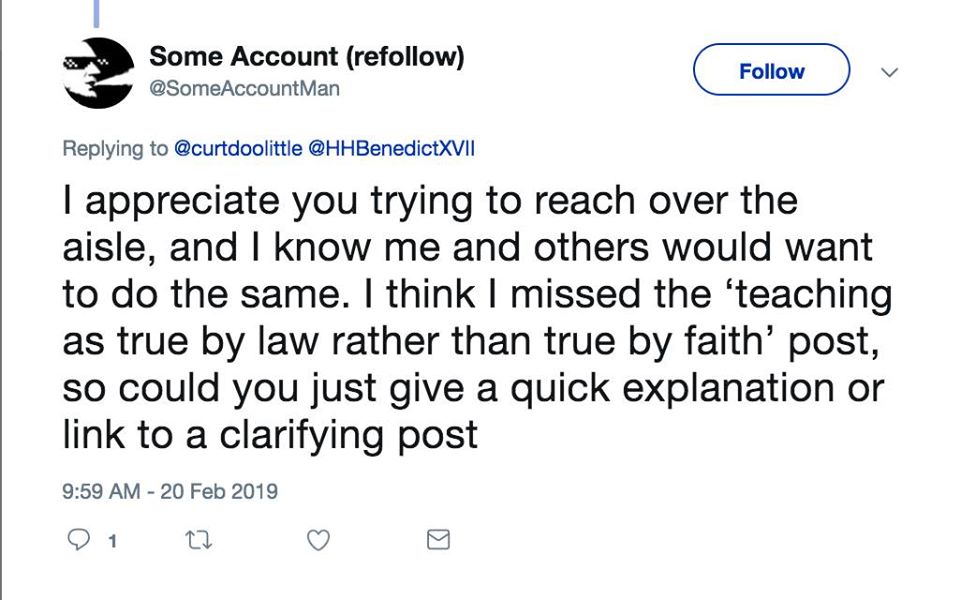
photos_and_videos/TimelinePhotos_SxeO6JU-xg/52637180_10157001249142264_256881942434152448_n_10157001249012264.jpg My life in a single image :)Nicholas Christopher Richard[Kinsella shrieks softly in the distance]Feb 20, 2019, 11:59 PMBenjamin BakerI wonder what he meant by this?Feb 21, 2019, 12:35 AMDaniel Roland AndersonWell, you’re not much good to us alive then. Are you?
😎Feb 21, 2019, 3:32 AMJWarren Prescott…and I’m all out of bubblegum.Feb 21, 2019, 7:46 AMMathuin HillgarthIt seems easy enough to understand, incentive based motivationFeb 21, 2019, 8:16 AMMichael D. AbbottFeb 21, 2019, 12:04 PMMy life in a single image 🙂
The scientific process allows us to create and test hypothesis such that we can use them to explain phenomena (within a degree of precision) and act on that knowledge (within the scope given by precision); but even such use comes with presuppositions (inherent limits).Presuppositions = [ Regularity | Shared Language ]One needs to presuppose that the phenomena under investigation have useful regularities which we can capture in a model (precise enough for us to act on it). If no regularity existed, our model would fail to help us make any prediction with any degree of reliability, and as such, it would work no better than fiction.Regularity := Unpredictable > Heuristic > Probabilistic > Deterministic > ConstantRegularity (constancy) sets an ideal limit on testing criteria, whose repeated application tests the consistency of models as they evolve, this guarantees constant maintenance of coherent models as a response to advances in instrumentation and logic.Science requires a common set of testing criteria, since without such common criteria, anyone could claim scientific status for their propositions. Science must work by the mapping of the “platonic folds” where theories fail to correspond enough with our data as to have any practical use.Shared Language := Nonsense > Associative > Meaningful > Operational > SynchronousSimultaneity (synchronism) sets an ideal limit on shared languages, which allows us to elaborate descriptions and constrain our imagination to that which someone seeks to communicate.Without (at least) an operational shared language, others will not execute commands (to measure, compare and transform) as intended. Deviations from shared language can result in many self-proclaimed “scientific” communities talking past each other.
Assumptions & Tools in Specific Disciplines
Beyond the core presuppositions that define science itself, specific disciplines adjoin premises (which complement the method), procedures (which sets a standard of action), techniques (which defines a common set of operations), and instruments (which expand the scope of exploration).Assumptions = [ Premises | Procedures | Techniques | Instruments ]Premises either evolve all the way from initial hypothesis towards its foundational status (in the scientific field) or result from the addition of ontological and logical assumptions from an expanded shared language.Ontological premises increase the vocabulary of a particular discipline beyond that of the scientific method, thus it provides the basic conceptual framework for further discussion. Scientific revolutions often result from the inspection into the “platonic foldings” (which define limits) for these systems.Logical premises restrict the range of linguistic operations upon which formal models get constructed. One can find the limits of a theory by mapping the points of failure where those limited set of operations predict beyond an acceptable margin of error.Techniques and Instruments evolve along with advances in technology (which expand that our physical senses), developments in the formal logic (which restrict our mental operations), and establishment of social institutions (which organize the community).Procedures evolve along with the tools of science (techniques and instruments) as operational definitions that convert theoretical constructs into measurable, comparable and transmutable data which one can then use.
Testing Criteria and Testimonial Constraints
Testing Criteria = [ Categorical | Logical | Empirical | Operational | Moral ] Testimonial Constraints = [ Scope | Information | Time ]The Categorical (which we may also call naming or identity) criterion refers to the proper avoidance of conflation by making explicit the ontology of a theory through labels and definitions, this allows us to eliminate a great deal of ambiguity and vagueness.The Logical (which we may also call internal consistency) criterion refers to the correct use of logical structures in our formal models of a theory and consistent narrative in informal models, this allows to eliminate ambiguity, restrict linguistic operations and to make further inferences.The Empirical (which we may also call external consistency) criterion refers to the use of data obtained from observations and experiments (through procedures) in order to verify predictions from theory.The Operational (which we may also call existential) criterion refers to the use of procedures in order to map from categories extant in our models into data which we can measure, compare and transform.The Moral (which we may also call reciprocal) criterion refers to the preservation of human cooperation, and for such to happen, our transactions must remain productive, symmetrical, warrantied, voluntary, and without negative externality.The Scope (which we may also call falsifiability) constraint refers to the use of empirical data and logical systems to find the limits where a theory fails to work with enough precision for us to act on it.The Information (which we may also call full accounting) constraint refers to the proper accounting of all relevant information through bias removal mechanisms such as double-blind, controlled, randomized trials; evaluation of construct validity; and market judgement (survival upon application).The Time (which we may also call survival) constraint refers to the survival of ideas after repeated exposure to testimonial judgement by all previous criteria to such an extent that we just integrate them into our assumptions.The Categorical, and Logical, and Empirical, and Operational, and Moral criteria judge the regularity of theories on (independent) dimensions of truthfulness, whereas the Information, and Scope, and Time criteria define constraints and obligations upon the application of all.
Assertions and Arguments under Testimonial Pragmatism
Assertions := Conceptual > Preferential > Practical > Moral > Rational > Decidable > Objective > IdenticalIdentical (tautological) propositions set an ideal limit on assertions, such that they describe with the greatest parsimony and precision possible.Arguments = [ Emotional | Normative | Logical | Analogical | Empirical | Economic | Testimonial ]Emotional arguments support (or contradict) an assertion by relating it to an emotional response upon the subject. It also includes arguments based on one’s intuitions.Normative arguments support (or contradict) an assertion by comparing it against the rules and norms which one considers to apply, whether its origin is biological, social, economic, or religious.Logical arguments support (or contradict) an assertion by analysis of the conceptual (its categorical consistency) and linguistic structure of the argument (its internal consistency).Analogical arguments support (or contradict) an assertion by means of a comparison with similar assertions about events in different contexts, such as the reference to specific examples.Empirical arguments support (or contradict) an assertion by using procedures to obtain data (measurement) and compare it with an assertion derived from an hypothesis (its external consistency).Economic arguments support (or contradict) an assertion by means like those of empirical arguments, but whose data comes from uncontrolled variable which one cannot measure directly.Testimonial arguments make use of normative, logical, analogical, empirical, and economic arguments in order to make practical, moral, rational, decidable, and objective assertions that survive the tests of categorical, logical, empirical, and operational consistency under the scope, information, and time constraints.
Evolutionary Epistemology under Testimonial Pragmatism
The scientific process works by use of its scientific method, which refers to the application of testing criteria as a way to filter out that which one finds untrue, rather than selection of that which is true.Assumptions := Association > Hypothesis > Theory > Law > AssumptionOne can visualize the process, being one of inquiry, as starting with a problem and proceeding towards a solution, but it does not impose limits upon how one arrives to the initial hypothesis, one is free to engage in creative association.Upon achieving crucial ideas by free association (of ideas), one needs to formulate an hypothesis by proper organization of concepts (hypothesis must survive identity and logical tests) and their operational definitions (which allows one to apply empirical tests).The hypothesis which survives further testing (by our application of empirical tests) become theories which we will perpetually submit to further testing as we evolve beyond our previous assumptions.Once a theory survives application in the markets it becomes a law, which in the case of human cooperation includes the test of reciprocal consistency. Those laws which survive the tests of time (continuous application of tests over time) may evolve into assumptions (our collective premises).While the previous description applies to the evolution of knowledge into premises, similar series apply to the evolution of other discipline specific assumptions such as procedures, techniques, and even instruments.
Knowledge beyond Testimonial Pragmatism
Knowledge = [ Presuppositions | Assumptions | Traditions | Experiences ]One can also consider a broader pragmatic hierarchy, where testimonial pragmatism remains at the center as its core (along with its presuppositions). Beyond this core we see each discipline add further assumptions, which must still submit to testimonial judgement.Beyond core presuppositions and discipline specific assumptions one can include inherited traditions and personal experiences. Time tested heuristics (embedded in traditions) have survival value, even if we cannot ascertain its reason in declarative propositions.Personal experiences which do not contradict testimonial law also take part on the hierarchy. Such experiences may help one to compose their own personal morality and may aid in the discovery phase of the scientific process.
Demonstrated Property under Propertarian Calculus
Self-Property – Body, Time, Actions, Memory, Concepts, Status, etc.
Personal Property – Houses, Cars, “Things”, etc.
Kinship Property – Mates, Children, Family, Friends, etc.
Cooperative Property – Organizational and Knowledge ties.
Shareholder Property – Recorded and Quantified shares.
Common Property – Citizenship, Artificial Property.
Your job is ‘inspiring, good and preferable’, Mine is ‘False, Un-testifiable, and Ir-reciprocal’. Anything that is not false, testifiable, and reciprocal is by definition not open to interference from the law.
Your job is the via positiva market for goods, services, and information, and my job is the via negativa market for prosecution of the imposition of costs against the demonstrated interests of others.
—“Interesting. What do you think is the purpose of religion?”—@HHBenedictXVII
The training of intuition by Myth, Ritual, and Repetition which as a consequence produces interpersonal Regularity and personal Mindfulness, by reduction of need for comprehension of increasingly complex information where we have increasing limits to agency, in complex polities.
Hence the distribution of religiosity vs rationality by intelligence and agency. Humans, esp women, have vulnerability to neuroticism (‘worry’, stress) if they lack agency.
photos_and_videos/TimelinePhotos_SxeO6JU-xg/53020240_10157000369792264_195392115428032512_o_10157000369782264.jpg —‘TEACHING AS TRUE BY LAW RATHER THAN TRUE BY FAITH’—
CLARIFICATION
Over the past few weeks I have been trying to find a means of limiting abrahamic means of false promise, baiting into moral hazard, and pilpul and critique, from application outside of christian doctrine, thereby ending the ability to pursue marxism, postmodernism, feminism, denialism and other application of abrahamic persuasion (deceit) in the ongoing war against our people by the globalists (mostly semites and their allies).
The solutions were either prohibit, gain compromise, or give compromise, which is the ancient one that faced the romans when attempting to bring the jews into the empire.
The ‘give compromise’ is an exchange: “spiritual is true by faith, and material is true by law”. This frustrates both parties a bit but is the only truly reciprocal exchange under the law. And it works for christianity alone because the law also requires compatibility with natural law. Judaism and Islam as well as marxism, postmodernism, feminism, and denialism are not compatible with the law.
So the remaining challenge is just to define christianity as some set of existing sects sharing some long standing tradition, limited to compliance with natural law AND the demarcation between the spiritual faith and the material law.
I felt it was not possible even to achieve this compromise, so it was better to state the law as the law, and grant christians a specific license under the law.
The exchange gives christianity peerage with the law. The exemption gives it permission under the law. And legal scholars will have to debate these things for centuries – because I cannot close the loophole of truthful speech because of the christian demand for identity between truth and myth.
So that is where I ended up. To avoid the question by specific license rather than compromising on the question as a difference between faith and law.
-CurtNick DahlheimH/t Dave Martel and John Mark—this is a fascinating response in light of your interview together Sunday….Feb 20, 2019, 1:30 PMDave MartelI have zero issue as a Heathen separating Law from faith/supernaturalism/mysticism.
But, also as a Heathen who lives his life with an understanding of metaphysics and spiritualism, I’m going to be very careful with anything that could possibly want to stifle or persecute what is dearest to me and my family.Feb 20, 2019, 1:38 PMEli Harman”Here, you can have a license to lie as long as you don’t do it in public.”
Something tells me the generosity of that offer will be lost on its intended recipients.Feb 20, 2019, 1:44 PMCurt Doolittlehence the burden of the definition of ‘christianity’Feb 20, 2019, 1:45 PMNick DahlheimAnd it is this attitude I’ve found so INCREDIBLY prevalent among the Heathen (and we are also disproportionately attracted to Propertarianism as opposed to conservative Christians)….and it is this attitude I love. It TOTALLY works with the letter and the spirit of Propertarian Law.Feb 20, 2019, 1:48 PMJohn MarkThank you for this clarification CurtFeb 20, 2019, 1:49 PMNick DahlheimThat’s why Christians must be segregated…..”The Benedict Option being the Only Option” (my official position on Christianity) was designed with this in mind….and they must pay a hefty tax in return for government services and martial protection….Feb 20, 2019, 1:49 PMNick DahlheimOne other option I’ve thought of—make Christian preachers have to have licenses to leave their “Benedict Option” communities…it will discourage evangelization.Feb 20, 2019, 1:54 PMCurt Doolittlenever happen. never have power without christians before the semites win control via underclasses.Feb 20, 2019, 1:55 PMNick DahlheimHmmmm…..Feb 20, 2019, 1:55 PMDaniel Roland AndersonI have a lot of Christian friends on the Right. All of them embrace a sect of Christianity that includes an ethno-nationalist component that puts a hard limit on the universalist, egalitarian aspects of Christianity.
Perhaps start with this ethnic component an identifier of sects that make sense.Feb 20, 2019, 2:30 PMCurt Doolittlethis is smart.Feb 20, 2019, 2:32 PMNick DahlheimChristianity used to be that way—and all of the denominations were remarkably stronger and more confident when that was the case prior to the civil rights and sexual revolutions of the 1960s….also, E. Michael Jones is right on this one point: the breakup of the old urban ethnic enclaves (most of whom were Catholic, but not all were–see the history of the Swedish enclave Andersonville in Chicago as a prime example) had a devastating impact on Catholics and to a slightly lesser degree mainline Protestants—their ethnic identity was weakened FIRST, and then their identification with their Christian denomination FOLLOWED. The data on this is clear when you set the 1960s as a marker and you see the steady secularization from that point forward—as well as civil rights and Hart-Cellar putting European demographics in jepoardy for the first timeFeb 20, 2019, 2:34 PMJesse Charles Tatsuoka FolsomI find the comparison to the Japanese approach fascinating in this situation. The Japanese are 95% (kinda) atheist or some such. At the same time, a large proportion put a huge store in ritual action. It is, so far as I can tell, essentially an amoralist society, less concerned with abstract ideas of “good” and “evil” than with what is functional in their society. While I don’t think being quite so uniform and regimented suits us in the West, I can at least say that in Japan, when, say, a nuclear disaster strikes, there is virtually no looting or rioting. Instead, the old line up to go in to deal with the radiation so the young don’t have to.Feb 20, 2019, 2:40 PMCurt Doolittlethey have the best system. just ‘how to get there’.
They are not amoral. just the opposite.
It’s just that they are homogenous.
So no need for artificial rules.Feb 20, 2019, 2:40 PMJesse Charles Tatsuoka FolsomI mean amoral in the Christian sense. In the sense that it’s not about comparison to some ultimately arbitrary set of rules supposedly set from on high. It is practical. If you don’t fit in to a criminal degree, it’s not because your values are “worse”. It’s just that they are incompatible with the rest of us. We don’t have to condemn you in a shaming sort of sense to remove your disruption by any means necessary. We aren’t absolutely better, there is no absolutely better, just the subjective comparison of values. We just agree and there are more of us than you.Feb 20, 2019, 2:44 PMJohn MarkDaniel Roland Anderson what sect(s) of Christianity are you referring to? (With hard limit on universalism via ethno-nationslism) Does such a thing exist in America? (Genuinely curious)Feb 20, 2019, 2:45 PMNick DahlheimI’m guessing some form of Christian Identity?Feb 20, 2019, 2:46 PMCurt Doolittle(european identity, full scope of our historical traditions)Feb 20, 2019, 2:47 PMDaniel Roland AndersonJohn Mark
Kinists come to mind. Christian Identity as well.Feb 20, 2019, 3:18 PMNick DahlheimCurt Doolittle I’m sure Belloc would prefer that to the Church under Bugoglio, aka FrancisFeb 20, 2019, 3:19 PMCorbus AureliusThe ethics is tied to the practicality of holding to an ethical system for the development of self and society. Action and consequence.Feb 20, 2019, 3:38 PMNick DahlheimCurt Doolittle Ding ding ding….and Black Pigeon Speaks did a great job in his most recent video illustrating thatFeb 20, 2019, 5:13 PMNick DahlheimJesse Charles Tatsuoka Folsom We can’t probably be as uniform as Japan, but we can copy their tight controls and emulate their in-group preferenceFeb 20, 2019, 5:14 PMDaniel Roland AndersonJohn Mark
This is an important topic. There are Catholics like Pat Buchanan and others who are strongly ethno-nationalist. Rik Storey could name some more I’m sure.
Many Protestants are hardcore ethno-nationalists.
I strongly suspect that these non-Universalist Christians would be more than willing to throw a Crusade to purge their religion of what they consider Leftist heresy.
If we could identify specifically which theological issues are inconsistent with Natural Law, that might give us a starting point to inquire as to whether non-Universalist sects might be potential supporters of Propertarianism, and allies against the Christian Left.Feb 20, 2019, 5:15 PMNick DahlheimDaniel Roland Anderson We probably still need a way to do that…we need to market correctly to push our numbers up but without sacrificing qualityFeb 20, 2019, 5:18 PMJohn MarkDaniel Roland Anderson shorthand: “no universalism”Feb 20, 2019, 6:03 PMNick DahlheimJohn Mark Yup….Pope Bugoglio’s church will not be tolerated. That of Pope JFH 1st (James Fox Higgins)….his Christianity will be toleratedFeb 20, 2019, 6:13 PMMichael ChurchillDaniel Roland Anderson It sure seems like searching for non-universalist Christians with a coherent understanding of WHY they are non-unilversalist is like searching for a needle in a haystack no?Feb 20, 2019, 7:43 PMDaniel Roland AndersonJohn Mark
Well, universalism is definitely out. I wonder what else are poison pills that I’m missing.
I’m just mostly glad Christianity is in my rear view mirror personally—but Christianity matters.Feb 20, 2019, 7:44 PMJohn MarkDaniel Roland Anderson another poison pill – kissing rear ends of the chosenFeb 20, 2019, 8:06 PMJohn MarkMichael Churchill that was my initial reaction tooFeb 20, 2019, 8:06 PMDaniel Roland AndersonJohn Mark
I’ll see if I can call in and SME.Feb 20, 2019, 8:07 PMJohn MarkThough I would be willing to bet there are fairly large numbers of Christians that are finished with the whole “being nice to ungrateful/duplicitous nonwhite immigrants” thing. Like JFH. We can tap into them.Feb 20, 2019, 8:15 PMDavid CarrBy a common hindrance we share built into this language we use, our vernacular came to rest on the words we forge as disconnected from the import of the letters that compose them. You might note that Hebrew, Japanese Kanji and Arabic script (as well as most notable historical languages, and all modern asian languages) impart a legend of symbols when teaching their alphabets, a table of definitions. We, the flock of Rome, forewent such a legend in favor of a round of song, re-purposed.
I posit that one or all of the Roman factions of the time purposely installed a vacuum where our symbol definitions would have helped those symbols hold their form over the centuries. Instead they fermented, coming to represent the totality of human sensory experience instead of merely reinforcing cultural assumption. We became daring, creative. We excelled in conquest and discovery. All this at the cost of social cohesion and general discipline in comparison to the speakers of more traditional languages.
Now, we founder. Our societies crumble, lacking the social backbone we don’t even know the need for. Luckily, the ferment is complete, and S’word has been drawn from S’tone. The true study of noetic science can begin.
https://davidiclineage.wordpress.com/2018/09/08/newest-draft-davidic-legend/Feb 20, 2019, 8:29 PMBill JoslinWe cannot grant special license nor peerage equal to law because that is what has gotten us to where we are today. It’s our death sentence.
A strict and impermeable wall between via negativa as well as application of power (law) by that constraint (public) from via positiva production of commons and goods (private).Feb 20, 2019, 9:28 PMJames Fox HigginsMy Christianity belongs in whole to no existing sect. The more I look at Church history from all perspectives the more I see weakness and/or corruption. I walk apart from the Church, though I love those within it.
My kind of heresy would need to be cogently developed to form any kind of institution. Give me ten more years.Feb 20, 2019, 10:01 PMNick DahlheimInterestingFeb 20, 2019, 10:07 PMDavid CarrIt seems to me precise legalism would entail an understanding of such roots, but of course that could just be me.Feb 20, 2019, 10:08 PMAubrey HarperDaniel Roland Anderson et al, the Amish and Quakers haven’t suffered the corruption of other sects and they aren’t even receptive to other outgroup non-kin Whites, let alone 3rd Worlders
They are the perfect model for hearth and kin based Christianity (plus electricity)Feb 20, 2019, 10:54 PMDaniel Roland AndersonChesley MillerFeb 21, 2019, 3:24 AMWilliam L. BengeI’m astonished this group’s framing goes wild, and even brings Christianity into a false dichotomy: presents it as some sort of force or belief-set opposed to heathenism.
Look. The cruelty finds origin not in some sincere quiet souls cast into the Roman circus, torn apart by lions. No, but in the desperation of the state.
A cleric is one bureaucrat in a system of bureaucrats, who at the first served his emperor (state), but later turned. These are not the quiet souls.
Why does this not have meaning to you? This is a problem.
Secondly, power corrupts and behold our chambers of power deliver just as expected. Many Italian names (history) and Latin documents (evidence) testify to the same regards Christendom.
Are there lessons missed? Maybe?
This road can become as smooth or bumpy as we force it to be. Volition.Feb 22, 2019, 10:40 AMNick DahlheimI agree with this—but, we have this huge practical burden of Christianity’s legacy over our culture that represents a practical burden…..even though their numbers are dwindling, the Churches still have a lot of people, even high-quality people (even though most churchgoers tend to come from the lower classes—so they won’ get these arguments). Moreover, Christianity has cast a pall over the way all of us think and “feel” and “intuit.” So, there’s a need to deal with it delicately with normies. Don’t get me wrong I’m one of the loudest voices here for Asatru over Christianity.Feb 22, 2019, 10:44 AMWilliam L. BengeRegards our modern heathens, we ought to respectfully warn:
Be wary of seeking advantage for recourse, prestige. Always bow to the greater rules of the competition. Honor is as important as the contest. The Romans provide ample lessons as to why.
PLEASE NOTE:
Curt goes far to respect the marketplace of ideas, even where the marketplace is the heart and mind of man.
What we recognize as according nature: internal coherence, external correspondence.
What is truthful?
Aye, for the one man to apply this test to self (for self)(for others)(for things) creates his personal journey into his own thoughts, and for which no law could ever restrict him.
God bless such a man.
What the market provides can create upset and surprise, both good and bad, and often does.Feb 22, 2019, 11:10 AMWilliam L. BengeAffirmativeFeb 22, 2019, 11:17 AMWilliam L. BengeThe idea I had in mind was that Christianity = heathenism, but what most feel is Christianity (a modern superstructure) detracts from Jesus grounded sensible ideas. Humble, quiet, effective, healthy and wholesome, a working way.
Did Caesar cast his pompous clergy (state employees) ($$$) into the circus with wild animals for sport, or did he instead feed the lower people of hearth (heathen) and home into his freakish foul machination?
These are aspects of truthfulness the marketplace will have to sort out. If we turn our noses up at any new or old evidence that presents itself anew, we probably wont escape punishment, usually in the way of frustrating progress elsewhere, countering disambiguation.Feb 22, 2019, 11:45 AMNick DahlheimWell, if I were Caesar now—I’d cast the pompous clergy (state employees as well as academics, financiers, media people, and politicians) ($$$) into the circus with wild animals for sport…..:PFeb 22, 2019, 11:49 AMWilliam L. BengeMan, I do like the way your mind works brother! 😀
BOOMFeb 22, 2019, 11:50 AMWilliam L. BengeNASCAR has standards they enforce. They’ll demand to check under the hood and where ever else on the vehicle they want to check. Veracity.
“We’re going to need to check the measurements. Please step clear.”
“C’mon now. Y’all know the drill.”Feb 22, 2019, 12:07 PMBill Joslin(I keep my heathenry at my hearth were it belongs)Feb 22, 2019, 1:15 PM—‘TEACHING AS TRUE BY LAW RATHER THAN TRUE BY FAITH’—
CLARIFICATION
Over the past few weeks I have been trying to find a means of limiting abrahamic means of false promise, baiting into moral hazard, and pilpul and critique, from application outside of christian doctrine, thereby ending the ability to pursue marxism, postmodernism, feminism, denialism and other application of abrahamic persuasion (deceit) in the ongoing war against our people by the globalists (mostly semites and their allies).
The solutions were either prohibit, gain compromise, or give compromise, which is the ancient one that faced the romans when attempting to bring the jews into the empire.
The ‘give compromise’ is an exchange: “spiritual is true by faith, and material is true by law”. This frustrates both parties a bit but is the only truly reciprocal exchange under the law. And it works for christianity alone because the law also requires compatibility with natural law. Judaism and Islam as well as marxism, postmodernism, feminism, and denialism are not compatible with the law.
So the remaining challenge is just to define christianity as some set of existing sects sharing some long standing tradition, limited to compliance with natural law AND the demarcation between the spiritual faith and the material law.
I felt it was not possible even to achieve this compromise, so it was better to state the law as the law, and grant christians a specific license under the law.
The exchange gives christianity peerage with the law. The exemption gives it permission under the law. And legal scholars will have to debate these things for centuries – because I cannot close the loophole of truthful speech because of the christian demand for identity between truth and myth.
So that is where I ended up. To avoid the question by specific license rather than compromising on the question as a difference between faith and law.
No man has any rights over any other, except in the group’s righthing of a wrong before the jury. “The Rights of Anglo Saxons”. A man has duty to a landholder (sovereign), in exchange for land and service. This is the meaning of ‘sovereignty’. It is not ‘individualism’. It is SOVEREIGNTY.
WE PLAN ON CONTINUOUSLY ROLLING COURSES – AT LEAST THE CORE ONES….
—“Hi Curt, I’ve taken a look at the website and am very keen on the courses available. Propertarianism is essential. Unfortunately I am way too busy with the final year of my degree and British politics at the moment. Will the opportunity to join classes roll over continuously, or is there a set window? Thanks”—, Reece
Oh yes. Of course. It’s continuous as long as we hae someone willing to run the course, answer questions, and grade assignments.
Courses need a minimum number of students in order for the instructor to have it worth his time, and students need each other to dialog with.
We start this coming week on the law (provided I don’t have any crisis that delays me a day or two… lol )