Form: Mini Essay

  • THREE CUTTING EDGE THINKING CLUSTERS by Giego Caleiro There are three cutting ed

    THREE CUTTING EDGE THINKING CLUSTERS

    by Giego Caleiro

    There are three cutting edge thinking clusters I believe we should unite

    1) The Incentive Tensors:

    Bostrom, Daniel Schmachtenberger (closer to the blade), David Sloan Wilson, Brett Weinstein, Joon Yun, Thiel, Eric Weinstein (trailing).

    Trying to find the basins and attractors that might stabilize future evolution (cultural, technological and memetic) away from Moloch (bad incentive structures), Azhathoth (evolutionary constraints).

    Related keywords: X-risks, Catastrophic Risks, incentive alignment, basins of attraction, exponential tech, differential progress, Singleton, transhumanism, multipolar equelibriae.

    2) The G Must Rise Clan:

    Michael Anthony Woodley of Menia, @Edward Dutton, Curt Doolittlele, Emil O. W. Kirkegaard, Alexander Kruel, etc…

    They caught up with the research on correlations between intelligence and genes to the point where they can use the genome of ancient populations to calculate their G, and the mechanisms that produce intelligence in populations, and see we are falling 1 point per decade and want to make G rise.

    Keywords: Social Epistasis Models, Intelligence decline, Woodley Effect, Anti-Flynn effect, Differential reproduction.

    3) The Individual x Group Differentiators:

    Ellen Clarke, Sloan David Sloan Wilson again, Price equation, Coase’s theory of the firm, Stuart Armstrong Anthropic Decision Theory, Eros Szathmary, Deacon, Tononi

    They try in different disciplines, from economics, to corporations, to biological organisms to artificial agents differentiatiate what is an individual versus what is a group. When do many individuals become a group through loss of autonomy and degeneration for instance, or to what extent is functional identity or similarity sufficient for something to be one versus a member of a group, or a copy etc….

    Keywords: Major Evolutionary Transition, Type 1 Type 2 object (in Clarke’s), Autonomy loss, degeneration, differentiation, autopoiesis, autocatalysis, synergy, merger.

    ———————————

    The reason I think these people should try to think together and understand each other’s fields is basically that we lack the appropriate tools to steer the future if any foot of this triad is ignored.

    We can only design the right incentive structures and alignment by recognizing the on the ground reality of reproduction, the fall in G in the last century and a half, and the expected continuation of this process in the current biogeographical and mating dynamics – both due to the dynamics themselves but also due to the astronomical and thus prohibitive cost of transition to a system where selection bypasses sex, sexual selection etc… e.g. genetic engineering is a dead end.

    Incentive structures and tensoring them on directions also requires understanding to what extent an agent is one or many, and how hard it will protect or help (Steve Omohundro comes to mind) its own survival and reproduction and what it considers part of itself or a larger group or different entity.

    Uniting these three paradigms was, and is, the bulk of my PhD thesis but seeing the stellar conversation between Schmachtenberger and Eric made me realize we’re probably closer to a point where that debate is legible to a wider audience than 5 years ago when I began writing.

    So I’d urge people who understand one of foot of the triad well to teach their foot to those in the other two, and everyone to try to learn the ones they are less familiar with.

    ________________

    In comments I’ll try to outlay examples of the problems of not grasping one foot in those working on a different one.Updated Apr 4, 2020, 2:47 PM


    Source date (UTC): 2020-04-04 14:47:00 UTC
  • photos_and_videos/TimelinePhotos_kg5QueHwVw/92587113_247850863279741_32738477420

    photos_and_videos/TimelinePhotos_kg5QueHwVw/92587113_247850863279741_32738477420

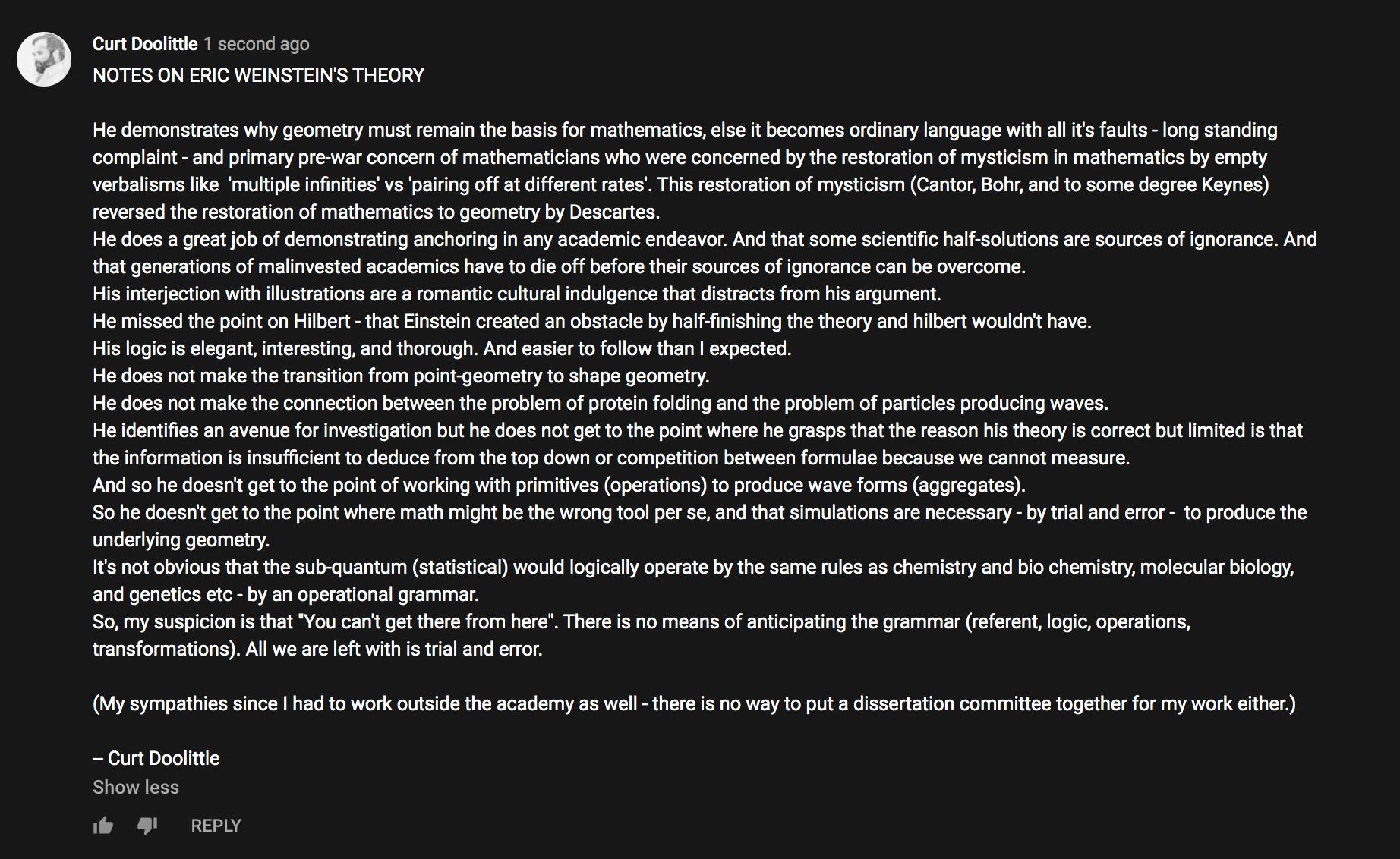
    photos_and_videos/TimelinePhotos_kg5QueHwVw/92587113_247850863279741_3273847742023073792_o_247850856613075.jpg NOTES ON ERIC WEINSTEIN’S THEORY

    He demonstrates why geometry must remain the basis for mathematics, else it becomes ordinary language with all it’s faults – long standing complaint – and primary pre-war concern of mathematicians who were concerned by the restoration of mysticism in mathematics by empty verbalisms like ‘multiple infinities’ vs ‘pairing off at different rates’. This restoration of mysticism (Cantor, Bohr, and to some degree Keynes) reversed the restoration of mathematics to geometry by Descartes.

    He does a great job of demonstrating anchoring in any academic endeavor. And that some scientific half-solutions are sources of ignorance. And that generations of malinvested academics have to die off before their sources of ignorance can be overcome.

    His interjection with illustrations are a romantic cultural indulgence that distracts from his argument.

    He missed the point on Hilbert – that Einstein created an obstacle by half-finishing the theory and hilbert wouldn’t have.

    His logic is elegant, interesting, and thorough. And easier to follow than I expected.

    He does not make the transition from point-geometry to shape geometry.

    He does not make the connection between the problem of protein folding and the problem of particles producing waves.

    He identifies an avenue for investigation but he does not get to the point where he grasps that the reason his theory is correct but limited is that the information is insufficient to deduce from the top down or competition between formulae because we cannot measure.

    And so he doesn’t get to the point of working with primitives (operations) to produce wave forms (aggregates).

    So he doesn’t get to the point where math might be the wrong tool per se, and that simulations are necessary – by trial and error – to produce the underlying geometry.

    It’s not obvious that the sub-quantum (statistical) would logically operate by the same rules as chemistry and bio chemistry, molecular biology, and genetics etc – by an operational grammar.

    So, my suspicion is that “You can’t get there from here”. There is no means of anticipating the grammar (referent, logic, operations, transformations). All we are left with is trial and error.

    (My sympathies since I had to work outside the academy as well – there is no way to put a dissertation committee together for my work either.)

    — Curt DoolittleNOTES ON ERIC WEINSTEIN’S THEORY

    He demonstrates why geometry must remain the basis for mathematics, else it becomes ordinary language with all it’s faults – long standing complaint – and primary pre-war concern of mathematicians who were concerned by the restoration of mysticism in mathematics by empty verbalisms like ‘multiple infinities’ vs ‘pairing off at different rates’. This restoration of mysticism (Cantor, Bohr, and to some degree Keynes) reversed the restoration of mathematics to geometry by Descartes.

    He does a great job of demonstrating anchoring in any academic endeavor. And that some scientific half-solutions are sources of ignorance. And that generations of malinvested academics have to die off before their sources of ignorance can be overcome.

    His interjection with illustrations are a romantic cultural indulgence that distracts from his argument.

    He missed the point on Hilbert – that Einstein created an obstacle by half-finishing the theory and hilbert wouldn’t have.

    His logic is elegant, interesting, and thorough. And easier to follow than I expected.

    He does not make the transition from point-geometry to shape geometry.

    He does not make the connection between the problem of protein folding and the problem of particles producing waves.

    He identifies an avenue for investigation but he does not get to the point where he grasps that the reason his theory is correct but limited is that the information is insufficient to deduce from the top down or competition between formulae because we cannot measure.

    And so he doesn’t get to the point of working with primitives (operations) to produce wave forms (aggregates).

    So he doesn’t get to the point where math might be the wrong tool per se, and that simulations are necessary – by trial and error – to produce the underlying geometry.

    It’s not obvious that the sub-quantum (statistical) would logically operate by the same rules as chemistry and bio chemistry, molecular biology, and genetics etc – by an operational grammar.

    So, my suspicion is that “You can’t get there from here”. There is no means of anticipating the grammar (referent, logic, operations, transformations). All we are left with is trial and error.

    (My sympathies since I had to work outside the academy as well – there is no way to put a dissertation committee together for my work either.)

    — Curt Doolittle


    Source date (UTC): 2020-04-03 10:44:00 UTC

  • THE THREE DEGREES OF AGREEMENT: THINK, TRUST, FEEL – AND THE VIRTUES, VICES, AND

    THE THREE DEGREES OF AGREEMENT: THINK, TRUST, FEEL – AND THE VIRTUES, VICES, AND COMMANDMENTS

    Autists need to think it, normies need to trust it, and empaths need to feel it. We all satisfy our need for understanding differently.

    All that matters is the physical law of the universe, the necessary law of evolution and transcendence, the natural law of man, the extension of natural law to the love of man, the debt we owe to nature and our ancestors. After that we need enough knowledge and skill to serve one another. and enough courage to defend one another.

    Whether you understand it, trust it, or feel it doesn’t matter.

    It’s not complicated.

    For children: “do not unto others as they would not have done unto them. do only unto others as you would have them do unto you.”

    For women, neither are the four agreements difficult:

    Agreement 1: Be Impeccable With Your Word

    Agreement 2: Don’t Take Anything Personally

    Agreement 3: Don’t Make Assumptions

    Agreement 4: Always Do Your Best

    For women, the christian virtues

    chastity

    temperance

    charity

    diligence

    patience

    kindness

    humility

    For Men, the Virtues are not difficult.

    The term “virtue” itself is derived from the Latin “virtus” (the personification of which was the deity Virtus), and had connotations of “manliness”, “honour”, worthiness of deferential respect, and civic duty as both citizen and soldier.

    The Four Greek Virtues

    Wisdom (vs cunning)

    Courage (vs victimhood)

    Moderation (epicureanism vs hedonism or asceticism)

    Justice (vs compassion)

    Doolittle’s Necessities

    Every man a craftsman (so he is not a scoundrel), a soldier (so he does his duty to his people), a warrior (so he is not a coward), Sheriff (so he defends the commons), judge (so he metes justice when he must), legislature (so he chooses his own path), and sovereign (so he takes responsibility for his actions).

    Aristotle’s Ethics

    As Aristotle says in the Nicomachean Ethics:

    “The golden mean between the extremes,

    at the right times (when),

    about the right things (what),

    towards the right people (who),

    for the right end (why),

    and in the right way (how).”

    THE VIA NEGATIVA

    THEVICES

    Pride

    Envy

    Gluttony

    Lust

    Wrath

    Greed

    Sloth

    THE CRIMES

    TEN COMMANDMENTS IN P-LAW TERMS

    (In response to James Dmitro Makienko and John Mark.)

    1 – God/Nature has given us the many laws of nature, the one natural law of man: reciprocity, and the one choice: transcendence into gods ourselves by those laws, or the end of our existence for failing.

    2 – You shall not use reciprocity falsely, or criticize reciprocity, and spread irreciprocity – this is to criticize god, god’s law, and doom mankind to failure of transcendence.

    4 – You must return your parent’s investment in you with reciprocity of obedience, respect, and care.

    5 – You shalt not commit murder – reciprocity of life cannot be restored, reciprocity of revenge cannot be unmade, and reciprocity in trust forever lost.

    6 – You shalt not commit adultery – reciprocity of the marriage promise cannot be restored.

    7 – You shalt not steal – reciprocity of goods may be restored, but reciprocity of trust cannot be restored.

    8 – You shalt not lie – reciprocity of deceit may be restored, reciprocity of harm may not be, and reciprocity of trust cannot be restored.

    9 – You shalt not contemplate lust of another’s wife or husband – lest in anger, weakness or folly you violate the reciprocity of a marriage.

    10 – You shalt not contemplate lust of another’s property, lest in anger, weakness or folly you violate the reciprocity of property.

    3 – One day a week you shall spend contemplating your reciprocity irreciprocity, to past, present and future kin and kith, and seek means of restitution.


    Source date (UTC): 2020-04-01 15:00:00 UTC

  • SUMMARY OF JFG/DOOLITTLE ON THE MOLYNEUX DEBATE That was fun. I always enjoy JF.

    SUMMARY OF JFG/DOOLITTLE ON THE MOLYNEUX DEBATE

    That was fun. I always enjoy JF. The public isn’t used to seeing how philosophy, law, science and math are done between practitioners – tediously precisely. I realize this kind of thing is difficult for the audience. And JF has to keep the audience engaged. Between my long expositions and jf’s audience representation it required a little cat herding on my part. That said, I think we got there.

    SUMMARY:

    (a) we are born with a distribution of moral preferences (Demand for treatment from others, and resistance to demands from other)s,

    (b) we exercise our moral preferences in a market competition for cooperation wherein we discover cooperation (sexual, social, economic, political, military) with people that satisfy our moral preferences,

    (c) groups of people increase in a division of labor and as they do so converge on moral norms (requirements for cooperation) that allow them to cooperatively succeed in their geographic, demographic, economic, institutional, and military conditions – and some of these they institute as laws (punishments for violations)

    (d) across human groups we converge on the same underlying rule within each of those different markets (e) that rule is reciprocity that preserves cooperation and prevents retaliation, within the limits of proportionality that cause members to defect.

    (e) but moral rules are only useful in creating and preserving cooperation and the outsized returns on cooperation,

    (f) and cooperation must be more beneficial than parasitism(free riding, black markets, rent seeking, corruption etc), and predation (conquest).

    (g) all human organizations of all kinds seek the minimum morality, maximum free riding, rent seeking, and corruption until there is insufficient free capital to incentivize adjustment to shocks, and the civilization collapses

    (h) so there is no moral rule outside of the utility of cooperation because ‘moral’ can only mean ‘within the limits of reciprocity and proportionality among those of us cooperating’. There is no morality in war.

    (i) the only universal moral rule is reciprocity – do not impose costs, including risks, directly or indirectly upon the demonstrated interests of others in your group.

    (j) there are no possible via positiva universal moral statements. Anything that is not immoral (reciprocal) is moral. People who claim otherwise are engaging in an act of fraud by claiming their preference must be paid for by others irreciprocally. They claim debts or injustice when there is none.

    CLOSING

    As such, JF was correct at the personal level in that all individuals demonstrate variation in moral demand of others;;

    And SM was half right at the socio-political level, and half right at the universal level, but stated the via positiva preference for a good instead of via negativa prohibition on the bad.

    In this sense both parties, adopting ideal types, rather than the use of series, talked past each other.

    P-law makes use of disambiguation through “operationalism, competition, and serialization’, and relies on the logic of incentives, supply and demand.

    We convert psychological , social, legal and political concepts into economic terms to take advantage of the minimization of error that results, at the expense of more reasoning and less intuiting.

    -Cheers


    Source date (UTC): 2020-04-01 14:57:00 UTC

  • ARTIFICIAL INTELLIGENCE: “YOU CAN’T GET THERE FROM HERE” —“We can’t approach a

    ARTIFICIAL INTELLIGENCE: “YOU CAN’T GET THERE FROM HERE”

    —“We can’t approach anything like intelligence with artificial neural networks … not in their current form.”— Hawkins

    —“All the trickly things we have done over the past seventy years hasn’t mattered – we’ve just taken advantage of moore’s law … it’s all short term gains.”— Rich Sutton (“Bitter Lesson”)

    —“If we scale up the current technology it won’t make any difference.”—

    —“You can’t mathematically model anything as complex as the brain, only mathematically explain why the biology does what it does, but it can’t be analyzed completely… it’s out of the realm of possibility. (we can build )”–

    —“Sparse Representations”–

    The neural networks of excitatory and inhibitory neurons, and preparatory dendrites, compete over time to ‘announce’ a winner that’s passed forward for integration into the current hierarchy of models. Very hard to fool, very robust networks.

    —“Machine learning… the next step has to be orthogonal to what we’re doing, because we’re at its limit.”—

    —“and ANN needs a lot of data. The human brain doesn’t. It’s extremely efficient.”—

    WHY I MOVED ON FROM AI

    This is why I stopped working on AI in the 80’s. Intelligence requires completely different computer architectures. It’s interesting that I got so close with the “before(state) during(change) after(state)” data structure: sequences; and with a hierarchy of geometric representations. But at <5mhz and 64k, even working in assembly language, I could already tell that it couldn’t be done with existing computers. We would need to invert the entire architecture to millions of tiny cores with local durable memory, at low power. If I had instead written and published a paper at the time rather than ‘moving on’ I would have bragging rights today. lol.

    If we had followed turing’s advice and made logical computers rather than numerical, we would be closer. but our emphasis on mathematics (the math trap again!!!) pushed engineering of computers in the wrong direction.


    Source date (UTC): 2020-04-01 14:56:00 UTC

  • REASON FOR CHRISTIAN AGITATION Over the past few years I have worked very hard o

    REASON FOR CHRISTIAN AGITATION

    Over the past few years I have worked very hard on comparative religion, and have come to understand why we desire it and how it fulfills those desires by a spectrum of means from the rational to the emotional.

    I was trying to solve a number of problems:

    1. The means by which judaism, christianity, and islam are taught and argued are the same means by which marxism, socialism, postmodernism, feminism, and the denial of the nature of mankind are taught and argued. So I was searching for a legal means to prevent the use of this method of teaching and arguing while preserving the good of christianity. This resulted in the same answer Thomas Jefferson came to when he compiled The Jefferson Bible. This Jefferson bible presents us with a Jesus who is ‘pure’ and free of dogma. And I discovered that while this is possible it is not tolerable. And because it is not tolerable it is impossible.

    I care only about the generations of our european religions. Including prehistoric natural, ancient heroic, and medieval Christian. And I care about preserving all three generations of them because of one of our unspoken secrets: european tripartism and trifunctionalism. When christians use this method of teaching and arguing against me or my work it makes me very angry – because I understand that this method is the means by which our civilization has been destroyed by the postwar jewish movement against western civlization. And I this threat is very real, very serious, and we are almost lost.

    So between my investigation into how to eliminate the abrahamic method of teaching and arguing, and between my frustration with the frequent use of this method by christians who were agitated by my investigation, I created a great deal of friction between the faithful, philosophical, and empirical Christians.

    2. I want to outlaw false religions that seek to destroy christianity, our philosophy, our science, our law, our civilization and our people. In particular, neigher Judaism nor Islam are religions – they are means of warfare from within masquerading as a religion. Early Christianity was likewise a means of warfare from within – we merley managed to ‘civilize it’ over the centuries after it was introduced to europe.

    3. I want to restore the religion to its political competition to the state, and restore its responsibility for birth, age of maturity, marriage, family and – at least – early education, and death. The state has proven too fashionable and religion’s value is in defense against the fashions and folly of the age.

    These three challenges are the reason for the conflict we have created between those of us who practice *empirical christianity* in the natural law, and those that practice spiritual and theological christianity.

    I advocate that we speak faith in matters of faith – the spirit, and law in matters of law – the material. And that if we attempt to cross those lines we must engage in deceit. And deceit is neither moral under the natural law, or moral under christian ethics.

    So we must continue our prehistoric practice of Tripartism and Trifunctionalism, which is the continuous balance of power between the Military, Law, and Faith.

    And in short, deliver unto God and Caesar each as his due.

    There is no place for theology in court.

    There is no place for court in faith.


    Source date (UTC): 2020-04-01 14:54:00 UTC

  • MY WORK ON CHRISTIANITY I work under the principle that the laws of nature, the

    MY WORK ON CHRISTIANITY

    I work under the principle that the laws of nature, the natural law of man, and the evolutionary necessity of the law of transcendence are the same whether we state them in Theological, Philosophical, and Scientific language. So whether you intuit, think, and speak in the Christian, Deist, or Naturalist language, and whether you choose to adhere to physical laws, the natural law of man, and the necessity of evolutionary laws out of faith, reason, or science, is irrelevant to the individual or to the polity, or to mankind unless you selfishly demand the rest of the world conform to your way of thinking, speaking. On the other hand, if you do not live in accordance with the physical, natural, and evolutionary then you work against yourself, your polity, your people, and mankind – and when you do so, you work against the Christian God, the deist god, or the condition of our people past present and future.

    In my work, to defend against the enemies of physical, natural, and evolutionary laws, I must put these laws in a constitution in the language of the law, and science is the language of the law. Because we need people to think across the spectrum of intuitive, rational, and empirical thought so that we can solve intuitive, rational, and empirical questions, for intuitive, rational, and empirical minds. And we cannot demand people intuit, think, and speak in exclusively intuitive, rational, or empirical language. All we can do is demand that people behave according to physical, natural, and evolutionary laws. We cannot force people to have faith, reason, or the burden of the sciences, nor to abandon faith, reason, and the utility of the sciences. We can only write the law such that those who ACT contrary to the laws of nature, of man, and of evolutionary transcendence, can be prosecuted by the law, in the language of the law, if they transgress. Because the law consists only of the means of resolving disputes over action – not of intuition, feeling, or thought.


    Source date (UTC): 2020-04-01 14:54:00 UTC

  • THE DIFFICULT IDEA TO GET ACROSS (important) When I say “the big problem is swit

    THE DIFFICULT IDEA TO GET ACROSS

    (important)

    When I say “the big problem is switching people from idealism (homogenous bias) under which each person seeks whatever bias fits his, to realism (heterogeneous bias) that is aware of the market competition. In other words, monopoly is endemic in western moral thinking bcause we’ve been homogenous since our beginnings. So we have no means of defense against the LIE of the value of diversity.

    This is yet another example of the f—king stupidity of libertarian tropes (sophistry).

    If you build high trust high value commons, then diversity increases transaction costs that all ancestors worked to reduce. So the reason we seek SOME diversity is to increase novelty because we seek to hyper-consume cheap novelty (consumption that destroys commons) rather than expensive novelty (innovation, continued capitalization of commons).

    I don’t know how to explain this more simply. I would appreciate anyone who could.

    Leftists spend down inheritance to feed herd instinct for numbers.


    Source date (UTC): 2020-04-01 14:52:00 UTC

  • WHAT IS THE ROLE OF BUSINESS AND INDUSTRY IN SOCIETY? (probably very important)

    WHAT IS THE ROLE OF BUSINESS AND INDUSTRY IN SOCIETY?

    (probably very important)

    —“Also do you have any writings you could point me to on your views on big business’ role in society? Namely, I do see cultural marxism and other factors at play throughout university and entertainment, but the pressures from big biz for cheap labor, for mass immigration of more customers etc. as the primary driving force behind our replacement. Does a mixed economy with strong tariffs and other incentives prevent this from happening in the future?”—

    BUSINESS(INDUSTRY):

    1. The production of goods, services and information.

    2. The normalization of middle class behavior (everyone is a potential customer)

    3. The production of the possibility of the self organizing – civil- society.

    Business increases customer base, dependencies and alliances until everyone in the society is a customer, dependency, and alliance

    BIG BUSINESS(INDUSTRY)

    1. The role of big business in society is to provide a durable sustainable revenue stream upon which to base the political revenue necessary for the incremental suppression of parasitism that makes possible the extension of trust and opportunity down into smaller and smaller producers, which in turn produces the middle class ethic which is the source of high trust – that is initiated by the militia.

    (important)

    2. Big businesses are difficult to compete with because they can ‘socialize’ costs of obtaining and holding customer relationships over time. So this ‘stability’ must be thought of as the economic equivalent of the military – defense of the economic territory. So just as the military creates a defensive wall against military conquest, big business creates a defensive wall against economic conquest.

    (Important!)

    3. Obviously big business can afford to pay for research and development. This is a minor role. Because big business cannot compete with the government for basic research. The government performs basic research industry applied research. And Small and Medium Business applies the results of basic research to niche (smaller) markets.

    4 (Limits) The problem evident throughout all of history is that the middle class (Business and industry) has no more incentive to limit it’s consumption of economic opportunity than the citizenry has incentive to limit it’s consumption of human and institutional capital. So this is the important insight of fascism and nationalism: that profit at national expense is a theft of capital: privatization of commons or socialization of losses.

    5. The same applies for the government. The state and finance sectors (and now the academic sector) will happily destroy the genetic human cultural institutional and civilizational capital through immigration and expansion. So this is the limit of all markets, and why free markets are always a fraud: either you are increasing domestic capital or not. If you are not then you are consuming it. And if you are consuming it then you are an uncontrolled growth: a cancer. Whether you are private or public or individual.

    (important!)

    THE ORGANIZATION OF SOCIETY

    Defense (Military, Law)

    … Commons (politics, economics, law)

    … … Production (trade, business, industry, science)

    … … … Consumption (reproduction child care, education, home)

    … … … … Luxury Consumption (celebration, sports, entertainment, signal goods and services)

    … … … … … Destruction (dysgenia, immigration, conversion, crime, drugs, falsehood)

    That’s the net of it.

    -Curt Doolittle


    Source date (UTC): 2020-04-01 13:19:00 UTC

  • HOW ABOUT CHECKS AND BALANCES AT THE TOP?? First, there is very little federal g

    HOW ABOUT CHECKS AND BALANCES AT THE TOP??

    First, there is very little federal government left. It consists almost exclusively of the military and treasury plus the insurer function of the treasury. The states are more like european states except that they share a military. (a) Monarchs are superior to presidents and prime ministers, prime ministers are superior to presidents, hired CEO’s are superior to prime ministers. Competing contractors are superior to bureaucracies. So Governors > Senate > Executives (Professional Cabinet) > Bureaucracies (Minimum) > Firms (maximum) (b) The checks and balances rely more on court (suits) against individuals and groups than on votes. After courts, then approval of federal appropriations. Appropriations are not pooled so they are more like payment plans. So there is no discretionary use of these fees. After that we have votes for our governors. Our governors (and governments) appoint senators. The only significant improvement would be an hereditary monarchy to overrule if something gets out of hand (think the present queen of England with more likely exercise of power.) The french really ruined government. The english had it right. Our experiment didn’t work as well as our enumerated rights in the constitution. So the P-constitutional amendments further enumerate rights and shift from the french vision of government back to the British. (classes).


    Source date (UTC): 2020-03-31 22:40:00 UTC