There is a difference between european people (a race), european culture (a tradition), european civilization (a strategy), and the institutional TECHNOLOGY in science, language, myth, literature, philosophy, law, institutions. Any people can copy them if they are able – it appears no one else is able. And this is the ONLY remaining european technological advantage: genetics and civilization. And this remaining advantage is what the enemy seeks to destroy as they did Greece, Rome, and the continent.
photos_and_videos/TimelinePhotos_dJ9jhts2Ng/84391809_566699850593576_5036898427955314688_n_566699843926910.jpg SNP’S (SNIPS) THE ‘BITS’ OF THE GENOME
(basic genetic terms)
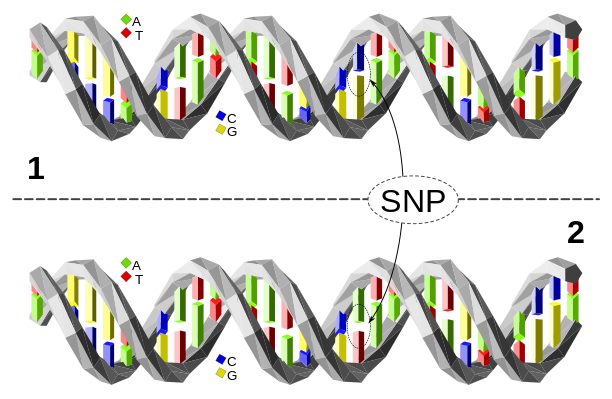
A single-nucleotide polymorphism (SNP, or ‘snip’) is a substitution of a single nucleotide that occurs at a specific position in the genome, where each variation is present at a level of more than 1% in the population
More than 335 million SNPs have been found across humans from multiple populations. A typical genome differs from the reference human genome at 4 to 5 million sites, most of which (more than 99.9%) consist of SNPs and short indels
Single-nucleotide polymorphisms may fall within coding sequences of genes, non-coding regions of genes, or in the intergenic regions (regions between genes). SNPs within a coding sequence do not necessarily change the amino acid sequence of the protein that is produced, due to degeneracy of the genetic code.
The genomic distribution of SNPs is not homogenous; SNPs occur in non-coding regions more frequently than in coding regions or, in general, where natural selection is acting and “fixing” the allele (eliminating other variants) of the SNP that constitutes the most favorable genetic adaptation.
A large part of DNA (more than 98% for humans) is non-coding, meaning that these sections do not serve as patterns for protein sequences.
SNPs in the coding region are of two types: synonymous and nonsynonymous SNPs. Synonymous SNPs do not affect the protein sequence, while nonsynonymous SNPs change the amino acid sequence of protein.
SNPs that are not in protein-coding regions may still affect gene splicing, transcription factor binding, messenger RNA degradation, or the sequence of noncoding RNA.SNP’S (SNIPS) THE ‘BITS’ OF THE GENOME
(basic genetic terms)
A single-nucleotide polymorphism (SNP, or ‘snip’) is a substitution of a single nucleotide that occurs at a specific position in the genome, where each variation is present at a level of more than 1% in the population
More than 335 million SNPs have been found across humans from multiple populations. A typical genome differs from the reference human genome at 4 to 5 million sites, most of which (more than 99.9%) consist of SNPs and short indels
Single-nucleotide polymorphisms may fall within coding sequences of genes, non-coding regions of genes, or in the intergenic regions (regions between genes). SNPs within a coding sequence do not necessarily change the amino acid sequence of the protein that is produced, due to degeneracy of the genetic code.
The genomic distribution of SNPs is not homogenous; SNPs occur in non-coding regions more frequently than in coding regions or, in general, where natural selection is acting and “fixing” the allele (eliminating other variants) of the SNP that constitutes the most favorable genetic adaptation.
A large part of DNA (more than 98% for humans) is non-coding, meaning that these sections do not serve as patterns for protein sequences.
SNPs in the coding region are of two types: synonymous and nonsynonymous SNPs. Synonymous SNPs do not affect the protein sequence, while nonsynonymous SNPs change the amino acid sequence of protein.
SNPs that are not in protein-coding regions may still affect gene splicing, transcription factor binding, messenger RNA degradation, or the sequence of noncoding RNA.
…The tendency of people to see their projects and themselves as more singular than they actually are.
False consensus effect
… The tendency for people to overestimate the degree to which others agree with them
Bandwagon effect
… The tendency to do (or believe) things because many other people do (or believe) the same. Related to groupthink and herd behavior
Empathy gap
… The tendency to underestimate the influence or strength of feelings, in either oneself or others
Groupthink
… Where the desire for harmony or conformity in the group results in an irrational or dysfunctional decision-making outcome.
Shared information bias
… The tendency for group members to spend more time and energy discussing information that all members are already familiar with (i.e., shared information), and less time and energy discussing information that only some members are aware of (i.e., unshared information).
Illusion of asymmetric insight
…People perceive their knowledge of their peers to surpass their peers’ knowledge of them
Illusion of transparency
… People overestimate others’ ability to know themselves, and they also overestimate their ability to know others.
Dunning–Kruger effect
… The tendency for unskilled individuals to overestimate their own ability and the tendency for experts to underestimate their own ability
Curse of knowledge
… When better-informed people find it extremely difficult to think about problems from the perspective of lesser-informed people
Illusory superiority
… Overestimating one’s desirable qualities, and underestimating undesirable qualities, relative to other people. (Also known as “better-than-average effect”, or “superiority bias”.)
Naïve realism
… The belief that we see reality objectively and without bias; that the facts are plain for all to see; that rational people will agree with us; and that those who don’t are either uninformed, lazy, irrational, or biased.
Just-world hypothesis
… The tendency for people to want to believe that the world is fundamentally just, causing them to rationalize an otherwise inexplicable injustice as deserved by the victim(s).
Ambiguity effect
… The tendency to avoid options for which the probability of a favorable outcome is unknown
Anchoring
…. The tendency to rely too heavily, or “anchor”, on one trait or piece of information when making decisions (usually the first piece of information acquired on that subject)
Doubling Down
… Or Backfire effect. The reaction to disconfirming evidence by strengthening one’s previous beliefs.
FYI: Mandatory Conformist is a via positiva and that’s wrong. Instead, the via-negativa term is Zero Tolerance for Defection. In other words, you can do whatever you want as long is it’s not resistance, defection, or treason against the polity. (We have rule of law – they don’t)
This is the value of a Fascist State (Where fascist means Ethnonationalist, Authoritarian, State Capitalist, Mandatory Conformist.) And people prefer it.
China demonstrated that Fascism won the 20th. Heterogeneous Immigration demonstrated that Democracy lost the 20th.
#newright https://twitter.com/Tobeech/status/1223886335729115137
This is the value of a Fascist State (Where fascist means Ethnonationalist, Authoritarian, State Capitalist, Mandatory Conformist.) And people prefer it.
China demonstrated that Fascism won the 20th. Heterogeneous Immigration demonstrated that Democracy lost the 20th.
#newright https://t.co/XXx0xcA254
—“Seems like” insinuates an association (bad or good, but usually bad) without putting forth any capital or reliable information to back your claim. The classic “I don’t really know, but I think I know, ya know?”–Zack Passmore
(It’s an attempt to undermine without warrantying your words.)
Yes P = Propertarianism, and we use P-Method, P-Logic, P-Testimony or Testimonialism, P-Ethics or Propertarian ethics, P-Law or Natural Law of Reciprocity, Disambiguation by Serialization and Operationalism, ePrime, The Copula. Operational Language and Vocabulary. Inflationary and deflationary Grammars. Fictionalisms. Deceits. Abrahamic method of deceit. The Grammars, Ternary Logic, Compatibilism, The Coercive Technologies, Three Classes of Elites, Falsification, Decidability, Truth as Demand for decidability., Warranty of Due Diligence, Reciprocity, Imposition of costs, Demonstrated Interest. Property In Toto. And we repeat the properties of Reciprocity, Testimony, property in to, the sequence of deceits, the sequences of crimes, and the abrahamic method pretty much constantly, and we describe human behavior in these terms using the language of economics.
It seems overwhelming. If we get it into ‘propertarianism for dummies’ I’m not sure it will be. But it’s been harder than we thought.