Form: Definition

  • photos_and_videos/TimelinePhotos_kg5QueHwVw/85046746_206469310751230_44654820159

    photos_and_videos/TimelinePhotos_kg5QueHwVw/85046746_206469310751230_44654820159

    photos_and_videos/TimelinePhotos_kg5QueHwVw/85046746_206469310751230_4465482015956795392_o_206469307417897.jpg CATEGORIES OF RELIGION

    By: Luke Weinhagen, via Brandon Hayes

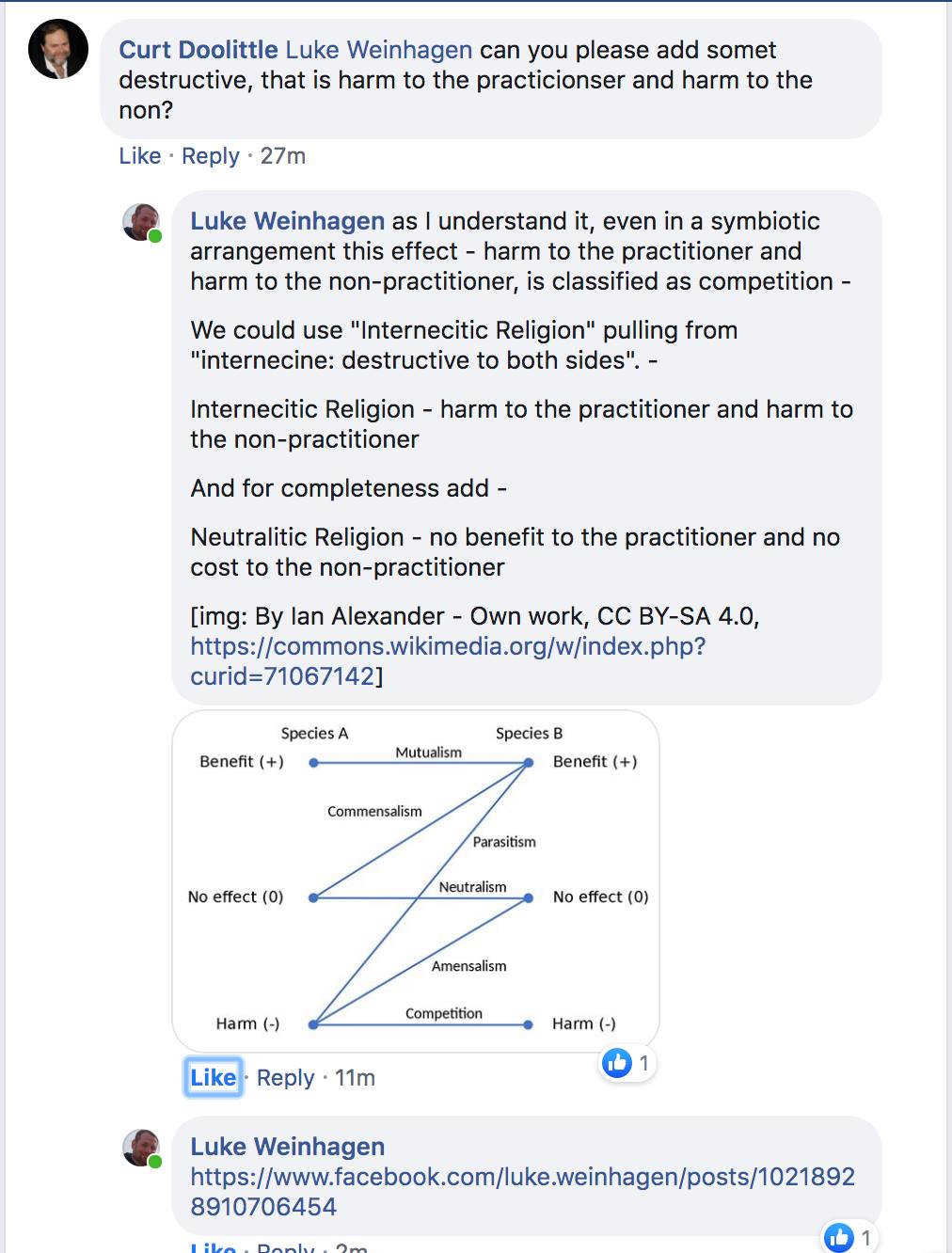
    (Core) (expanded) (added “Internecitic Religion”)

    Examining the effects of belief systems from the frame of symbiosis –

    Mutualitic Religion – benefit to practitioners and benefit to non-practitioners

    Commensalitic Religion – benefit to practitioners with no cost to non-practitioner

    Neutralitic Religion – no benefit to the practitioner and no cost to the non-practitioner

    Amensalitic Religion – no benefit to the practitioner and harm to the non-practitioner

    Parasitic Religion – benefit to the practitioner and harm to the non-practitioner

    Internecitic Religion – harm to the practitioner and harm to the non-practitionerCATEGORIES OF RELIGION

    By: Luke Weinhagen, via Brandon Hayes

    (Core) (expanded) (added “Internecitic Religion”)

    Examining the effects of belief systems from the frame of symbiosis –

    Mutualitic Religion – benefit to practitioners and benefit to non-practitioners

    Commensalitic Religion – benefit to practitioners with no cost to non-practitioner

    Neutralitic Religion – no benefit to the practitioner and no cost to the non-practitioner

    Amensalitic Religion – no benefit to the practitioner and harm to the non-practitioner

    Parasitic Religion – benefit to the practitioner and harm to the non-practitioner

    Internecitic Religion – harm to the practitioner and harm to the non-practitioner


    Source date (UTC): 2020-02-13 11:55:00 UTC

  • To equate sentience (feeling of changes in state), and awareness (of change inst

    To equate sentience (feeling of changes in state), and awareness (of change instate of environment) and semi-consiousness (prediction of future states and possible reactions), consciousness (prediction of future permutations of state), to transformations of state is a leap.


    Source date (UTC): 2020-02-12 19:38:56 UTC

    Original post: https://twitter.com/i/web/status/1227678491539365890

    Reply addressees: @robinhanson

    Replying to: https://twitter.com/i/web/status/1227678025543757826


    IN REPLY TO:

    Unknown author

    @robinhanson So if the point is to clarify that the brain is just a collection of similar cells in various forms of organization, and that for all intents and purposes our brain is an outgrowth of our consciousness (modeling of our body and movement in space) yes.

    Original post: https://x.com/i/web/status/1227678025543757826

  • DEFINE: DETERMINISM All events, including human action, are ultimately determine

    DEFINE: DETERMINISM

    All events, including human action, are ultimately determined by causes external to human thought (will). We categorize this limitation as constraining causality to realism (the universe exists) and naturalism (causes are independent of human thought and human thought has no influence on causality except through action). Some philosophers have taken determinism to imply that individual human beings have no free will and cannot be held morally responsible for their actions.

    In science, determinism means that the universe demonstrates regularity and therefore we can identify general rules (laws of nature).

    I don’t pay much attention to philosophy – it’s mostly nonsense. If you can’t say it in testimony: math, logic, science, economics or law then it’s probably nonsense.

    And yeah. The vocabulary, grammar, and logic of economics includes psychology, sociology, politics, and group strategy.


    Source date (UTC): 2020-02-11 07:49:00 UTC

  • THE STATE The state is the only de-facto sovereign (organization) in competition

    THE STATE

    The state is the only de-facto sovereign (organization) in competition with other polities for territory, resources, trade routes, built capital, and population.

    The state maintains that sovereignty as an insurer of last resort, maintaining a monopoly of violence in its capacity of insurer of last resort. It obtains income to pay for its function as an insurer of last resort, through fees sufficient to provide insurance against all competitors.

    The state adds value by suppression of all competitors to it’s fees, using the judicial system – thereby freeing the population from many high friction transaction costs in exchange for one low friction transaction cost (taxes). This is why states are always wealthier than non states – economic velocity.

    The government produces commons in addition to the states in order to generate the returns from commons – organizing the production of non-consumables prohibiting privatization by consumption ‘abusus’, but by allowing “usus” (use), creating ‘fructus’ (fruits).

    The production of commons increases population, trade, and therefore revenues that can be distributed between the production of common when times are fair(good), and functioning as insurer of last resort when times are dear (hard).

    Since the cost of both sovereignty and commons is only determined by market competition, then we have no say about the construction of state, military, judiciary, government, and institutions. We have only say in how competitive we desire to be and the relative conditions we live under.

    To produce a relatively anarchic polity would require only the production of sufficient military capability to deny all competitors, and retaining population and production necessary to pay for it, with the commons necessary to retain that population.

    In other words you don’t get to choose very much if you want to survive as a polity.

    The only means of minimizing a government long term is to do what I’ve recommended, which is exhaustive application of the law of reciprocity limiting allr ents, and then a payment (tax) system that was as closests to operating a business as possible. And that would require, exactly what I’ve proposed.


    Source date (UTC): 2020-02-09 13:32:00 UTC

  • A LITTLE CONTEXT FOR WHEN I USE “MONARCHY” Rule of Law Monarchy (Strictly Constr

    A LITTLE CONTEXT FOR WHEN I USE “MONARCHY”

    Rule of Law Monarchy (Strictly Constructed Natural Law)

    Constitutional Monarchy (Traditional Articulated Rights law)

    Christian Monarch (Church Sanctioned Customary Law)

    King ( Private Property Traditional Customary European Law )

    Imperial Tzar (Military Arbitrary Ruler – Post Mongol Russia )

    Imperial Caesar (Military Arbitrary Ruler – Pagan Europe)

    State Dictator – (Military Arbitrary Ruler)


    Source date (UTC): 2020-02-07 12:10:00 UTC

  • IDEAL,Unaccountable: True/Is true …or… Is true? –vs– REAL. Accountable: I

    IDEAL,Unaccountable: True/Is true …or… Is true?

    –vs–

    REAL. Accountable: I promise I can say …or… Can I say?

    3 = 9/3 is true ……. Unaccountable

    I Promise 3 = 9/3 …. Accountable


    Source date (UTC): 2020-02-06 12:56:00 UTC

  • Yes, only reciprocal and truthful speech is free under natural law. And since tr

    Yes, only reciprocal and truthful speech is free under natural law. And since truthfulness is merely a property of reciprocity, it’s only included for clarity. P makes it possible to tell if someone is speaking truthfully (testifiably). So if it’s not irreciprocal it’s open.


    Source date (UTC): 2020-02-05 03:31:18 UTC

    Original post: https://twitter.com/i/web/status/1224898263112933377

    Reply addressees: @QuestionMThings

    Replying to: https://twitter.com/i/web/status/1224896600436301824


    IN REPLY TO:

    Original post on X

    Original tweet unavailable — we could not load the text of the post this reply is addressing on X. That usually means the tweet was deleted, the account is protected, or X does not expose it to the account used for archiving. The Original post link below may still open if you view it in X while signed in.

    Original post: https://twitter.com/i/web/status/1224896600436301824

  • DO LAWS EXPIRE UNDER P? QUICK DEFINITIONS: LAW – rules in a given political orde

    DO LAWS EXPIRE UNDER P?

    QUICK DEFINITIONS:

    LAW – rules in a given political order

    NATURAL LAW – Reciprocity

    COMMAND – Rule by Degree

    LEGISLATION – A rule by decree of a legislative body

    REGULATION – Rule for enforcing legislation

    CONTRACT OF THE COMMONS – A contract between representatives on behalf of the people having force of law.

    FINDING OF LAW – record of decision made by a court for future reference.

    BODY OF LAW – the sum of all of the above.

    CONTRACT – an agreement under law insured by a court.

    A constitution describes process and procedure for the production of commons.

    All contracts must state dependencies, fulfillment criteria, an expiration date, termination clauses, means of restitution, and responsible parties.

    Under P-Law we may only make contracts of the commons, and findings of law.

    Regulations are processed as changes to the terms of the contract of the commons.

    As such all contracts of the commons expire.

    As such we should expect regular renewal of those contracts whose value remains in place – and regular termination of contracts of the commons and regulations that no longer apply – and a chain of terminated contracts of the commons and regulations that are dependent upon those terminated contracts of the commons.


    Source date (UTC): 2020-02-04 23:06:00 UTC

  • DEFINE CAUCASIAN (FROM QUORA) Caucasian is like many terms – as they evolve, we

    DEFINE CAUCASIAN (FROM QUORA)

    Caucasian is like many terms – as they evolve, we attribute different definitions to them. The term Caucasian was used in the census and was synonymous with white european christian. This evolved into the conventional term for european peoples: latin, germanic, slavic, finnic.

    Man is a self-domesticated animal. Domestication is achieved by neoteny and suppression of underclass (genetic load) reproduction by sexual selection and environmental selection.

    The primary difference between races (or subspecies depending upon your tolerance for the truth), is that we vary largely by the degree of neoteny (suppression of maturity) vs increase in rate and depth of matureity, and in adaptation to local climates and more importantly – disease gradients.

    There are many others including rates of identical twins, variations in cranial size, minor skull and muscle difference, large differences in body scent, variations in the distribution of spatial verbal abilities, succeptibility to certain diseases, and mental illnesses.

    However, almost all the meaningful(consequential) differences are variations in one trait: neoteny (domestication) – with east asians the least sexually developed, caucasians in the middle, and then Africans the most and fastest sexually developed. Almost all group differences in social cultural, and political order are caused by this variation. The other significant dimension is the size of our genetic loads (lower and underclasses).

    There is little difference in our global elites across the races. But our conflicts come from proximity to one another given the vastly different sizes of our workingl, lower, and underclasses. For example, when we compare IQ differences between races and subraces, we are comparing differences in the size of the classes. In warm climates genetic load survives, and sexual maturity and rates of reproduction increase – and in cold climates where people live indoors in close quarters for many months of the year, and must organize to maintain animals and food over winters, sexual and natural selection reduce the lower classes rapidly.

    So given our differences in the rate and depth of sexual maturity, and the difference in the size of our underclasses, this creates groups that display different behavior, and conflict over what acceptable behavior is, and conflict over the commons and institutions we desire.

    There are three or four surviving races (subspecies): West Eurasian, African, and Asian – and the fourth is the austronesian remainder of early african migrations.

    West eurasians include everyone who isn’t african, (iranic-dravidian), east asian, or austronesian.

    Genetically, morphologically/phenotypically, civilizationally, culturally we separate the west eurasian people into post-glacial proto-peoples: the southern branch of north african, semitic (marsh arab, afro-asiatic), the eastern branch: turkic, and the indo-european branch: european, iranic, anatolian (lost), and the iranic branch integrated (lost) in admixture in india.

    We use ‘Caucasian’ as a synonym for europeans from spain to the urals, an south to the caucuses mountains.

    However, in practice we use it as synonymous for european christendom, and ‘white’ synonymous with european christendom -excluding the people of the caucuses.

    Since the greeks, southern italians, and Sardianins are remnants of the anatolian migration we include them as europeans and caucasians.


    Source date (UTC): 2020-02-04 22:18:00 UTC
  • TENDENCY FOR PEOPLE TO GENETICALLY ASSOCIATE Feb 3, 2020, 8:33 PM

    https://en.wikipedia.org/wiki/HomophilyTHE TENDENCY FOR PEOPLE TO GENETICALLY ASSOCIATE

    https://en.wikipedia.org/wiki/HomophilyUpdated Feb 3, 2020, 8:33 PM


    Source date (UTC): 2020-02-03 20:33:00 UTC