Doolittle’s Comments On Silver’s Quotes from his Book:
1. The story data tells us is often the one we’d like to hear, and we usually make sure it has a happy ending.
3. There are entire disciplines in which predictions have been failing, often at a great cost to society.
4. Some stone-age strengths have become information-age weaknesses.
5. We can never make perfectly objective predictions. They will always be tainted by our subjective point of view.
(CD: They will always be tainted by our wants for the world rather than untainted by a description of the world. we live in paradigms of utility.)
6. A belief in the objective truth -and a commitment to pursuing it- is the first prerequisite of making better predictions.
(CD: very few of us seek truth. We all seek utility not truth. For some of us truth and utility are identical. for others it forces them into competition with darwin – and truth is the enemy of false genes as much as false ideas.)
7. Prediction is important because it connects subjective and objective reality.
(CD: prediction is important because it falsifies many subjective realities training us to predict objective realities.)
8. We are undoubtedly living with many delusions that we do not even realize.
(CD: psychology must be the study of cognitive error, bias, wishful thinking and deceit – and the sciences efforts at compensating for them.)
9. We must become more comfortable with probability and uncertainty.
10. We must think more carefully about the assumptions and beliefs that we bring to a problem.
11. A certain amount of immersion in a topic will provide disproportionally more insight that an executive summary.
12. The signal is the truth. The noise is what distracts us from the truth.
13. Precise forecasts masquerade as accurate ones.
14. If you have reason to think that yesterday’s forecast was wrong, there is no glory in sticking to it.
15. New ideas are sometimes found in the most granular details of a problem where few others bother to look.
16. Extrapolation is a very basic method of prediction -usually, much too basic.
(CD: One must never extrapolate a trend – everything in nature equilibrates.)
17. In many cases involving predictions about human activity, the very act of prediction can alter the way that people behave.
18. The most effective flu prediction might be the one that fails to come to fruition because it motivates people toward more healthful choices.
19. While simplicity can be a virtue for a model, a model should at least be sophisticatedly simple.
(CD: the quality of a prediction is dependent upon the quality and quantity of information, not the complexity of the model.)
20. We can never achieve perfect objectivity, rationality, or accuracy in our beliefs. Instead, we can strive to be less subjective, less irrational, and less wrong.
(CD: we have spent, because of theology, far too much of our history in via-positiva justification, and are still escaping it. Instead we must focus on via positiva reduction of ignorance, error, bias, wishful thinking, and deceit.)
21. Recently, […] some well-respected statisticians have begun to argue that frequentist statistics should no longer be taught to undergraduates. […] In fact, if what you read what’s been written in the past ten years, it’s hard to find anything that doesn’t advocate a Bayesian approach.
(CD: Bayseian accounting is superior to mathematical averages. when stated in this manner the difference in quality of prediction is rather obvious.)
22. There is strong empirical evidence that there is a benefit in aggregating different forecasts.
(CD: competition between theories produces information not only about one theory but about the minds of man making those theories.)
21. This is another of those Information-age risks: we share so much information that our independence is reduced. (CD: information that is not true (parsimonious)
22. Perhaps the central finding of behavioral economics is that most of us are overconfident when we make predictions.
(CD: we evolved overconfidence because action for gain is necessary. We confuse the necessity of action for gain with applying it beyond its evolutionary purpose.)
23. In science, progress is possible. In fact, if one believes in Bayes’ theorem, scientific progress is inevitable as predictions are made and as beliefs are tested and refined.
(CD: Whether mathematical Bayes or Philosophical Popper, or Cognitive science’s lesson that our brains operate by massively parallel similarly bayesian means, learning through trial and error no matter how error prone, will produce either progress in knowledge or failure to survive.)
24. The March toward scientific progress is not always straightforward, and some well-regarded (even “consensus”) theories are later proved wrong- but either way science tends to move toward the truth.
(CD: The difference between the fundamental sciences and entrepreneurship, and daily action is that fundamental science is a luxury good, the findings of which may propagate through the polity over time – but daily action in life has no such luxury of time and cost – we must produce returns. This conflict illustrates the problem of our evolutionary demand for action influencing our overconfidence in science, and conversely, our science ignoring time and cost. )
25. Under Bayes’ theorem, no theory is perfect. Rather, it is a work in progress, always subject to further refinement and testing.
(CD: I knew bayes first, Godel second, hayek third, popper fourt, and kuhn fifth. Bayes provides accounting on one end, then popper, then kuhn, and then hayek on the other end. Only during the past twenty years have we understood the brain’s mixture of elementary composition and spatial attribution. Same process, different scales. It’s not just bayesian – it’s the only possible epistemological method and everything else is a legacy failure we call ‘justificationism’.)
EMPTY CRITICISMS TO OBSCURE UNSATISFIED DEMAND I NEVER SET OUT TO SUPPLY
—“I think Curt is working with an oversimplified, inaccurate theory of language, which leads to many liberal problems (Propertarianism as merely an intensification of liberalism), but I’ve always enjoyed some of his encyclopedic observations (because those are all necessarily written scientifically anyways, so there can be some compatibility).”—Imperius
I am not working on an oversimplified and inaccurate theory of language, I am working on disambiguating language into causal axis (which I have done – as far as I know it’s complete). You are, as many right-wing-postmoderists are, correctly stating that language can via positiva be used to construct paradigms by narrative expression that are useful for various purposes in pseudoscientific, rational(continental sophomoric), literary (analogistic), mythological(heroic analogistic), supernatural prose.
But that’ isn’t my objective (which you know). My objective is to write law that is decidable regardless of the USEFUL paradigms employed, by anyone whenever they are in CONFLICT. So the answer is, yes, P is so far flawless for purpose intended: decidability in matters of conflict. And since you and yours seek secular theology, the christians and muslims supernatural theology, and those like me seek scientific(Testimonial) decidability. So I’m writing a constitution serving all in the only language commensurable across all. I am not (as you wish I would) create a literary, philosophical, or theological religion dependent upon appeal to empathy(emotion) or sympathy(intuition), only reason.
P provides no via positiva for any of the empathic, intuitionistic, or sympathetic market demands. It however does provide via negativa for juridical, political, and military, demands. So the best anyone can do (that I know of) is precisely what we have seen: rebel against science and reason without offering an alternative solution other than return to christian theology – which is impossible for all but those evolved to demand it.
You want a continental secular theology, or perhaps occult theology, or perhaps supernatural theology that appeals to empathy and intuition. And if you want something like abrahamic religions or buddhism that is intentionally designed to circumvent criticism by science and reason, then go ahead and try to create one. But criticizing P while not producing an alternative, is simply unearned attention seeking on one hand and critique without competing alternative on the other. P is actionable. When I see some other centrist, libertarian, or conservative put out a work product that is other than pretense of knowledge and pretense of solution we can talk. Until then, there is no other new game in town.
You’re missing the point that only the west could invent science (testimony) because only the west practiced the combination of militia, truth, reciprocity, heroism, excellence, markets, and aristocracy (meritocracy).
Now that we have given the world our science and technology and law and finance like we gave the world empiricism, like we gave the world logic and reason and roman law, like we gave the world horse, bronze, and wheel, and like the old world gave us writing, bronze, and agriculture. And like we gave the world eugenics. Now, we will see how the chinese do vs the europeans.
If the british choose to restore the british empire rather than fall to the french conquest of europe, and the russian re-conquest of eastern europe, then china will have a competitor.
But this presumes we will not have a revolution on the scale of the past, or the scale of the chinese, and reverse the primitivization of western civilization by the second abrahamic conquest and the defection of our women.
Did you see what I did there?
You can have the technological products of our people, but you can’t have our ‘technology’ because it’s genetic and cultural. We only have to preserve tthat technology to win.
IT’S ALL RECIPROCITY … EXTENSION OF PHYSICAL LAWS TO HUMAN DISPLAY WORD AND DEED
While the principle innovation of P is Testimonialism, truthful testimony is merely reciprocity in speech. Agency is only possible under reciprocity. Trust is only possible under Reciprocity. Eugenia is only possible under Reciprocity. The foundation of P, the Natural Law of Reciprocity – is of course, just reciprocity: limiting one’s display word and deed to the productive, fully informed, warrantied, voluntary transfers of demonstrated interests, free of imposition of costs upon the demonstrated interests of others by externality.
So while the physical world is dependent upon entropy and it’s consequences in the laws of thermodynamics, life requires reciprocity across generations; and humans have memory and the ability to predict futures using it, and to act to seize opportunities from those predictions.
But while cooperation is disproportionately productive (advantageous), and while we can trade debts, resulting in reciprocity over time, we can also consistently generate debts and live parasitically off others – until they retaliate (which they always do).
Reciprocity breaks down through disintermediation that limits the ability to test whether the sum of debts and repayments result in a balance (reciprocity). And this is what the state has achieved in all walks of life under pursuit of equality. But the result has been reversal of the universalization of middle class manners ethics and morals, and the reversal of underclass eugenics.
Humans can, through life, defeat entropy, and through productivity, continue to defeat it, despite our increasingly costly brains; but reverse that existence through the continuous production of debt (parasitism) rather than reciprocity (mutually beneficial production), and continuous eugenics.
The presumption of ignorance and error is a polite manifestation of western ethics of discourse, but it is not however evidenced in history. We err far less than we deceive, and the vast majority of thought is but elaborate deception to perpetuate one fraud, another, or many.
@MattPirkowski Hmm… I had to work on the eradication of deceit, and came to the opposite conclusion: that conceptual development is discernibly either reciprocal or irreciprocal(fraud), and thus the judgement is possible and necessary: one dark age of ignorance and deceit is enough.
@MattPirkowski Hmm… I had to work on the eradication of deceit, and came to the opposite conclusion: that conceptual development is discernibly either reciprocal or irreciprocal(fraud), and thus the judgement is possible and necessary: one dark age of ignorance and deceit is enough.
Paradigmatic convergence to parsimony is demonstrable. We call it testimony. Which is what the sciences seek to replicate (operational language) – and the platonists seek circumvent. They must preserve pretense of knowledge – if only for self image. 😉 Which such prose exposes.
@curtdoolittle Perhaps they mix what you perceive as colloquial and technical, but I have no reason to assume that we prima facie share those categorical boundaries.
(or incredible liars. Jury is in on the aristotelians(scientific). Jury is deliberating on the platonists (literary), and a conviction is likely. Why? pretty good evidence more harm than good.)
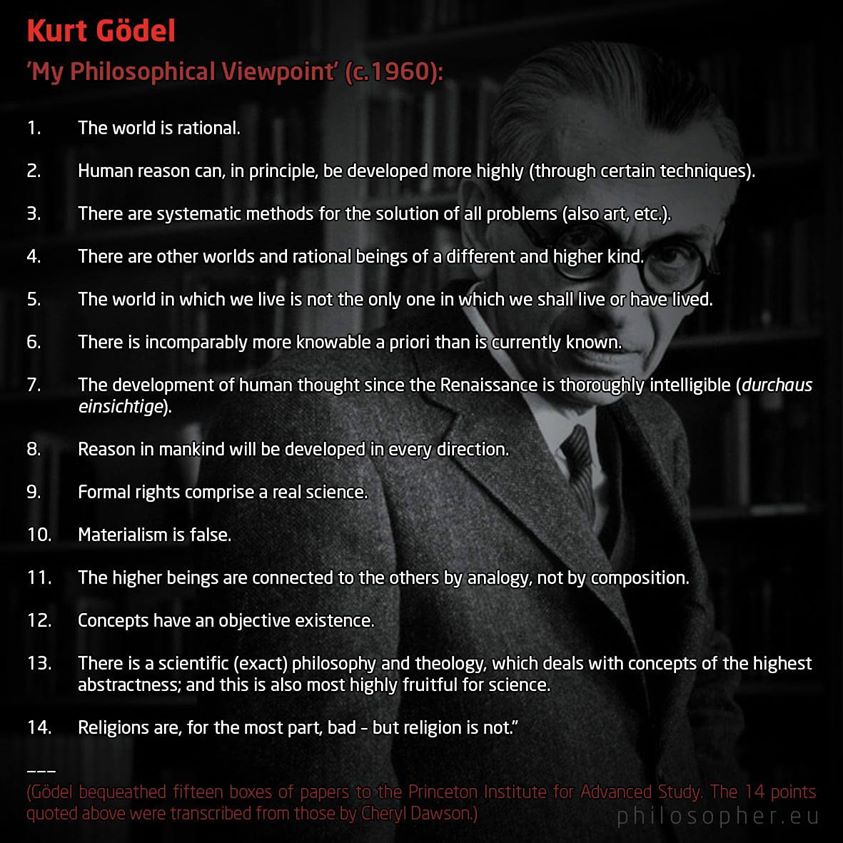
photos_and_videos/TimelinePhotos_dJ9jhts2Ng/72688499_485728855357343_7095469642973446144_o_485728848690677.jpg CONTRAST GOEDEL WITH P – REQUEST FROM KASH V.
(Godel is a Platonist, I’m an operationalist)
1. Man acts rationally, and by rationally amorally. But given the disproportionate value of cooperation, and the disproportionate risk of retaliation, it’s just in his interest to act morally much more often than immorally.
1a. We can incrementally reduce observations of the universe, using our senses, reason, and instrumentation to descriptions of invariant constant relations (paradigms)
1b + 3. We can describe (explain) all of experience as constant relations (a single paradigm)
2. While our ability to reason is constant, every increase convergence of our instruments and paradigms increases the explanatory power available to our reason.
4. The capacity to reason is a deterministic product of entropy at convenient temperatures in convenient conditions, for sufficient periods of time. It is likely that given the vastness of the universe, other creatures have evolved reason, and that while the logic of constant relations will exist, and mathematics as a logic of constant positional relations will exist in some form, that the composition of experience that results from different body structures will result in different techniques for employing reason. (think octopi). And that the ability of these creatures may vastly outperform ours.
5. Because we are able to use our powers of prediction using free association to construct a model of the world we exist in, and the worlds we might exist in, and the worlds we cannot exist in, we can experience, many candidate worlds.
5b. The set of demands we evolved and express daily is largely invariant. The set of paradigms we use to imagine opportunities for fulfilling those demands evolves (and devolves) constantly. So while we largely increase the coherence of paradigms, and approach a single paradigm for describing the universe, we have experienced the world differently in the past than in the present, and will so again experience it differently in the future.
6. If we can construct an operational grammar and paradigm for a given set of constant relations, we can produce an operational logic of that set of constant relations, and conduct experiments logically by trial and error as we do in mathematics. To do so we require convergence of paradigms to the point of marginal indifference of those logical constructions. But the Analytic program failed, and Godel and Frege et all were wrong – closure does not exist.
7. Yes the development of thought since Aristotle expanded on Democritus, has been consistent and rational with the exception of the semitic abrahamic dark ages of supernatural ignorance.
8. Reason is reason is reasoning and there is nothing to it. There are however endless permutations of reason especially as knowledge increases.
9. The via-negativa of Natural Law can be restated in the via-positiva as Natural rights, and this logic and empirical combination produces a science of cooperation, and law the institutional enforcement of cooperation under that law, and economics the measure of it’s success, and economics the language of analysis and measurement within that science.
10.The material(noun) and the Operational(verb) are true (exist, and are testifiable). The platonic (ideal) is false. All sets of constant relations are identified, retained, applied, reinforced, and revised by merging physical stimuli with physical organization of information in the brain, producing a hierarchy of changes in state over time we call ‘experience’. So while it is correct to say that the universe is deterministic (composed of constant relations), it is only correct to say that we can observe sets of constant relations, identify them (category), compare them, name them, and predict future states of of them, and in relation to them. These memories and predications like running consist of physical potential, that produce results in time. In other words, al of reality is constructed physically, from a hierarchy of changes in state over time we call experience.
12. Concepts do not exist. the potential for Concepts exists. Running only exists when one is running. We have the potential to run. We have the potential to identify sets of constant relations (concepts), but experience of contexts only exist when we are acting to recall them in time.
13. It appears we can know the most parsimonious paradigm, and host of parsimonious sub-paradigms of increasing complexity (permutations) allowing us to speak the truth using evidence – science; that we can know the same for choices using arguments – philosophy; and we can know the same for collective organization using stories – theology.
14. Existing religions are bad to terrible to suicidal – but human psychological, social, political, and strategic demand for the products of ‘religion’ (order) are endless. So we need to educate one another in mindfulness, ethics(interpersonal), morality (extrapersonal), political, and strategic (competitive), by means gracefully increasing and decreasing in accessibility: parable, story, history, reason and general rules, science and outcomes.CONTRAST GOEDEL WITH P – REQUEST FROM KASH V.
(Godel is a Platonist, I’m an operationalist)
1. Man acts rationally, and by rationally amorally. But given the disproportionate value of cooperation, and the disproportionate risk of retaliation, it’s just in his interest to act morally much more often than immorally.
1a. We can incrementally reduce observations of the universe, using our senses, reason, and instrumentation to descriptions of invariant constant relations (paradigms)
1b + 3. We can describe (explain) all of experience as constant relations (a single paradigm)
2. While our ability to reason is constant, every increase convergence of our instruments and paradigms increases the explanatory power available to our reason.
4. The capacity to reason is a deterministic product of entropy at convenient temperatures in convenient conditions, for sufficient periods of time. It is likely that given the vastness of the universe, other creatures have evolved reason, and that while the logic of constant relations will exist, and mathematics as a logic of constant positional relations will exist in some form, that the composition of experience that results from different body structures will result in different techniques for employing reason. (think octopi). And that the ability of these creatures may vastly outperform ours.
5. Because we are able to use our powers of prediction using free association to construct a model of the world we exist in, and the worlds we might exist in, and the worlds we cannot exist in, we can experience, many candidate worlds.
5b. The set of demands we evolved and express daily is largely invariant. The set of paradigms we use to imagine opportunities for fulfilling those demands evolves (and devolves) constantly. So while we largely increase the coherence of paradigms, and approach a single paradigm for describing the universe, we have experienced the world differently in the past than in the present, and will so again experience it differently in the future.
6. If we can construct an operational grammar and paradigm for a given set of constant relations, we can produce an operational logic of that set of constant relations, and conduct experiments logically by trial and error as we do in mathematics. To do so we require convergence of paradigms to the point of marginal indifference of those logical constructions. But the Analytic program failed, and Godel and Frege et all were wrong – closure does not exist.
7. Yes the development of thought since Aristotle expanded on Democritus, has been consistent and rational with the exception of the semitic abrahamic dark ages of supernatural ignorance.
8. Reason is reason is reasoning and there is nothing to it. There are however endless permutations of reason especially as knowledge increases.
9. The via-negativa of Natural Law can be restated in the via-positiva as Natural rights, and this logic and empirical combination produces a science of cooperation, and law the institutional enforcement of cooperation under that law, and economics the measure of it’s success, and economics the language of analysis and measurement within that science.
10.The material(noun) and the Operational(verb) are true (exist, and are testifiable). The platonic (ideal) is false. All sets of constant relations are identified, retained, applied, reinforced, and revised by merging physical stimuli with physical organization of information in the brain, producing a hierarchy of changes in state over time we call ‘experience’. So while it is correct to say that the universe is deterministic (composed of constant relations), it is only correct to say that we can observe sets of constant relations, identify them (category), compare them, name them, and predict future states of of them, and in relation to them. These memories and predications like running consist of physical potential, that produce results in time. In other words, al of reality is constructed physically, from a hierarchy of changes in state over time we call experience.
12. Concepts do not exist. the potential for Concepts exists. Running only exists when one is running. We have the potential to run. We have the potential to identify sets of constant relations (concepts), but experience of contexts only exist when we are acting to recall them in time.
13. It appears we can know the most parsimonious paradigm, and host of parsimonious sub-paradigms of increasing complexity (permutations) allowing us to speak the truth using evidence – science; that we can know the same for choices using arguments – philosophy; and we can know the same for collective organization using stories – theology.
14. Existing religions are bad to terrible to suicidal – but human psychological, social, political, and strategic demand for the products of ‘religion’ (order) are endless. So we need to educate one another in mindfulness, ethics(interpersonal), morality (extrapersonal), political, and strategic (competitive), by means gracefully increasing and decreasing in accessibility: parable, story, history, reason and general rules, science and outcomes.
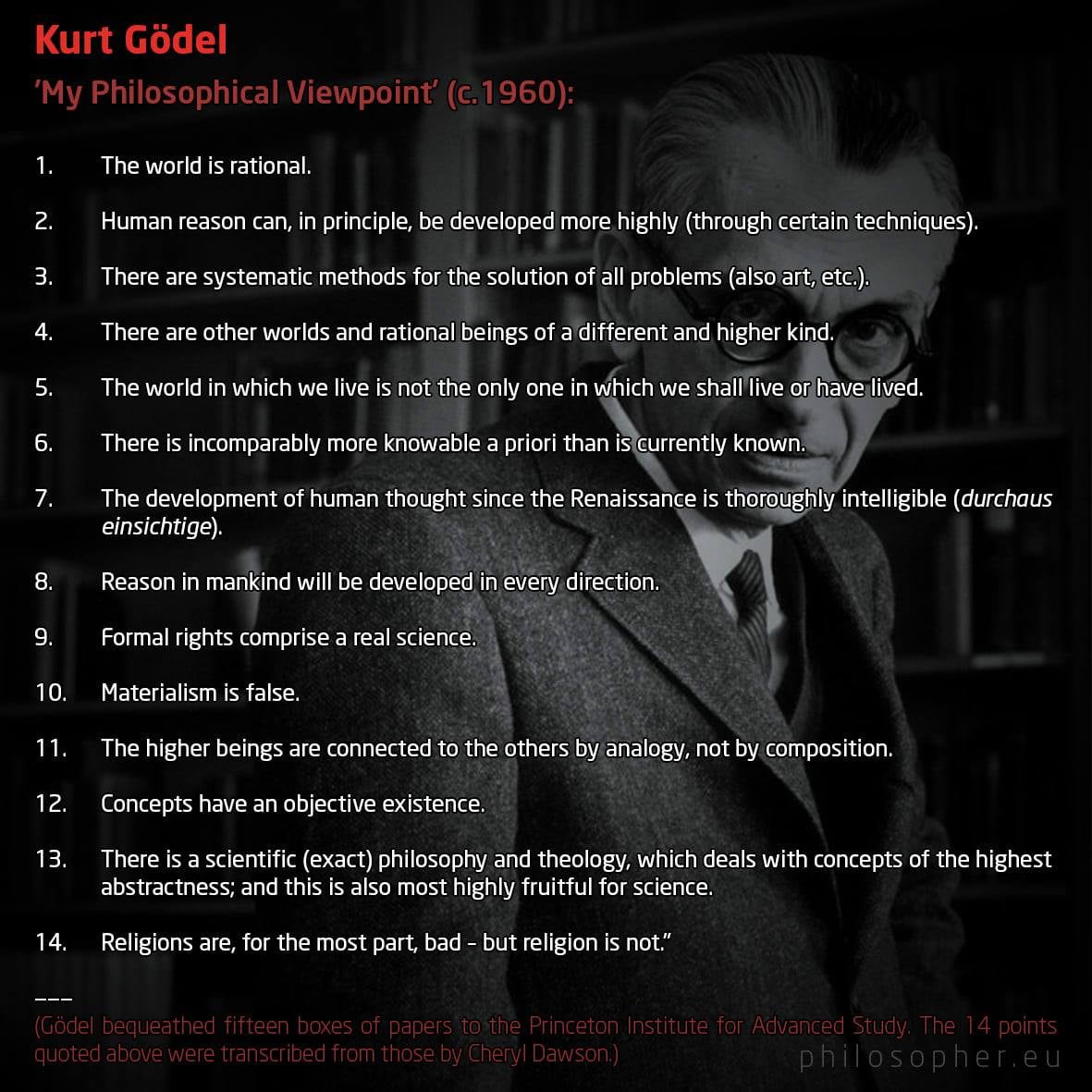
photos_and_videos/TimelinePhotos_kg5QueHwVw/72355004_137347730996722_5914367204375134208_o_137347727663389.jpg CONTRAST WITH P – REQUEST FROM KASH VIKAS
(Godel is a Platonist and I’m an Operationalist. This contrast is rather helpful in illustrating the operational vs platonist vs empirical.)
1. Man acts rationally, and by rationally amorally. But given the disproportionate value of cooperation, and the disproportionate risk of retaliation, it’s just in his interest to act morally much more often than immorally.
1a. We can incrementally reduce observations of the universe, using our senses, reason, and instrumentation to descriptions of invariant constant relations (paradigms)
1b + 3. We can describe (explain) all of experience as constant relations (a single paradigm)
2. While our ability to reason is constant, every increase convergence of our instruments and paradigms increases the explanatory power available to our reason.
4. The capacity to reason is a deterministic product of entropy at convenient temperatures in convenient conditions, for sufficient periods of time. It is likely that given the vastness of the universe, other creatures have evolved reason, and that while the logic of constant relations will exist, and mathematics as a logic of constant positional relations will exist in some form, that the composition of experience that results from different body structures will result in different techniques for employing reason. (think octopi). And that the ability of these creatures may vastly outperform ours.
5. Because we are able to use our powers of prediction using free association to construct a model of the world we exist in, and the worlds we might exist in, and the worlds we cannot exist in, we can experience, many candidate worlds.
5b. The set of demands we evolved and express daily is largely invariant. The set of paradigms we use to imagine opportunities for fulfilling those demands evolves (and devolves) constantly. So while we largely increase the coherence of paradigms, and approach a single paradigm for describing the universe, we have experienced the world differently in the past than in the present, and will so again experience it differently in the future.
6. If we can construct an operational grammar and paradigm for a given set of constant relations, we can produce an operational logic of that set of constant relations, and conduct experiments logically by trial and error as we do in mathematics. To do so we require convergence of paradigms to the point of marginal indifference of those logical constructions. But the Analytic program failed, and Godel and Frege et all were wrong – closure does not exist.
7. Yes the development of thought since Aristotle expanded on Democritus, has been consistent and rational with the exception of the semitic abrahamic dark ages of supernatural ignorance.
8. Reason is reason is reasoning and there is nothing to it. There are however endless permutations of reason especially as knowledge increases.
9. The via-negativa of Natural Law can be restated in the via-positiva as Natural rights, and this logic and empirical combination produces a science of cooperation, and law the institutional enforcement of cooperation under that law, and economics the measure of it’s success, and economics the language of analysis and measurement within that science.
10.The material(noun) and the Operational(verb) are true (exist, and are testifiable). The platonic (ideal) is false. All sets of constant relations are identified, retained, applied, reinforced, and revised by merging physical stimuli with physical organization of information in the brain, producing a hierarchy of changes in state over time we call ‘experience’. So while it is correct to say that the universe is deterministic (composed of constant relations), it is only correct to say that we can observe sets of constant relations, identify them (category), compare them, name them, and predict future states of of them, and in relation to them. These memories and predications like running consist of physical potential, that produce results in time. In other words, al of reality is constructed physically, from a hierarchy of changes in state over time we call experience.
12. Concepts do not exist. the potential for Concepts exists. Running only exists when one is running. We have the potential to run. We have the potential to identify sets of constant relations (concepts), but experience of contexts only exist when we are acting to recall them in time.
13. It appears we can know the most parsimonious paradigm, and host of parsimonious sub-paradigms of increasing complexity (permutations) allowing us to speak the truth using evidence – science; that we can know the same for choices using arguments – philosophy; and we can know the same for collective organization using stories – theology.
14. Existing religions are bad to terrible to suicidal – but human psychological, social, political, and strategic demand for the products of ‘religion’ (order) are endless. So we need to educate one another in mindfulness, ethics(interpersonal), morality (extrapersonal), political, and strategic (competitive), by means gracefully increasing and decreasing in accessibility: parable, story, history, reason and general rules, science and outcomes.CONTRAST WITH P – REQUEST FROM KASH VIKAS
(Godel is a Platonist and I’m an Operationalist. This contrast is rather helpful in illustrating the operational vs platonist vs empirical.)
1. Man acts rationally, and by rationally amorally. But given the disproportionate value of cooperation, and the disproportionate risk of retaliation, it’s just in his interest to act morally much more often than immorally.
1a. We can incrementally reduce observations of the universe, using our senses, reason, and instrumentation to descriptions of invariant constant relations (paradigms)
1b + 3. We can describe (explain) all of experience as constant relations (a single paradigm)
2. While our ability to reason is constant, every increase convergence of our instruments and paradigms increases the explanatory power available to our reason.
4. The capacity to reason is a deterministic product of entropy at convenient temperatures in convenient conditions, for sufficient periods of time. It is likely that given the vastness of the universe, other creatures have evolved reason, and that while the logic of constant relations will exist, and mathematics as a logic of constant positional relations will exist in some form, that the composition of experience that results from different body structures will result in different techniques for employing reason. (think octopi). And that the ability of these creatures may vastly outperform ours.
5. Because we are able to use our powers of prediction using free association to construct a model of the world we exist in, and the worlds we might exist in, and the worlds we cannot exist in, we can experience, many candidate worlds.
5b. The set of demands we evolved and express daily is largely invariant. The set of paradigms we use to imagine opportunities for fulfilling those demands evolves (and devolves) constantly. So while we largely increase the coherence of paradigms, and approach a single paradigm for describing the universe, we have experienced the world differently in the past than in the present, and will so again experience it differently in the future.
6. If we can construct an operational grammar and paradigm for a given set of constant relations, we can produce an operational logic of that set of constant relations, and conduct experiments logically by trial and error as we do in mathematics. To do so we require convergence of paradigms to the point of marginal indifference of those logical constructions. But the Analytic program failed, and Godel and Frege et all were wrong – closure does not exist.
7. Yes the development of thought since Aristotle expanded on Democritus, has been consistent and rational with the exception of the semitic abrahamic dark ages of supernatural ignorance.
8. Reason is reason is reasoning and there is nothing to it. There are however endless permutations of reason especially as knowledge increases.
9. The via-negativa of Natural Law can be restated in the via-positiva as Natural rights, and this logic and empirical combination produces a science of cooperation, and law the institutional enforcement of cooperation under that law, and economics the measure of it’s success, and economics the language of analysis and measurement within that science.
10.The material(noun) and the Operational(verb) are true (exist, and are testifiable). The platonic (ideal) is false. All sets of constant relations are identified, retained, applied, reinforced, and revised by merging physical stimuli with physical organization of information in the brain, producing a hierarchy of changes in state over time we call ‘experience’. So while it is correct to say that the universe is deterministic (composed of constant relations), it is only correct to say that we can observe sets of constant relations, identify them (category), compare them, name them, and predict future states of of them, and in relation to them. These memories and predications like running consist of physical potential, that produce results in time. In other words, al of reality is constructed physically, from a hierarchy of changes in state over time we call experience.
12. Concepts do not exist. the potential for Concepts exists. Running only exists when one is running. We have the potential to run. We have the potential to identify sets of constant relations (concepts), but experience of contexts only exist when we are acting to recall them in time.
13. It appears we can know the most parsimonious paradigm, and host of parsimonious sub-paradigms of increasing complexity (permutations) allowing us to speak the truth using evidence – science; that we can know the same for choices using arguments – philosophy; and we can know the same for collective organization using stories – theology.
14. Existing religions are bad to terrible to suicidal – but human psychological, social, political, and strategic demand for the products of ‘religion’ (order) are endless. So we need to educate one another in mindfulness, ethics(interpersonal), morality (extrapersonal), political, and strategic (competitive), by means gracefully increasing and decreasing in accessibility: parable, story, history, reason and general rules, science and outcomes.