Oct 15, 2019, 2:15 PM
—“I can believe in natural law in itself because I see evidence of it all around me. That’s what I attribute all the beauty of creation to.”—Martin Štěpán via Alain Dwight
Oct 15, 2019, 2:15 PM
—“I can believe in natural law in itself because I see evidence of it all around me. That’s what I attribute all the beauty of creation to.”—Martin Štěpán via Alain Dwight
Oct 15, 2019, 2:15 PM
—“I can believe in natural law in itself because I see evidence of it all around me. That’s what I attribute all the beauty of creation to.”—Martin Štěpán via Alain Dwight
Oct 15, 2019, 2:22 PM Jonathan Haidt on his book The Coddling of the American Mind standard.co.uk https://standard.co.uk/lifestyle/books/jonathan-haidt-the-coddling-of-the-american-mind-a4261081.html? SCALE AND THE STORE OF TRUST by Luke Weinhagen ( CD: I’m Sharing because of this bit of genius:
—“The system can not scale beyond its ability to generate and store trust and begins to fail immediately when the extraction of stored trust exceeds the production of trust. That store can act as a buffer during a period of backsliding (and can enable a lot of really destructive behavior in the guise of “tolerance”), but it will not save us.”— Luke Weinhagen
) === COMPLETE POST ===
—-“We came out of a century that had some of the worst horrors in history but which made extraordinary progress on almost every conceivable front in the decades afterwards, and now we’re backsliding.” — Jon Haidt
Putting this in the context I’ve been building over the last couple weeks, the “progress” Haidt is describing (from my perspective) are the mechanisms we developed to foster the development of trust that became possible through the shared exposure to those horrors. I agree with both Haidt and Doolittle in that the outcome of this backsliding in inevitable should it continue. The lesson will impose itself. Whether we learn from it, kindly or not, is another matter. Looking at Curt’s response in the same context I’ve been using –
“…conspicuous consumption of compromises between genes, gender, class, and interests” = extraction of trust. “…cooperative necessity in social orders…” = mechanisms for the production of trust
The system can not scale beyond its ability to generate and store trust and begins to fail immediately when the extraction of stored trust exceeds the production of trust. That store can act as a buffer during a period of backsliding (and can enable a lot of really destructive behavior in the guise of “tolerance”), but it will not save us. “Domestication” is the process of transcendence from each of the lower foundational rules of human interaction to the next higher form of interaction/expansion of the capacity to store trust. THE FOUNDATIONS 1. Via Positiva: ……. The Golden Rule. 2. Via Negativa: ….. The Silver Rule. 3. Via Logica: ……….The Natural Law of Reciprocity. 4. Via Existentia: …. Rule of Law, ………………………….. … The Jury, and ………………………….. … Markets in everything. 5. Via Violentia: …. The Iron Rule. Might Makes Right. Both of these texts are worth a read when you get a chance. – Luke Weinhagen
Oct 15, 2019, 2:22 PM Jonathan Haidt on his book The Coddling of the American Mind standard.co.uk https://standard.co.uk/lifestyle/books/jonathan-haidt-the-coddling-of-the-american-mind-a4261081.html? SCALE AND THE STORE OF TRUST by Luke Weinhagen ( CD: I’m Sharing because of this bit of genius:
—“The system can not scale beyond its ability to generate and store trust and begins to fail immediately when the extraction of stored trust exceeds the production of trust. That store can act as a buffer during a period of backsliding (and can enable a lot of really destructive behavior in the guise of “tolerance”), but it will not save us.”— Luke Weinhagen
) === COMPLETE POST ===
—-“We came out of a century that had some of the worst horrors in history but which made extraordinary progress on almost every conceivable front in the decades afterwards, and now we’re backsliding.” — Jon Haidt
Putting this in the context I’ve been building over the last couple weeks, the “progress” Haidt is describing (from my perspective) are the mechanisms we developed to foster the development of trust that became possible through the shared exposure to those horrors. I agree with both Haidt and Doolittle in that the outcome of this backsliding in inevitable should it continue. The lesson will impose itself. Whether we learn from it, kindly or not, is another matter. Looking at Curt’s response in the same context I’ve been using –
“…conspicuous consumption of compromises between genes, gender, class, and interests” = extraction of trust. “…cooperative necessity in social orders…” = mechanisms for the production of trust
The system can not scale beyond its ability to generate and store trust and begins to fail immediately when the extraction of stored trust exceeds the production of trust. That store can act as a buffer during a period of backsliding (and can enable a lot of really destructive behavior in the guise of “tolerance”), but it will not save us. “Domestication” is the process of transcendence from each of the lower foundational rules of human interaction to the next higher form of interaction/expansion of the capacity to store trust. THE FOUNDATIONS 1. Via Positiva: ……. The Golden Rule. 2. Via Negativa: ….. The Silver Rule. 3. Via Logica: ……….The Natural Law of Reciprocity. 4. Via Existentia: …. Rule of Law, ………………………….. … The Jury, and ………………………….. … Markets in everything. 5. Via Violentia: …. The Iron Rule. Might Makes Right. Both of these texts are worth a read when you get a chance. – Luke Weinhagen
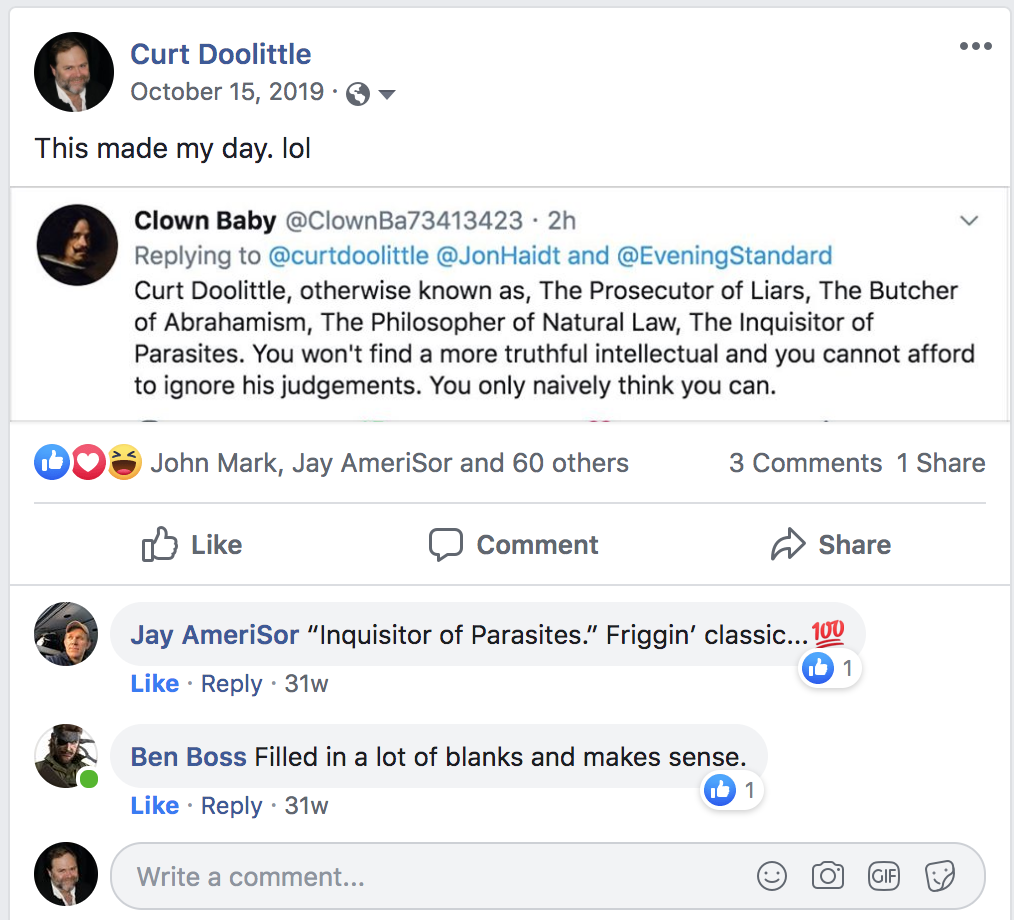
—“Curt Doolittle, otherwise known as, The Prosecutor of Liars, The Butcher of Abrahamism, The Philosopher of Natural Law, The Inquisitor of Parasites. You won’t find a more truthful intellectual and you cannot afford to ignore his judgements. You only naively think you can.”— a Friend
Oct 16, 2019, 10:49 AM (Godel is a Platonist and I’m an Operationalist. This contrast is rather helpful in illustrating the operational vs platonist vs empirical.)
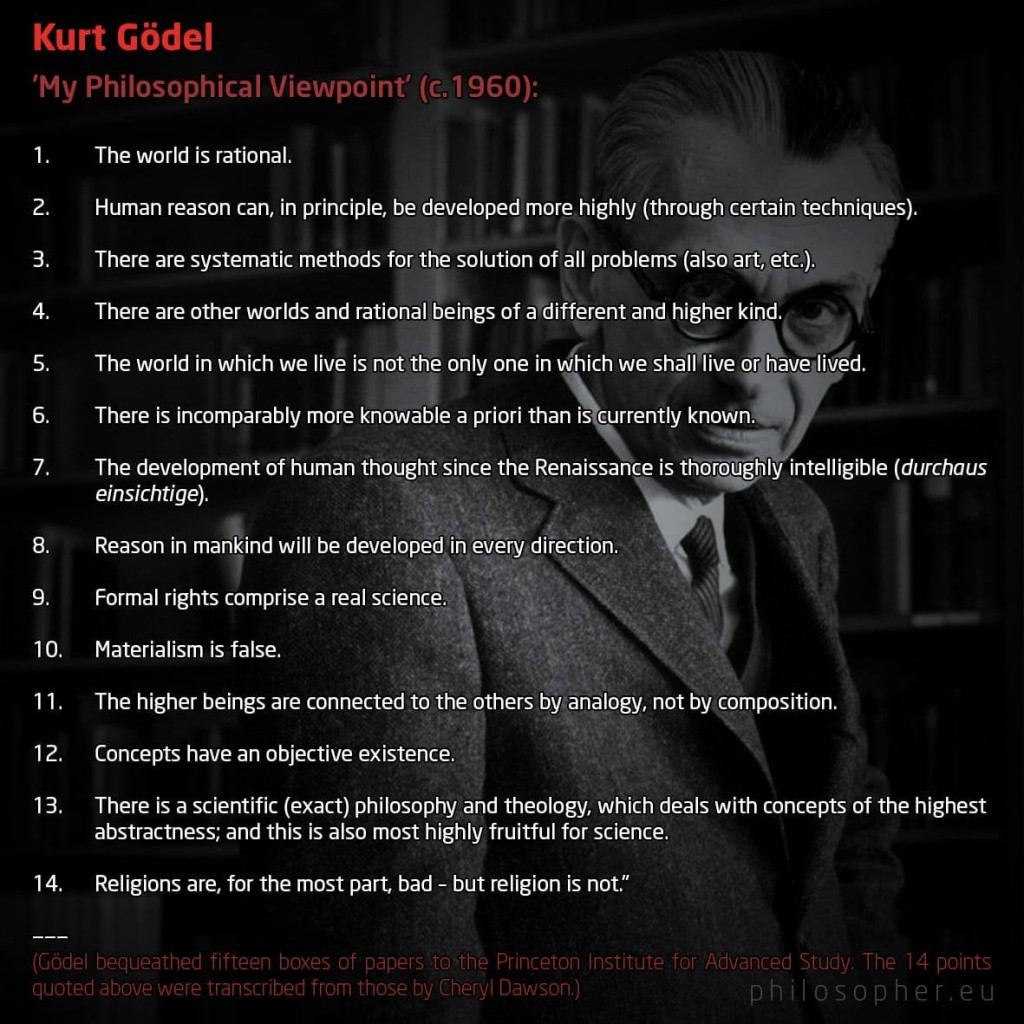
Existing religions are bad to terrible to suicidal – but human psychological, social, political, and strategic demand for the products of ‘religion’ (order) are endless. So we need to educate one another in mindfulness, ethics(interpersonal), morality (extrapersonal), political, and strategic (competitive), by means gracefully increasing and decreasing in accessibility: parable, story, history, reason and general rules, science and outcomes.’
CONTRAST WITH P – REQUEST FROM KASH VIKAS
(Godel is a Platonist and I’m an Operationalist. This contrast is rather helpful in illustrating the operational vs platonist vs empirical.)
Man acts rationally, and by rationally amorally. But given the disproportionate value of cooperation, and the disproportionate risk of retaliation, it’s just in his interest to act morally much more often than immorally.
1a. We can incrementally reduce observations of the universe, using our senses, reason, and instrumentation to descriptions of invariant constant relations (paradigms)
1b + 3. We can describe (explain) all of experience as constant relations (a single paradigm)
Oct 16, 2019, 10:49 AM (Godel is a Platonist and I’m an Operationalist. This contrast is rather helpful in illustrating the operational vs platonist vs empirical.)
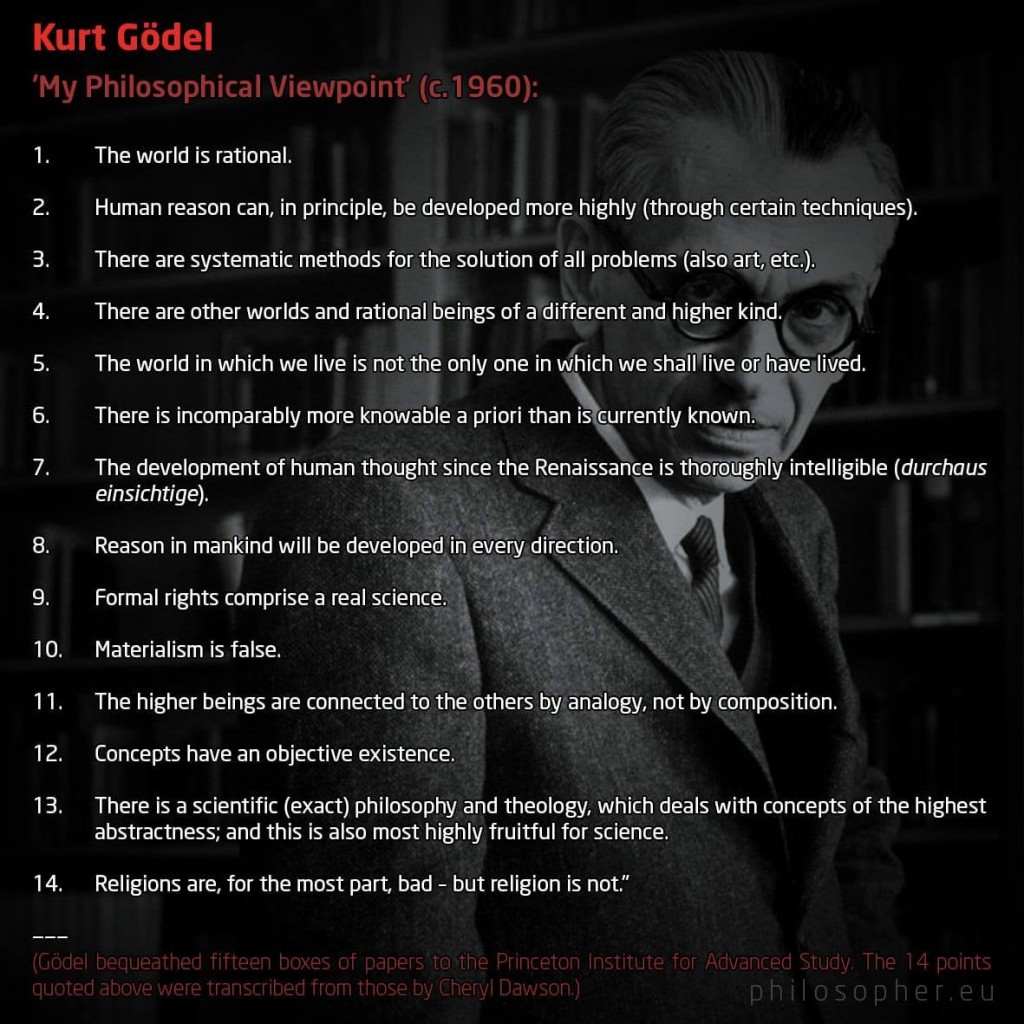
Existing religions are bad to terrible to suicidal – but human psychological, social, political, and strategic demand for the products of ‘religion’ (order) are endless. So we need to educate one another in mindfulness, ethics(interpersonal), morality (extrapersonal), political, and strategic (competitive), by means gracefully increasing and decreasing in accessibility: parable, story, history, reason and general rules, science and outcomes.’
CONTRAST WITH P – REQUEST FROM KASH VIKAS
(Godel is a Platonist and I’m an Operationalist. This contrast is rather helpful in illustrating the operational vs platonist vs empirical.)
Man acts rationally, and by rationally amorally. But given the disproportionate value of cooperation, and the disproportionate risk of retaliation, it’s just in his interest to act morally much more often than immorally.
1a. We can incrementally reduce observations of the universe, using our senses, reason, and instrumentation to descriptions of invariant constant relations (paradigms)
1b + 3. We can describe (explain) all of experience as constant relations (a single paradigm)
Oct 16, 2019, 7:38 PM Meth, Heroin, Cocaine all feel good. Sugar feels good. Wheat feels good. Pornography feels good. The fake affections of prostitutes feel good. Comforting lies feel good. Hyperconsumption feels good. Virtue signaling feels good. Feeling good isn’t a test of anything other than the sensations we evolved as hunter gatherers. We have developed many means under agrarianism, pastoralism, civilization, industrialism, and the sciences, by which to achieve sensations that we could not obtain from the natural world except as subtle cues to scarcity. That something feels good (or bad) in the moment tells us very little about whether it is cumulatively good for us, for those around us, for our people, civilizations, and man. The opiates of the masses indeed do feel good. They are however extremely BAD for us. In fact, they are genocidal. ~Curt Doolittle
Oct 16, 2019, 7:38 PM Meth, Heroin, Cocaine all feel good. Sugar feels good. Wheat feels good. Pornography feels good. The fake affections of prostitutes feel good. Comforting lies feel good. Hyperconsumption feels good. Virtue signaling feels good. Feeling good isn’t a test of anything other than the sensations we evolved as hunter gatherers. We have developed many means under agrarianism, pastoralism, civilization, industrialism, and the sciences, by which to achieve sensations that we could not obtain from the natural world except as subtle cues to scarcity. That something feels good (or bad) in the moment tells us very little about whether it is cumulatively good for us, for those around us, for our people, civilizations, and man. The opiates of the masses indeed do feel good. They are however extremely BAD for us. In fact, they are genocidal. ~Curt Doolittle
Oct 17, 2019, 8:57 AM While the principal innovation of P is Testimonialism, truthful testimony is merely reciprocity in speech. Agency is only possible under reciprocity. Trust is only possible under Reciprocity. Eugenia is only possible under Reciprocity. The foundation of P, the Natural Law of Reciprocity – is of course, just reciprocity: limiting one’s display word and deed to the productive, fully informed, warrantied, voluntary transfers of demonstrated interests, free of imposition of costs upon the demonstrated interests of others by externality. So while the physical world is dependent upon entropy and it’s consequences in the laws of thermodynamics, life requires reciprocity across generations; and humans have memory and the ability to predict futures using it, and to act to seize opportunities from those predictions. But while cooperation is disproportionately productive (advantageous), and while we can trade debts, resulting in reciprocity over time, we can also consistently generate debts and live parasitically off others – until they retaliate (which they always do). Reciprocity breaks down through disintermediation that limits the ability to test whether the sum of debts and repayments result in a balance (reciprocity). And this is what the state has achieved in all walks of life under pursuit of equality. But the result has been reversal of the universalization of middle class manners ethics and morals, and the reversal of underclass eugenics. Humans can, through life, defeat entropy, and through productivity, continue to defeat it, despite our increasingly costly brains; but reverse that existence through the continuous production of debt (parasitism) rather than reciprocity (mutually beneficial production), and continuous eugenics.