Theme: Productivity

  • THE HIDDEN DECLINE IN HUMAN CAPITAL—AND THE DANGER AHEAD by Peter Temin, Profess

    THE HIDDEN DECLINE IN HUMAN CAPITAL—AND THE DANGER AHEAD

    by Peter Temin, Professor Emeritus of Economics, Massachusetts Institute of Technology(MIT).

    U.S. GDP accounting underestimates intangible capital, overstates financial capital, and is all but oblivious to the the erosion of human and social capital. A serious growth slowdown is coming.

    The American economy changed rapidly in the last half-century. We kept track of this transformation through the National Income and Product Accounts (NIPA), a set of statistical constructs that were designed before these changes started. Our national accounts have stretched to accommodate new and growing service activities, but they are still organized by their original design. This can be seen in the growth of financial activity and the efforts of many economists to fit finance into our measurement of national product and of economic growth. I argue in my paper that our current economic data fail to describe accurately the path of growth in our new economy. They fail to see that the United States is consuming its capital stock now and will suffer later, rather like killing the family cow to have a steak dinner.

    Modern growth theory started with two papers by Robert M. Solow in the late 1950s. The first paper showed that it was possible to create a stable model of economic growth using a Keynesian model of investment and capital. The second paper showed that this model failed to explain most of American growth in the first half of the 20th century (Solow, 1956, 1957).

    Other economists expanded Solow’s model by adding additional types of capital: human capital, social capital, financial capital. The first addition was to add human capital by measuring the effect of education on productivity. This enabled economists to work with an expanded Solow model. The second addition was to add social capital. This was added in cross-sectional regressions and has not been applied to ongoing growth estimates. The third addition was added by assuming that wealth equals physical capital, that is, financial capital is indistinguishable from physical assets (Mankiw, Romer and Weil, 1992; Hall and Jones, 1999; Dasgupta, 2007; Piketty 2014).

    These additions furnished explanations of economic growth in the United States and other countries. The importance of these contributions was confirmed in many empirical studies, but the NIPA continues to calculate Private Fixed Investment, a Keynesian construct, as the investment part of GDP. This problem is acute in the data for finance. Philippon (2015, 1435) concluded that, “The unit cost of financial intermediation does not seem to have decreased significantly in recent years.” As he says, this is surprising on several grounds. I build on his work to understand whether this result is the result of how the underlying data were collected.

    This disconnect infects the calculation of economic growth. Griliches (1990, 1994) noted over two decades ago that more and more of GDP is composed of services, which also have been called intangibles. It is hard to estimate the output of the financial sector, for example, so it is measured by its inputs. As I will show, although this may give a useful measure of current activity, it is less informative about economic growth.

    There are two problems. It is hard to measure productivity if inputs and outputs are conflated. If we fail to include productivity growth of an increasing part of the national product, we increasingly will underestimate the growth of the national product. Further, if we do not have a good measure of output, it is almost impossible to measure investments in finance and other intangibles. If we do not have good measures of the various forms of capital listed here, we will not be able to think hard about longer-run growth. Concern about this latter point provides the motivation for this paper.

    Outside the literature on the national product, there are many treatments of these new forms of capital. In addition to financial capital, human capital has been the center of explanations for the United States’ economic domination in the twentieth century as well as the progress of individuals within the United States (Golden and Katz, 2008; Heckman, Pinto and Savelyev, 2013). Social capital has been the center of analyses of economic growth in the United States and elsewhere and in the long and short run (Putnam, 1993, 2000; Dasgupta, 2007). Measuring these forms of capital poses many of the same problems as measuring financial capital.

    I review in this paper the accounting methods used to compile investment data to understand how these other forms of capital behave in an economy that has changed markedly since the 1950s. I conclude that current accounting of growth in GDP fails to include the kind of investment that generates these other forms of capital. This conclusion has three implications. First, short-run growth as currently calculated bears more relation to short-run Keynesian analysis than to what we know about long-run economic growth. Second, financial capital increases inequality more than it generates growth for the entire economy. Third, we are now allowing human and social capital to depreciate, auguring ill for future economic growth in the United States.

    Peter Temin is Elisha Gray II Professor Emeritus of Economics at the Massachusetts Institute of Technology (MIT). His “The Political Economy of Mass Incarceration and Crime: An Analytic Model,” has just been published by the International Journal of Political Economy. A revised version of an earlier INET Working Paper, it will be freely available on line for the month after January 5, 2019: https://www.tandfonline.com/do…

    References

    Dasgupta, Partha. 2007. Economics: A Very Short Introduction. Oxford: Oxford University Press.

    Golden, Claudia, and Lawrence F. Katz. 2008. The Race between Eduction and Technology. Cambridge, MA Harvard University Press.

    Griliches, Zvi (ed.). Output Measurement in the Service Sectors. Chicago: Chicago University Press, 1990.

    Griliches, Zvi. 1994. “Productivity, R&D, and the Data Constraint.” American Economic Review, 84 (1): 1-23.

    Hall, Robert E., and Charles I. Jones. 1999. “Why Do Some Countries Produce So Much More Output per Worker than Others?” Quarterly Journal of Economics, 83-116.

    Heckman, James, Rodrigo Pinto, and Peter Savelyev. 2013. “Understanding the Mechanisms Through Which an Influential Early Childhood Program Boosted Adult Outcomes.” American Economic Review, 103 (6): 2052-2086.

    Mankiw, N. Gregory, David Romer and David N. Weil. 1992. “A Contribution to the Empirics of Economic Growth.” Quarterly Journal of Economics 107 (2): 407-37.

    Philippon, Thomas. 2015. “Has the US Financial Industry Become Less Efficient? On the Theory and Measurement of Financial Intermediation.” American Economic Review 105 (4), 1408-1438.

    Piketty, Thomas. 2014. Capital in the Twenty-First Century. Cambridge, MA: Harvard University Press.

    Putnam, Robert D. 1993. Making Democracy Work: Civic Tradition in Modern Italy. Princeton: Princeton University Press.

    Putnam, Robert D. 2000. Bowling Alone: The Collapse and Revival of American Community. New York: Simon and Shuster.

    Solow, Robert M. 1956. “A Contribution to the Theory of Economic Growth.” Quarterly Journal of Economics 70: 65-94.

    Solow, Robert M. 1957. “Technical Change and the Aggregate Production Function.” Review of Economics and Statistics 39: 312-20.

    VIA:

    https://www.ineteconomics.org/perspectives/blog/the-hidden-decline-in-human-capital-and-the-danger-ahead?

    PAPER:

    https://www.ineteconomics.org/uploads/papers/WP_86-Temin-Finance-in-Economic-Growth.pdf


    Source date (UTC): 2019-01-16 07:00:00 UTC
  • “Curt when you say ‘productive’ what do you mean?”— Eric Orwoll. Anything that

    —“Curt when you say ‘productive’ what do you mean?”— Eric Orwoll.

    Anything that is not unproductive. For example, blackmail does not increase any form of capital – it is voluntary but parasitic.

    In economics if the returns on an opportunity cost of a transaction is greater than the returns on the next most preferable opportunity cost (holding the good, service, or information), then it is unproductive.

    This is a bit difficult for most people to deal with because it consists almost entirely of via-negativa logic.

    So we just measure changes to property in toto and ask if it is negative or positive.

    If it is positive it doesn’t matter if it’s voluntary.

    If it’s negative it’s very hard to imagine that it was voluntary.

    And it’s just as hard to demonstrate the counter to that statement as it is to counter the premise of rational action.

    When all else false demonstrated behavior is what it is: evidence of involuntary transfer.


    Source date (UTC): 2019-01-15 17:28:00 UTC

  • photos_and_videos/TimelinePhotos_SxeO6JU-xg/49813504_10156915427212264_687594539

    photos_and_videos/TimelinePhotos_SxeO6JU-xg/49813504_10156915427212264_687594539

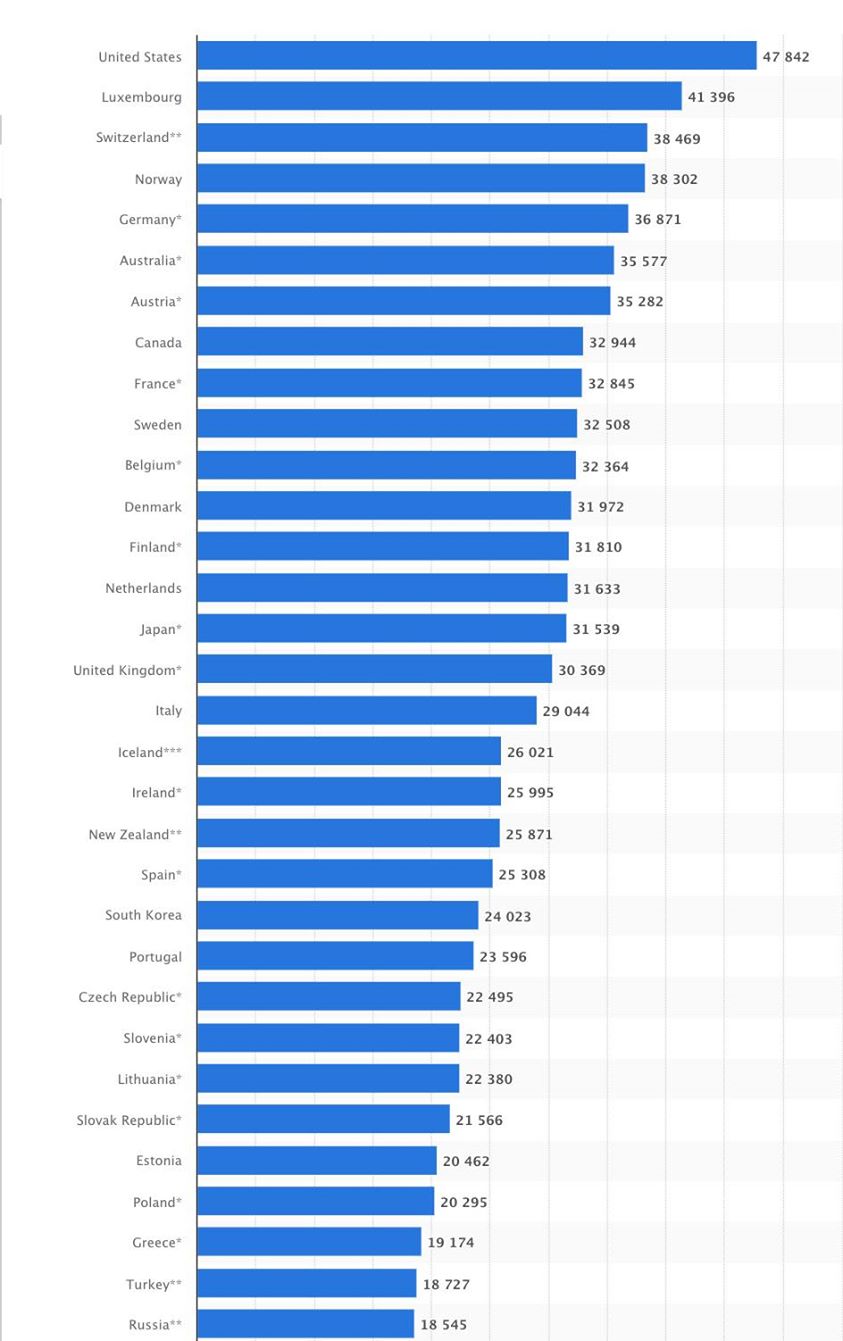
    photos_and_videos/TimelinePhotos_SxeO6JU-xg/49813504_10156915427212264_6875945394799378432_o_10156915427207264.jpg Gross adjusted household disposable income per capita of OECD countries in 2017 (in U.S. dollars)

    WHY BRITS SEEM POOR (THEY ARE)Gregory GichevI wanna eventually learn more about SwitzerlandJan 13, 2019, 10:09 PMCurt DoolittleThere is nothing to learn. Superior people and culture, superior geographic position, offering banking services to wealthy people who seek to avoid abusive taxation. Now, aside from that it’s fucking gorgeous, and the men all serve in the militia so they’re fit. etc. But they’re swiss german and they still have no fucking sense of humor…lolJan 13, 2019, 10:13 PMCurt DoolittleThe best country you can have is one that has a militia, white collar biz, the siwss method of governmnet, and a SMALL POPULATION. The trick isto be SMALL and WHITE.Jan 13, 2019, 10:14 PMDemelza HaysThat’s why I live in Liechtenstein :)Jan 13, 2019, 10:47 PMDemelza HaysAKA Switzerland on steroids.Jan 13, 2019, 10:47 PMDarren HowellDon’t know how Australia made it that high on the list? Certainly not representative of folks I know 😔Jan 13, 2019, 10:52 PMMichael DetrickIt would be very interesting to see a graph of the GAHDI per capita (isn’t there a glitch in saying “household” and “per capita” together?) adjusted to the cost of living in each of these countries as well as a comparison of the cost of living and the standard of living. Given these variables and based on my travels to many of the countries on this list, I would tend to predict that the USA will still be at the top of the list. All the more reason for us to adopt socialist policies so we can all be poor and miserable together.Jan 13, 2019, 11:08 PMKari Anne DorstadWell im happy to know that this is just a gross assessment! Yes I totally understand that ! I’ll pass all this info on to the next generation !Jan 14, 2019, 12:47 AMJohn ReevesLet a thousand Liechtensteins bloom! (Each with their own nuclear arsenal 😏)Jan 14, 2019, 12:59 AMJohn ReevesMurrika is wealthy because of our diversity and faith in God (Israel).Jan 14, 2019, 1:01 AMVengefül BobmoranIt’s amazing how much richer USA is compared to the other White and ‘new’ countries.

    Also, WTF Canada, how can you be so poor while sharing so much with USA?Jan 14, 2019, 1:58 AMScott CameronMost of the big gains in personal wealth in the UK come from real estate. There are more people living in England (50+ million) than there are living in California (37 million) and the population keeps increasing despite a sub replacement birth rate. That’s why the British pay the highest real estate taxes in the world.Jan 14, 2019, 1:59 AMJohn ReevesThe UK is a giant real estate ponzi scheme. A more extreme, concentrated version of what boomers are doing in the US.Jan 14, 2019, 2:00 AMLucy GummyScott Cameron British millennials are so poor it’s not even funnyJan 14, 2019, 3:10 AMScott CameronLucy Gummy https://www.youtube.com/watch?v=LrniPwzF7dQJan 14, 2019, 3:12 AMPhill KnyspelDoes this account for welfare like healthcare? Because brits do have access to that.Jan 14, 2019, 3:17 AMLars Lessingand forcing your USD on everybodyJan 14, 2019, 3:22 AMAlex MacleodAccess only in principle.Jan 14, 2019, 3:24 AMLisa OuthwaiteYeah, they have to force us to pay for that because nobody in their right mind would do so voluntarily.Jan 14, 2019, 3:24 AMCody CoxThis doesn’t accurately reflect income disparity and is misleading. I’ll bet a steak dinner that the average US joe is poorer than the average Brit.Jan 14, 2019, 3:26 AMSteven JacksonPhill Knyspel well we pay (those of us who work) £250/month for the privilege of waiting 3 weeks to see a gp and 8 hours in a&eJan 14, 2019, 4:07 AMLisa Outhwaite70% of the NHS budget goes towards treating lifestyle choice diseases. After pensions, it is our largest outgoing so in effect we spend more on managing people’s sugar habits than we do defence and education combined.Jan 14, 2019, 4:40 AMFrancesco Principi…like the italiansJan 14, 2019, 4:41 AMSteven JacksonLisa Outhwaite exactly, we pay to keep the irresponsible supplied with drugs and surgery when 90+% of the time a change in lifestyle or diet would cure everything.

    Also, cousin marriage and birth defects are putting stress on the system hereJan 14, 2019, 4:50 AMPhill KnyspelI am not interested in arguing the merits and cons of state provided healthcare I was just pointing out that this should be included in regards to gdp per capita and the same goes for education.Jan 14, 2019, 5:21 AMPhill KnyspelAlso you only wait 8 hours because the nhs is strained due to mass migration. If this was reduced the nhs would be fine .Jan 14, 2019, 5:23 AMPhill KnyspelHow much would an insurance plan in the USA cost that covers everything like the nhs does cost?

    Serious question to any American because I have no idea .Jan 14, 2019, 5:24 AMSteven JacksonPhill Knyspel that’s why I said £250/month is the average people pay towards the NHS. Business pays a good bit and some is redirected from other taxes.

    Migration is not the only problem, it’s a government run system, management grows exponentially while the labour shrinks. Tenders for supplying the NHS are always overpriced, drugs cost the NHS many times more than supermarkets or private pharmacies. It’s unsustainable because it is not market based.Jan 14, 2019, 5:27 AMPhill KnyspelOk well how much do americans pay? How much is their average insurance plan that would provide the same service that I currently have access to in the uk ?Jan 14, 2019, 5:29 AMLisa OuthwaiteNHS is a monstrous cash-cow for pharmaceuticals, that feed off a sick and ageing population as a guaranteed source of income and with no market competition. It needs disbanding and replacing with something more competitive.Jan 14, 2019, 5:30 AMPhill KnyspelLisa Outhwaite how much does your current insurance plan cost and what are you not covered for ?Jan 14, 2019, 5:31 AMLisa OuthwaitePhill Knyspel I live in the UK.Jan 14, 2019, 5:32 AMSean RingWhat kind of tax deductions do Germany, Australia, Austria, and Canada have? Their tax rates are punitive. Is it because they have a high population of tax-savvy entrepreneurs?Jan 14, 2019, 6:03 AMNïcholas JüryMight be skewed due to the amount of billionaires who live in the US 🤷🏼‍♂️Jan 14, 2019, 7:10 AMGordon E. ComstockDemelza Hays So steroids make your country small. Good to know!Jan 14, 2019, 7:38 AMCurt DoolittleJan 14, 2019, 8:57 AMCurt DoolittleJan 14, 2019, 9:00 AMCurt DoolittleTHE USA FAVORS THE MIDDLE. THE UK THE BOTTOM.Jan 14, 2019, 9:03 AMCurt DoolittleJan 14, 2019, 9:03 AMCurt DoolittleThe UK will get worse faster from immigration of the third world than the usa.Jan 14, 2019, 9:04 AMCurt DoolittleITALY IS NOT A POOR COUNTRY.Jan 14, 2019, 9:05 AMCurt DoolittleITALY VS UK

    https://countryeconomy.com/countries/compare/italy/ukJan 14, 2019, 9:05 AMCurt DoolittleIt is better to be poor in the uk, working class in canada, middle class in the usa, and it doesn’t matter WHERE you are upper middle outside of western civ. And it doesn’t matter where you are upper anywhere.Jan 14, 2019, 9:06 AMCurt DoolittleNote that middle-class in usa != middle class uk.Jan 14, 2019, 9:07 AMFrancesco PrincipiCurt you must consider that the quality of the pubblic administration in Italy are worst then in UK by far.Jan 14, 2019, 9:09 AMDeclan CahillIreland could’ve been like the swissJan 14, 2019, 9:15 AMCurt DoolittleOf course, yes, but that only means that italy would be as wealthy as france with better administration. (which would require better law, better courts, and an intolerant public)Jan 14, 2019, 9:23 AMZachary BertCan I come visit any of you?

    I was looking at Ukraine or Mongolia.Jan 14, 2019, 11:20 AMZachary BertWhat [[[Kind]]] Of American?Jan 14, 2019, 11:21 AMPhill KnyspelOk so you live in the uk .Well the American healthcare system ranks lower than the uk in basically every metric .Jan 14, 2019, 11:28 AMLisa OuthwaitePhill Knyspel That doesn’t alter any of the points I’ve made above. Saying that another system is worse, hardly bolsters the argument.Jan 14, 2019, 11:37 AMPhill KnyspelEvery instance of a free market healthcare system accounting for similar populations is inferior.

    Handing healthcare entirely to the free market always results in a more expensive and inferior service for everyoneJan 14, 2019, 11:39 AMCurt DoolittleTotal Taxes per Person in the USA is:

    $8,943 (states vary from 4kpp to 16kpp in Delaware.

    Rough cost of medicaid per person in the USA is:

    $2k for child

    $3-4k for Adults

    $10k for the aged. (=3+ adults)

    $20k for the disabled (=5+ adults)

    The Private sector pays for working folk, and the public for non-working folk. Realistically working folk pay for themselves AND non-working folk.

    The USA Spends waaaay more on healthcare per capita than any other country, but then we have AMAZING health care compared to every other country.

    – Per capita national health expenditures:

    $10,348 (2016)

    – Total national health expenditures:

    $3.3 trillion (2016)

    – Total national health expenditures as a percent of Gross Domestic Product:

    17.9% (2016)

    – Percent of national health expenditures for hospital care:

    32.4% (2016)

    – Percent of national health expenditures for nursing care facilities and continuing care retirement communities:

    4.9% (2016)

    – Percent of national health expenditures for physician and clinical services:

    19.9 (2016)

    $- Percent of national health expenditures for prescription drugs:

    9.8% (2016)

    Principle differences:

    1 – Waiting Time and time wasted. (best in usa)

    2- Quality of customer service (Best in canada)

    3 – Quality of Facilities (best in usa)

    4 – Life extension (usa or canada)

    5 – No ‘death panels’. (usa)

    The USA follows the general rule that if you want to pay for it you can have it, and if you can’t pay for it you can have what we can justify. The USA is a middle class paradise. If you are working class then canada is better, and if you are underclass britain is better.

    Aussies and americans have more in common.

    Canadians and Brits have more in common.

    Germans and americans have more in common than brits and americans.

    Italians and americans have more in common than french and americans.

    Very interesting.Jan 14, 2019, 11:48 AMWill HarmThe United States is the third most populous nation in the world and this based on the average. It would be interesting to see this broken down by state.Jan 14, 2019, 12:13 PMSamiran BhaleUK is clearly ahead of Italy it seemsJan 14, 2019, 1:44 PMSean RingFrancisco, Italian healthcare is far superior to the NHS. For the little guy, that matters, no?Jan 14, 2019, 4:46 PMAngadjeet SangheraVeeeery interesting.Jan 14, 2019, 5:10 PMGabriel YbarraThey’re the most broken people on Earth.Jan 15, 2019, 4:54 PMGross adjusted household disposable income per capita of OECD countries in 2017 (in U.S. dollars)

    WHY BRITS SEEM POOR (THEY ARE)


    Source date (UTC): 2019-01-13 22:08:00 UTC

  • language improved the rate of cooperation – whether it improved the problem of r

    language improved the rate of cooperation – whether it improved the problem of resource allocation does not appear to be true. If you mean ‘productivity’ that would be true.


    Source date (UTC): 2019-01-12 00:39:02 UTC

    Original post: https://twitter.com/i/web/status/1083886034046341120

    Reply addressees: @torinmccabe @Imperius__13 @MatthausAnsatz @DataDistribute @JohnMarkSays @MahmoudZaini @TrueDilTom @Dick71224996

    Replying to: https://twitter.com/i/web/status/1083878376421707776


    IN REPLY TO:

    Original post on X

    Original tweet unavailable — we could not load the text of the post this reply is addressing on X. That usually means the tweet was deleted, the account is protected, or X does not expose it to the account used for archiving. The Original post link below may still open if you view it in X while signed in.

    Original post: https://twitter.com/i/web/status/1083878376421707776

  • photos_and_videos/TimelinePhotos_SxeO6JU-xg/49373614_10156897969902264_866677664

    photos_and_videos/TimelinePhotos_SxeO6JU-xg/49373614_10156897969902264_866677664

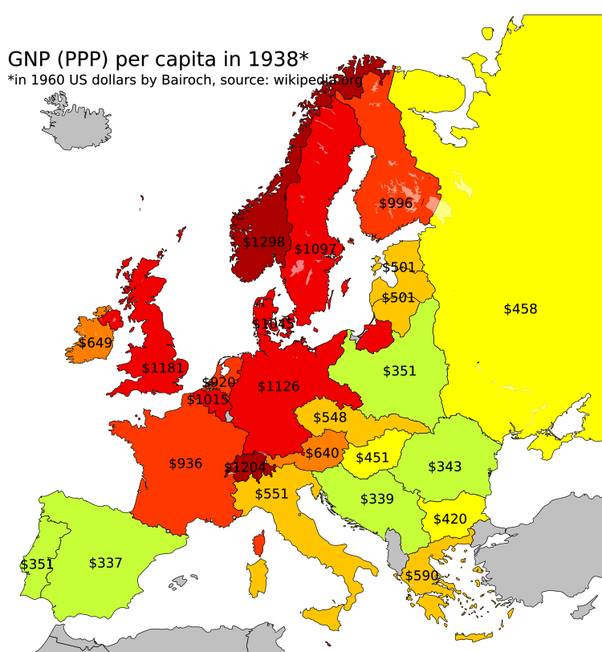
    photos_and_videos/TimelinePhotos_SxeO6JU-xg/49373614_10156897969902264_8666776646461685760_n_10156897969897264.jpg Croib MagaWhy was Norway rich in the early 20th century?Jan 5, 2019, 9:10 PMSean RingHere you go:

    https://link.medium.com/ZwVbNGbgfTJan 5, 2019, 9:12 PMCroib MagaWow. Never thought about that but it makes sense.Jan 5, 2019, 9:17 PMSean RingThe morals of the story:

    1. Be smart about your natural resources. (Norway)

    2. If you don’t have any, build a banking industry. (Switzerland)

    3. Manufacture, don’t bitch, to paraphrase James. (Germany, France, UK)

    4. Secede from the laziness. (Italy would be at least 70% higher without the Mezzogiorno.)

    5. Stay away from wine and war (the rest).Jan 5, 2019, 9:18 PMJonathan TilasWhat’s GNP?Jan 5, 2019, 9:28 PMSean RingGross National Product. It’s how they used to measure output before they switched to GDP. Quickly, it’s economic output by citizenship (regardless of where it’s produced) versus output within a country’s borders (regardless of who produced it).Jan 5, 2019, 9:35 PMGreg Hamiltonactually the moral of the story is have a R1b dominant society.Jan 5, 2019, 10:03 PMJonathan TilasSo wouldn’t higher numbers be better? I’m looking at this through the lens of GDPJan 5, 2019, 10:06 PMSean RingIf that were the case, Iberia would be much better off. https://upload.wikimedia.org/wikipedia/commons/e/ec/Haplogroup_R1b_%28Y-DNA%29.PNGJan 5, 2019, 10:44 PMSean RingJonathan Tilas Yes, absolutely.Jan 5, 2019, 10:45 PMSean RingThis may be clearer.Jan 5, 2019, 10:45 PMSean RingAnd I think the above reads “GDP” but they mean “GNP”.Jan 5, 2019, 10:46 PMVengefül BobmoranClearly GNP and GDP are missing something.

    Who cares if you’re doing bank while selling your future? You’re not productive, you’re just a shitty accountant.

    Or : No matter how rich you think you are, your own replacement is but a few distracted decades away.Jan 5, 2019, 11:43 PMLee TuckerSurprised Spain is so low. They really frittered their Empire`s legacyJan 6, 2019, 12:11 AMSean RingLee Tucker so true. If you haven’t read Ferguson’s Empire, I recommend it. It’s about England, but he contrasted how the Spanish crown constantly defaulted on its debt, despite having looted South America of its gold and silver, while England always paid its debts.Jan 6, 2019, 12:27 AMGreg HamiltonI didn’t claim guaranteed results.

    Statistics don’t work that way.Jan 6, 2019, 12:35 AMGreg HamiltonThe wealth of nations map highly correlates to the R1b R1a line.Jan 6, 2019, 12:36 AMSean RingAnd correlation doesn’t imply causation. Though, it is an interesting observation.Jan 6, 2019, 1:14 AMGreg HamiltonWell no shit…

    It’s more than an interesting observation. Genetics equals outcomesJan 6, 2019, 1:18 AMSean RingGreg, I don’t mean to piss on your parade, but basing anything on one variable isn’t good statistics.

    First, GNP/GDP is output, not wealth. I’m not splitting hairs there; debt matters. Second, the Scandis are every bit as productive, though their haplogroup isn’t R1b. I’ve already mentioned Iberia. Third, if the US didn’t defend Western Europe after WW2, the USSR would have run over the rest, destroying output everywhere. Luckily, they wouldn’t have to go over the Pyrenees.

    I’m onboard that IQ matters. But could you refer me to a paper on R1b dominant societies?Jan 6, 2019, 1:37 AMGöran DahlR1b is a Y-haplogroup, Greg; it doesn’t have an impact on your appearance, intelligence or behaviour. I hope you understand that. More than a quarter of all African-Americans are R1b, just so you know, and there’s an almost equal distribution of R1a and R1b in Germany and Norway, while there’s more than twice as much R1a in Sweden than R1b.Jan 6, 2019, 3:51 AMRichard HallSean Ring The Spanish empire was centrally run. The British was based on free enterprise.Jan 6, 2019, 4:46 AMLisa OuthwaiteNordic race FTW.Jan 6, 2019, 8:30 AMBartosz SzykThis map says only one thing – this was the GDP of the European countries in 1938.. nothing else..Jan 6, 2019, 10:48 AMGreg Hamiltondid I state a guarantee? No

    Did I state no other factors matter? No

    Did I state no other Haplogroups have a chance of success? No

    I’m not a mathematician but even I can figure out that threshold levels would matter (Africa) and that mixing different Haplogroups in varying percentages would create different outcomes.

    DNA plays a part in creating culture. DNA impacts IQ. Cultural IQ impacts success. IQ isn’t the only part of DNA that matters to success of a culture.

    A betting man having no other information to help factor would pick a R1b dominant culture as a prediction of successJan 6, 2019, 11:42 AMGöran DahlAs long as you understand that haplogroups have nothing to do with DNA at large, and that changing a man’s haplogroup from R1b to I1a does nothing to him, save for altering his paternal lineage.Jan 6, 2019, 12:25 PMGreg Hamiltonlol. Does nothing to him.

    Because lineage has nothing to do with who you are or cultureJan 6, 2019, 12:37 PMGreg Hamiltonhttps://www.sciencedirect.com/science/article/pii/S0160289612000529Jan 6, 2019, 12:38 PMGöran DahlIt does, in the sense that it tells you where your paternal ancestor came from. Don’t confuse it with autosomal DNA, which determines your ethnicity.Jan 6, 2019, 12:38 PMGreg HamiltonShow me anywhere in my discussion where I claimed it to be everything and other factors don’t matter ?

    You’re correcting or attempting to educate me on things I never said.Jan 6, 2019, 12:40 PMGreg HamiltonI say again. In the absence of other factors a betting man would pick a R1b dominant culture. It’s a solid solid betJan 6, 2019, 12:41 PM


    Source date (UTC): 2019-01-05 21:04:00 UTC

  • agile manifesto simply tech application of universal frame. not unique. common b

    agile manifesto simply tech application of universal frame. not unique. common before industrialization. continuous recursive progress with immediate feedback eliminates error early and cheaply, reinforces early and cheaply, and merely restates normal life’s epistemology.


    Source date (UTC): 2019-01-01 21:01:56 UTC

    Original post: https://twitter.com/i/web/status/1080207519635697664

    Reply addressees: @jonathanwilson @tferriss

    Replying to: https://twitter.com/i/web/status/1080200923014725632


    IN REPLY TO:

    @jonathanwilson

    @curtdoolittle Very similar, yes! I’d love some examples you can think of where Agile’s manifesto sounds like Seneca. @tferriss will be interested in this thread.

    Original post: https://twitter.com/i/web/status/1080200923014725632

  • Sitting on the world’s optimum trade route, and taxing everything that goes thro

    Sitting on the world’s optimum trade route, and taxing everything that goes through it, and destroying every people within it, and stagnating them, is NOT a measure of success. Being either end of the bronze age (w & e) and continuously innovating science (w), and reason (e) are.


    Source date (UTC): 2019-01-01 16:43:56 UTC

    Original post: https://twitter.com/i/web/status/1080142591621033984

    Reply addressees: @nntaleb @charlesmurray

    Replying to: https://twitter.com/i/web/status/1079549079099768832


    IN REPLY TO:

    @nntaleb

    That was what I tried to convey to that hawker-mountebank Charles Murray @charlesmurray when he wrote his gerrymandering book on how the “West” was great, redefining West as whatever has been recently successful.

    Original post: https://twitter.com/i/web/status/1079549079099768832

  • Nassim: So I just unfortunately realized that your FatTony et all, sensibilities

    Nassim: So I just unfortunately realized that your FatTony et all, sensibilities is just Semitic hatred of high trust peoples who produce their extraordinary wealth by the production of COMMONS. And this insight, if widely understood will destroy your reputation even further.


    Source date (UTC): 2019-01-01 13:04:14 UTC

    Original post: https://twitter.com/i/web/status/1080087302574092288

    Reply addressees: @nntaleb

    Replying to: https://twitter.com/i/web/status/1079812795166851072


    IN REPLY TO:

    @nntaleb

    I can understand someone saying “listen, I love strangers but I am more comfortable w/my nationality, shared values” (homophily) or “neighbors get along better than rommates” (fractal localism). But making “others” genetically “inferior” using IQ “science” is quite sinister.

    Original post: https://twitter.com/i/web/status/1079812795166851072

  • Stephan is Correct. IQ (meaning, the relative size of genetic classes as measure

    Stephan is Correct. IQ (meaning, the relative size of genetic classes as measured by rate of learning), is the MOST important factor in group wealth. PERIOD.


    Source date (UTC): 2019-01-01 12:49:42 UTC

    Original post: https://twitter.com/i/web/status/1080083643786244097

    Reply addressees: @nntaleb

    Replying to: https://twitter.com/i/web/status/1079812795166851072


    IN REPLY TO:

    @nntaleb

    I can understand someone saying “listen, I love strangers but I am more comfortable w/my nationality, shared values” (homophily) or “neighbors get along better than rommates” (fractal localism). But making “others” genetically “inferior” using IQ “science” is quite sinister.

    Original post: https://twitter.com/i/web/status/1079812795166851072

  • PLEASE UNDERSTAND WHAT THIS MEANS —“It was a good year for wealth creation. It

    PLEASE UNDERSTAND WHAT THIS MEANS

    —“It was a good year for wealth creation. It was a tough year in financial markets, but for people who are creating wealth through companies, the economy itself is very strong.”— Michael Zeuner, managing partner of WE Family Offices.


    Source date (UTC): 2019-01-01 02:27:47 UTC

    Original post: https://twitter.com/i/web/status/1079927134792105984