Theme: Measurement

  • The Method – Decidability

    The Method – Decidability

    DECIDABILITY

    Precision, Completeness, and Decidability

    “Well, my take is that the brain evolved for graceful improvement and graceful failure of decidability.” [N]ow that we understand our journey, we can begin with the methodology. There are three parts to it:

    • Decidability via Disambiguation, Deflation, Operationalization, Serialization, and Competition. (Terms)
    • Strict Construction of Transactions, in a Contract for Meaning (Statements) and;
    • Due Diligence Against Ignorance, Error, Bias, and Deceit ( where due diligence requires tests of correspondence, consistency, possibility, rationality, reciprocity, completeness and coherence).

    These chapters will contain lots of definitions. You won’t have to retain them the first time. We’ll repeat them over and over again. And we will summarize them at the end of each chapter. And then repeat summaries at the end of chapters until you see how everything fits together neatly. So think of our work together as building familiarity with terms, series, checklists, and processes, until we produce a complete outline of the methodology, that you can refer back to until you have internalized it. In this chapter we will cover Decidability, Disambiguation, Deflation, Operational-ization, Serialization and Competition. The rest of the methodology will follow in subsequent chapters.

    Decidability (action)

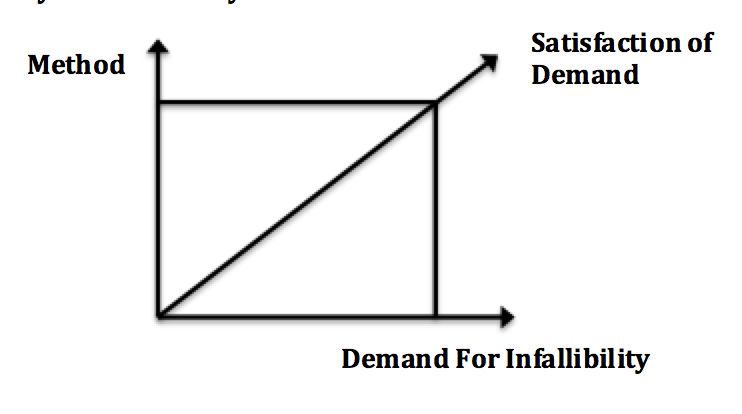
    The Satisfaction of Demand For Infallibility

    A question (or statement) is Decidable (true or false: consistent, correspondent, possible; good or bad, and sufficient) if (a) an algorithm (argument, or set of operations) exists within the limits of the system (domain: set of axioms, rules, theories) that one can use to produce a decision and (b) if sufficient information for the decision is present within the system such that, (c) one need not appeal to either information outside of the system, or DISCRETION (INTUITION, VALUES) to supply information necessary to DECIDE. Ergo, if DISCRETION (choice) is unnecessary, a proposition is DECIDABLE. If Discretion is necessary then the question may be DISCRETIONARY (subjective choice) but it is not DECIDABLE (objective). Or for the most reductive version: the subjective requires appeal to intuition (judgment) and the objective requires only appeal to present information.

    |Choice| Decidable > Discretionary(opinion) > Choice(preference, presumed good) > Random Selection (undecidable) > In-actionable The purpose of our method is to produce decidability as a means of circumventing the dependence on discretion and choice. By our diligent production of decidability we produce a value independent universal language of testimony in all subjects; but particularly in the subjects most vulnerable to discretionary impulse: cooperation, ethics, morality, and politics.

    Note: This emphasis on decidability explains the difference between rule of law (decidable) and rule by discretion (undecidable, and therefore subjective discretion or choice are required). If discretion is required, then it is rule by discretion (choice) if not, then rule of law.

    Demand For Increasingly Infallible Decidability In an effort to avoid the mistake of relying upon an Ideal Type, we will describe a spectrum, or ordered hierarchy of Demand for DECIDABILITY. That way we do not ask the universe to fit our definition, but that we provide a definition that corresponds to decidability in all cases we can perceive in the universe. Spectrum of Decidability:

    1. Intelligible: Decidable enough to imagine a conceptual relationship
    2. Reasonable: Decidable enough for me to feel confident about my decision (that it will satisfy my needs, and is not a waste of time, energy, resource )
    3. Actionable: Decidable enough for me to take actions that produce positive results.
    4. Moral: Decidable enough for me to not cause others to react negatively to me, if they have knowledge of my actions.
    5. Normative: Decidable enough to resolve a conflict without subjective opinion among my fellow people with similar values.
    6. Judicial: Decidable enough to resolve a conflict without subjective opinion across different peoples with different values.
    7. Scientific: Decidable regardless of all opinions or perspectives (‘True’)
    8. Logical: Decidable out of physical or logical necessity
    9. Tautological: Decidably identical in properties (referents) if not references (terms).

    So to borrow the one of many terms from Economics, we can see in this series (list) a market demand for increasingly infallible decidability.
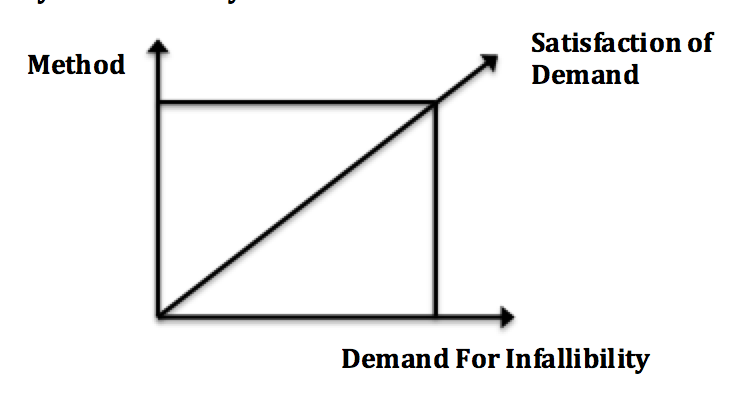
    The Methods of Decidability We can also separate the actions of intuiting (intuition), from reasoning (all processes of the mind), from rationalism (justification), from calculation (in the wider sense – transformation of inputs into outputs) from computation (algorithm).

    |DECIDABLE| Unintelligible(Incomprehensible) > Intelligible(Comprehensible) > Possible (actionable) > Preferable > Good (Normative, Moral) > Decidable(Judicial) > True (scientific) > Analytically True (logical) > Tautologically True (Tautological)

    and    

    |COGNITION| Comprehensible > Imaginable > Reasonable > Rational > Calculable > Computational > Identical

    and

    |METHOD| Experiential(emotional) > Rational (law : Social or Contractual) Theoretic (science: existential) > Axiomatic(logic: mental) > Each of these methods of reasoning depends upon a different degree of demand for the infallibility of decidability. So when we say we can decide a question, we mean it satisfies the demand for the infallibility of decidability.

    Note: This technique, where we test the satisfaction of demand for infallibility, will frame most of our thinking, and it is the principle difference between logical, philosophical, scientific, and legal thought. That is because it is the most complete of logical, philosophical, scientific, and legal thought.

    Producing Decidability

    The Deflationary Method

    Deflation And Disambiguation The technique we will use is Deflation and Disambiguation, where we use the term deflation as in conflation, and “de-conflation”, and where we use disambiguation as in ambiguous and unambiguous. These terms function as an evolution of the terms ‘analytic’ or ‘analytical’; meaning “to break into constituent parts”. However, instead of breaking into constituent parts, we break terms into Series, Spectra, Tables, Hierarchies, or Graphs of one or more Constant Relations through a process of (a) competition and (b) reduction to commensurable measurements (terms) we call operational language (or grammar). The purpose of deflation is to both limit the constant relations in our definitions to those that are decidable, and eliminate constant relations that are unnecessary for decidability. As a consequence of deflation we will produce multiple opportunities for comparison and decidability. And as such we will increase our chances of both confirmation and falsification.   Although, as we will discover later, it is falsification, not confirmation that provide us with greater decidability.   

    How We Deflate Language

    Dimensions, Dimensions, and Dimensions

    |DEFLATING| Constant Relations > Operational Terms > Competition in Series > Competition between SeriesThe Problem of Continuous Recursive Disambiguation We seek to satisfy the Demand for the infallibility of decidability. For historical reasons we tend to think in terms of creating meaning, but the process we use when speaking is the use of symbols to produce continuously recursive disambiguation. This ‘success by the negative’ or ‘via-negativa’ will be another of the central themes of our work. So to produce a stream of language AND to understand a stream of language we accumulate names of some set of constant relations(words) and helpers (words) that assist in the relations between those words, and by the accumulation of names and relations we reduce by speaking and restore by listening, a model (network of constant relations) that satisfies the demand for infallibility of decidability.

    |Understanding| Free Association -> Hypothesis -> (repeat) -> (Demand for Infallibility Satisfied. OR Not Satisfied)Continuous Recursive Disambiguation At Scale We make use of this same process at scale, in what we call ‘epistemology’ or ‘the continuous recursive falsification and therefore survival of demand for infallibility of decidability. The Process of Satisfying Demand for Infallibility of a Statement (Knowledge):

    • Free Association -> Test of Survivability of Inquiry (way-finding).
    • Hypothesis -> Test of survivability of Fitness, in personal falsification.
    • Theory -> Test survivability of Possibility in Applied
    • Law -> Test of Survivability of Application in the Market
    • Convention -> Test of Survivability of Habituation in the Market
    • Metaphysical Value Judgment -> Test of Survivability of Integration in the Market for application

    So whether as individual thinking through a problem in our minds, or as speaker and audience, as groups, as markets, as societies, as mankind, we test our ideas by a process of continuous competition for infallibility in the market for ideas that survive increasing scope of application. The Problem of Suggestion: Substitution, Conflation, and Ambiguity Every word (symbol) we speak in every stream of words, produces free association in the audience. We ‘suggest’ meaning with our expressions, sounds, words, phrases, sentences, narratives, and arguments. Then we continuously strive to disambiguate these suggestions until the other party demonstrates we have satisfied (at present) the demand for infallibility sufficiently to convey meaning (a contract for meaning. An agreement on experiences.) When someone says ‘I understand’ they convey acceptance of your offer (contract) for meaning within the limits of the demand for infallibility, in the given context. Unfortunately, in our optimism, we fail to perform due diligence with one another, and often let the conversation evolve until we confirm (justify) or disconfirm (falsify) our network of meaning and break the prior contract for meaning. More, unfortunately, even without our optimism, we may simply lack the vocabulary, grammars, and paradigms, to convey what we imagine we understand despite our inability to articulate it. And most unfortunately, it is quite easy to use the process of suggestion to force the audience to substitute a falsehood, conflate one circumstance with another, or inflate the scope, intensity, or values. In other words – it’s very easy to lie. And the only way of circumventing the problem of suggestion is due diligence: trying to falsify what we’ve understood. The positive solution to this problem is ‘seek to understand’ rather than agree. This is relatively expensive and puts the burden on the audience. The negative is ‘skepticism’ – which is cheaper and requires less knowledge, and puts the burden on the speaker. One way, the other, or both, are often required to produce a contract for meaning. The practical reality is, that this job falls always to the person better informed. The unfortunate problem is that the person most informed may have malincentives. If that is the case then no matter what due diligence we make use of, only warranty sufficient to cover the costs of failing to satisfy the demand for infallibility will provide us with decidability, to agree on a contingent contract for meaning. Note: As we continue this journey together the use of the language of law, contract, and economics will eliminate most of the weaknesses of moral and philosophical language, and provide you with a much superior model for analysis at the cost of more ‘steps’. Starting with Terms: Comparisons are costly. The more complex the comparison the more costly. We have a natural tendency to reduce the cost of composing speech and accumulating understanding. Some cultures use languages with a very large number of terms. Some languages use a very small number of terms. Large numbers of terms limit the need for suggestion. Small numbers of terms increase the need for suggestion. We describe this difference between High Context, Low Precision language of fewer terms and loose grammar, with Low Context, High Precision language with many terms and strict grammar. English is a low context, high precision language with strict grammar. Asian languages are high context, low precision. To westerners they are poetic. To Asians, western languages are burdensome. Same for our writing. Asian languages require more context and interpretation. Germanic languages little context. In effect, high context languages are stories, while low context languages are recipes. Germanic languages are military, engineering, and scientific languages. Whereas east Asian languages are moral, literary, and poetic languages. That said, it only takes about 300 words to satisfy travel demands in nearly any language. And in English around 1000 words are all that is necessary for interpersonal non-technical communication. However, even in our low context high precision language we tend to seek words with wide general meaning on one hand, or ideal meaning on the other, and rely on suggestion and context to relieve the burden of composing continuously recursive disambiguating prose. That leads us to the problem of general and ideal types. The Problem of Ideal Types Ideal types are constructs or concepts which create a paradigm by which to compare phenomenon and ideas. However, it turns out that a single stereotype, or paradigm encourages us to try to ‘fit’ data to model, and in doing so engage in various forms of conflation and inflation, that introduces error and bias. The Use of Series for Precision We will use series (spectra) of related words or phrases to describe a concept consisting of one or more constant relations from beginning to end. A series (spectrum) puts terms in competition with one another and forces us to choose which term refers to which properties. This competition prevents us from the ‘fitting’, conflating, and inflating we use with ideal types. Note: If you habituate the practice of converting ideals into one or more series (spectra) your reasoning will dramatically improve. Disambiguation of our Consciousness: Our Faculties We possess at least these faculties: Our physical senses (perceptions), our intuitionistic and emotional faculties (emotions, intuitions, imagination), and our conscious and cognitive faculties (thought, reason, calculation), and we can put them to use (test them) by producing action (movement) and that subset of actions we call speech (communication). We have no control over our senses. We have intuitions that are outside our control, though can train our intuitions a bit, but intuition is not open to introspection. We can train our reason and much of our reason is open to introspection. We can act, even if not introspectively decompose how we cause our body to act. We can speak and introspect our use of language, and even think in language. This difference between involuntary sensation, |Faculties| Perception (physical) > Intuition (emotion, impulse, intuition) > Cognition (thought, imagination, reason) > Action(testing) > Speech (testing – communication(via others)). Experiences: We will define our Experience as consisting of the combined results of Perception, Intuition, and Cognition as they change or remain constant over time. 1 – Our Perceptions with our Five Senses: sight, sound, touch, taste, and smell. 2 – Our Intuitions: Emotion, Intuition (including prediction), Imagination. 3 – Our Cognitions: Free Association (daydreaming), Thought, Reason, Calculation

    |Experience| Perception > Intuition > Cognition > Action -> (repeat)

    CORRESPONDENCE AND CONSISTENCY

    THE TESTS OF CONSISTENCY, INCONSISTENCY, AND CONTRADICTION The problem of Correspondence, Consistency, and Coherence Correspondence in language, more complex relations to name.

    • Numbers are very simple, despite the ‘magic’ (technically ‘idealism’) mathematicians attribute to them. Numbers refer to names of positions. When we create numbers of any size we are using ‘positional naming’. That’s it. Number means name for a position. That’s all. If you have ten children in your family, all born in some order, and all having different names, if you memorize that order then you can use the children’s names as positions in order, and build your decimal numbering system with those positional names instead of the ones we use. (Yes, people do such things).
    • When we ‘count’ we use the names of positions to refer to that count. Three refers to the third position. One hundred to the one hundredth position. We us the term Ordinal when we refer to positions. We use the term Cardinal when we refer to
    • We can count anything we choose to, that can be counted. Some things are countable and some are not. For example, trees are countable, but we resort to stand, grove and forest when counting is impractical. It’s possible to count grains of wheat, but impractical. It’s not possible to count water other than perhaps drops. Instead we use weight or volume to count that which is impractical or impossible to count.
    • When we count something countable, we say the positional name refers to some set of that something. And that relationship between number(name) and referent(what we’re counting) is correspondence. The beauty of numbers is that because they are so simple (meaning nothing but position) we can use them to correspond to almost anything we can imagine that is countable or countable by some measure.
    • Now the problem is, what if we say ‘men? Well, that’s a very broadly correspondent. It’s all humans that are not female or children. If we say “this apple”, “my older brother Thomas”, or “The Moon” those are very precise names that are narrowly correspondent with some set of constant relations.
    • When we say “a horse” we refer to a category of relations that we have learned to association with the term ‘horse’ from experience, testimony and fiction. When we say “unicorn” we refer to a set of constant relations we have learned partly from experience (horse, wings, horn, flying), or testimony, but when combined from only from fiction. In this case a horse is meaningful and correspondent with reality. And a unicorn is internally consistent with a fiction, but not externally correspondent with reality. This is the difference between internal consistency of ideas and words (such that no contradiction or falsehood exists), and words and ideas externally correspondent with existence (such that no non-correspondence exists). This distinction assists us in clarifying the relationship between consistent (internally: between words and imagination that can imagined) and correspondent (between words and reality that can be perceived.).

    |Speech| Incoherent (no contract for meaning possible) > Coherent (contract for meaning possible) > Verbally Consistent (words or symbols and their constant relations are non contradictory) > Perceivably Correspondent (words and symbols correspond with the constant relations

    | Coherent | … sufficient for meaning | Internally Consistent | … sufficient for demand | Externally Correspondent | … sufficient for demand So the problem with correspondence is satisfaction of the demand for infallibility in the given context, in the current contract for meaning (coherence, consistency, correspondence). When we use a name (referrer) does it satisfy the demand for disambiguity we imply infallible by the term ‘identity’? Or does it leave open the possibility of suggestion, conflation, or inflation? If we cannot satisfy the demand for infallibility of decidability, we can only perform by due diligence (present) or demand warranty (future).  

    COMMENSURABILITY

    PRODUCING CONSISTENCY, CORRESPONDENCE, AND COHERENCE The Problem of Commensurability Then we have the problem of the differences between apples and oranges. Both our countable, but they are not identical. Two things are commensurable when they are measurable using the same standard of measurement. 1) Numbers render countable objects commensurable 2) Units of Measure render weights and volumes commensurable. 3) Measurements render spatial commensurable 4) Physics renders physical actions commensurable. 5) Money and prices render goods and services commensurable 6) Property renders cooperation (ethics, morals, politics) commensurable 7) Names render categories of properties commensurable. 8) Categories render sets of properties commensurable. 9) Properties render sets of constant relations commensurable. The The Commensurability of Observability The Commensurability of Actions The Commensurability of Sensations The Incommensurability of Values Commensurability of terms vs referents No longer measure a third   Calculable (Calculability) (once commensurable then calculable) Man As The Measure Of All Things To Man …Faculties Produce Measurements ( …. )  Actions Create Commensurability….. Everything can be described by the actions required to describe it. (stories, recipes). If a thing can be described by the senses, intuitions, or reason, it can be explained in terms of senses. If a thing cannot be described by the senses intuitions or reason, it can be explained by the means of reducing it to an analogy to experience: measurements. Language Consists of Measurements All language consists of a series of measurements the purpose of which is to produce continuously recursive disambiguation in the audience, sufficient to satisfy the demand for infallibility given the context of the promise made. Man is the measure of all things to man, and language consists of parsimonious (true), accurate (sufficient), poetic(analogical but sufficient), inaccurate (insufficient) or deceitful measurements, that produce a stream of experiences of continuous recursive disambiguation (precision) in the audience such that their demand for infallibility of correspondence in the context is met – or not.   Testimony (Speech) consisting of Measurements can be Tested. ( … ) Producing Terms Producing Terms That Are Measurements Production of Unambiguous Terms and Operational Definitions that are Testable     Deflation (Deconflation and Disambiguation) We deflate into the identical, comparable (differential), measurable, and commensurable, and separate the observable and testifiable (Senses), from the arguable and testable (Cognitions), from the arbitrary, preferential, and opined (Intuitions).   Differentiation (Identity) Producing Comparability, Measurability, Commensurability, and Identity.   Comparability Measurability Commensurability Identity   Which is a verbose way of asking “Which one of these things is not like the others” about the Sensory, Intuitionistic, and Cognitive differences, until no conflation remains. Something vs. Nothing: We can perceive the change between Something and Nothing.   Something, Nothing, Everything ( … )  

    |Existence| (Nothing = Everything) > Something (subset)Time (change in time: story): To Perceive either State or Change in State we perceive the passage of Time. Without Time, we cannot speak of constant relations, because we cannot perceive either constant relations or changes in state that would falsify those freely associated relations. Change in Time ( … ) State (A story of Continuity): We can Perceive and generate an experience only over changes in time. Constant relations in time when those relations might differ. State depends upon time, time depends upon some utility. Change in State ( … ) Change (A Story of Change): We perceive Change (differences) our senses and intuitions. We exert some degree of guidance of our cognitions. Change ( … ) difference in perception. Constant, Inconstant, and Contingent Relations: We perceive constant relations and changes in constant relations over time.   Constant Relations 1 : properties constant within a referent 2 : properties shared between two or more referents. 3 : properties remaining constant between two or more states.   Inconstant Relations 1 : properties not constant within a referent 2 : properties not shared between two or more referents. 3 : properties not constant between two or more states.   Contingent Relations 1 : properties contingent within a referent 2 : properties contingently shared between two or more referents. 3 : properties contingently between two or more states.   Continuous Accumulation: We accumulate the indistinquishable (emotions, intuitions) that are not open to introspection,   Continuous Recursion (Comparison and Competition): we recursively     Competition for Excitement: (of neurons)    Limits Limits to Comprehension   accumulation of association vs falsification of associations   Computational efficiency.   State Persistence vs breadth search, vs depth search   Continuous Recursive Disambiguation vs Scale of Set of Constant Relations(density)       Names Properties, Categories, and their Names     Properties (A Story of Constant Relations) ( … ) analogy to experience – A construction of a combination of experiences. (sense(physical), intuition, and mind (reason, will)     Categories (a Story of Properties, Relations, and Values) ( … )    

    |Collections| Senses collect in > Experiences (sets) collect in> Properties (names of sets) collect in > Categories (names of sets) Name, Noun, Referrer vs. Referent (social, contract, index, efficiency)   Identity (uniqueness) Identity consists of some set of marginally indifferent properties in constant relations that persists over some period of time.   PropertyCategory (Types) Marginal differences in state of collection (set or subset) of constant relations in Time sufficient to satisfy the demand for disambiguation in the context at hand.   Name Noun Referrer Referent   Names refer to categories, identities, or properties consisting either of what we operationally define them to mean, or what we negotiate them to mean, or what the market for terms has determined that they mean. Time Time is our only Resource Our first resource is time. Our evolution of action, sentience, intelligence, cooperation, division of labor, and development writing, narrative, numbers, money, accounting, reason, law and science serve to produce increasing returns on time. When we increase our numbers in physical space we decrease opportunity costs (time). When we increase incremental suppression of parasitism and free riding, we decrease transaction costs (time). trades, money, savings, store time – time to trade with others. 1 — Time is limited and the only infinite scarcity2 — Man is a costly form of life in an unpredictable universe.

    “We are not wealthier than cavemen, we have merely made everything infinitely cheaper.”

    Defeating Time( … ) Subtraction of the Time Dimension   For example, numbers consist of names of positions, which by virtue or order maintain constant relations. We then manipulate accounts (balances, expressions, variables) by maintaining ratios (constant relations) and call that process ‘mathematics’. We generally perform this set of ratio-transformations in a particular sequence, always trying to simplify or rearrange. But what we rarely consider is that unless we specifically account for it most mathematics ignores time – which is its principle benefit to us outside of commensurability: time. Time and Production Cycles from the Trivial to the Grand. ( … ) “Harmonies or disharmonies” between short, medium, and long We cannot know the intelligence of distant ancestors. Planning a series of steps in sequence must emerge – which requires recursion. Consciousness must emerge, meaning, the ability to compare states. Cooperation must emerge, meaning, the ability to empathize with intent. At some point we must develop sufficient computational ability to manipulate our bodies in some way that allows for unambiguous communication, or a means of continuous disambiguation, that is fast enough for one another to make use of in real time, and easy enough for one another to retain. And at some point, given sufficient computational ability, memory, and state persistence independent of recursion, language must emerge. At some point the value of such communication much be such that the cost of it is offset by the rewards of it. And we should see a cliff in history where there is a dramatic change when we did develop those abilities. And we do see it – rather recently. But language requires a system of measurement. The system of measurement is limited by our senses. And as such meaning refers to a set of measurements, eventually reducible to analogies to human experience. So while semantic content (measurements) must vary from species to species, grammar (continuous recursive disambiguation) should be universal in the sense that it varies predictably with computational abilities. We can understand a child, a person with 60IQ, 70IQ and so on, up to 200+ IQ. But as far as I can tell the set of measurements (basis of semantics) remain the same, and all that changes is the scope of the state persisted, the depth of recursion, and the density and distance of relations, and the ability to model (forecast). In other words, simple people are in fact simply ‘more simple’ in the density of content of their semantics, use of grammar, and models (Stories) that they can construct with them. So universal grammar as a set of computational minimums and efficiencies, should always exist, and human universal grammar as universal grammar limited to human measurements (semantics), does exist. And any organism with sufficient computational (neural) capacity, should develop some means of communication using some variation of universal grammar, and some sense-perception – action dependent semantics. The Problem of Constant Relations All human thought consists of the physical production of constant yet contingent relations in neurons. That is all neurons can store: constant yet contingent relations. Relations between stimuli. Those relations begin with stimuli and through sequential layers, accumulate in increasingly combinatory relations, and through iterations, in real time, create a ‘persistence of vision’ (a model or models) that we experience as the culmination of continuous stimulation of our senses, and the admixture of those senses with upward associations, and downward models. When we refer to consciousness, we refer our ability to judge continuous differences between changes in state produced by the iterations of stimuli, memory, and synthesis into models. Neurons can fire two hundred times a second. It takes about one hundred milliseconds to cause your body to physically act (depending upon the distance). It takes about a half a second to react to a scare. It takes approximately one half to three seconds of continuous stimulation to construct a new model (waking up, experiencing a surprise, or walking into a new room). And the persistence of vision effect (on memory) has a half life of something on the order of half a second. Although variation in short term memory is one of the abilities that vastly differentiates us. When someone uses the term logical they mean (whether they understand it or not), that the network of constant relations between the universe, the perception of stimuli, their neural memory (relations), memory (categories) and models (networks of categories), remains consistent (internally), correspondent (externally), and coherent (free of conflict or contradiction). Identity Consists of a set of Constant Relations (Properties) – all the way up and all the way down from the senses to our ideas. Identity is discovered by free association, followed by elimination of non-constant relations. (falsification) Commensurability can be produced by use of a third reference that renders more than one referent measurable by another. (money, length, space, volume, current). Numbers consist of nothing more than names of positions and as such can refer to any constant positional relation, and as such we achieve scale independence. And as such numbers allow us to produce commensurability of most if not all phenomenon. All complex phenomenon consists of multiple, and often very dense causal relations and produce semi-constant intermediary relations. And we put our primary effort into determining which of those relations both direct and intermediary contribute to the production of changes in state and which of them do not.   Constant Perceptions, Constant Actions, Constant Incentives, and Inconstant Values Humans possess marginally indifferent senses, emotions, and physical capabilities – at least in the sense that we differ in amplitude rather than existence. And for this reason we can imitate (act), sympathize (think), and empathize (feel) one another’s actions, thoughts, and emotions sufficiently to cooperate on means and ends. But it rarely occurs to us that while we cannot equate our valuations and therefore emotions that reflect those valuations, and we cannot equate our understanding unless reduced to a series of simple decidable propositions, we CAN equate actions, the five senses, and simple logical vs. illogical relations. And as such, we CAN equate any statements represented as a series of actions that change state. In other words, just as prices consist of money and numbers, and those prices create commensurability between goods, so can our perceptions and actions produce statements that provide commensurability regardless of our knowledge, understanding, and ability. The Problem of (permanent) Contingency of Relations   Differences: Competition vs. Comparison, vs. Commensurability

    1. a) Competition: Without competition (comparison, differences) we have no means of distinction and without distinction we cannot make a choice.
    2. b) Constant Relations: Referrers, Properties, relations, and values are determined by marginally indifferent, comparable, or commensurable Constant Relations vs Inconstant Relations between states.

    Forms of competition:

    |Comparable|: Identical > Indifferent(in context/limits) > Marginally Indifferent > comparable > commensurable(via intermediary measure) > incommensurable (different) The problem of selection (withholding) The problem of suggestion The Problem of Inflation, The Problem of ConflationThe Utility of DeflationThe Problem of Ambiguity and Utility of Disambiguation Disambiguation by Context Disambiguation by Association Disambiguation by Disassociation  

    SERIALIZATION OF TERMS

     Organizing into Series, Spectra, Tables, Trees. Get Many Synonyms of shared relations.Starting and Ending with Limits (…)  

    OPERATIONAL DEFINITIONS OF TERMS

      (constant relations)(subjectively testable)(changes in state in time)(sequentially testable)   Example: Given the series:

    |Impositions| Criminal > Ethical > Moral > Evil 

    Competition

    (d) Equilibrating forces between series. (e) The evolutionary result of competition between sets of equilibrating forces. The Market Competition for Meaning (Positiva) (epistemic process)

    |Meaning| Utterances > Construction > Falsification > Agreement > Warranty.   DEFINITION OF MEANING MEANING (dimensional definition) (a) normative content (relations) (market) (b) habitual content (relations) (personal) (c) intentional content (relations) (d) extended (externalities) content (relations) (e) important (value) content (relations)   A network of relations(associations) reducible to a network of analogies to experience. Where experience can refer to any combination of physical, emotional, and mental experiences.   ETYMOLOGY: “INTEND” “intend, have in mind,” Old English mænan “to mean, intend, signify; tell, say; complain, lament,” from West Germanic *mainijan (source also of Old Frisian mena “to signify,” Old Saxon menian “to intend, signify, make known,” Dutch menen, German meinen “think, suppose, be of the opinion”), from PIE *meino- “opinion, intent” (source also of Old Church Slavonic meniti “to think, have an opinion,” Old Irish mian “wish, desire,” Welsh mwyn “enjoyment”), perhaps from root *men- (1) “to think.” Conversational question you know what I mean? attested by 1834. ( …. ) consisting of relations.   Stimulation by the Physical, Emotional, Intellectual (Christmas Tree Lights) (variances by agency) (agency as ‘distance’) Competition between via-Positiva and via-NegativaMarket Competition Provides Survival Market Competition Between HemispheresThe Two Faces of Suggestion (necessary for meaning)(vulnerability to deceit) Triangulation (estimation)Iterative Triangulation (estimation) “Market Competition”  

    Dimensions

      (THESE SERIES SERVE AS DIMENSIONS) Dimension: a series of terms (states) consisting of constant relations, organized in a scale – preferably from lower to upper limit. In computer science a Dimension Table refers to a range of possible values, usually in some order, sharing constant relations: a table of values. (Between sets of constant relations) Paradigm (Network, Frame)(Networks of commensurability) ( internally consistent networks of commensurability) (may not be consistent with other paradigms) (correspondent or non-correspondent) Convergence: Language of Testimony, the language of Science: Operationalism Truth: The Most Parsimonious Paradigm (…) Story: Continuous Recursive Disambiguation ( … ) Generative Grammar, Universal Grammar ( … ) In the 1950s Chomsky used |computability| Babbage > Boole > Turing > Chomsky to produce ‘generative’ or algorithmic grammar. Note that it is irrelevant in generative grammar whether or not a grammar is closed. Note that in what we will do here in Testimonialism is not rely on self-closure as in logic , but on transactional sentences as in programming, accounting, and if we are lucky, one day soon – law. Neural Economy / Computational Efficiency ( … ) Story as Transaction (exchange) (all the way up and down)A Grammar: A grammar is….
  • The Method – Decidability

    The Method – Decidability

    DECIDABILITY

    Precision, Completeness, and Decidability

    “Well, my take is that the brain evolved for graceful improvement and graceful failure of decidability.” [N]ow that we understand our journey, we can begin with the methodology. There are three parts to it:

    • Decidability via Disambiguation, Deflation, Operationalization, Serialization, and Competition. (Terms)
    • Strict Construction of Transactions, in a Contract for Meaning (Statements) and;
    • Due Diligence Against Ignorance, Error, Bias, and Deceit ( where due diligence requires tests of correspondence, consistency, possibility, rationality, reciprocity, completeness and coherence).

    These chapters will contain lots of definitions. You won’t have to retain them the first time. We’ll repeat them over and over again. And we will summarize them at the end of each chapter. And then repeat summaries at the end of chapters until you see how everything fits together neatly. So think of our work together as building familiarity with terms, series, checklists, and processes, until we produce a complete outline of the methodology, that you can refer back to until you have internalized it. In this chapter we will cover Decidability, Disambiguation, Deflation, Operational-ization, Serialization and Competition. The rest of the methodology will follow in subsequent chapters.

    Decidability (action)

    The Satisfaction of Demand For Infallibility

    A question (or statement) is Decidable (true or false: consistent, correspondent, possible; good or bad, and sufficient) if (a) an algorithm (argument, or set of operations) exists within the limits of the system (domain: set of axioms, rules, theories) that one can use to produce a decision and (b) if sufficient information for the decision is present within the system such that, (c) one need not appeal to either information outside of the system, or DISCRETION (INTUITION, VALUES) to supply information necessary to DECIDE. Ergo, if DISCRETION (choice) is unnecessary, a proposition is DECIDABLE. If Discretion is necessary then the question may be DISCRETIONARY (subjective choice) but it is not DECIDABLE (objective). Or for the most reductive version: the subjective requires appeal to intuition (judgment) and the objective requires only appeal to present information.

    |Choice| Decidable > Discretionary(opinion) > Choice(preference, presumed good) > Random Selection (undecidable) > In-actionable The purpose of our method is to produce decidability as a means of circumventing the dependence on discretion and choice. By our diligent production of decidability we produce a value independent universal language of testimony in all subjects; but particularly in the subjects most vulnerable to discretionary impulse: cooperation, ethics, morality, and politics.

    Note: This emphasis on decidability explains the difference between rule of law (decidable) and rule by discretion (undecidable, and therefore subjective discretion or choice are required). If discretion is required, then it is rule by discretion (choice) if not, then rule of law.

    Demand For Increasingly Infallible Decidability In an effort to avoid the mistake of relying upon an Ideal Type, we will describe a spectrum, or ordered hierarchy of Demand for DECIDABILITY. That way we do not ask the universe to fit our definition, but that we provide a definition that corresponds to decidability in all cases we can perceive in the universe. Spectrum of Decidability:

    1. Intelligible: Decidable enough to imagine a conceptual relationship
    2. Reasonable: Decidable enough for me to feel confident about my decision (that it will satisfy my needs, and is not a waste of time, energy, resource )
    3. Actionable: Decidable enough for me to take actions that produce positive results.
    4. Moral: Decidable enough for me to not cause others to react negatively to me, if they have knowledge of my actions.
    5. Normative: Decidable enough to resolve a conflict without subjective opinion among my fellow people with similar values.
    6. Judicial: Decidable enough to resolve a conflict without subjective opinion across different peoples with different values.
    7. Scientific: Decidable regardless of all opinions or perspectives (‘True’)
    8. Logical: Decidable out of physical or logical necessity
    9. Tautological: Decidably identical in properties (referents) if not references (terms).

    So to borrow the one of many terms from Economics, we can see in this series (list) a market demand for increasingly infallible decidability.

    The Methods of Decidability We can also separate the actions of intuiting (intuition), from reasoning (all processes of the mind), from rationalism (justification), from calculation (in the wider sense – transformation of inputs into outputs) from computation (algorithm).

    |DECIDABLE| Unintelligible(Incomprehensible) > Intelligible(Comprehensible) > Possible (actionable) > Preferable > Good (Normative, Moral) > Decidable(Judicial) > True (scientific) > Analytically True (logical) > Tautologically True (Tautological)

    and    

    |COGNITION| Comprehensible > Imaginable > Reasonable > Rational > Calculable > Computational > Identical

    and

    |METHOD| Experiential(emotional) > Rational (law : Social or Contractual) Theoretic (science: existential) > Axiomatic(logic: mental) > Each of these methods of reasoning depends upon a different degree of demand for the infallibility of decidability. So when we say we can decide a question, we mean it satisfies the demand for the infallibility of decidability.

    Note: This technique, where we test the satisfaction of demand for infallibility, will frame most of our thinking, and it is the principle difference between logical, philosophical, scientific, and legal thought. That is because it is the most complete of logical, philosophical, scientific, and legal thought.

    Producing Decidability

    The Deflationary Method

    Deflation And Disambiguation The technique we will use is Deflation and Disambiguation, where we use the term deflation as in conflation, and “de-conflation”, and where we use disambiguation as in ambiguous and unambiguous. These terms function as an evolution of the terms ‘analytic’ or ‘analytical’; meaning “to break into constituent parts”. However, instead of breaking into constituent parts, we break terms into Series, Spectra, Tables, Hierarchies, or Graphs of one or more Constant Relations through a process of (a) competition and (b) reduction to commensurable measurements (terms) we call operational language (or grammar). The purpose of deflation is to both limit the constant relations in our definitions to those that are decidable, and eliminate constant relations that are unnecessary for decidability. As a consequence of deflation we will produce multiple opportunities for comparison and decidability. And as such we will increase our chances of both confirmation and falsification.   Although, as we will discover later, it is falsification, not confirmation that provide us with greater decidability.   

    How We Deflate Language

    Dimensions, Dimensions, and Dimensions

    |DEFLATING| Constant Relations > Operational Terms > Competition in Series > Competition between SeriesThe Problem of Continuous Recursive Disambiguation We seek to satisfy the Demand for the infallibility of decidability. For historical reasons we tend to think in terms of creating meaning, but the process we use when speaking is the use of symbols to produce continuously recursive disambiguation. This ‘success by the negative’ or ‘via-negativa’ will be another of the central themes of our work. So to produce a stream of language AND to understand a stream of language we accumulate names of some set of constant relations(words) and helpers (words) that assist in the relations between those words, and by the accumulation of names and relations we reduce by speaking and restore by listening, a model (network of constant relations) that satisfies the demand for infallibility of decidability.

    |Understanding| Free Association -> Hypothesis -> (repeat) -> (Demand for Infallibility Satisfied. OR Not Satisfied)Continuous Recursive Disambiguation At Scale We make use of this same process at scale, in what we call ‘epistemology’ or ‘the continuous recursive falsification and therefore survival of demand for infallibility of decidability. The Process of Satisfying Demand for Infallibility of a Statement (Knowledge):

    • Free Association -> Test of Survivability of Inquiry (way-finding).
    • Hypothesis -> Test of survivability of Fitness, in personal falsification.
    • Theory -> Test survivability of Possibility in Applied
    • Law -> Test of Survivability of Application in the Market
    • Convention -> Test of Survivability of Habituation in the Market
    • Metaphysical Value Judgment -> Test of Survivability of Integration in the Market for application

    So whether as individual thinking through a problem in our minds, or as speaker and audience, as groups, as markets, as societies, as mankind, we test our ideas by a process of continuous competition for infallibility in the market for ideas that survive increasing scope of application. The Problem of Suggestion: Substitution, Conflation, and Ambiguity Every word (symbol) we speak in every stream of words, produces free association in the audience. We ‘suggest’ meaning with our expressions, sounds, words, phrases, sentences, narratives, and arguments. Then we continuously strive to disambiguate these suggestions until the other party demonstrates we have satisfied (at present) the demand for infallibility sufficiently to convey meaning (a contract for meaning. An agreement on experiences.) When someone says ‘I understand’ they convey acceptance of your offer (contract) for meaning within the limits of the demand for infallibility, in the given context. Unfortunately, in our optimism, we fail to perform due diligence with one another, and often let the conversation evolve until we confirm (justify) or disconfirm (falsify) our network of meaning and break the prior contract for meaning. More, unfortunately, even without our optimism, we may simply lack the vocabulary, grammars, and paradigms, to convey what we imagine we understand despite our inability to articulate it. And most unfortunately, it is quite easy to use the process of suggestion to force the audience to substitute a falsehood, conflate one circumstance with another, or inflate the scope, intensity, or values. In other words – it’s very easy to lie. And the only way of circumventing the problem of suggestion is due diligence: trying to falsify what we’ve understood. The positive solution to this problem is ‘seek to understand’ rather than agree. This is relatively expensive and puts the burden on the audience. The negative is ‘skepticism’ – which is cheaper and requires less knowledge, and puts the burden on the speaker. One way, the other, or both, are often required to produce a contract for meaning. The practical reality is, that this job falls always to the person better informed. The unfortunate problem is that the person most informed may have malincentives. If that is the case then no matter what due diligence we make use of, only warranty sufficient to cover the costs of failing to satisfy the demand for infallibility will provide us with decidability, to agree on a contingent contract for meaning. Note: As we continue this journey together the use of the language of law, contract, and economics will eliminate most of the weaknesses of moral and philosophical language, and provide you with a much superior model for analysis at the cost of more ‘steps’. Starting with Terms: Comparisons are costly. The more complex the comparison the more costly. We have a natural tendency to reduce the cost of composing speech and accumulating understanding. Some cultures use languages with a very large number of terms. Some languages use a very small number of terms. Large numbers of terms limit the need for suggestion. Small numbers of terms increase the need for suggestion. We describe this difference between High Context, Low Precision language of fewer terms and loose grammar, with Low Context, High Precision language with many terms and strict grammar. English is a low context, high precision language with strict grammar. Asian languages are high context, low precision. To westerners they are poetic. To Asians, western languages are burdensome. Same for our writing. Asian languages require more context and interpretation. Germanic languages little context. In effect, high context languages are stories, while low context languages are recipes. Germanic languages are military, engineering, and scientific languages. Whereas east Asian languages are moral, literary, and poetic languages. That said, it only takes about 300 words to satisfy travel demands in nearly any language. And in English around 1000 words are all that is necessary for interpersonal non-technical communication. However, even in our low context high precision language we tend to seek words with wide general meaning on one hand, or ideal meaning on the other, and rely on suggestion and context to relieve the burden of composing continuously recursive disambiguating prose. That leads us to the problem of general and ideal types. The Problem of Ideal Types Ideal types are constructs or concepts which create a paradigm by which to compare phenomenon and ideas. However, it turns out that a single stereotype, or paradigm encourages us to try to ‘fit’ data to model, and in doing so engage in various forms of conflation and inflation, that introduces error and bias. The Use of Series for Precision We will use series (spectra) of related words or phrases to describe a concept consisting of one or more constant relations from beginning to end. A series (spectrum) puts terms in competition with one another and forces us to choose which term refers to which properties. This competition prevents us from the ‘fitting’, conflating, and inflating we use with ideal types. Note: If you habituate the practice of converting ideals into one or more series (spectra) your reasoning will dramatically improve. Disambiguation of our Consciousness: Our Faculties We possess at least these faculties: Our physical senses (perceptions), our intuitionistic and emotional faculties (emotions, intuitions, imagination), and our conscious and cognitive faculties (thought, reason, calculation), and we can put them to use (test them) by producing action (movement) and that subset of actions we call speech (communication). We have no control over our senses. We have intuitions that are outside our control, though can train our intuitions a bit, but intuition is not open to introspection. We can train our reason and much of our reason is open to introspection. We can act, even if not introspectively decompose how we cause our body to act. We can speak and introspect our use of language, and even think in language. This difference between involuntary sensation, |Faculties| Perception (physical) > Intuition (emotion, impulse, intuition) > Cognition (thought, imagination, reason) > Action(testing) > Speech (testing – communication(via others)). Experiences: We will define our Experience as consisting of the combined results of Perception, Intuition, and Cognition as they change or remain constant over time. 1 – Our Perceptions with our Five Senses: sight, sound, touch, taste, and smell. 2 – Our Intuitions: Emotion, Intuition (including prediction), Imagination. 3 – Our Cognitions: Free Association (daydreaming), Thought, Reason, Calculation

    |Experience| Perception > Intuition > Cognition > Action -> (repeat)

    CORRESPONDENCE AND CONSISTENCY

    THE TESTS OF CONSISTENCY, INCONSISTENCY, AND CONTRADICTION The problem of Correspondence, Consistency, and Coherence Correspondence in language, more complex relations to name.

    • Numbers are very simple, despite the ‘magic’ (technically ‘idealism’) mathematicians attribute to them. Numbers refer to names of positions. When we create numbers of any size we are using ‘positional naming’. That’s it. Number means name for a position. That’s all. If you have ten children in your family, all born in some order, and all having different names, if you memorize that order then you can use the children’s names as positions in order, and build your decimal numbering system with those positional names instead of the ones we use. (Yes, people do such things).
    • When we ‘count’ we use the names of positions to refer to that count. Three refers to the third position. One hundred to the one hundredth position. We us the term Ordinal when we refer to positions. We use the term Cardinal when we refer to
    • We can count anything we choose to, that can be counted. Some things are countable and some are not. For example, trees are countable, but we resort to stand, grove and forest when counting is impractical. It’s possible to count grains of wheat, but impractical. It’s not possible to count water other than perhaps drops. Instead we use weight or volume to count that which is impractical or impossible to count.
    • When we count something countable, we say the positional name refers to some set of that something. And that relationship between number(name) and referent(what we’re counting) is correspondence. The beauty of numbers is that because they are so simple (meaning nothing but position) we can use them to correspond to almost anything we can imagine that is countable or countable by some measure.
    • Now the problem is, what if we say ‘men? Well, that’s a very broadly correspondent. It’s all humans that are not female or children. If we say “this apple”, “my older brother Thomas”, or “The Moon” those are very precise names that are narrowly correspondent with some set of constant relations.
    • When we say “a horse” we refer to a category of relations that we have learned to association with the term ‘horse’ from experience, testimony and fiction. When we say “unicorn” we refer to a set of constant relations we have learned partly from experience (horse, wings, horn, flying), or testimony, but when combined from only from fiction. In this case a horse is meaningful and correspondent with reality. And a unicorn is internally consistent with a fiction, but not externally correspondent with reality. This is the difference between internal consistency of ideas and words (such that no contradiction or falsehood exists), and words and ideas externally correspondent with existence (such that no non-correspondence exists). This distinction assists us in clarifying the relationship between consistent (internally: between words and imagination that can imagined) and correspondent (between words and reality that can be perceived.).

    |Speech| Incoherent (no contract for meaning possible) > Coherent (contract for meaning possible) > Verbally Consistent (words or symbols and their constant relations are non contradictory) > Perceivably Correspondent (words and symbols correspond with the constant relations

    | Coherent | … sufficient for meaning | Internally Consistent | … sufficient for demand | Externally Correspondent | … sufficient for demand So the problem with correspondence is satisfaction of the demand for infallibility in the given context, in the current contract for meaning (coherence, consistency, correspondence). When we use a name (referrer) does it satisfy the demand for disambiguity we imply infallible by the term ‘identity’? Or does it leave open the possibility of suggestion, conflation, or inflation? If we cannot satisfy the demand for infallibility of decidability, we can only perform by due diligence (present) or demand warranty (future).  

    COMMENSURABILITY

    PRODUCING CONSISTENCY, CORRESPONDENCE, AND COHERENCE The Problem of Commensurability Then we have the problem of the differences between apples and oranges. Both our countable, but they are not identical. Two things are commensurable when they are measurable using the same standard of measurement. 1) Numbers render countable objects commensurable 2) Units of Measure render weights and volumes commensurable. 3) Measurements render spatial commensurable 4) Physics renders physical actions commensurable. 5) Money and prices render goods and services commensurable 6) Property renders cooperation (ethics, morals, politics) commensurable 7) Names render categories of properties commensurable. 8) Categories render sets of properties commensurable. 9) Properties render sets of constant relations commensurable. The The Commensurability of Observability The Commensurability of Actions The Commensurability of Sensations The Incommensurability of Values Commensurability of terms vs referents No longer measure a third   Calculable (Calculability) (once commensurable then calculable) Man As The Measure Of All Things To Man …Faculties Produce Measurements ( …. )  Actions Create Commensurability….. Everything can be described by the actions required to describe it. (stories, recipes). If a thing can be described by the senses, intuitions, or reason, it can be explained in terms of senses. If a thing cannot be described by the senses intuitions or reason, it can be explained by the means of reducing it to an analogy to experience: measurements. Language Consists of Measurements All language consists of a series of measurements the purpose of which is to produce continuously recursive disambiguation in the audience, sufficient to satisfy the demand for infallibility given the context of the promise made. Man is the measure of all things to man, and language consists of parsimonious (true), accurate (sufficient), poetic(analogical but sufficient), inaccurate (insufficient) or deceitful measurements, that produce a stream of experiences of continuous recursive disambiguation (precision) in the audience such that their demand for infallibility of correspondence in the context is met – or not.   Testimony (Speech) consisting of Measurements can be Tested. ( … ) Producing Terms Producing Terms That Are Measurements Production of Unambiguous Terms and Operational Definitions that are Testable     Deflation (Deconflation and Disambiguation) We deflate into the identical, comparable (differential), measurable, and commensurable, and separate the observable and testifiable (Senses), from the arguable and testable (Cognitions), from the arbitrary, preferential, and opined (Intuitions).   Differentiation (Identity) Producing Comparability, Measurability, Commensurability, and Identity.   Comparability Measurability Commensurability Identity   Which is a verbose way of asking “Which one of these things is not like the others” about the Sensory, Intuitionistic, and Cognitive differences, until no conflation remains. Something vs. Nothing: We can perceive the change between Something and Nothing.   Something, Nothing, Everything ( … )  

    |Existence| (Nothing = Everything) > Something (subset)Time (change in time: story): To Perceive either State or Change in State we perceive the passage of Time. Without Time, we cannot speak of constant relations, because we cannot perceive either constant relations or changes in state that would falsify those freely associated relations. Change in Time ( … ) State (A story of Continuity): We can Perceive and generate an experience only over changes in time. Constant relations in time when those relations might differ. State depends upon time, time depends upon some utility. Change in State ( … ) Change (A Story of Change): We perceive Change (differences) our senses and intuitions. We exert some degree of guidance of our cognitions. Change ( … ) difference in perception. Constant, Inconstant, and Contingent Relations: We perceive constant relations and changes in constant relations over time.   Constant Relations 1 : properties constant within a referent 2 : properties shared between two or more referents. 3 : properties remaining constant between two or more states.   Inconstant Relations 1 : properties not constant within a referent 2 : properties not shared between two or more referents. 3 : properties not constant between two or more states.   Contingent Relations 1 : properties contingent within a referent 2 : properties contingently shared between two or more referents. 3 : properties contingently between two or more states.   Continuous Accumulation: We accumulate the indistinquishable (emotions, intuitions) that are not open to introspection,   Continuous Recursion (Comparison and Competition): we recursively     Competition for Excitement: (of neurons)    Limits Limits to Comprehension   accumulation of association vs falsification of associations   Computational efficiency.   State Persistence vs breadth search, vs depth search   Continuous Recursive Disambiguation vs Scale of Set of Constant Relations(density)       Names Properties, Categories, and their Names     Properties (A Story of Constant Relations) ( … ) analogy to experience – A construction of a combination of experiences. (sense(physical), intuition, and mind (reason, will)     Categories (a Story of Properties, Relations, and Values) ( … )    

    |Collections| Senses collect in > Experiences (sets) collect in> Properties (names of sets) collect in > Categories (names of sets) Name, Noun, Referrer vs. Referent (social, contract, index, efficiency)   Identity (uniqueness) Identity consists of some set of marginally indifferent properties in constant relations that persists over some period of time.   PropertyCategory (Types) Marginal differences in state of collection (set or subset) of constant relations in Time sufficient to satisfy the demand for disambiguation in the context at hand.   Name Noun Referrer Referent   Names refer to categories, identities, or properties consisting either of what we operationally define them to mean, or what we negotiate them to mean, or what the market for terms has determined that they mean. Time Time is our only Resource Our first resource is time. Our evolution of action, sentience, intelligence, cooperation, division of labor, and development writing, narrative, numbers, money, accounting, reason, law and science serve to produce increasing returns on time. When we increase our numbers in physical space we decrease opportunity costs (time). When we increase incremental suppression of parasitism and free riding, we decrease transaction costs (time). trades, money, savings, store time – time to trade with others. 1 — Time is limited and the only infinite scarcity2 — Man is a costly form of life in an unpredictable universe.

    “We are not wealthier than cavemen, we have merely made everything infinitely cheaper.”

    Defeating Time( … ) Subtraction of the Time Dimension   For example, numbers consist of names of positions, which by virtue or order maintain constant relations. We then manipulate accounts (balances, expressions, variables) by maintaining ratios (constant relations) and call that process ‘mathematics’. We generally perform this set of ratio-transformations in a particular sequence, always trying to simplify or rearrange. But what we rarely consider is that unless we specifically account for it most mathematics ignores time – which is its principle benefit to us outside of commensurability: time. Time and Production Cycles from the Trivial to the Grand. ( … ) “Harmonies or disharmonies” between short, medium, and long We cannot know the intelligence of distant ancestors. Planning a series of steps in sequence must emerge – which requires recursion. Consciousness must emerge, meaning, the ability to compare states. Cooperation must emerge, meaning, the ability to empathize with intent. At some point we must develop sufficient computational ability to manipulate our bodies in some way that allows for unambiguous communication, or a means of continuous disambiguation, that is fast enough for one another to make use of in real time, and easy enough for one another to retain. And at some point, given sufficient computational ability, memory, and state persistence independent of recursion, language must emerge. At some point the value of such communication much be such that the cost of it is offset by the rewards of it. And we should see a cliff in history where there is a dramatic change when we did develop those abilities. And we do see it – rather recently. But language requires a system of measurement. The system of measurement is limited by our senses. And as such meaning refers to a set of measurements, eventually reducible to analogies to human experience. So while semantic content (measurements) must vary from species to species, grammar (continuous recursive disambiguation) should be universal in the sense that it varies predictably with computational abilities. We can understand a child, a person with 60IQ, 70IQ and so on, up to 200+ IQ. But as far as I can tell the set of measurements (basis of semantics) remain the same, and all that changes is the scope of the state persisted, the depth of recursion, and the density and distance of relations, and the ability to model (forecast). In other words, simple people are in fact simply ‘more simple’ in the density of content of their semantics, use of grammar, and models (Stories) that they can construct with them. So universal grammar as a set of computational minimums and efficiencies, should always exist, and human universal grammar as universal grammar limited to human measurements (semantics), does exist. And any organism with sufficient computational (neural) capacity, should develop some means of communication using some variation of universal grammar, and some sense-perception – action dependent semantics. The Problem of Constant Relations All human thought consists of the physical production of constant yet contingent relations in neurons. That is all neurons can store: constant yet contingent relations. Relations between stimuli. Those relations begin with stimuli and through sequential layers, accumulate in increasingly combinatory relations, and through iterations, in real time, create a ‘persistence of vision’ (a model or models) that we experience as the culmination of continuous stimulation of our senses, and the admixture of those senses with upward associations, and downward models. When we refer to consciousness, we refer our ability to judge continuous differences between changes in state produced by the iterations of stimuli, memory, and synthesis into models. Neurons can fire two hundred times a second. It takes about one hundred milliseconds to cause your body to physically act (depending upon the distance). It takes about a half a second to react to a scare. It takes approximately one half to three seconds of continuous stimulation to construct a new model (waking up, experiencing a surprise, or walking into a new room). And the persistence of vision effect (on memory) has a half life of something on the order of half a second. Although variation in short term memory is one of the abilities that vastly differentiates us. When someone uses the term logical they mean (whether they understand it or not), that the network of constant relations between the universe, the perception of stimuli, their neural memory (relations), memory (categories) and models (networks of categories), remains consistent (internally), correspondent (externally), and coherent (free of conflict or contradiction). Identity Consists of a set of Constant Relations (Properties) – all the way up and all the way down from the senses to our ideas. Identity is discovered by free association, followed by elimination of non-constant relations. (falsification) Commensurability can be produced by use of a third reference that renders more than one referent measurable by another. (money, length, space, volume, current). Numbers consist of nothing more than names of positions and as such can refer to any constant positional relation, and as such we achieve scale independence. And as such numbers allow us to produce commensurability of most if not all phenomenon. All complex phenomenon consists of multiple, and often very dense causal relations and produce semi-constant intermediary relations. And we put our primary effort into determining which of those relations both direct and intermediary contribute to the production of changes in state and which of them do not.   Constant Perceptions, Constant Actions, Constant Incentives, and Inconstant Values Humans possess marginally indifferent senses, emotions, and physical capabilities – at least in the sense that we differ in amplitude rather than existence. And for this reason we can imitate (act), sympathize (think), and empathize (feel) one another’s actions, thoughts, and emotions sufficiently to cooperate on means and ends. But it rarely occurs to us that while we cannot equate our valuations and therefore emotions that reflect those valuations, and we cannot equate our understanding unless reduced to a series of simple decidable propositions, we CAN equate actions, the five senses, and simple logical vs. illogical relations. And as such, we CAN equate any statements represented as a series of actions that change state. In other words, just as prices consist of money and numbers, and those prices create commensurability between goods, so can our perceptions and actions produce statements that provide commensurability regardless of our knowledge, understanding, and ability. The Problem of (permanent) Contingency of Relations   Differences: Competition vs. Comparison, vs. Commensurability

    1. a) Competition: Without competition (comparison, differences) we have no means of distinction and without distinction we cannot make a choice.
    2. b) Constant Relations: Referrers, Properties, relations, and values are determined by marginally indifferent, comparable, or commensurable Constant Relations vs Inconstant Relations between states.

    Forms of competition:

    |Comparable|: Identical > Indifferent(in context/limits) > Marginally Indifferent > comparable > commensurable(via intermediary measure) > incommensurable (different) The problem of selection (withholding) The problem of suggestion The Problem of Inflation, The Problem of ConflationThe Utility of DeflationThe Problem of Ambiguity and Utility of Disambiguation Disambiguation by Context Disambiguation by Association Disambiguation by Disassociation  

    SERIALIZATION OF TERMS

     Organizing into Series, Spectra, Tables, Trees. Get Many Synonyms of shared relations.Starting and Ending with Limits (…)  

    OPERATIONAL DEFINITIONS OF TERMS

      (constant relations)(subjectively testable)(changes in state in time)(sequentially testable)   Example: Given the series:

    |Impositions| Criminal > Ethical > Moral > Evil 

    Competition

    (d) Equilibrating forces between series. (e) The evolutionary result of competition between sets of equilibrating forces. The Market Competition for Meaning (Positiva) (epistemic process)

    |Meaning| Utterances > Construction > Falsification > Agreement > Warranty.   DEFINITION OF MEANING MEANING (dimensional definition) (a) normative content (relations) (market) (b) habitual content (relations) (personal) (c) intentional content (relations) (d) extended (externalities) content (relations) (e) important (value) content (relations)   A network of relations(associations) reducible to a network of analogies to experience. Where experience can refer to any combination of physical, emotional, and mental experiences.   ETYMOLOGY: “INTEND” “intend, have in mind,” Old English mænan “to mean, intend, signify; tell, say; complain, lament,” from West Germanic *mainijan (source also of Old Frisian mena “to signify,” Old Saxon menian “to intend, signify, make known,” Dutch menen, German meinen “think, suppose, be of the opinion”), from PIE *meino- “opinion, intent” (source also of Old Church Slavonic meniti “to think, have an opinion,” Old Irish mian “wish, desire,” Welsh mwyn “enjoyment”), perhaps from root *men- (1) “to think.” Conversational question you know what I mean? attested by 1834. ( …. ) consisting of relations.   Stimulation by the Physical, Emotional, Intellectual (Christmas Tree Lights) (variances by agency) (agency as ‘distance’) Competition between via-Positiva and via-NegativaMarket Competition Provides Survival Market Competition Between HemispheresThe Two Faces of Suggestion (necessary for meaning)(vulnerability to deceit) Triangulation (estimation)Iterative Triangulation (estimation) “Market Competition”  

    Dimensions

      (THESE SERIES SERVE AS DIMENSIONS) Dimension: a series of terms (states) consisting of constant relations, organized in a scale – preferably from lower to upper limit. In computer science a Dimension Table refers to a range of possible values, usually in some order, sharing constant relations: a table of values. (Between sets of constant relations) Paradigm (Network, Frame)(Networks of commensurability) ( internally consistent networks of commensurability) (may not be consistent with other paradigms) (correspondent or non-correspondent) Convergence: Language of Testimony, the language of Science: Operationalism Truth: The Most Parsimonious Paradigm (…) Story: Continuous Recursive Disambiguation ( … ) Generative Grammar, Universal Grammar ( … ) In the 1950s Chomsky used |computability| Babbage > Boole > Turing > Chomsky to produce ‘generative’ or algorithmic grammar. Note that it is irrelevant in generative grammar whether or not a grammar is closed. Note that in what we will do here in Testimonialism is not rely on self-closure as in logic , but on transactional sentences as in programming, accounting, and if we are lucky, one day soon – law. Neural Economy / Computational Efficiency ( … ) Story as Transaction (exchange) (all the way up and down)A Grammar: A grammar is….

  • Glossary of Terms

    (NOTE, This glossary should provide a sentence or two definition with pointers to the section of the book that provides exposition.)

    P-Method, P-Logic, P-Testimony or Testimonialism, P-Ethics or Propertarian ethics, P-Law or Natural Law of Reciprocity, Operational Language and Vocabulary. Disambiguation by Serialization and Operationalism,   The Copula, The Verb To-Be, ePrime, The Grammars, Inflationary and deflationary Grammars. Fictionalisms. Deceits. Abrahamic method of deceit.   Ternary Logic, Compatibilism, The Coercive Technologies, Three Classes of Elites, Adversarialism, Falsification, Justification Decidability, Truth as Demand for decidability., Warranty of Due Diligence, Reciprocity, Imposition of costs, Demonstrated Interest. Property In Toto.   ABRAHAMISM (Deceits)In our Glossary of Natural Law “Abrahamism” refers to the argumentative technique of using Pilpul (via-positiva), and Critique (via-negativa) to construct sophisms (the argumentative equivalent of numerology and astrology) via use of disapproval, ridicule, shaming, rallying, loading, framing, suggestion, obscurantism, overloading, straw-manning, undue-praise, the Fictionalisms in ideal, pseudo-rational and pseudoscientific forms, appeals to reasonableness, and false promise, to create hazards. This technique is a variation on the female competitive strategy by which false promises of opportunity for approval, advocacy, defense, affection, sex, and care taking, and the threat of gossiping, ridicule, shaming, and rallying, and deprivation of opportunity for affection and sex are used to constrain and manipulate males, and use to threaten females with Ostracization from cooperation, sharing, assistance, and support. All three Abrahamic religions, Rousseu’s Moralism, Kantian philosophy, Marxist argument, and Postmodern thought all make use of this technique of argument, often stated as “Dialectic” but operationally consisting of Pilpul vs Critique. Most of Propertarianism (the Natural Law of Reciprocity) consists of attempts to prevent Abrahamic arguments and replace them with Testimonial (Ratio-Scientific-and-Operational) arguments so that Law (Constitutions) can be constructed strictly and logically and is not open to accidental, intentional, misinterpretation. Thus requiring legislatures reform a law rather than allow legislation from the Jurist’s bench – which is the means by which the US Constitution was undermined. AESTHETICS(philosophy) – A branch of philosophy dealing with beauty and the beautiful, especially with judgments of taste concerning them. The philosophy or science of art. AGENCY (Propertarianism) —“The capacity of individuals to act independently and to make their own free choices subject to personal or external limitations. By contrast, structure refers to those factors that determine or limit an individual and his or her decisions, such as gender, social class, ethnicity, religion, customs, education, economic institutions, government, propaganda, ability, knowledge, ignorance, error, bias, wishful thinking, and deceit. Meaning that one’s agency is determined by the combination of beneficial institutions, abilities, and knowledge and inhibiting institutions, abilities, and knowledge”— As an example, God would have perfect agency, because would have perfect knowledge(omniscience), perfect reason, perfect emotions, perfect mindfulness, perfect ability to act (omnipotence), unlimited resources, and no competition, no need to cooperate, and therefore no need for conventions, laws, institutions, or infrastructure. As humans we have imperfect knowledge, imperfect reason, imperfect mindfulness, imperfect emotions, limited range of actions, limited resources, and we live in a world where we must compete, must cooperate to compete, and to do so require conventions, laws, institutions, and infrastructure. So, Agency consists of the degree to which one approaches perfect ability to act, when not limited by knowledge, reason, emotions, mindfulness, range of action, available instrumentation, available resources, competition, cooperation, conventions, laws, institutions and infrastructure. Given we can never have unlimited knowledge, unlimited resources, and we have limited ability to be free of competition, need for cooperation, conventions, laws, institutions, and infrastructure, we can seek largely to improve our knowledge, reason, mindfulness, and assets so that we maximize our agency within the available limits. CONVERSELY (VIA NEGATIVA) Remove sources of lack of fitness, lack of character (virtue), lack of resources, sources of normative and institutional resistance, sources of ignorance, error, bias, and deceit – all the impediments to agency – and agency will result. Then selecting a philosophy – a means of decidability – by which one can obtain one’s ends, and an aesthetic that values one’s passions in accordance with that philosophy. AGENCY = POTENTIAL ENERGY by Simon Ström Agency = potential energy (PE) Force = applied energy (F) Event = Impulse (Imp), [force vector + temporal dimension] Consequence = displacement vector (s) Action = work (W) Externalities = Waste heat (h) W = F * s COMMODITY(economics)– A comparatively homogeneous product that can typically be bought in bulk. It usually refers to a raw material – oil, cotton, cocoa, silver – but can also describe a manufactured product used to make other things, for example, microchips used in personal computers. COMMON LAW(law)– Legally binding rules or principles of justice developed in the course of history from the gradual accumulation of rulings by judges in individual cases, as differentiated from the kind of statute law embodied in special legal codes or statutes enacted by legislative assemblies or imposed by executive decrees. The importance of the common law heritage is particularly great in the legal systems of Great Britain and of most former British colonies, including the U.S. COMMONS(law, economics) – Originally, meaning Land or resources belonging to or affecting the whole of a community. More articulately: any form of property to which members of a group share an interests, but where that interest is obtained by an unspecified membership in the group rather than by explicit possession of title. I use this term to refer to both physical property and normative commons. The problem with commons is that without shares, even un-tradable shares, the ownership of the commons cannot be protected from confiscation by various means including immigration, or political confiscation. DECIDABILTY, DECIDABLE vs DISCRETION (testimony)

    In the REVERSE: a question (statement) is DECIDABLE if an algorithm (set of operations) exists within the limits of the system (rules, axioms, theories) that can produce a decision (choice). In other words, if the sufficient information for the decision is present (ie: is decidable) within the “system”(ie: grammar).

    In the OBVERSE: Instead, we should determine if there is a means of choosing without the need for additional information supplied from outside the system (ie: not discretionary).

    Or in simple terms, if DISCRETION is necessary the question is undecidable, and if discretion is unnecessary, a proposition is decidable. This separates reason (or calculation in the wider sense) from computation (algorithm).DEMONSTRATED PROPERTY(law) – an expanded definition of property that is based upon the full scope of what humans consider to be property, based upon what they demonstrate that they consider to be property. Demonstrated Property is the definition of ‘property’ used in Propertarianism. EMOTIONS (psychology)Emotions are reactions to changes in state of “capital” we refer to as Property in Toto that we either have, or might have: obtaining it, saving it, or holding options on past, present and future utility of it. That utility can reduce our physical, intellectual, emotional, reproductive, or time costs. Our “values” influence us in the sense that the value we attribute to any given form of capital varies according to our gender, class, ability, condition, and inventory of existing capital. EMPIRICAL (testimony)– “Empirical” means observable, and therefore measurable, and therefore commensurable, and therefore open to tests of coherence. Empirical: Reciprocally Observable, and therefore agreeable, or disagreeable.

    1. Empirical means observable such that claims can be intersubjectively verifiable or falsifiable: meaning the observation can be “agreed or disagreed upon”;
    2. in addition it means a sufficient volume of observations that we falsify the fragility of episodic memories, our tendency to err, our tendency to find patterns that don’t exist, or to bias the results, and to use both to deceive ;
    3. in addition it means using physical instruments of measurement to compensate for the limits of our senses, perception, and the resulting limits to intuition, prediction, and memory;
    4. in addition it means using logical instruments of measurement (testing) of constant, contingent, inconstant, and non-relations to compensate for the limits of our intuition, imagination, prediction, and reason and as such to prevent claims made in ignorance, error, bias, and deceit.
    5. together consisting of tests of reciprocity of information, and the possibility of Agreement or disagreement by reciprocity of information using due diligence in the falsification of sense, perception, intuition, prediction, and claim by RECIPROCAL due diligence using quantity, quality, consistency, causality.

    See the value of operational language? If you have the words for it, most philosophical discourses is rendered nonsense. See how law (competition) differs from philosophy by reduction to reciprocity not the self (philosophical justification)? Like I said, in almost all cases philosophical questions are sophisms due to idealism rather than realism – operational language. EXTERNALITY, EXTERNALITIES(law, economics) – An economic side-effect. Externalities are costs or benefits arising from an economic activity that affects somebody other than the people engaged in economic activity and are not reflected fully in PRICES. Positive Externality: A positive externality is a side-effect produced by taking an action that causes an involuntary increase in an individual’s inventory of property-in-toto* (Most normative commons are constructed by way of positive externalities) Negative Externality: A negative externality is a side-effect produced by taking an action that causes an involuntary decrease in an individual’s inventory of property-in-toto*   (Immoral actions produce negative externalities, moral actions do not) GHETTO ETHICS (Abrahamism)– literally, the ethics of the medieval urban ghetto. As a ‘state within a state’ residents of the ghetto can conduct exchange as if they are state actors by relying upon high trust exchange in-group, while using low trust exchange out-group. However, in any polity, each of us cannot act as a ‘state’ by applying low trust with some and high trust with others because the net result is a near-universally low trust society for the vast majority. In such an environment demand for the state and its interventions as a proxy for trust remains high, since low trust is by definition the use of cunning and deception to obtain discounts and premiums that the opposite party would not tolerate willingly. In other words, low trust ethics are parasitic, and impose high transaction costs on the population. The underlying point I’m making is the absurdity of using the model of a state within a state to advocate for a stateless society. In that lens the entire Rothbardian project is… well, absurdly illogical. Laughable even. Aristocratic egalitarianism (the protestant ethic) suppresses all cheating such that demand for the state is low because transaction costs and conflicts are minimized, while the velocity of production and exchange is high. GRAMMARS (testimony)

    |TRUTHFUL GRAMMARS OF EXPRESSION| Math, Logic, Science, Operations(protocols, processes, recipes), Economics (money, banking, finance, accounting), Law (Natural), History(Description, Narration), Literature (including poetry > essay > fiction > mythology).

    |FICTIONALISMS| Deceit > Sophism->Innumeracy > Idealism- >Surrealism > Pseudoscience->Magic > Supernaturalism->Occultism.

    |DECEITS| failure of due diligence > ignorance > error > bias > wishful thinking > loading > framing > suggestion > obscurantism > fictionalism > denialism > and deceit.

    |ABRAHAMIC GRAMMARS|: Disapproval as substitute for argument > False Promise > Baiting into Hazard > Pilpul (sophism) > Critique () > Heaping of Undue Praise, Straw Man Criticism as a Vehicle for Disapproval > Reputation Destruction > Failure to Supply a Competing alternative capable of surviving same criticisms > Authoritarian Conformity,

    |AVOIDANCE| Disapproval > shaming > moralizing > psychologizing > ridicule >rallying > gossiping > undermining > and reputation-destruction. “DSRRGUR”.

    |ABRAHAMIC EVOLUTION| Abrahamism > (Adding Platonism) > Judaism > Christianity > Islam > (Dark Age Theology) > Marxism > Postmodernism > Feminism > Denialism: “APMPFD”.ALIENABLE / ALIENATION / INALIENABLE

    ALIENABLE: able to be transferred to new ownership. ALIENATION: the transfer of the ownership of property rights. INALIENABLE:  incapable of being alienated, surrendered, or transferred In property law, the possessor may not have the right to sell a parcel of land—no right of alienation. So the parcel is “inalienable” as to the possessor. We are used to seeing the term in the context of rights. Inalienable rights. Rights that cannot be taken away from you without violating Natural Law. But what about the other application of the principle? You CAN’T transfer the right of self defense. You have no ability to alienate a right if the right is inalienable. You can pay/incentivize someone to help you defend yourself, but you can’t transfer the right away.. This is brilliant and true and the consequences of trying to transfer your duty in this regard result in loss of sovereignty. In the US we still have the ability to be sovereign, but we have not behaved sovereign for quite some time as a population and that needs to change immediately if not sooner. Militia service is costly in the sense that it takes time, preparedness, planning, etc which is why people have offloaded the cost of sovereignty onto other extralegal organizations. Having “police” incentivizes the shift of the cost of sovereignty onto those willing to serve for a price and it moves the common man away from maximizing his agency in a setting of aristocratic egalitarianism and peerage and puts the common man in the position of submissive subject. |LAW| Transcendence > Sovereignty + Reciprocity (One Law) > Insurer (Court) (King / Judge of last resort) > The Discovered Law > The Referee (Judge) > The Jury -> The Thang -> The Senate -> { the King/Monarchy, the Senate/Lords(oligarchy) And the House (industry) and the Church (families) and the “those who have only the law to defend them – the underclasses”}. |LONG CYCLE OF HISTORY| {MALE EVOLUTIONARY TERRITORIAL: Fast Western > Medium Rational Eastern > Slow Narrative Indian Indian} vs FEMALE DEVOLUTIONARY MIGRATORY: Supernatural Semitic counter-evolutionary strategy. With Africa, Americas and Pacifica Lagging, and (it appears) Australian-NZ regressing. |MARKETS| Expression > Association > Cooperation > Reproduction > Production > Conflict Resolution (law) > Commons > Polities (order) > (War). |ORDER| Need to Acquire Resources > Action to Improve Acquisition > Cooperation to Improve > Opportunity for Parasitism > Incentive for Parasitism > Preserve incentive to cooperate > Prevent disincentives > Punish to create Disincentives > organize to punish to create disincentives. OPERATIONALISM, OPERATIONISM, INTUITIONISM

    OPERATIONALISM (PHYSICS): Operationalism is physics was important because it demonstrated that we expended a great deal of time and money by NOT practicing operationalism and that Einstein’s innovation should have been much earlier and could have been if we had practiced it.

    http://plato.stanford.edu/entries/operationalism/

    INTUITIONISM (MATHEMATICS): Intuitionism in mathematics was less important because there are few if any externalities produced by classical mathematical operations other than the psychological fallacy that there exists some separate mathematical reality. http://plato.stanford.edu/entries/intuitionism/ See Also: Constructive Mathematics:

    ECONOMIC INTUITIONISM/OPERATIONALISM IS MEANINGFUL: Therefore the HIGHEST moral requirement for demonstration of construction is in the domain of economics wherein the greatest externalities are caused by economic policy.

    OPERATIONISM (PSYCHOLOGY): Operationism in psychology was important in the recent transformation of psychology from a pseudoscience, to an experimental discipline, and because psychologists do produce, and did produce negative externalities – harm, to others. Not the least of which was multiple generations suffering from illnesses cast as cognitive problems. http://philsci-archive.pitt.edu/199/1/operat.htm

    DEFINITION: PARSIMONY “Lowest cost across all dimensions testable by man”

    EXPANSION – Given human faculties: sense, disambiguation (constant relations), perception(integration-prediction), auto-association-prediction, attention-prediction (will), recursion-prediction, and release of actions; – And dimensions of tests of constant relations: free associative, categorical, logical, empirical, operational, rational choice, reciprocal rational choice, completeness; Parsimony must refer to:

    “Lowest Cost”, expanded to:

    the lowest cost (least information), description of a chain of causation surviving tests of: entropy, realism, naturalism, operationalism, and;

    bounded rational self interest:

    in the seizure of opportunity, from the field of identified opportunities, given the opportunity cost of the opportunity, determined by competition for the greatest return in the shortest time for the least effort, with the greatest certainty at the lowest risk, to the point of disequilibrium and subsequent re-equilibration, eliminating the opportunity from the field of opportunities.

    and

    reciprocity (repeating the above) is the only productive rather than parasitic (costly) means of interaction. (- although parasitism and predation are profitable means of interaction, they are consumptive not productive.) The difference between: – Testimony (due diligence by self), – Coherence(consistency by audience), – Parsimony(competition by market), … is grammatical (point-of-view), and an application of and conformity to, – the law of epistemology (free association-idea-> hypothesis-surviving > theory-surviving > application-surviving)

    I can fuss with this a bit to make it as tight as reciprocity and testimony, or any of the other definitions, but ‘skeptical subjective testing against Occam’s Razor serves as the colloquial reduction.POWER, PARETO, NASH DISTRIBUTIONS, EQUILIBRIUMS ( economics, sociology, politics)

    The Law of Social Orders

    POWER

    PARETO

    NASHPHENOMENON – noun, plural phenomena, or, especially for 3, phenomenons. An observed or observable change in state of a referent. PRAXEOLOGY (economics) – Intuitionism (Praxeology) in economics is important because manipulation of the economy causes redistributions, gains and losses. As a moral constraint, it is only slightly less influential than law. DEMONSTRATED INTERESTS, |PROPERTY IN TOTO|: DEMONSTRATED PROPERTY IN TOTO (Demonstrated Property)

    I. Self-Property Personal property: “Things an individual has a Monopoly Of Control over the use of.” ….a) Physical Body ….b) Actions and Time ….c) Memories, Concepts, and Identities: tools that enable us to plan and act. In the consumer economy, this includes brands. ….d) Status and Class (mate and relation selection, and reputation.)

    II. Personal Property ….a) Several-Property: Those things external to our bodies that we claim a monopoly of control over.

    III. Kinship Property ….a) Mates (access to sex/reproduction) ….b) Children (genetics) ….c) Familial Relations (security) ….d) Non-Familial Relations (utility) ….e) Consanguineous property (tribal and family ties)

    IV. Cooperative Property ….a) Organizational ties (work) ….b) Knowledge ties (skills, crafts)

    V. Shareholder Property ….a) Shares: Partnership or shareholdership: Recorded And Quantified Shareholder Property (physical shares in a tradable asset)

    VI. Common Property ….b) Commons: Unrecorded and Unquantified Shareholder Property (shares in commons) ….c) Artificial Property: (property created by fiat agreement) Intellectual Property.

    VII. Common Informal Institutional Property: ….a) Informal (Normative) Property: Our norms: manners, ethics, morals, myths, and rituals that consist of our social portfolio and which make our social order possible.

    VIII. Common Formal Institutional Property ….a) Formal Institutional Property: Formal (Procedural) Institutions: Our institutions: Religion (including the secular religion), Government, Laws.

     INSTITUTIONAL PROPERTY RIGHTS AND OBLIGATIONS

    I. Obligations

    1) Non-Imposition : (a) Productive, (b) Fully informed, (c) Warrantied, (d) Voluntary Transfer(Exchange) of property-in-toto, (e) Free of External Imposition of Costs against others’ Property-in-toto.

    II. Rights

    a) Constituo – Homesteading: Convert into property through bearing a cost of transformation. b) Transitus – Transit: passage through 3d space. c) Usus – Use: setting up a stall. d) Fructus – Fruits: (blackberries, wood, profits) e) Mancipio – Emancipation: (sale, transfer) f) Abusus – Abuse: (Consumption or Destruction) Opposite of Constituo.

    CATEGORIES OF DEMONSTRATED INTEREST

    I) Non-Property (Bring under total control) ….CONTROL: Total Control ….PURPOSE: Create Property ….YES: Constituo, Transitus, Usus, Fructus, Mancipio, Abusus. II) Possession III) Consensual Possession IV) Normative Possession – “property” V) INSTITUTIONAL POSSESSION – “PROPERTY RIGHTS”

    i) Personal (Private) Property (limited control) ….PURPOSE: Acquisition Inventory and Consumption ….YES: Transitus, Usus, Fructus, Mancipio, ….MAYBE: Abusus ii) Shareholder (Private) Property (very limited control) ….CONTROL: Very Limited Control ….PURPOSE: Dividends from Cooperation ….YES: Fructus ….MAYBE: ?Transitus, ?Usus,?Mancipio, ….NO: Abusus iii) Common (Public) Property (All Citizen Shareholders) ….CONTROL: No control. ….PURPOSE: Prohibition on Consumption. ….MAYBE: Transitus, Usus, Fructus, ….NO: Mancipio, Abusus

    |CRIMES| Predation > Parasitism > Free Riding > Conspiracy > War > Evil.

    I – Predation (Physical)- Criminal Prohibitions. Harm: a. Murder b. Violence (harm, rape, damage, asymmetry of force) c. Theft (asymmetry of control) *FREEDOM Achieved Upon Suppression.

    II – Parasitism– Unethical Prohibitions. Fraud (Informational): d. Hazard Production (Baiting, Entrapment), Poisoning the Well (Gossip, Ridicule, Shaming, Rallying, Reputation Destruction, Straw Manning, Heaping of Undue Praise on the undeserving.) e. Fraud (false information) f. Omission (Omitting information) g. Obscurantism (Obscuring information) h. Obstruction (Inhibiting someone else’s transaction) *ETHICALITY Achieved Upon Suppression.

    III – Free-Riding (Social)- Immoral Prohibitions. Free Riding (Social): i. Profit without contribution to production. j. Externalization (externalizing costs of any transaction) k. Free Riding (using externalities for self-benefit) l. Socializing Losses (externalization to commons) m. Privatizing Gains (appropriation of commons) *MORALITY Achieved Upon Suppression.

    IV – Political Prohibitions. Conspiracy (Political): n. Monopoly, Cartel Seeking (or partial monopoly) o. Rent Seeking (organizational free riding) p. Corruption ( organized rent seeking) q. Conspiracy (organized indirect theft) r. Extortion (Organized direct theft), Blackmail. *LIBERTY Achieved Upon Suppression.

    V – War. Military Prohibitions. Warfare (Military): s. Conversion (Propaganda, Religious or normative theft of norms) t. Overbreeding u. Immigration. (dilution of norms, institutions, genes) v. War (organized violence for the purpose of theft) w. Conquest. (reorganization of all property and relations) x. Genocide. (extermination of kin and genetic future)

    *SOVEREIGNTY Achieved Upon Suppression.

    VI – Evil z. The imposition of costs upon the interests of others without intent or incentive for gain, but for the purpose of causing them loss regardless of one’s gain or loss.PROTOCOL, MEDICAL PROTOCOL(medicine) Medical treatments and tests are discussed as protocols. Medical (Prevention, Diagnosis and Treatment), – Advisory. Clinical (Research and field trials), – Required. Procedural (EMT, Nurses, Operating rooms.) – Strictest. RECIPROCITY (economics, law): the practice of exchanging things with others for mutual benefit, especially privileges granted by one individual, group, organization, polity, or country to another. REFERRER, REFERENT (REFERENCE), CO-REFERENTIAL(Linguistics)– A referrer or reference is the symbol or name that refers to a person, thing, or idea. Note that we use the term “Referrer” rather than reference. A referent is a person or thing to which a name – a linguistic expression or other symbol – refers.   A referrer and a referent refer to one another and are therefore co-referential. RENT SEEKING (Economics) – In public choice theory as well as in economics, rent-seeking means seeking to increase one’s share of existing wealth without creating new wealth. Simple Version: “Corruption from outside the government inside of inside the government.”

    NOUN 1. the fact or practice of manipulating public policy or economic conditions as a strategy for increasing profits. “cronyism and rent-seeking have become an integral part of the way our biggest companies do business”

    ADJECTIVE 1. engaging in or involving the manipulation of public policy or economic conditions as a strategy for increasing profits. “rent-seeking lobbyists” Rent-seeking results in reduced economic efficiency through misallocation of resources, reduced wealth-creation, lost government revenue, heightened income inequality, and potential national decline. In its original sense, rent seeking is the act of gaining partial ownership of land in order to gain control of a part of its production. In government it is the act of gaining privileges, redistribution or partial monopolies. In its broadest sense it is the act of obtaining some sort if claim on the productivity of others rather than producing something ones self, or through voluntary exchange. We all seek rents. We all seek opportunity for benefitting from either the actions of our organizations, the actions of others, or the grant of state state monopolies. Women seek mates as monetary rents and men to ease the burden of childrearing. We all seek rents. We could argue that rent seeking is the primary incentive for cooperation. Because so few of us are productive enough through direct exchange of our efforts. The only rent thats totally moral is interest. Interest is free of involuntary transfer. Interest, in the sense that we rent money to others, contrary to our superstitions, is moral. Now, It is possible to seek rents via interest. Either through usury or through leveraging the state’s fiat money. One can collect interest on production. On can collect interest on consumption. Neither of these things is necessary. Both are voluntary. Neither produce negative externalities. They create whole sequences of positive externalities. But collecting interest on externalities is immoral if it creates externalities that produce involuntary transfers. Rothbards ghetto ethics actually encourage involuntary transfers. Under the false presumption that the market will solve the problem through competition. But Since all things being equal, profit from externalities is greater than the same loan without externalities, just the opposite is true. The market will encourage externalities. Also, ghetto ethics assume that judges will not hold people accountable for those externalities and require restitution of them. But they have and will. Because it is consistent with the ethics of property to do so. STRICT CONSTRUCTION (law): Strict Construction is an abused term where the courts instead use the terms Textualism and Original Intent. But under Propertarian property rights theory, Strict Construction refers to requiring that any law passed be accompanied by argument showing that such a law is specifically authorized by the constitution. In other words, laws constitute permissible legal operations. And none of them can violate property rights. This is important because otherwise, if discretion is required, then judges can insert deception, imaginary content, bias and error into the body of law. (As they have done, circumventing the legislature, the constitution, and property rights.) As such the principle of Propertarian Strict Construction (as opposed to Textualism’s strict construction) requires that we operationally define the construct of all any law. This principle is important because laws have the greatest effect on a polity – and often the greatest unintended effect upon individuals and the polity. TRUST (psychology, sociology, law): Where one party experiences mindfulness in predicting that the intertemporal actions of another party, will not impose costs upon one’s demonstrated intersets; and to advance mutual interests given the opportunity; within the limits of demand for bearing the costs of doing so. I might refine that a bit but it’s pretty good. THREE INSTINCTS (haidt, biology) Reciprocate, Contract, Disgust, and Familial Priority, and Kin Selection.   TRUTH  Testimony sufficient to meet Demand for decidability. ( … ) THE HIERARCHY OF THE LAWS

    VIA NEGATIVA 1. Laws of Nature (Measurement) … Physics … Chemistry … Biology … … Ecology … Consciousness … Economics

    Laws of Action … Engineering (?Where?) … … ( … ) Applied

    Laws of Thought ( Logics ) … ( … ) … Neural Economy

    Laws of Speech (Grammars) … … Logic … … Mathematics … … … Positional Naming … … … Counting … … … Arithmetic … … … … Accounting … … … Geometry … … … Calculus … … … Statistics … … Algorithm … … Recipe, Protocol … … Testimony … … Description … … Narration … … Fiction … … Fictionalisms … … … Sophistry, Idealism, Surrealism .… … … Spiritual, Occult, Supernatural … … … Magical, Supernormal, Pseudo scientific … … Deceits

    Natural Law (Cooperation) … Juridical Law ( Conflict Resolution) … … Law of Property (Conflict Avoidance) … … Law of Tort (Conflict over Harms) … … Law of Contract (Conflict over Trades) … Normative Law (…) … … Manners, Ethics, Morals, … … Strategy (Traditions, Rituals, Myths, Histories) … … Institutions formal and informal .… Legislation (Commons Production) … … Regulation (Prior Restraints) … Command ( Deciding the Undecidable ) … Treaty ( Between insurers of last resort ) … War ( Beyond the Limits of Cooperation )WEST, THE WEST, WESTERN CIVILIZATION ( … ) |WEST, THE | Transcendence (into Gods) > Agency > Heroism + Excellence > Sovereignty + Reciprocity > Truth + Duty > Natural Law + Jury > Contract + Markets in Everything > Optimum Private + Optimum Commons > Optimum Evolutionary Adaptation to Change |*| Vulnerability to deceit.

    Note: “Gods: Those with Agency: Omnicognizance (reason, OmniIndependence (Emotions, biases), Omniscience (knowledge), Omnipotence (Physical), Immortality (time), Others (Law of Sovereignty+Reciprocity). Note that the Russian version does not include reciprocity.”

  • Glossary of Terms

    (NOTE, This glossary should provide a sentence or two definition with pointers to the section of the book that provides exposition.)

    P-Method, P-Logic, P-Testimony or Testimonialism, P-Ethics or Propertarian ethics, P-Law or Natural Law of Reciprocity, Operational Language and Vocabulary. Disambiguation by Serialization and Operationalism,   The Copula, The Verb To-Be, ePrime, The Grammars, Inflationary and deflationary Grammars. Fictionalisms. Deceits. Abrahamic method of deceit.   Ternary Logic, Compatibilism, The Coercive Technologies, Three Classes of Elites, Adversarialism, Falsification, Justification Decidability, Truth as Demand for decidability., Warranty of Due Diligence, Reciprocity, Imposition of costs, Demonstrated Interest. Property In Toto.   ABRAHAMISM (Deceits)In our Glossary of Natural Law “Abrahamism” refers to the argumentative technique of using Pilpul (via-positiva), and Critique (via-negativa) to construct sophisms (the argumentative equivalent of numerology and astrology) via use of disapproval, ridicule, shaming, rallying, loading, framing, suggestion, obscurantism, overloading, straw-manning, undue-praise, the Fictionalisms in ideal, pseudo-rational and pseudoscientific forms, appeals to reasonableness, and false promise, to create hazards. This technique is a variation on the female competitive strategy by which false promises of opportunity for approval, advocacy, defense, affection, sex, and care taking, and the threat of gossiping, ridicule, shaming, and rallying, and deprivation of opportunity for affection and sex are used to constrain and manipulate males, and use to threaten females with Ostracization from cooperation, sharing, assistance, and support. All three Abrahamic religions, Rousseu’s Moralism, Kantian philosophy, Marxist argument, and Postmodern thought all make use of this technique of argument, often stated as “Dialectic” but operationally consisting of Pilpul vs Critique. Most of Propertarianism (the Natural Law of Reciprocity) consists of attempts to prevent Abrahamic arguments and replace them with Testimonial (Ratio-Scientific-and-Operational) arguments so that Law (Constitutions) can be constructed strictly and logically and is not open to accidental, intentional, misinterpretation. Thus requiring legislatures reform a law rather than allow legislation from the Jurist’s bench – which is the means by which the US Constitution was undermined. AESTHETICS(philosophy) – A branch of philosophy dealing with beauty and the beautiful, especially with judgments of taste concerning them. The philosophy or science of art. AGENCY (Propertarianism) —“The capacity of individuals to act independently and to make their own free choices subject to personal or external limitations. By contrast, structure refers to those factors that determine or limit an individual and his or her decisions, such as gender, social class, ethnicity, religion, customs, education, economic institutions, government, propaganda, ability, knowledge, ignorance, error, bias, wishful thinking, and deceit. Meaning that one’s agency is determined by the combination of beneficial institutions, abilities, and knowledge and inhibiting institutions, abilities, and knowledge”— As an example, God would have perfect agency, because would have perfect knowledge(omniscience), perfect reason, perfect emotions, perfect mindfulness, perfect ability to act (omnipotence), unlimited resources, and no competition, no need to cooperate, and therefore no need for conventions, laws, institutions, or infrastructure. As humans we have imperfect knowledge, imperfect reason, imperfect mindfulness, imperfect emotions, limited range of actions, limited resources, and we live in a world where we must compete, must cooperate to compete, and to do so require conventions, laws, institutions, and infrastructure. So, Agency consists of the degree to which one approaches perfect ability to act, when not limited by knowledge, reason, emotions, mindfulness, range of action, available instrumentation, available resources, competition, cooperation, conventions, laws, institutions and infrastructure. Given we can never have unlimited knowledge, unlimited resources, and we have limited ability to be free of competition, need for cooperation, conventions, laws, institutions, and infrastructure, we can seek largely to improve our knowledge, reason, mindfulness, and assets so that we maximize our agency within the available limits. CONVERSELY (VIA NEGATIVA) Remove sources of lack of fitness, lack of character (virtue), lack of resources, sources of normative and institutional resistance, sources of ignorance, error, bias, and deceit – all the impediments to agency – and agency will result. Then selecting a philosophy – a means of decidability – by which one can obtain one’s ends, and an aesthetic that values one’s passions in accordance with that philosophy. AGENCY = POTENTIAL ENERGY by Simon Ström Agency = potential energy (PE) Force = applied energy (F) Event = Impulse (Imp), [force vector + temporal dimension] Consequence = displacement vector (s) Action = work (W) Externalities = Waste heat (h) W = F * s COMMODITY(economics)– A comparatively homogeneous product that can typically be bought in bulk. It usually refers to a raw material – oil, cotton, cocoa, silver – but can also describe a manufactured product used to make other things, for example, microchips used in personal computers. COMMON LAW(law)– Legally binding rules or principles of justice developed in the course of history from the gradual accumulation of rulings by judges in individual cases, as differentiated from the kind of statute law embodied in special legal codes or statutes enacted by legislative assemblies or imposed by executive decrees. The importance of the common law heritage is particularly great in the legal systems of Great Britain and of most former British colonies, including the U.S. COMMONS(law, economics) – Originally, meaning Land or resources belonging to or affecting the whole of a community. More articulately: any form of property to which members of a group share an interests, but where that interest is obtained by an unspecified membership in the group rather than by explicit possession of title. I use this term to refer to both physical property and normative commons. The problem with commons is that without shares, even un-tradable shares, the ownership of the commons cannot be protected from confiscation by various means including immigration, or political confiscation. DECIDABILTY, DECIDABLE vs DISCRETION (testimony)

    In the REVERSE: a question (statement) is DECIDABLE if an algorithm (set of operations) exists within the limits of the system (rules, axioms, theories) that can produce a decision (choice). In other words, if the sufficient information for the decision is present (ie: is decidable) within the “system”(ie: grammar).

    In the OBVERSE: Instead, we should determine if there is a means of choosing without the need for additional information supplied from outside the system (ie: not discretionary).

    Or in simple terms, if DISCRETION is necessary the question is undecidable, and if discretion is unnecessary, a proposition is decidable. This separates reason (or calculation in the wider sense) from computation (algorithm).DEMONSTRATED PROPERTY(law) – an expanded definition of property that is based upon the full scope of what humans consider to be property, based upon what they demonstrate that they consider to be property. Demonstrated Property is the definition of ‘property’ used in Propertarianism. EMOTIONS (psychology)Emotions are reactions to changes in state of “capital” we refer to as Property in Toto that we either have, or might have: obtaining it, saving it, or holding options on past, present and future utility of it. That utility can reduce our physical, intellectual, emotional, reproductive, or time costs. Our “values” influence us in the sense that the value we attribute to any given form of capital varies according to our gender, class, ability, condition, and inventory of existing capital. EMPIRICAL (testimony)– “Empirical” means observable, and therefore measurable, and therefore commensurable, and therefore open to tests of coherence. Empirical: Reciprocally Observable, and therefore agreeable, or disagreeable.

    1. Empirical means observable such that claims can be intersubjectively verifiable or falsifiable: meaning the observation can be “agreed or disagreed upon”;
    2. in addition it means a sufficient volume of observations that we falsify the fragility of episodic memories, our tendency to err, our tendency to find patterns that don’t exist, or to bias the results, and to use both to deceive ;
    3. in addition it means using physical instruments of measurement to compensate for the limits of our senses, perception, and the resulting limits to intuition, prediction, and memory;
    4. in addition it means using logical instruments of measurement (testing) of constant, contingent, inconstant, and non-relations to compensate for the limits of our intuition, imagination, prediction, and reason and as such to prevent claims made in ignorance, error, bias, and deceit.
    5. together consisting of tests of reciprocity of information, and the possibility of Agreement or disagreement by reciprocity of information using due diligence in the falsification of sense, perception, intuition, prediction, and claim by RECIPROCAL due diligence using quantity, quality, consistency, causality.

    See the value of operational language? If you have the words for it, most philosophical discourses is rendered nonsense. See how law (competition) differs from philosophy by reduction to reciprocity not the self (philosophical justification)? Like I said, in almost all cases philosophical questions are sophisms due to idealism rather than realism – operational language. EXTERNALITY, EXTERNALITIES(law, economics) – An economic side-effect. Externalities are costs or benefits arising from an economic activity that affects somebody other than the people engaged in economic activity and are not reflected fully in PRICES. Positive Externality: A positive externality is a side-effect produced by taking an action that causes an involuntary increase in an individual’s inventory of property-in-toto* (Most normative commons are constructed by way of positive externalities) Negative Externality: A negative externality is a side-effect produced by taking an action that causes an involuntary decrease in an individual’s inventory of property-in-toto*   (Immoral actions produce negative externalities, moral actions do not) GHETTO ETHICS (Abrahamism)– literally, the ethics of the medieval urban ghetto. As a ‘state within a state’ residents of the ghetto can conduct exchange as if they are state actors by relying upon high trust exchange in-group, while using low trust exchange out-group. However, in any polity, each of us cannot act as a ‘state’ by applying low trust with some and high trust with others because the net result is a near-universally low trust society for the vast majority. In such an environment demand for the state and its interventions as a proxy for trust remains high, since low trust is by definition the use of cunning and deception to obtain discounts and premiums that the opposite party would not tolerate willingly. In other words, low trust ethics are parasitic, and impose high transaction costs on the population. The underlying point I’m making is the absurdity of using the model of a state within a state to advocate for a stateless society. In that lens the entire Rothbardian project is… well, absurdly illogical. Laughable even. Aristocratic egalitarianism (the protestant ethic) suppresses all cheating such that demand for the state is low because transaction costs and conflicts are minimized, while the velocity of production and exchange is high. GRAMMARS (testimony)

    |TRUTHFUL GRAMMARS OF EXPRESSION| Math, Logic, Science, Operations(protocols, processes, recipes), Economics (money, banking, finance, accounting), Law (Natural), History(Description, Narration), Literature (including poetry > essay > fiction > mythology).

    |FICTIONALISMS| Deceit > Sophism->Innumeracy > Idealism- >Surrealism > Pseudoscience->Magic > Supernaturalism->Occultism.

    |DECEITS| failure of due diligence > ignorance > error > bias > wishful thinking > loading > framing > suggestion > obscurantism > fictionalism > denialism > and deceit.

    |ABRAHAMIC GRAMMARS|: Disapproval as substitute for argument > False Promise > Baiting into Hazard > Pilpul (sophism) > Critique () > Heaping of Undue Praise, Straw Man Criticism as a Vehicle for Disapproval > Reputation Destruction > Failure to Supply a Competing alternative capable of surviving same criticisms > Authoritarian Conformity,

    |AVOIDANCE| Disapproval > shaming > moralizing > psychologizing > ridicule >rallying > gossiping > undermining > and reputation-destruction. “DSRRGUR”.

    |ABRAHAMIC EVOLUTION| Abrahamism > (Adding Platonism) > Judaism > Christianity > Islam > (Dark Age Theology) > Marxism > Postmodernism > Feminism > Denialism: “APMPFD”.ALIENABLE / ALIENATION / INALIENABLE

    ALIENABLE: able to be transferred to new ownership. ALIENATION: the transfer of the ownership of property rights. INALIENABLE:  incapable of being alienated, surrendered, or transferred In property law, the possessor may not have the right to sell a parcel of land—no right of alienation. So the parcel is “inalienable” as to the possessor. We are used to seeing the term in the context of rights. Inalienable rights. Rights that cannot be taken away from you without violating Natural Law. But what about the other application of the principle? You CAN’T transfer the right of self defense. You have no ability to alienate a right if the right is inalienable. You can pay/incentivize someone to help you defend yourself, but you can’t transfer the right away.. This is brilliant and true and the consequences of trying to transfer your duty in this regard result in loss of sovereignty. In the US we still have the ability to be sovereign, but we have not behaved sovereign for quite some time as a population and that needs to change immediately if not sooner. Militia service is costly in the sense that it takes time, preparedness, planning, etc which is why people have offloaded the cost of sovereignty onto other extralegal organizations. Having “police” incentivizes the shift of the cost of sovereignty onto those willing to serve for a price and it moves the common man away from maximizing his agency in a setting of aristocratic egalitarianism and peerage and puts the common man in the position of submissive subject. |LAW| Transcendence > Sovereignty + Reciprocity (One Law) > Insurer (Court) (King / Judge of last resort) > The Discovered Law > The Referee (Judge) > The Jury -> The Thang -> The Senate -> { the King/Monarchy, the Senate/Lords(oligarchy) And the House (industry) and the Church (families) and the “those who have only the law to defend them – the underclasses”}. |LONG CYCLE OF HISTORY| {MALE EVOLUTIONARY TERRITORIAL: Fast Western > Medium Rational Eastern > Slow Narrative Indian Indian} vs FEMALE DEVOLUTIONARY MIGRATORY: Supernatural Semitic counter-evolutionary strategy. With Africa, Americas and Pacifica Lagging, and (it appears) Australian-NZ regressing. |MARKETS| Expression > Association > Cooperation > Reproduction > Production > Conflict Resolution (law) > Commons > Polities (order) > (War). |ORDER| Need to Acquire Resources > Action to Improve Acquisition > Cooperation to Improve > Opportunity for Parasitism > Incentive for Parasitism > Preserve incentive to cooperate > Prevent disincentives > Punish to create Disincentives > organize to punish to create disincentives. OPERATIONALISM, OPERATIONISM, INTUITIONISM

    OPERATIONALISM (PHYSICS): Operationalism is physics was important because it demonstrated that we expended a great deal of time and money by NOT practicing operationalism and that Einstein’s innovation should have been much earlier and could have been if we had practiced it.

    http://plato.stanford.edu/entries/operationalism/

    INTUITIONISM (MATHEMATICS): Intuitionism in mathematics was less important because there are few if any externalities produced by classical mathematical operations other than the psychological fallacy that there exists some separate mathematical reality. http://plato.stanford.edu/entries/intuitionism/ See Also: Constructive Mathematics:

    ECONOMIC INTUITIONISM/OPERATIONALISM IS MEANINGFUL: Therefore the HIGHEST moral requirement for demonstration of construction is in the domain of economics wherein the greatest externalities are caused by economic policy.

    OPERATIONISM (PSYCHOLOGY): Operationism in psychology was important in the recent transformation of psychology from a pseudoscience, to an experimental discipline, and because psychologists do produce, and did produce negative externalities – harm, to others. Not the least of which was multiple generations suffering from illnesses cast as cognitive problems. http://philsci-archive.pitt.edu/199/1/operat.htm

    DEFINITION: PARSIMONY “Lowest cost across all dimensions testable by man”

    EXPANSION – Given human faculties: sense, disambiguation (constant relations), perception(integration-prediction), auto-association-prediction, attention-prediction (will), recursion-prediction, and release of actions; – And dimensions of tests of constant relations: free associative, categorical, logical, empirical, operational, rational choice, reciprocal rational choice, completeness; Parsimony must refer to:

    “Lowest Cost”, expanded to:

    the lowest cost (least information), description of a chain of causation surviving tests of: entropy, realism, naturalism, operationalism, and;

    bounded rational self interest:

    in the seizure of opportunity, from the field of identified opportunities, given the opportunity cost of the opportunity, determined by competition for the greatest return in the shortest time for the least effort, with the greatest certainty at the lowest risk, to the point of disequilibrium and subsequent re-equilibration, eliminating the opportunity from the field of opportunities.

    and

    reciprocity (repeating the above) is the only productive rather than parasitic (costly) means of interaction. (- although parasitism and predation are profitable means of interaction, they are consumptive not productive.) The difference between: – Testimony (due diligence by self), – Coherence(consistency by audience), – Parsimony(competition by market), … is grammatical (point-of-view), and an application of and conformity to, – the law of epistemology (free association-idea-> hypothesis-surviving > theory-surviving > application-surviving)

    I can fuss with this a bit to make it as tight as reciprocity and testimony, or any of the other definitions, but ‘skeptical subjective testing against Occam’s Razor serves as the colloquial reduction.POWER, PARETO, NASH DISTRIBUTIONS, EQUILIBRIUMS ( economics, sociology, politics)

    The Law of Social Orders

    POWER

    PARETO

    NASHPHENOMENON – noun, plural phenomena, or, especially for 3, phenomenons. An observed or observable change in state of a referent. PRAXEOLOGY (economics) – Intuitionism (Praxeology) in economics is important because manipulation of the economy causes redistributions, gains and losses. As a moral constraint, it is only slightly less influential than law. DEMONSTRATED INTERESTS, |PROPERTY IN TOTO|: DEMONSTRATED PROPERTY IN TOTO (Demonstrated Property)

    I. Self-Property Personal property: “Things an individual has a Monopoly Of Control over the use of.” ….a) Physical Body ….b) Actions and Time ….c) Memories, Concepts, and Identities: tools that enable us to plan and act. In the consumer economy, this includes brands. ….d) Status and Class (mate and relation selection, and reputation.)

    II. Personal Property ….a) Several-Property: Those things external to our bodies that we claim a monopoly of control over.

    III. Kinship Property ….a) Mates (access to sex/reproduction) ….b) Children (genetics) ….c) Familial Relations (security) ….d) Non-Familial Relations (utility) ….e) Consanguineous property (tribal and family ties)

    IV. Cooperative Property ….a) Organizational ties (work) ….b) Knowledge ties (skills, crafts)

    V. Shareholder Property ….a) Shares: Partnership or shareholdership: Recorded And Quantified Shareholder Property (physical shares in a tradable asset)

    VI. Common Property ….b) Commons: Unrecorded and Unquantified Shareholder Property (shares in commons) ….c) Artificial Property: (property created by fiat agreement) Intellectual Property.

    VII. Common Informal Institutional Property: ….a) Informal (Normative) Property: Our norms: manners, ethics, morals, myths, and rituals that consist of our social portfolio and which make our social order possible.

    VIII. Common Formal Institutional Property ….a) Formal Institutional Property: Formal (Procedural) Institutions: Our institutions: Religion (including the secular religion), Government, Laws.

     INSTITUTIONAL PROPERTY RIGHTS AND OBLIGATIONS

    I. Obligations

    1) Non-Imposition : (a) Productive, (b) Fully informed, (c) Warrantied, (d) Voluntary Transfer(Exchange) of property-in-toto, (e) Free of External Imposition of Costs against others’ Property-in-toto.

    II. Rights

    a) Constituo – Homesteading: Convert into property through bearing a cost of transformation. b) Transitus – Transit: passage through 3d space. c) Usus – Use: setting up a stall. d) Fructus – Fruits: (blackberries, wood, profits) e) Mancipio – Emancipation: (sale, transfer) f) Abusus – Abuse: (Consumption or Destruction) Opposite of Constituo.

    CATEGORIES OF DEMONSTRATED INTEREST

    I) Non-Property (Bring under total control) ….CONTROL: Total Control ….PURPOSE: Create Property ….YES: Constituo, Transitus, Usus, Fructus, Mancipio, Abusus. II) Possession III) Consensual Possession IV) Normative Possession – “property” V) INSTITUTIONAL POSSESSION – “PROPERTY RIGHTS”

    i) Personal (Private) Property (limited control) ….PURPOSE: Acquisition Inventory and Consumption ….YES: Transitus, Usus, Fructus, Mancipio, ….MAYBE: Abusus ii) Shareholder (Private) Property (very limited control) ….CONTROL: Very Limited Control ….PURPOSE: Dividends from Cooperation ….YES: Fructus ….MAYBE: ?Transitus, ?Usus,?Mancipio, ….NO: Abusus iii) Common (Public) Property (All Citizen Shareholders) ….CONTROL: No control. ….PURPOSE: Prohibition on Consumption. ….MAYBE: Transitus, Usus, Fructus, ….NO: Mancipio, Abusus

    |CRIMES| Predation > Parasitism > Free Riding > Conspiracy > War > Evil.

    I – Predation (Physical)- Criminal Prohibitions. Harm: a. Murder b. Violence (harm, rape, damage, asymmetry of force) c. Theft (asymmetry of control) *FREEDOM Achieved Upon Suppression.

    II – Parasitism– Unethical Prohibitions. Fraud (Informational): d. Hazard Production (Baiting, Entrapment), Poisoning the Well (Gossip, Ridicule, Shaming, Rallying, Reputation Destruction, Straw Manning, Heaping of Undue Praise on the undeserving.) e. Fraud (false information) f. Omission (Omitting information) g. Obscurantism (Obscuring information) h. Obstruction (Inhibiting someone else’s transaction) *ETHICALITY Achieved Upon Suppression.

    III – Free-Riding (Social)- Immoral Prohibitions. Free Riding (Social): i. Profit without contribution to production. j. Externalization (externalizing costs of any transaction) k. Free Riding (using externalities for self-benefit) l. Socializing Losses (externalization to commons) m. Privatizing Gains (appropriation of commons) *MORALITY Achieved Upon Suppression.

    IV – Political Prohibitions. Conspiracy (Political): n. Monopoly, Cartel Seeking (or partial monopoly) o. Rent Seeking (organizational free riding) p. Corruption ( organized rent seeking) q. Conspiracy (organized indirect theft) r. Extortion (Organized direct theft), Blackmail. *LIBERTY Achieved Upon Suppression.

    V – War. Military Prohibitions. Warfare (Military): s. Conversion (Propaganda, Religious or normative theft of norms) t. Overbreeding u. Immigration. (dilution of norms, institutions, genes) v. War (organized violence for the purpose of theft) w. Conquest. (reorganization of all property and relations) x. Genocide. (extermination of kin and genetic future)

    *SOVEREIGNTY Achieved Upon Suppression.

    VI – Evil z. The imposition of costs upon the interests of others without intent or incentive for gain, but for the purpose of causing them loss regardless of one’s gain or loss.PROTOCOL, MEDICAL PROTOCOL(medicine) Medical treatments and tests are discussed as protocols. Medical (Prevention, Diagnosis and Treatment), – Advisory. Clinical (Research and field trials), – Required. Procedural (EMT, Nurses, Operating rooms.) – Strictest. RECIPROCITY (economics, law): the practice of exchanging things with others for mutual benefit, especially privileges granted by one individual, group, organization, polity, or country to another. REFERRER, REFERENT (REFERENCE), CO-REFERENTIAL(Linguistics)– A referrer or reference is the symbol or name that refers to a person, thing, or idea. Note that we use the term “Referrer” rather than reference. A referent is a person or thing to which a name – a linguistic expression or other symbol – refers.   A referrer and a referent refer to one another and are therefore co-referential. RENT SEEKING (Economics) – In public choice theory as well as in economics, rent-seeking means seeking to increase one’s share of existing wealth without creating new wealth. Simple Version: “Corruption from outside the government inside of inside the government.”

    NOUN 1. the fact or practice of manipulating public policy or economic conditions as a strategy for increasing profits. “cronyism and rent-seeking have become an integral part of the way our biggest companies do business”

    ADJECTIVE 1. engaging in or involving the manipulation of public policy or economic conditions as a strategy for increasing profits. “rent-seeking lobbyists” Rent-seeking results in reduced economic efficiency through misallocation of resources, reduced wealth-creation, lost government revenue, heightened income inequality, and potential national decline. In its original sense, rent seeking is the act of gaining partial ownership of land in order to gain control of a part of its production. In government it is the act of gaining privileges, redistribution or partial monopolies. In its broadest sense it is the act of obtaining some sort if claim on the productivity of others rather than producing something ones self, or through voluntary exchange. We all seek rents. We all seek opportunity for benefitting from either the actions of our organizations, the actions of others, or the grant of state state monopolies. Women seek mates as monetary rents and men to ease the burden of childrearing. We all seek rents. We could argue that rent seeking is the primary incentive for cooperation. Because so few of us are productive enough through direct exchange of our efforts. The only rent thats totally moral is interest. Interest is free of involuntary transfer. Interest, in the sense that we rent money to others, contrary to our superstitions, is moral. Now, It is possible to seek rents via interest. Either through usury or through leveraging the state’s fiat money. One can collect interest on production. On can collect interest on consumption. Neither of these things is necessary. Both are voluntary. Neither produce negative externalities. They create whole sequences of positive externalities. But collecting interest on externalities is immoral if it creates externalities that produce involuntary transfers. Rothbards ghetto ethics actually encourage involuntary transfers. Under the false presumption that the market will solve the problem through competition. But Since all things being equal, profit from externalities is greater than the same loan without externalities, just the opposite is true. The market will encourage externalities. Also, ghetto ethics assume that judges will not hold people accountable for those externalities and require restitution of them. But they have and will. Because it is consistent with the ethics of property to do so. STRICT CONSTRUCTION (law): Strict Construction is an abused term where the courts instead use the terms Textualism and Original Intent. But under Propertarian property rights theory, Strict Construction refers to requiring that any law passed be accompanied by argument showing that such a law is specifically authorized by the constitution. In other words, laws constitute permissible legal operations. And none of them can violate property rights. This is important because otherwise, if discretion is required, then judges can insert deception, imaginary content, bias and error into the body of law. (As they have done, circumventing the legislature, the constitution, and property rights.) As such the principle of Propertarian Strict Construction (as opposed to Textualism’s strict construction) requires that we operationally define the construct of all any law. This principle is important because laws have the greatest effect on a polity – and often the greatest unintended effect upon individuals and the polity. TRUST (psychology, sociology, law): Where one party experiences mindfulness in predicting that the intertemporal actions of another party, will not impose costs upon one’s demonstrated intersets; and to advance mutual interests given the opportunity; within the limits of demand for bearing the costs of doing so. I might refine that a bit but it’s pretty good. THREE INSTINCTS (haidt, biology) Reciprocate, Contract, Disgust, and Familial Priority, and Kin Selection.   TRUTH  Testimony sufficient to meet Demand for decidability. ( … ) THE HIERARCHY OF THE LAWS

    VIA NEGATIVA 1. Laws of Nature (Measurement) … Physics … Chemistry … Biology … … Ecology … Consciousness … Economics

    Laws of Action … Engineering (?Where?) … … ( … ) Applied

    Laws of Thought ( Logics ) … ( … ) … Neural Economy

    Laws of Speech (Grammars) … … Logic … … Mathematics … … … Positional Naming … … … Counting … … … Arithmetic … … … … Accounting … … … Geometry … … … Calculus … … … Statistics … … Algorithm … … Recipe, Protocol … … Testimony … … Description … … Narration … … Fiction … … Fictionalisms … … … Sophistry, Idealism, Surrealism .… … … Spiritual, Occult, Supernatural … … … Magical, Supernormal, Pseudo scientific … … Deceits

    Natural Law (Cooperation) … Juridical Law ( Conflict Resolution) … … Law of Property (Conflict Avoidance) … … Law of Tort (Conflict over Harms) … … Law of Contract (Conflict over Trades) … Normative Law (…) … … Manners, Ethics, Morals, … … Strategy (Traditions, Rituals, Myths, Histories) … … Institutions formal and informal .… Legislation (Commons Production) … … Regulation (Prior Restraints) … Command ( Deciding the Undecidable ) … Treaty ( Between insurers of last resort ) … War ( Beyond the Limits of Cooperation )WEST, THE WEST, WESTERN CIVILIZATION ( … ) |WEST, THE | Transcendence (into Gods) > Agency > Heroism + Excellence > Sovereignty + Reciprocity > Truth + Duty > Natural Law + Jury > Contract + Markets in Everything > Optimum Private + Optimum Commons > Optimum Evolutionary Adaptation to Change |*| Vulnerability to deceit.

    Note: “Gods: Those with Agency: Omnicognizance (reason, OmniIndependence (Emotions, biases), Omniscience (knowledge), Omnipotence (Physical), Immortality (time), Others (Law of Sovereignty+Reciprocity). Note that the Russian version does not include reciprocity.”

  • Very good. Markets empirically determine the coincidence of demands given the cu

    Very good. Markets empirically determine the coincidence of demands given the current circumstances.


    Source date (UTC): 2019-11-13 20:40:26 UTC

    Original post: https://twitter.com/i/web/status/1194716674726989825

  • Very good. Markets empirically determine the coincidence of demands given the cu

    Very good. Markets empirically determine the coincidence of demands given the current circumstances.


    Source date (UTC): 2019-11-13 19:45:57 UTC

    Original post: https://twitter.com/i/web/status/1194702962553229314

    Reply addressees: @fryskefilosoof

    Replying to: https://twitter.com/i/web/status/1194696889125548034


    IN REPLY TO:

    Original post on X

    Original tweet unavailable — we could not load the text of the post this reply is addressing on X. That usually means the tweet was deleted, the account is protected, or X does not expose it to the account used for archiving. The Original post link below may still open if you view it in X while signed in.

    Original post: https://twitter.com/i/web/status/1194696889125548034

  • photos_and_videos/TimelinePhotos_dJ9jhts2Ng/74494387_506079669988928_67982803816

    photos_and_videos/TimelinePhotos_dJ9jhts2Ng/74494387_506079669988928_67982803816

    photos_and_videos/TimelinePhotos_dJ9jhts2Ng/74494387_506079669988928_6798280381654106112_o_506079666655595.jpg Separate Noise from Signal – the Black Swans

    Work on the Signal – the Black Swans

    It’s all going straight to hell. (Really.)

    ===

    The walt disney small world ended.

    Immigration ended it.

    Trade is one thing.

    Internal conflict is another.

    My family, my friends, my nation, into a single entity.

    A very short period of globalization

    And now ‘ts returning to the way it always was.

    EU, wto, one world government, etc – that was the ‘oddity’

    Yes it does feel like the 1930’s … It feels 1910, 1930, 1850, Different nations pursing different ends.

    The nation state is dominant

    Economics no longer deciding factor

    Where tensions within nations more important.

    And where solutions between nations are solved like they have been in most of human history

    The natural process of conflict occurs.

    Declining nations: China. Russia. Struggle to keep their place.

    Rising: japan – Socially Stable. Turkey – Doing fine.

    Wars correct imbalance.It’s not an aberration. It’s how we adjust.

    The current USA is about close to the civil war. Or the depression. Not as much as 1960’s/70’s assassinations, conunter-culture was hated.

    ===

    USA is an empire, domestically which is ok, but globally, totally useless. we aren’t organized or designed to be an empire.

    So we have a choice. To end or expand the global empire. To end or retreat to the domestic empire.

    And that is what I want to envisino.

    Whwat will we do.

    What is possible

    Bcause only europeans can do it – or others would have.

    ===

    We had an age of empires, where each empire protected its own trade own colonies, and was relatively autarkic.

    We had a world war and blew it all up.

    Americans were the only ones left standing…

    American set up the rules for the new age…

    America would pay for the global transport commons completing the british empire’s objectives.

    And this would let everyone rebuild.

    While america fought world communism…

    And while america fights communism v2 jewish destruction of western civlization from within.

    And while america fights communism v3 islamism

    And rebuild they did… ad america kept paying.

    And communism ended … and america kept paying.

    But The chinese have abandoned communism and returned to authoritarian national socialism —

    And the indians are rapidly returning to ethnonationalism.

    And Turkey has rapidly turned to ethnonationalism.

    And the Russians have abandoned communism and returned to authoritarian national socialism

    And eastern europe wants nothing to do with undermining by jewish hedonism.

    And as soon as the next global contraction hits the german car business – germany is gone and so is europe.

    +Canada must export to survive. It’s a competitor or enemy. +They can’t run a first world economy without robots. Japanese are automating – de-sourcesing.

    +Boomers have pushed down the rate of return, but they are gonna start pulling money out of the economy, quadruple cost of capitals. (millenials are a waste of skin) they do consume. stupid shit.

    + Brexit. Always going to be a hard crash. Never Ending Brextension.

    + The EU is dead. There is no way for eu to run an export economy without the USA. It’s a sweet spot. Non performing loans are ridiculous. They don’t do what we do.

    + I’m going to bet on chinese success at ruthless retention of their civilization. they are terribly dependent as is europe, that no matter what happens it will be catastrophic.

    ===

    + The developed world’s population has crashed and it’s not recoverable. There is nothing that can be done. the world financial and economic system MUST CRASH.

    + Productivity has flattened. (crashed). (economic downturn) Moving into a new period of needing something to invest in.

    + We don’t need anyone. We hardly import anything, yet we are responsible for paying for everything.

    + The USA is shifting from the greatest source of stability to the greatest risk of disruption.

    + Stability of the markets is no longer good for us. We profit from benefit from chaos in the world energy markets.

    + We control the global financial system and can deny entire countries, companies, or transactions access to the global market.

    + Our market can adapt to producing all goods other countries supply us with.

    + Germany is gone. China is gone. we can easily destroy the any country in the world economically, an we ares still the only people able project power.

    + Demise of London as a Financial Center – friendly biz environment, reliable, rules. EU, so the first stop on capital flight from euro zone. Sidney, NY, Aukland, Switzerland.

    ====

    So there is a lot of talent in this world that will want to come here. It hasn’t happened since the german civil wars – which is why we have so many germans.

    ===

    WHY HAS THE USA BEEN SUCCESSFUL

    – new continent

    – best arable land in the world

    – superior genetics, institutions, technology

    – immigration of pent up middle class genetics

    WHAT THE FUTURE LOOKS LIKE

    – end of the global order

    – restoration of the competition between civilizations

    – restoration of nationalism

    AND IN THE USA

    – energy, food, and market independence

    – draw for world IQ

    BUT

    – flight of talent to european peoples

    IF

    – we make it sustainable.

    SO

    – lets make it sustainable.

    – using japanese automation

    – japanese, russian, chinese, indian nationalism

    – containment of semitism jewish and muslim.

    – and our historical means of organization…..

    (why hire a millennial instead of an international)?Separate Noise from Signal – the Black Swans

    Work on the Signal – the Black Swans

    It’s all going straight to hell. (Really.)

    ===

    The walt disney small world ended.

    Immigration ended it.

    Trade is one thing.

    Internal conflict is another.

    My family, my friends, my nation, into a single entity.

    A very short period of globalization

    And now ‘ts returning to the way it always was.

    EU, wto, one world government, etc – that was the ‘oddity’

    Yes it does feel like the 1930’s … It feels 1910, 1930, 1850, Different nations pursing different ends.

    The nation state is dominant

    Economics no longer deciding factor

    Where tensions within nations more important.

    And where solutions between nations are solved like they have been in most of human history

    The natural process of conflict occurs.

    Declining nations: China. Russia. Struggle to keep their place.

    Rising: japan – Socially Stable. Turkey – Doing fine.

    Wars correct imbalance.It’s not an aberration. It’s how we adjust.

    The current USA is about close to the civil war. Or the depression. Not as much as 1960’s/70’s assassinations, conunter-culture was hated.

    ===

    USA is an empire, domestically which is ok, but globally, totally useless. we aren’t organized or designed to be an empire.

    So we have a choice. To end or expand the global empire. To end or retreat to the domestic empire.

    And that is what I want to envisino.

    Whwat will we do.

    What is possible

    Bcause only europeans can do it – or others would have.

    ===

    We had an age of empires, where each empire protected its own trade own colonies, and was relatively autarkic.

    We had a world war and blew it all up.

    Americans were the only ones left standing…

    American set up the rules for the new age…

    America would pay for the global transport commons completing the british empire’s objectives.

    And this would let everyone rebuild.

    While america fought world communism…

    And while america fights communism v2 jewish destruction of western civlization from within.

    And while america fights communism v3 islamism

    And rebuild they did… ad america kept paying.

    And communism ended … and america kept paying.

    But The chinese have abandoned communism and returned to authoritarian national socialism —

    And the indians are rapidly returning to ethnonationalism.

    And Turkey has rapidly turned to ethnonationalism.

    And the Russians have abandoned communism and returned to authoritarian national socialism

    And eastern europe wants nothing to do with undermining by jewish hedonism.

    And as soon as the next global contraction hits the german car business – germany is gone and so is europe.

    +Canada must export to survive. It’s a competitor or enemy. +They can’t run a first world economy without robots. Japanese are automating – de-sourcesing.

    +Boomers have pushed down the rate of return, but they are gonna start pulling money out of the economy, quadruple cost of capitals. (millenials are a waste of skin) they do consume. stupid shit.

    + Brexit. Always going to be a hard crash. Never Ending Brextension.

    + The EU is dead. There is no way for eu to run an export economy without the USA. It’s a sweet spot. Non performing loans are ridiculous. They don’t do what we do.

    + I’m going to bet on chinese success at ruthless retention of their civilization. they are terribly dependent as is europe, that no matter what happens it will be catastrophic.

    ===

    + The developed world’s population has crashed and it’s not recoverable. There is nothing that can be done. the world financial and economic system MUST CRASH.

    + Productivity has flattened. (crashed). (economic downturn) Moving into a new period of needing something to invest in.

    + We don’t need anyone. We hardly import anything, yet we are responsible for paying for everything.

    + The USA is shifting from the greatest source of stability to the greatest risk of disruption.

    + Stability of the markets is no longer good for us. We profit from benefit from chaos in the world energy markets.

    + We control the global financial system and can deny entire countries, companies, or transactions access to the global market.

    + Our market can adapt to producing all goods other countries supply us with.

    + Germany is gone. China is gone. we can easily destroy the any country in the world economically, an we ares still the only people able project power.

    + Demise of London as a Financial Center – friendly biz environment, reliable, rules. EU, so the first stop on capital flight from euro zone. Sidney, NY, Aukland, Switzerland.

    ====

    So there is a lot of talent in this world that will want to come here. It hasn’t happened since the german civil wars – which is why we have so many germans.

    ===

    WHY HAS THE USA BEEN SUCCESSFUL

    – new continent

    – best arable land in the world

    – superior genetics, institutions, technology

    – immigration of pent up middle class genetics

    WHAT THE FUTURE LOOKS LIKE

    – end of the global order

    – restoration of the competition between civilizations

    – restoration of nationalism

    AND IN THE USA

    – energy, food, and market independence

    – draw for world IQ

    BUT

    – flight of talent to european peoples

    IF

    – we make it sustainable.

    SO

    – lets make it sustainable.

    – using japanese automation

    – japanese, russian, chinese, indian nationalism

    – containment of semitism jewish and muslim.

    – and our historical means of organization…..

    (why hire a millennial instead of an international)?


    Source date (UTC): 2019-11-13 16:57:00 UTC

  • Testimony (Propertarianism) consists of … the use of procedural falsification;

    Testimony (Propertarianism) consists of
    … the use of procedural falsification;
    … in all dimensions of human perception;
    … resulting in the completion of the Scientific Method ;
    … its… https://www.facebook.com/permalink.php?story_fbid=505889610007934&id=100017606988153


    Source date (UTC): 2019-11-13 15:27:43 UTC

    Original post: https://twitter.com/i/web/status/1194637976216723456

  • DEFINITION: PARSIMONY “Lowest cost across all dimensions testable by man” EXPANS

    DEFINITION: PARSIMONY

    “Lowest cost across all dimensions testable by man”

    EXPANSION

    – Given human faculties: sense, disambiguation (constant relations), perception(integration-prediction), auto-association-prediction, attention-prediction (will), recursion-prediction, and release of actions;

    – And dimensions of tests of constant relations: free associative, categorical, logical, empirical, operational, rational choice, reciprocal rational choice, completeness;

    Parsimony must refer to:

    “Lowest Cost”, expanded to:

    – the lowest cost (least information), description of a chain of causation

    – surviving tests of: entropy, realism, naturalism, operationalism,

    – and;

    – bounded rational self interest:

    – in the seizure of opportunity,

    – from the field of identified opportunities,

    – given the opportunity cost of the opportunity,

    – determined by competition for the greatest return in the shortest time for the least effort, with the greatest certainty at the lowest risk,

    – to the point of disequilibrium and subsequent re-equilibration,

    – eliminating the opportunity from the field of opportunities.

    – and

    – reciprocity (repeating the above) is the only productive rather than parasitic (costly) means of interaction.

    (- although parasitism and predation are profitable means of interaction, they are consumptive not productive.)

    The difference between:

    – Testimony (due diligence by self),

    – Coherence(consistency by audience),

    – Parsimony(competition by market),

    … is grammatical (point-of-view), and an application of and conformity to,

    – the law of epistemology (free association-idea-> hypothesis-surviving > theory-surviving > application-surviving)

    I can fuss with this a bit to make it as tight as reciprocity and testimony, or any of the other definitions, but ‘skeptical subjective testing against Occam’s Razor serves as the colloquial reduction.


    Source date (UTC): 2019-11-13 09:21:00 UTC

  • Yeah, well it’s obvious we just need more data, and it looks like it’s coming. ;

    Yeah, well it’s obvious we just need more data, and it looks like it’s coming. 😉


    Source date (UTC): 2019-11-10 05:08:43 UTC

    Original post: https://twitter.com/i/web/status/1193395036496519168

    Reply addressees: @eruditenights

    Replying to: https://twitter.com/i/web/status/1193394772741738498


    IN REPLY TO:

    @eruditenights

    @curtdoolittle this is a reference to the paper now let me see if I can find the original paper sorry I’m on my iPhone and my MacBook charger is broken with no MacBook battery , this study seems BIG on “confirming” your findings https://t.co/WfmSjNJqae

    Original post: https://twitter.com/i/web/status/1193394772741738498