1) A ‘church’ (institution) is a good thing. Christianity reduced to five principles is the optimum game strategy (cooperation). Mindfulness is better taught by stoic means. Christianity in abrahamic prose is a bad thing. Incentives can cause the church to self correct (adapt).
Original tweet unavailable — we could not load the text of the post this reply is addressing on X. That usually means the tweet was deleted, the account is protected, or X does not expose it to the account used for archiving. The Original post link below may still open if you view it in X while signed in.
Foreign support FOLLOWS achievement. It does not PRECEED achievement. Do you know how hard it was to get US and european money and attention in Ukraine????
Original tweet unavailable — we could not load the text of the post this reply is addressing on X. That usually means the tweet was deleted, the account is protected, or X does not expose it to the account used for archiving. The Original post link below may still open if you view it in X while signed in.
How did lenin do it? How were the muslims kicked out of spain? what institutions created the arab spring? What institutions the IRA’s victory. Institutions are the result of monetary, economic, or religious force.
Original tweet unavailable — we could not load the text of the post this reply is addressing on X. That usually means the tweet was deleted, the account is protected, or X does not expose it to the account used for archiving. The Original post link below may still open if you view it in X while signed in.
James, if this is a forum for discussion, then it’s a value. Which would require posting both sides of the debate. If this is a form for you to express your frustrations then it is no longer anything to do with theory policy and philosophy, but simply just emotional. Just create an “I hate trump” forum and put it there. But at present you’re not acting any differently from the alt-right-green-frog folks except your posting pseudo-rational propaganda instead of openly irrational green-frog cartoons.
You have energy and a particular gift. And if you employ it honestly then you can make a contribution to the world.
I’m honest about my work and my bias. (and yes, the fact that The Clinton Foundation defrauded me of $2M they said they would pay me for developing the greenhouse-gas measurement software, after we rescued their efforts in India at Microsoft’s request; and the fact that I have direct experience with these people – including Murdoch’s wife – might color my judgement a bit. These are ‘bad’ immoral, people for whom lying is simply a justifiable means of achieving their ends.)
Anger destroys honesty. Half truths are lies. Half arguments are just half truths.
Hence why I argue in the manner that I do: the only ‘good’ is exchange. The only ‘moral’ is non-imposition of costs.
Um. You are silly. It’s built on the common law, accounting, the corporation, banking, sail, cannon and steel. Belief systems are just storytelling. Men act in the real world.
Original tweet unavailable — we could not load the text of the post this reply is addressing on X. That usually means the tweet was deleted, the account is protected, or X does not expose it to the account used for archiving. The Original post link below may still open if you view it in X while signed in.
… (a) coaches/mentors for young men, and a way to filter those coaches to eliminate the quacks and losers, and we will seek to concentrate income in small numbers of them.
… (b) a class in teaching mindfulness (self authoring) in the three points of the spectrum: stoicism, epicureanism, and aristocracy (the amount of available agency). Again, concentrating income in small numbers.
… (c) a participating network of Paintball/Airsoft groups
… (d) a participating network of firearms instructors/ranges that teach not TARGET shooting but fight-shooting (i have specific requirements for this).
… (e) a VERY select group of fire-and-movement trainers in the SWAT rather than MILITARY experience. (De-emphasizing patrol and emphasizing strikes and raids. )
… (f) a VERY select group of martial arts (striking, wrestling)
… (g) “the idiots guide to lifting heavy things.”
… (h) ” organized hiking, camping, marching etc” events with barbeques or sandwitches. afterward.
… (i) political event participation in the assistance of others without drawing specific attention to the institute or the movement.
Fighting and shooting are high returns for the first 20%. In other words, 80% of the benefit of training is in the first 20% of the training.
This is how we make men fit.
Most young men who need this kind of thing do not have a lot of extra money. We need to make sure we are using scale so that we keep the prices down for them.
I recommend reading “The Accidental Superpower” by Peter Zeihan on this topic. It explains the following:
As you can see above, the United States has 15,000 miles of interconnected waterways, more than the rest of the planet put together. That’s important because moving “stuff” from point A to point B is expensive, but less expensive if you float it. That means the United States is destined to be capital rich because it’s citizenry has direct access to a lot of “stuff” at low cost.
And you see that long blue line in the picture above? That’s called the Greater Mississippi basin. It sits on the largest arable land in the entire world. Thats called the “American bread basket” and is home to a LOT of farmers. All this food is transported at low cost to Minneapolis-St. Paul or Chicago, and then transported very cheaply throughout the United States, and via Houston, the world.
Ever wonder why Americans have a tendency to be isolationist? It’s because Midwesterners don’t NEED the rest of the world. The rest of the world NEEDS us, in order to keep their food cost low so they can invest in other “stuff.” But because American food is so cheap and easily accessible, our coastal elitists can invest in other extravagant things such as industrial, technological and philosophical inventions.
This helps explain America’s leading role in the industrial and technological revolutions. America can build great universities, great cities and great militaries because the most important commodity, food and water, is heavily prevalent to Americans.
2. Natural resources
Now, I will stop harping on about food. But not only does the United States have lots of water and food, but it has four large mountain ranges with tons of raw minerals to choose from.
The Appalachian, Rockies, Nevadas, and Alaskan Ranges are home to hundreds of billions of pounds worth of bauxite, iron, gold, silver, copper, and pretty much everything you can think of. Not only that, but America also has this….
You see all that dark brown? That’s more oil and natural gas reserves than any other country on planet earth. And this doesn’t have Alaska’s ANWAR field, which may have more natural gas and oil than all of continental US put together.
This means that continental America has its own food, water, oil, natural gas, and raw minerals. In theory, we could cut ourselves off from the rest of the world, and we’d be fine (I’m not suggesting this). The rest of the world does not have that luxury.
And to top it all off, America is one of the most naturally defendable pieces of geography in the world…
3. Essentially an island (protected)
America is effectively an island. It has the Atlantic to the east, the Pacific to the west, deserts protecting us from the south and forests and lakes protecting us from the north.
When America builds a military, it’s not to defend our borders, but instead to project outward our influence. Our armies and navies can go wherever and whenever it wants, and no one can do the same to us. It’s why America tends to be reckless in some of its foreign policy decisions, whereas other powers don’t have that luxury. This simple reality is why many powers become frustrated with American hegemony, because when we make a foreign policy blunder, we barely suffer any consequences. But it has an overwhelming impact on the rest of the world.
4. Culture (people)
Americans are a pure settler culture. When the Industrial Revolution hit Europe, millions of poor Europeans lost their livelihoods due to a decrease in need for agricultural labor. As a consequence, millions of these Europeans flooded into America. How did America handle this?
Well, the American Anglo-Saxon elite allowed populations to come into America with the expectation that they wouldn’t be a burden on the state. These new Americans were handed a rifle, sent out West, and told to fight themselves a plot of land, cultivate it, defend it on their own, and trade it into the east coast. The only time when the US Government would get involved was if a Native Tribe was successfully repelling the process of European settlement. In that event, the US sent an overwhelming force to “neutralize” the threat. That would be the polite way to say that.
This helps explain the American culture of extreme individualism and the “leave our community alone” culture. When the Germans, Irish, or Scots settled in America, they did so as a community specific to their own. This community built their own church in their image and created a system of governance appropriate to them.
These communities were essentially Socialist networks in their make-up. These populations donated generously to the local church, at which the church used those funds to build schools and hospitals intended to be used solely by the community members. All interactions with “that town down the river” were to be strictly on the basis of trade and common defense against Natives. The most able men of these communities learned English so they had a common language to discuss trade and defense with the surrounding communities.
Understanding this process is essential to understanding how all American universities have their origins as theological institutions, intended to educate the local German or Scottish community on their historic, religious, and economic practices. Harvard, for example, was founded on behalf of Anglo-Saxon Puritan Minister John Harvard “to advance learning and perpetuate it to posterity, dreading to leave an illiterate ministry to the churches when our present ministers shall lie in the dust.” Harvard was originally intended to train Puritan ministers to preach the Gospel throughout the Anglo-Saxon colonies in 1643.
Similarly, this is why American hospitals are called by their original religious affiliation. The “Methodist Hospital,” “Lutheran Hospital” or “Presbyterian Hospital” are examples of European settlement institutions that have their origin in the “take care of your own community and your own people” mentality. This also explains America’s hesitancy to adopt more European or Canadian style healthcare, welfare, or gun policy. Each individual settlement believed in taking care of their own community, and gets frustrated when the state attempts to supersede settlement law.
While this does have its own problems, this has helped create the American entrepreneurial culture. America is home to some of the the world’s most advanced technological and industrial companies. It started as a way for the German settlement to figure out a better way to trade into the Scottish settlement down the river. It has now become “what communication method using technological software is most desirable to the consumer.”
5. Adherence to English Common Law
The Angles, Saxons, Normans, Danes, Welsh, and Scots put together an impressive political structure in Greater Britain from the fall of Rome through the Magna Carta and the Glorious Revolution. An adherence to the common belief in the divinity of the individual and the respect of individual liberties, has kept the government of the United States from interfering with the development of American enterprise.
English Common Law is a byproduct of Anglo-Saxon judicial practices, Jewish theological practices via Christianity, Greek Legislative practices, and Roman organization/infrastructure. It’s combined many of the greatest political philosophies into one brilliant simple idea, espoused from the English Glorious Revolution, John Locke to Thomas Jefferson.
What makes America exceptional is a byproduct of its geography, culture, and history. It’s also what makes us despised in many parts of the world. Americans are a byproduct of Western European pioneering and conquest, with some 72–80% of our population being a descendant from Western Europe. 15% Anglo-Saxon, 15% German, 15% Hispanic (Spanish), 15% Irish, 5% Scottish, 5% Italian, 5% Scandinavian and a 5% Slavic/Balkan/Jewish admixture. It is also home to 13% African American, 4% East Asian and 2% Asian Indian/Middle Eastern. And sadly, only about 1% is Native American, once a people who solely populated this land alone.
*** Interesting facts – There are 28 million descendants of Ireland in America, almost 6 times that of the island of Ireland. There are more ethnic Greater Britons (England, Scotland and Wales) in America than in Great Britain (70–84 million vs. 66 million). More than one third of the global ethnic German population (German, Dane, Swedish, Norwegian, Austrian) lives in America. There are more ethnic Poles living in Chicago than in any other Polish city with the only exception its Capitol, Warsaw.
But in the end, it’s a land of many different cultures that settled within this divinely gifted land, and a people who learned a common language, share a common history and share a common destiny. While our history is regretful in some regards of cultural and ethnic infighting, it is an unfortunate process of forming many different cultures into one. And while our assimilation process is viewed as ugly to outsiders, it’s much more effective than any other nation to date.
It’s the individualist American ethic, founded on Judaeo-Christian Protestant Individualism, that will continue to propel our institutions to the highest competitive advantage. And for us Americans, although foreigners despise our patriotism, this is something we are very thankful for.
I recommend reading “The Accidental Superpower” by Peter Zeihan on this topic. It explains the following:
As you can see above, the United States has 15,000 miles of interconnected waterways, more than the rest of the planet put together. That’s important because moving “stuff” from point A to point B is expensive, but less expensive if you float it. That means the United States is destined to be capital rich because it’s citizenry has direct access to a lot of “stuff” at low cost.
And you see that long blue line in the picture above? That’s called the Greater Mississippi basin. It sits on the largest arable land in the entire world. Thats called the “American bread basket” and is home to a LOT of farmers. All this food is transported at low cost to Minneapolis-St. Paul or Chicago, and then transported very cheaply throughout the United States, and via Houston, the world.
Ever wonder why Americans have a tendency to be isolationist? It’s because Midwesterners don’t NEED the rest of the world. The rest of the world NEEDS us, in order to keep their food cost low so they can invest in other “stuff.” But because American food is so cheap and easily accessible, our coastal elitists can invest in other extravagant things such as industrial, technological and philosophical inventions.
This helps explain America’s leading role in the industrial and technological revolutions. America can build great universities, great cities and great militaries because the most important commodity, food and water, is heavily prevalent to Americans.
2. Natural resources
Now, I will stop harping on about food. But not only does the United States have lots of water and food, but it has four large mountain ranges with tons of raw minerals to choose from.
The Appalachian, Rockies, Nevadas, and Alaskan Ranges are home to hundreds of billions of pounds worth of bauxite, iron, gold, silver, copper, and pretty much everything you can think of. Not only that, but America also has this….
You see all that dark brown? That’s more oil and natural gas reserves than any other country on planet earth. And this doesn’t have Alaska’s ANWAR field, which may have more natural gas and oil than all of continental US put together.
This means that continental America has its own food, water, oil, natural gas, and raw minerals. In theory, we could cut ourselves off from the rest of the world, and we’d be fine (I’m not suggesting this). The rest of the world does not have that luxury.
And to top it all off, America is one of the most naturally defendable pieces of geography in the world…
3. Essentially an island (protected)
America is effectively an island. It has the Atlantic to the east, the Pacific to the west, deserts protecting us from the south and forests and lakes protecting us from the north.
When America builds a military, it’s not to defend our borders, but instead to project outward our influence. Our armies and navies can go wherever and whenever it wants, and no one can do the same to us. It’s why America tends to be reckless in some of its foreign policy decisions, whereas other powers don’t have that luxury. This simple reality is why many powers become frustrated with American hegemony, because when we make a foreign policy blunder, we barely suffer any consequences. But it has an overwhelming impact on the rest of the world.
4. Culture (people)
Americans are a pure settler culture. When the Industrial Revolution hit Europe, millions of poor Europeans lost their livelihoods due to a decrease in need for agricultural labor. As a consequence, millions of these Europeans flooded into America. How did America handle this?
Well, the American Anglo-Saxon elite allowed populations to come into America with the expectation that they wouldn’t be a burden on the state. These new Americans were handed a rifle, sent out West, and told to fight themselves a plot of land, cultivate it, defend it on their own, and trade it into the east coast. The only time when the US Government would get involved was if a Native Tribe was successfully repelling the process of European settlement. In that event, the US sent an overwhelming force to “neutralize” the threat. That would be the polite way to say that.
This helps explain the American culture of extreme individualism and the “leave our community alone” culture. When the Germans, Irish, or Scots settled in America, they did so as a community specific to their own. This community built their own church in their image and created a system of governance appropriate to them.
These communities were essentially Socialist networks in their make-up. These populations donated generously to the local church, at which the church used those funds to build schools and hospitals intended to be used solely by the community members. All interactions with “that town down the river” were to be strictly on the basis of trade and common defense against Natives. The most able men of these communities learned English so they had a common language to discuss trade and defense with the surrounding communities.
Understanding this process is essential to understanding how all American universities have their origins as theological institutions, intended to educate the local German or Scottish community on their historic, religious, and economic practices. Harvard, for example, was founded on behalf of Anglo-Saxon Puritan Minister John Harvard “to advance learning and perpetuate it to posterity, dreading to leave an illiterate ministry to the churches when our present ministers shall lie in the dust.” Harvard was originally intended to train Puritan ministers to preach the Gospel throughout the Anglo-Saxon colonies in 1643.
Similarly, this is why American hospitals are called by their original religious affiliation. The “Methodist Hospital,” “Lutheran Hospital” or “Presbyterian Hospital” are examples of European settlement institutions that have their origin in the “take care of your own community and your own people” mentality. This also explains America’s hesitancy to adopt more European or Canadian style healthcare, welfare, or gun policy. Each individual settlement believed in taking care of their own community, and gets frustrated when the state attempts to supersede settlement law.
While this does have its own problems, this has helped create the American entrepreneurial culture. America is home to some of the the world’s most advanced technological and industrial companies. It started as a way for the German settlement to figure out a better way to trade into the Scottish settlement down the river. It has now become “what communication method using technological software is most desirable to the consumer.”
5. Adherence to English Common Law
The Angles, Saxons, Normans, Danes, Welsh, and Scots put together an impressive political structure in Greater Britain from the fall of Rome through the Magna Carta and the Glorious Revolution. An adherence to the common belief in the divinity of the individual and the respect of individual liberties, has kept the government of the United States from interfering with the development of American enterprise.
English Common Law is a byproduct of Anglo-Saxon judicial practices, Jewish theological practices via Christianity, Greek Legislative practices, and Roman organization/infrastructure. It’s combined many of the greatest political philosophies into one brilliant simple idea, espoused from the English Glorious Revolution, John Locke to Thomas Jefferson.
What makes America exceptional is a byproduct of its geography, culture, and history. It’s also what makes us despised in many parts of the world. Americans are a byproduct of Western European pioneering and conquest, with some 72–80% of our population being a descendant from Western Europe. 15% Anglo-Saxon, 15% German, 15% Hispanic (Spanish), 15% Irish, 5% Scottish, 5% Italian, 5% Scandinavian and a 5% Slavic/Balkan/Jewish admixture. It is also home to 13% African American, 4% East Asian and 2% Asian Indian/Middle Eastern. And sadly, only about 1% is Native American, once a people who solely populated this land alone.
*** Interesting facts – There are 28 million descendants of Ireland in America, almost 6 times that of the island of Ireland. There are more ethnic Greater Britons (England, Scotland and Wales) in America than in Great Britain (70–84 million vs. 66 million). More than one third of the global ethnic German population (German, Dane, Swedish, Norwegian, Austrian) lives in America. There are more ethnic Poles living in Chicago than in any other Polish city with the only exception its Capitol, Warsaw.
But in the end, it’s a land of many different cultures that settled within this divinely gifted land, and a people who learned a common language, share a common history and share a common destiny. While our history is regretful in some regards of cultural and ethnic infighting, it is an unfortunate process of forming many different cultures into one. And while our assimilation process is viewed as ugly to outsiders, it’s much more effective than any other nation to date.
It’s the individualist American ethic, founded on Judaeo-Christian Protestant Individualism, that will continue to propel our institutions to the highest competitive advantage. And for us Americans, although foreigners despise our patriotism, this is something we are very thankful for.
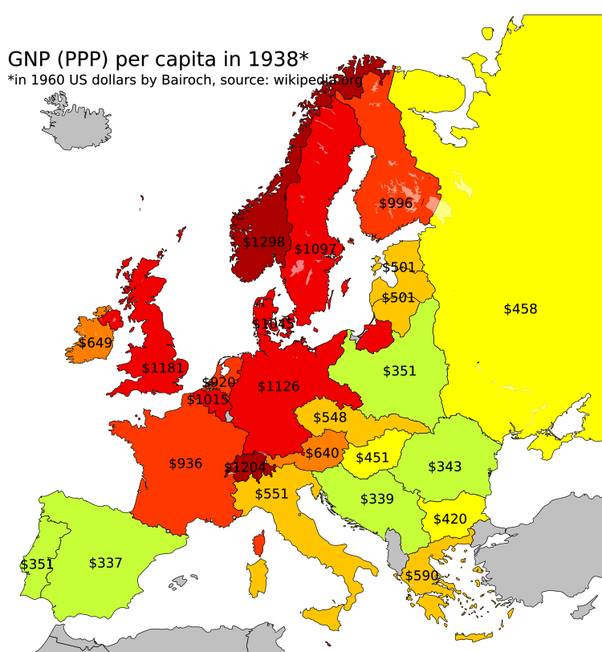
photos_and_videos/TimelinePhotos_SxeO6JU-xg/49373614_10156897969902264_8666776646461685760_n_10156897969897264.jpg Croib MagaWhy was Norway rich in the early 20th century?Jan 5, 2019, 9:10 PMSean RingHere you go:
https://link.medium.com/ZwVbNGbgfTJan 5, 2019, 9:12 PMCroib MagaWow. Never thought about that but it makes sense.Jan 5, 2019, 9:17 PMSean RingThe morals of the story:
1. Be smart about your natural resources. (Norway)
2. If you don’t have any, build a banking industry. (Switzerland)
3. Manufacture, don’t bitch, to paraphrase James. (Germany, France, UK)
4. Secede from the laziness. (Italy would be at least 70% higher without the Mezzogiorno.)
5. Stay away from wine and war (the rest).Jan 5, 2019, 9:18 PMJonathan TilasWhat’s GNP?Jan 5, 2019, 9:28 PMSean RingGross National Product. It’s how they used to measure output before they switched to GDP. Quickly, it’s economic output by citizenship (regardless of where it’s produced) versus output within a country’s borders (regardless of who produced it).Jan 5, 2019, 9:35 PMGreg Hamiltonactually the moral of the story is have a R1b dominant society.Jan 5, 2019, 10:03 PMJonathan TilasSo wouldn’t higher numbers be better? I’m looking at this through the lens of GDPJan 5, 2019, 10:06 PMSean RingIf that were the case, Iberia would be much better off. https://upload.wikimedia.org/wikipedia/commons/e/ec/Haplogroup_R1b_%28Y-DNA%29.PNGJan 5, 2019, 10:44 PMSean RingJonathan Tilas Yes, absolutely.Jan 5, 2019, 10:45 PMSean RingThis may be clearer.Jan 5, 2019, 10:45 PMSean RingAnd I think the above reads “GDP” but they mean “GNP”.Jan 5, 2019, 10:46 PMVengefül BobmoranClearly GNP and GDP are missing something.
Who cares if you’re doing bank while selling your future? You’re not productive, you’re just a shitty accountant.
Or : No matter how rich you think you are, your own replacement is but a few distracted decades away.Jan 5, 2019, 11:43 PMLee TuckerSurprised Spain is so low. They really frittered their Empire`s legacyJan 6, 2019, 12:11 AMSean RingLee Tucker so true. If you haven’t read Ferguson’s Empire, I recommend it. It’s about England, but he contrasted how the Spanish crown constantly defaulted on its debt, despite having looted South America of its gold and silver, while England always paid its debts.Jan 6, 2019, 12:27 AMGreg HamiltonI didn’t claim guaranteed results.
Statistics don’t work that way.Jan 6, 2019, 12:35 AMGreg HamiltonThe wealth of nations map highly correlates to the R1b R1a line.Jan 6, 2019, 12:36 AMSean RingAnd correlation doesn’t imply causation. Though, it is an interesting observation.Jan 6, 2019, 1:14 AMGreg HamiltonWell no shit…
It’s more than an interesting observation. Genetics equals outcomesJan 6, 2019, 1:18 AMSean RingGreg, I don’t mean to piss on your parade, but basing anything on one variable isn’t good statistics.
First, GNP/GDP is output, not wealth. I’m not splitting hairs there; debt matters. Second, the Scandis are every bit as productive, though their haplogroup isn’t R1b. I’ve already mentioned Iberia. Third, if the US didn’t defend Western Europe after WW2, the USSR would have run over the rest, destroying output everywhere. Luckily, they wouldn’t have to go over the Pyrenees.
I’m onboard that IQ matters. But could you refer me to a paper on R1b dominant societies?Jan 6, 2019, 1:37 AMGöran DahlR1b is a Y-haplogroup, Greg; it doesn’t have an impact on your appearance, intelligence or behaviour. I hope you understand that. More than a quarter of all African-Americans are R1b, just so you know, and there’s an almost equal distribution of R1a and R1b in Germany and Norway, while there’s more than twice as much R1a in Sweden than R1b.Jan 6, 2019, 3:51 AMRichard HallSean Ring The Spanish empire was centrally run. The British was based on free enterprise.Jan 6, 2019, 4:46 AMLisa OuthwaiteNordic race FTW.Jan 6, 2019, 8:30 AMBartosz SzykThis map says only one thing – this was the GDP of the European countries in 1938.. nothing else..Jan 6, 2019, 10:48 AMGreg Hamiltondid I state a guarantee? No
Did I state no other factors matter? No
Did I state no other Haplogroups have a chance of success? No
I’m not a mathematician but even I can figure out that threshold levels would matter (Africa) and that mixing different Haplogroups in varying percentages would create different outcomes.
DNA plays a part in creating culture. DNA impacts IQ. Cultural IQ impacts success. IQ isn’t the only part of DNA that matters to success of a culture.
A betting man having no other information to help factor would pick a R1b dominant culture as a prediction of successJan 6, 2019, 11:42 AMGöran DahlAs long as you understand that haplogroups have nothing to do with DNA at large, and that changing a man’s haplogroup from R1b to I1a does nothing to him, save for altering his paternal lineage.Jan 6, 2019, 12:25 PMGreg Hamiltonlol. Does nothing to him.
Because lineage has nothing to do with who you are or cultureJan 6, 2019, 12:37 PMGreg Hamiltonhttps://www.sciencedirect.com/science/article/pii/S0160289612000529Jan 6, 2019, 12:38 PMGöran DahlIt does, in the sense that it tells you where your paternal ancestor came from. Don’t confuse it with autosomal DNA, which determines your ethnicity.Jan 6, 2019, 12:38 PMGreg HamiltonShow me anywhere in my discussion where I claimed it to be everything and other factors don’t matter ?
You’re correcting or attempting to educate me on things I never said.Jan 6, 2019, 12:40 PMGreg HamiltonI say again. In the absence of other factors a betting man would pick a R1b dominant culture. It’s a solid solid betJan 6, 2019, 12:41 PM