GRAMMARS: Myths > Fictionalisms > Literatures (fictions) > Histories > Sciences > Logics > Senses The continuous recursive disambiguation of reality, from the most intuitionistic and subjective measurements, to the most non-intuitive and objective measurements. All speech consists of weights and measures. We just constantly improve our weights and measures. Parsimony(a fully accounted consistency, correspondence, possibility, and coherence) consists of the true names of the categories of the universe. They are just very costly and time consuming for humans to discover.
Theme: Grammar
-
Grammars
GRAMMARS: Myths > Fictionalisms > Literatures (fictions) > Histories > Sciences > Logics > Senses The continuous recursive disambiguation of reality, from the most intuitionistic and subjective measurements, to the most non-intuitive and objective measurements. All speech consists of weights and measures. We just constantly improve our weights and measures. Parsimony(a fully accounted consistency, correspondence, possibility, and coherence) consists of the true names of the categories of the universe. They are just very costly and time consuming for humans to discover.
-
Curt Doolittle updated his status. GRAMMARS: Myths > Fictionalisms > Literatures
Curt Doolittle updated his status.
GRAMMARS: Myths > Fictionalisms > Literatures (fictions) > Histories > Sciences > Logics > Senses
The continuous recursive disambiguation of reality, from the most intuitionistic and subjective measurements, to the most non-intuitive and objective measurements.
All speech consists of weights and measures. We just constantly improve our weights and measures.
Parsimony(a fully accounted consistency, correspondence, possibility, and coherence) consists of the true names of the categories of the universe.
They are just very costly and time consuming for humans to discover.
Source date (UTC): 2018-07-09 17:05:46 UTC
-
Curt Doolittle updated his status. THE GRAMMARS OF DECEPTION AND ADDICTION the p
Curt Doolittle updated his status.
THE GRAMMARS OF DECEPTION AND ADDICTION
the purpose of christianity is subjugation (submission)
the purpose of judaism is subjugation (submission).
the purpose of islam is subjugation (submission)
Abrahamic grammars of pilpul and critique are simply well constructed lies that through repeated use produce an addiction response, the same way that membership in (submission to) the pack or tribe produces an addiction response.
It’s a brilliant hack really.
Evil as hell.
But brilliant.
Source date (UTC): 2018-07-09 15:58:22 UTC
-
GRAMMARS: Myths > Fictionalisms > Literatures (fictions) > Histories > Sciences
GRAMMARS: Myths > Fictionalisms > Literatures (fictions) > Histories > Sciences > Logics > Senses
The continuous recursive disambiguation of reality, from the most intuitionistic and subjective measurements, to the most non-intuitive and objective measurements.
All speech consists of weights and measures. We just constantly improve our weights and measures.
Parsimony(a fully accounted consistency, correspondence, possibility, and coherence) consists of the true names of the categories of the universe.
They are just very costly and time consuming for humans to discover.
Source date (UTC): 2018-07-09 13:05:00 UTC
-
THE GRAMMARS OF DECEPTION AND ADDICTION the purpose of christianity is subjugati
THE GRAMMARS OF DECEPTION AND ADDICTION
the purpose of christianity is subjugation (submission)
the purpose of judaism is subjugation (submission).
the purpose of islam is subjugation (submission)
Abrahamic grammars of pilpul and critique are simply well constructed lies that through repeated use produce an addiction response, the same way that membership in (submission to) the pack or tribe produces an addiction response.
It’s a brilliant hack really.
Evil as hell.
But brilliant.
Source date (UTC): 2018-07-09 11:58:00 UTC
-
JOSLIN HITS IT OUT OF THE PARK. by Bill Joslin (Just want to say that no one els
JOSLIN HITS IT OUT OF THE PARK.
by Bill Joslin
(Just want to say that no one else has made it this far, and bill is rocking it.)
1 ———-
PSYCHOLOGY
Psychology – ostensive (experiential) argumentation to account for behavior.
Incentive: seek a monopoly on perception via ostensive grammars
Alternative: Aquisitionism where by human behaviour can be fully accounted via incentives.
Outcome: a market for coherence via descriptive explanations of behaviour which can be tested with low or no context (declarative).
2 ————
POLITICAL *-OCRACY
Any *-ocracy (democracy, oligarchy, Plutarchy, monarchy etc) are systemic moral justifications for control of nomocracy argued through imperatives.
Incentive: to obtain a monopoly on the creation and execution of law – power over others argued via preferences for one “the good”.
Alternative: propertarianism whereby all transactions must meet the criteria of perfect reciprocity.
Outcome: disambiguous execution of law. A market for the creation of many “goods”.
3 ———-
RELIGIOUS THEOLOGY
Religio-philosophical are sets of arguments for prefered criteria of measuring truth.
Incentive: obtain a monopoly on truth (justify god like proclamations about reality). Unwarranted declaration.
Alternative: Testimonialism which uses all available criteria to demonstrate due diligence in eliminating error, bias, and deception
Outcome: a market for coherence.
4 ———
MONOPOLY(DECEPTION) VS MARKET(TRUTH)
In all cases above, the former uses ostensive or imperative grammars to obtain a monopoly.
Each alternative “deframes” arguments, converting ostensive and imperative grammars into declarative statements.
Why? Because only the declarative has the quality of being testable.
This results in the destruction of monopolies over perception, law (violence) and truth allowing reality to dictate decisions and actions.
Source date (UTC): 2018-07-08 19:53:00 UTC
-
Bill Joslin Pls tell me how you interpret the readability of this bit of text. I
Bill Joslin
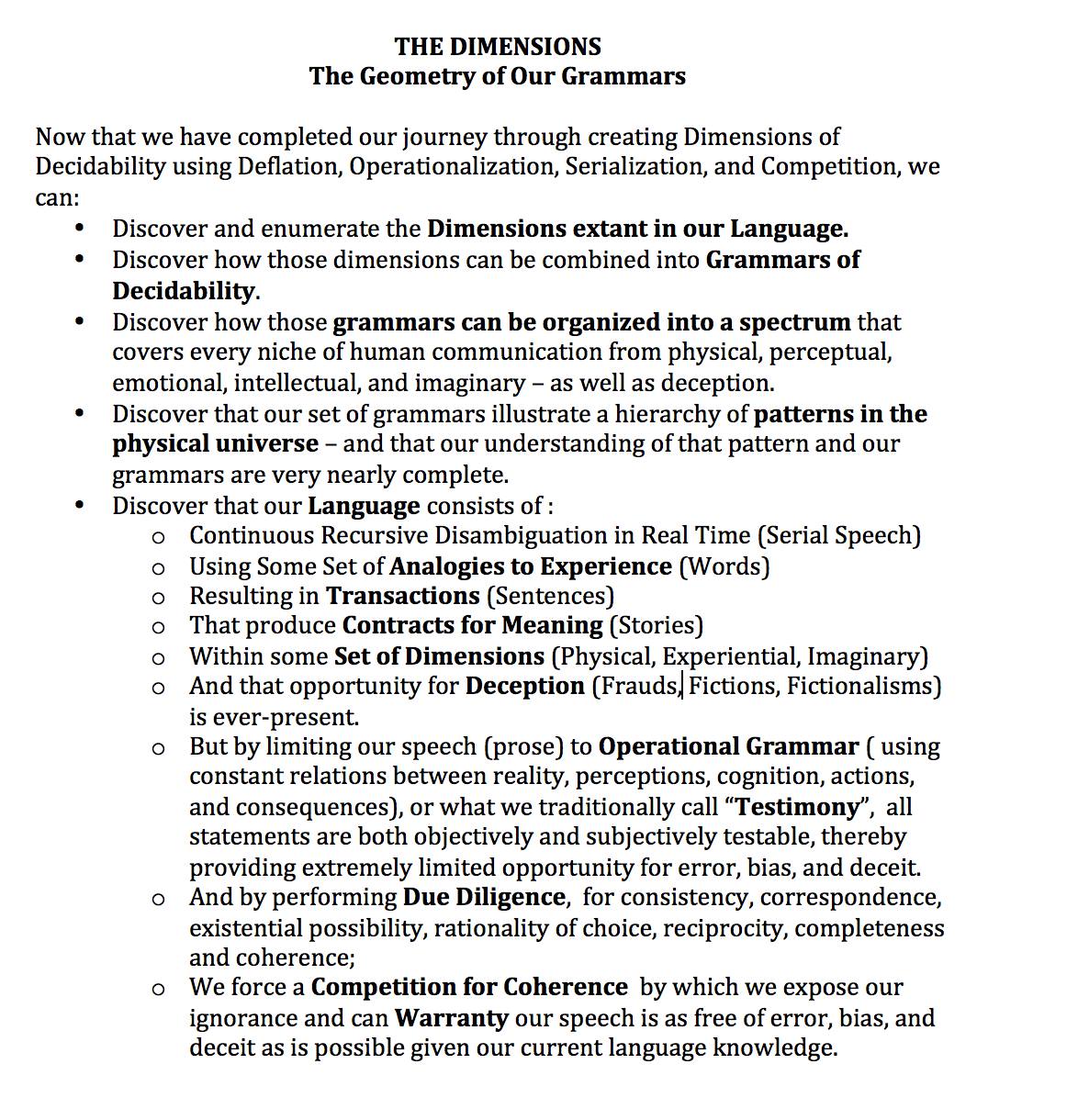
Pls tell me how you interpret the readability of this bit of text. It is quite dense, but provides a summary of the chapter topics. -thx
Source date (UTC): 2018-07-07 20:06:35 UTC
-
photos_and_videos/your_posts/36788064_10156480109452264_7785502387283689472_o_10
photos_and_videos/your_posts/36788064_10156480109452264_7785502387283689472_o_10156480109447264.jpg @[655376421:2048:Bill Joslin]
Pls tell me how you interpret the readability of this bit of text. It is quite dense, but provides a summary of the chapter topics. -thxNeil A. BucklewIt occurs to me, that the complete grammers will continuously be just inside the edge of complete (broadly withheld from reaching the actual limit as a whole system, because it is not continous in all dimensions, as operations are discrete, iterated operations create a discrete spectrum, with no exclusions). And that only local or specific exchanges will be proven (or will need to be, most importantly, as time and energy are constraints on usage) complete through serial speech attested to by the participants, as in a court trial.
the complete grammers can only be described as complete with the spectrum defining its limits in all proven dimensions, with room for new dimensions(if any exist and can be found) being bound to the iterative process.
i think all i have really said here, is to change the third bullet point to say: “discover how those grammers can be organized into a DISCRETE SPECTRUM that covers…”. with the understanding that this system being discrete also incorporates non discrete subsystems.
as i have not fully incorporated the grammers as a practice i will likely need to come back for correction.Jul 07, 2018 5:08pmCurt Doolittletrue, but i think i have all the categories. and thats because they start repeating (recursively)Jul 07, 2018 5:49pmCurt Doolittleand thank you btw… :)Jul 07, 2018 5:49pmNeil A. Bucklewright. once you realize the categories repeat recursively, you have ALL categories.Jul 07, 2018 5:50pmNeil A. Bucklewso really you are just identifying sub sections that were unknown.Jul 07, 2018 5:51pmBill JoslinLooking nowJul 07, 2018 6:08pmBill JoslinI think this is good. I see no errors. If anything, it serves more than just as a summary but also as a measure of understanding. What I mean by measure of understanding, each bullet acts as a touchstone. If read and it isn’t completely clear and complete in to the student/reader then they know there is more to integrate and understand.
As per last night’s conversation we might eventually be able to bridge this to a “Geometry of Accountable Action”. Faliure to act successfully, I’m thinking, suffers from a similiar sort of ambiguity (ambiguity of perception and intention) and thus as the west continued to disambiguate grammars, more degrees-of-freedom to act became available.Jul 07, 2018 6:21pmBill Joslin(as per the first paragraph above – the summary acts as a demonstration of its content)Jul 07, 2018 6:23pmReece Edward HaynesPersonally I find this to be very helpful. Maps out how these elements fit together, what they contribute towards and allows me to see at a glance where I need to study more deeply.Jul 07, 2018 6:49pmCurt DoolittleI think I have the whole thing reduced to forms that almost everyone will understand. We’ll see. But I think so.Jul 07, 2018 6:59pmNeil A. Bucklewthere is one problem here. continuous disambiguation increases complexity. increased complexity decreases degrees of freedom. good to restrict people from lies, but also tends to railroad people on to chains of action, with few options and increasingly rare opportunities for change.Jul 07, 2018 7:06pmCurt Doolittle?? no that phrse refers to universal grammarJul 07, 2018 7:34pmLuan RaphaelI wouldn’t place the “But” part at the same nesting level under the “Our language consists of” part.Jul 07, 2018 7:56pmLuan RaphaelI’d pull it back an restart with “discover”, such as: Discover that by limiting…Jul 07, 2018 7:57pmLuan RaphaelBut that’s just a formatting detail, of course.Jul 07, 2018 7:58pmCurt Doolittleshared vision. already moved. ;)Jul 07, 2018 8:06pmNeil A. Bucklewbut our words are also our actions. they have observable behavioral consequences. they weave dicernable patterns.
we are accountable for lies(violence of information, in the experiential and imaginary dimensions) just as we are for physical violence in the physical dimension.Jul 07, 2018 8:18pmBill JoslinDisambiguation doesn’t necessarily result in complication. It would only do so if the object/concept being expressed had been oversimplified or is inherently complicated.
Further to that thete is a distinction between complicated and complex. Complex systems result from non-linear iterations (reflexive) of a few simple processes. Complication results from layering of many many simple linear process. (Roughly speaking)Jul 07, 2018 8:35pmNeil A. Bucklewlet me correct my language and go through my process publicly, as your original statement never mentioned complexity or complication, but i inferred it from continuous disambiguation. feel free to correct any of this technobabble and point out what i am missing.
it is not merely continuous disambiguation. disambiguation is one of the simple processes, along with serialization that are iterated, creating a complex system(the grammars).
complexity can be described with a scalar. that is you can describe the “level” of complexity of a system with a single number. in the cases we are dealing with, that is usually the number of iterations of the fundamental “simple” process or processes, which also has a non zero complexity. I.e a minimal axiomatic descriptive complexity of each single process, or there would be nothing to iterate. but complexity(as it is studied) is not restricted to large numbers of iterations of a handful of simple processes and their results, but can be many simple processes and systems with iterations, and only certain parts of the process of one system interact with other simple systems or the complex system independently. this includes your separate definition of Complication.
so all systems/processes can be described as complex, just to what degree. though counterintuitive, it is not really different from stating that there is no deceleration, only movement and change of movement known as acceleration. of course, that does not necessarily make it true, merely a candidate.
complication (as i see it, and have learned to internally define it, as i have not seen a formal definition that delineates it from complexity), cannot be described as a scalar. complication is a description from outside the system or process, based upon emotion as a reaction to being faced with a system or process whos complexity scalar is higher than one wants to deal with and would prefer to reduce.
so i am giving you hell here it may seem, but it is in the pursuit of clarity and disambiguation. there is a lot of work yall have done that i have missed, and what better way than to jump in the pool and start swimming.Jul 07, 2018 9:50pmBill JoslinHave you gone through Curt’s document laying out the grammars. I’m not sure we’re having the same conversationJul 08, 2018 12:17amNeil A. BucklewBill this? if so, yes. i have not seen a document specifying definitions.
https://propertarianism.com/category/attributes/grammar-of-natural-law/Jul 08, 2018 1:07amBill JoslinNeil A. Bucklew no. the great big spreadsheetJul 08, 2018 2:02amNeil A. BucklewBill Joslin where is this? there is a lot of stuff on propertarianism.com but this does not show up front for something so important.Jul 08, 2018 2:42amCurt DoolittleGrammars of Decidability (Draft)
https://propertarianism.files.wordpress.com/2017/10/periodic-table-of-speech-draft2.pdf
pls do not spread this around since it’s pre-release material and this is only last fall’s version. And because it is one of the principle insights for framing langauge as transactions.Jul 08, 2018 7:13amNeil A. BucklewCurt Doolittle you can delete this now.Jul 08, 2018 3:45pmBill Joslin
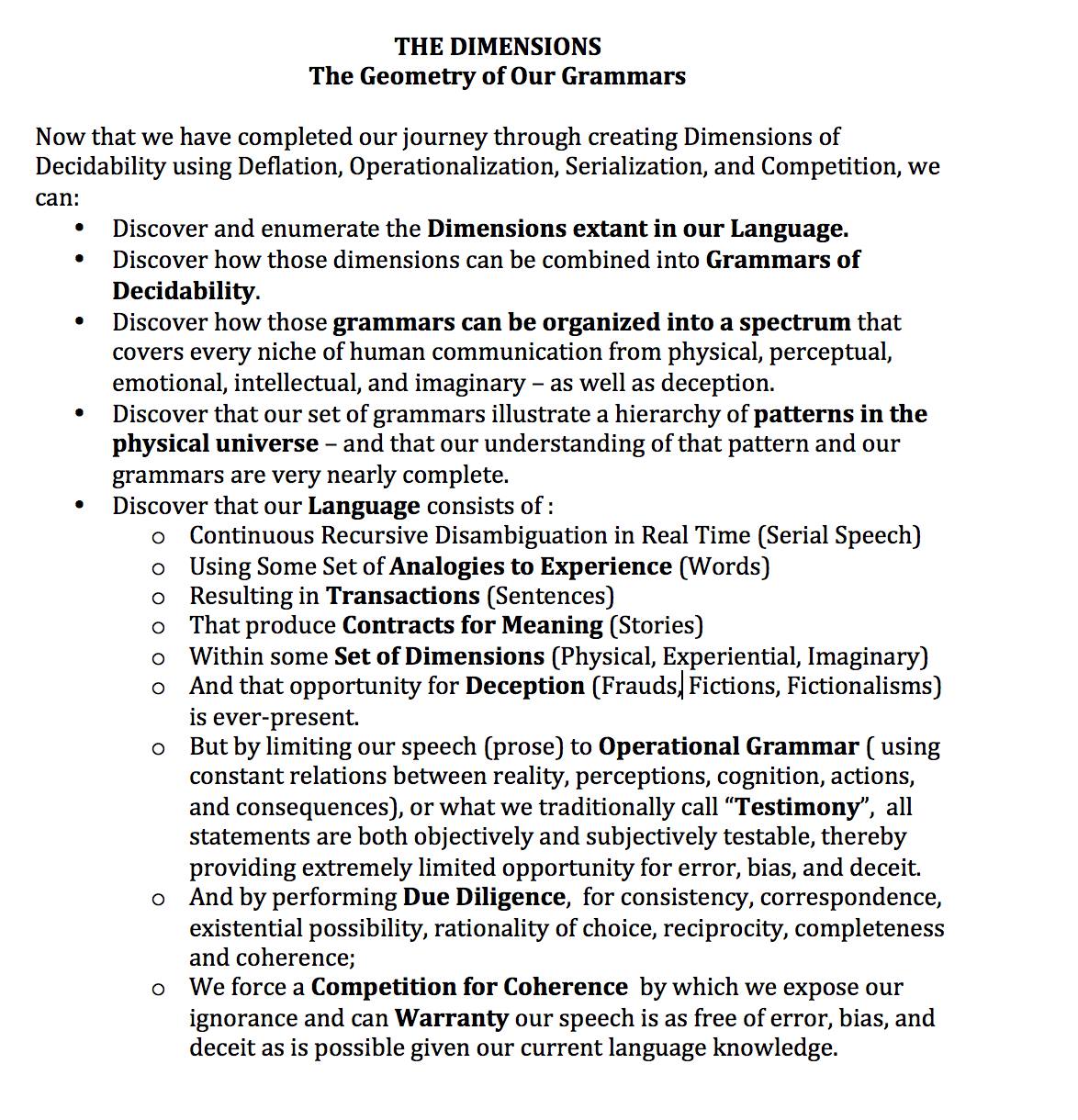
Pls tell me how you interpret the readability of this bit of text. It is quite dense, but provides a summary of the chapter topics. -thx
Source date (UTC): 2018-07-07 16:06:00 UTC
-
photos_and_videos/TimelinePhotos_43196237263/36788064_10156480109452264_77855023
photos_and_videos/TimelinePhotos_43196237263/36788064_10156480109452264_7785502387283689472_o_10156480109447264.jpg @[655376421:2048:Bill Joslin]
Pls tell me how you interpret the readability of this bit of text. It is quite dense, but provides a summary of the chapter topics. -thxNeil A. BucklewIt occurs to me, that the complete grammers will continuously be just inside the edge of complete (broadly withheld from reaching the actual limit as a whole system, because it is not continous in all dimensions, as operations are discrete, iterated operations create a discrete spectrum, with no exclusions). And that only local or specific exchanges will be proven (or will need to be, most importantly, as time and energy are constraints on usage) complete through serial speech attested to by the participants, as in a court trial.
the complete grammers can only be described as complete with the spectrum defining its limits in all proven dimensions, with room for new dimensions(if any exist and can be found) being bound to the iterative process.
i think all i have really said here, is to change the third bullet point to say: “discover how those grammers can be organized into a DISCRETE SPECTRUM that covers…”. with the understanding that this system being discrete also incorporates non discrete subsystems.
as i have not fully incorporated the grammers as a practice i will likely need to come back for correction.Jul 07, 2018 5:08pmCurt Doolittletrue, but i think i have all the categories. and thats because they start repeating (recursively)Jul 07, 2018 5:49pmCurt Doolittleand thank you btw… :)Jul 07, 2018 5:49pmNeil A. Bucklewright. once you realize the categories repeat recursively, you have ALL categories.Jul 07, 2018 5:50pmNeil A. Bucklewso really you are just identifying sub sections that were unknown.Jul 07, 2018 5:51pmBill JoslinLooking nowJul 07, 2018 6:08pmBill JoslinI think this is good. I see no errors. If anything, it serves more than just as a summary but also as a measure of understanding. What I mean by measure of understanding, each bullet acts as a touchstone. If read and it isn’t completely clear and complete in to the student/reader then they know there is more to integrate and understand.
As per last night’s conversation we might eventually be able to bridge this to a “Geometry of Accountable Action”. Faliure to act successfully, I’m thinking, suffers from a similiar sort of ambiguity (ambiguity of perception and intention) and thus as the west continued to disambiguate grammars, more degrees-of-freedom to act became available.Jul 07, 2018 6:21pmBill Joslin(as per the first paragraph above – the summary acts as a demonstration of its content)Jul 07, 2018 6:23pmReece Edward HaynesPersonally I find this to be very helpful. Maps out how these elements fit together, what they contribute towards and allows me to see at a glance where I need to study more deeply.Jul 07, 2018 6:49pmCurt DoolittleI think I have the whole thing reduced to forms that almost everyone will understand. We’ll see. But I think so.Jul 07, 2018 6:59pmNeil A. Bucklewthere is one problem here. continuous disambiguation increases complexity. increased complexity decreases degrees of freedom. good to restrict people from lies, but also tends to railroad people on to chains of action, with few options and increasingly rare opportunities for change.Jul 07, 2018 7:06pmCurt Doolittle?? no that phrse refers to universal grammarJul 07, 2018 7:34pmNeil A. Bucklewbut our words are also our actions. they have observable behavioral consequences. they weave dicernable patterns.
we are accountable for lies(violence of information, in the experiential and imaginary dimensions) just as we are for physical violence in the physical dimension.Jul 07, 2018 8:18pmBill JoslinDisambiguation doesn’t necessarily result in complication. It would only do so if the object/concept being expressed had been oversimplified or is inherently complicated.
Further to that thete is a distinction between complicated and complex. Complex systems result from non-linear iterations (reflexive) of a few simple processes. Complication results from layering of many many simple linear process. (Roughly speaking)Jul 07, 2018 8:35pmNeil A. Bucklewlet me correct my language and go through my process publicly, as your original statement never mentioned complexity or complication, but i inferred it from continuous disambiguation. feel free to correct any of this technobabble and point out what i am missing.
it is not merely continuous disambiguation. disambiguation is one of the simple processes, along with serialization that are iterated, creating a complex system(the grammars).
complexity can be described with a scalar. that is you can describe the “level” of complexity of a system with a single number. in the cases we are dealing with, that is usually the number of iterations of the fundamental “simple” process or processes, which also has a non zero complexity. I.e a minimal axiomatic descriptive complexity of each single process, or there would be nothing to iterate. but complexity(as it is studied) is not restricted to large numbers of iterations of a handful of simple processes and their results, but can be many simple processes and systems with iterations, and only certain parts of the process of one system interact with other simple systems or the complex system independently. this includes your separate definition of Complication.
so all systems/processes can be described as complex, just to what degree. though counterintuitive, it is not really different from stating that there is no deceleration, only movement and change of movement known as acceleration. of course, that does not necessarily make it true, merely a candidate.
complication (as i see it, and have learned to internally define it, as i have not seen a formal definition that delineates it from complexity), cannot be described as a scalar. complication is a description from outside the system or process, based upon emotion as a reaction to being faced with a system or process whos complexity scalar is higher than one wants to deal with and would prefer to reduce.
so i am giving you hell here it may seem, but it is in the pursuit of clarity and disambiguation. there is a lot of work yall have done that i have missed, and what better way than to jump in the pool and start swimming.Jul 07, 2018 9:50pmBill JoslinHave you gone through Curt’s document laying out the grammars. I’m not sure we’re having the same conversationJul 08, 2018 12:17amNeil A. Bucklew@[655376421:2048:Bill] this? if so, yes. i have not seen a document specifying definitions.
https://propertarianism.com/category/attributes/grammar-of-natural-law/Jul 08, 2018 1:07amBill Joslin@[586461036:2048:Neil A. Bucklew] no. the great big spreadsheetJul 08, 2018 2:02amNeil A. Bucklew@[655376421:2048:Bill Joslin] where is this? there is a lot of stuff on propertarianism.com but this does not show up front for something so important.Jul 08, 2018 2:42amCurt DoolittleGrammars of Decidability (Draft)
https://propertarianism.files.wordpress.com/2017/10/periodic-table-of-speech-draft2.pdf
pls do not spread this around since it’s pre-release material and this is only last fall’s version. And because it is one of the principle insights for framing langauge as transactions.Jul 08, 2018 7:13amNeil A. Bucklew@[741197263:2048:Curt Doolittle] you can delete this now.Jul 08, 2018 3:45pmBill Joslin
Pls tell me how you interpret the readability of this bit of text. It is quite dense, but provides a summary of the chapter topics. -thx
Source date (UTC): 2018-07-07 16:06:00 UTC