Theme: Grammar

  • Don’t confuse words for facts. Words are measurements that reflect sense-percept

    Don’t confuse words for facts. Words are measurements that reflect sense-perception-utility-value. We may not know how to measure correctly (have the right words).

    The brain uses very a simple three way matrix for emotions, and it biases them only by reproductive strategy.


    Source date (UTC): 2020-04-19 16:29:02 UTC

    Original post: https://twitter.com/i/web/status/1251910688102133766

    Reply addressees: @MrMatt444 @JonHaidt

    Replying to: https://twitter.com/i/web/status/1251908687557537798

  • I am a public intellectual. I use it by its definition. I use it by its definiti

    I am a public intellectual. I use it by its definition. I use it by its definition as used by public intellectuals. I cannot cow tow to every colloquial version of terms or I would have none to use. 😉


    Source date (UTC): 2020-04-14 22:02:43 UTC

    Original post: https://twitter.com/i/web/status/1250182724125630465

    Reply addressees: @jim_rutt @_Indirection

    Replying to: https://twitter.com/i/web/status/1250180987855802372

  • by Bjarg Jonsson Each academic discipline has it’s own language and terminology.

    by Bjarg Jonsson

    Each academic discipline has it’s own language and terminology. Part of becoming a professional in a discipline requires a basic mastery of the language used in describing the principles of operation.

    I have no academic background in law. However, with a Black’s Law Dictionary one can research what particular words mean in the practice of law. Reasonable suspicion, probable cause, jury nullification, etc can be understood by layman; otherwise a policeman could not arrest someone for a crime and write the changing documents with the elements to reach probable cause for indictment.

    I was taught in grad school, the difference between average people and bright people was not whether average people could learn something. But bright people just learn faster, which would be an advantage in multi discipline learning.

    John Mark is very important because he is explaining the concepts of propertarianism in the language of the everyday person and they get it. When we want to impress each other with how smart we are we use words (big) which are not normally in the other guy’s lexicon. Want reach the masses, you have use words out of their dictionary. They will get it, tit for tat.


    Source date (UTC): 2020-04-13 20:30:00 UTC

  • MATH VERSUS NATURAL LAW — THE SAME? Math is a logic of positional naming, and

    MATH VERSUS NATURAL LAW — THE SAME?

    Math is a logic of positional naming, and Natural law a logic of Property Naming. The grammar of both Math and Law consists of operations on names. So in math we use operations to maintain balance (equilibrium) on both sides of an equal’s sign, and in natural law we use operations to maintain balance between individuals.

    See?

    Here:

    Human Logical Facility (constant relations) >

    …. Human Language Facility (sequence of sounds) >

    …. …. Human Grammar Facility (rules of continuous recursive disambiguation) >

    …. …. …. Grammars (deflationary <- ordinary -> inflationary) >

    …. …. …. …. Math (positional names) >

    …. …. …. …. …. Programming (procedural names) >

    …. …. …. …. …. …. Natural Law (human actions) >

    …. …. …. …. …. …. …. Ordinary Language (utility) >

    …. …. …. …. …. …. …. …. Opining (Loading, Framing)

    …. …. …. …. …. …. …. …. …. Fictions (adding what’s not there)

    …. …. …. …. …. …. …. …. …. …. Fictionalisms (sophistry pseudoscience, supernaturalism)

    …. …. …. …. …. …. …. …. …. …. …. Deceit (lying)

    …. …. …. …. …. …. …. …. …. …. …. …. Denial

    …. …. …. …. …. …. …. …. …. …. …. …. …. Silence

    (Notice: Note how I left out verbal logic, rationalism, and philosophy because they’re included in sophistry.)


    Source date (UTC): 2020-04-12 08:33:00 UTC

  • “In Natural Law, what would represent the radix? Moreover, as in mathematics whe

    —“In Natural Law, what would represent the radix? Moreover, as in mathematics where the radix point separates integers from fractionals, would you say in Natural Law the radix point exists between ordinary language and opining?”—Billy Law-Bregan

    Smart. Good thinking. Good question.

    In mathematics the radix is the base set of names of positions (nouns), before restoring to positional naming (multipliers of the base: phrases). The grammar of mathematics adds the possible operations (verbs), all of which are variations on addition or its reverse, subtraction (transformations), and the only possible tests of positional comparison, less, equal, or greater (equilibria), an the only possible test of agreement (truth, false, undecidable)

    In law, the equivalent of radix (base nouns) consist of the vocabulary of actionable references given human facility for sensation, perception, intuition (nouns, names, referents), the vocabulary of operations (verbs, thought word and deed), and the possible changes in state (transformations), and the and the only possible tests comparison (possibility) and only possible test of agreement (empiricism-observation-action, logic-consistency-intuition-word, and experience-sense-perception-autoassociation ).

    So yes the human grammatical facility, and the structure of grammar, the structure of transactions with that grammar(journal), and the epistemology of the story(ledger) is the same across every one of the grammars from deflationary (math) to functional (programming) to operational (natural law) to ordinary language to the inflationary grammars of narratives, fictions, fictionalisms, and deceits.

    MATH: Actor (presumed), associated reference (object named by positional name), name of referent – number (positional name), transformation, change in state, consequence, external consequence, repeat, sum, total.

    LAW: Actor, Action (name of human action), associated reference (object), transformation, change in state, consequence, external consequence, repeat, sum, total.

    STORY: name of referent – actor, action, transformation, consequence, external consequence, repeat, sum, total

    All grammars are the same and accounting, finance, and economics are the least error prone methods of describing human action. In this sense, law asks us for a full accounting of human actions so that we can test whether the statements are testifiable (fully accounted) or not, and if not, then how they are not fully accounted, and by deduction, why they aren’t. (ignorance, error, bias, wishful thinking, loading-farming, suggestion-obscurantism-overloading, the fictionalisms of sophistry, pseudoscience, or the occult, or outright deceit.

    Ergo P-law fits in the sequence: arithmetic, accounting, programming, natural law, economics, group strategy.


    Source date (UTC): 2020-04-12 08:33:00 UTC
  • So (a) I’m speaking to the audience in a compromise grammar (market). (b) You ar

    So (a) I’m speaking to the audience in a compromise grammar (market). (b) You are disapproving without doing due diligence (assuming you understand and not asking why I’m doing so),(c) countersignaling my shaming of your for failure of due diligence.

    Learn the law. End error. 😉


    Source date (UTC): 2020-04-05 15:31:11 UTC

    Original post: https://twitter.com/i/web/status/1246822702566031360

    Reply addressees: @MillikanTamzin @DudeMaximus

    Replying to: https://twitter.com/i/web/status/1246822205083791361


    IN REPLY TO:

    Unknown author

    @MillikanTamzin @DudeMaximus Shaming for disapproval to avoid the argument, falsehood, irreciprocity, and failure of due diligence, is a demand for restitution, under test of reciprocity. The opposite is not.

    Learn the law. You will be better for it.

    Me: “Speak to the audience in a compromise grammar.”

    Original post: https://x.com/i/web/status/1246822205083791361

  • photos_and_videos/TimelinePhotos_kg5QueHwVw/92324954_249561333108694_21594331704

    photos_and_videos/TimelinePhotos_kg5QueHwVw/92324954_249561333108694_21594331704

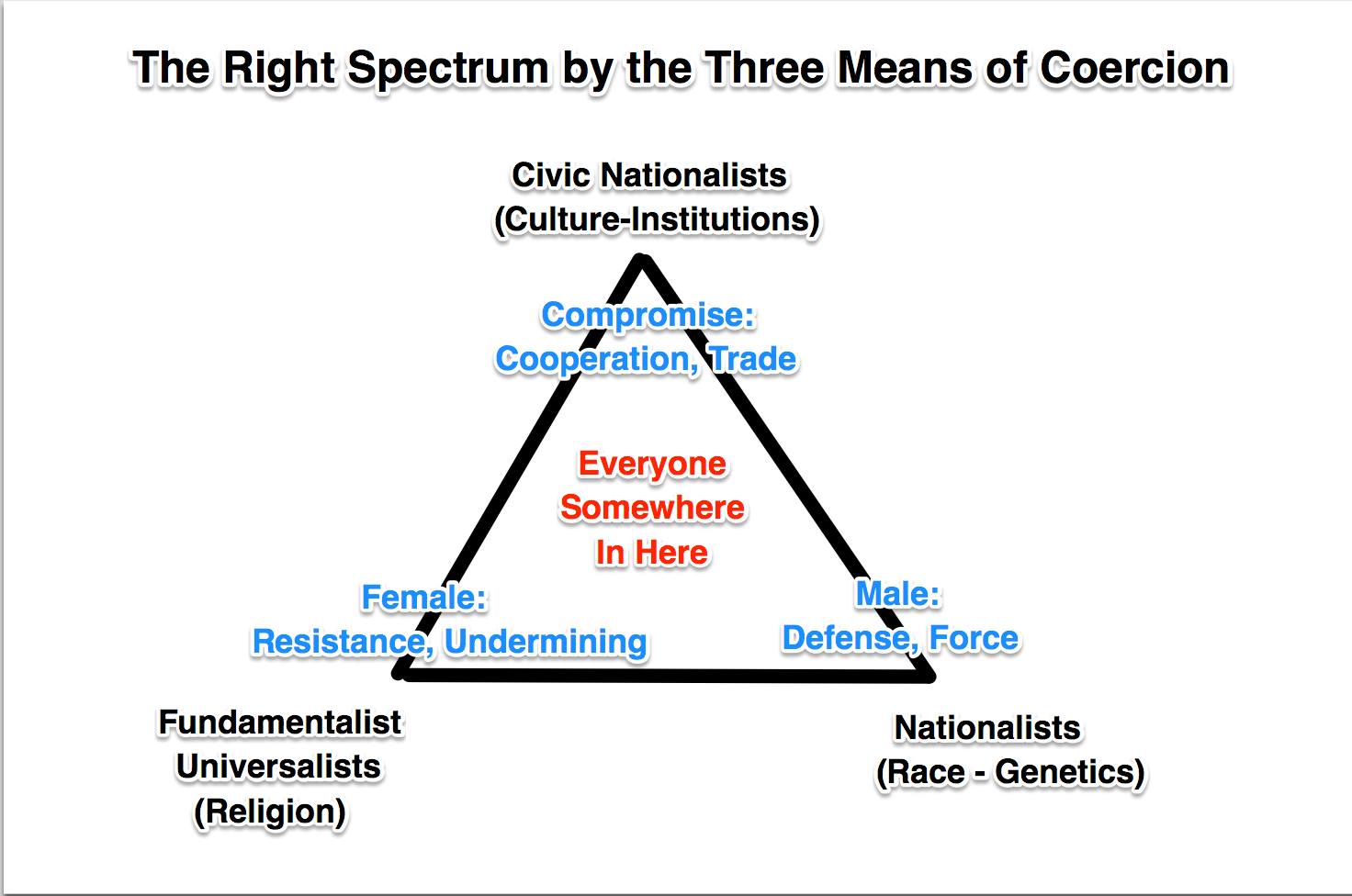
    photos_and_videos/TimelinePhotos_kg5QueHwVw/92324954_249561333108694_2159433170435440640_o_249561326442028.jpg OUR PEOPLE USE AT LEAST THREE GRAMMARS, SPEAK IN A COMPROMISE GRAMMAR (important)

    (a grammar = paradigm, vocabulary, operations, logic)

    1) Theology (intuition) Feminine

    2) Philosophy (reason) Compromise

    3) Law-Science (action) Masculine.

    and otherwise in:

    4) Ordinary (normative) language

    Some of us specialize. Some of us generalize (ordinary language). Some of us combine.

    I largely speak in law-science

    I can bridge to philosophy (rationalism)

    I can bridge to theology (intuition)

    This bridges mean ‘compromise on common ground’ and avoid uncommon ground.

    We are common ground on natural law, christian love, and some sort of constitution (usually).

    We are on uncommon ground on atheism, fundamentalism, sophistry and critique, and pseudoscience.

    Western civilization has always been trifunctional, with ‘priests’ for law, and faith, and generals for war. We can only succeed as western civilization as trifunctional. Because human beings feel, think, and act by trifunctional differences. Because those differences are biological. And it is the COMPROMISE between those positions by exchange within the market despite our desires for extremes exclusively in our interests that allowed us to out-compete all other peoples until the second semitic destruction of our civilization from within in the 20th century.OUR PEOPLE USE AT LEAST THREE GRAMMARS, SPEAK IN A COMPROMISE GRAMMAR (important)

    (a grammar = paradigm, vocabulary, operations, logic)

    1) Theology (intuition) Feminine

    2) Philosophy (reason) Compromise

    3) Law-Science (action) Masculine.

    and otherwise in:

    4) Ordinary (normative) language

    Some of us specialize. Some of us generalize (ordinary language). Some of us combine.

    I largely speak in law-science

    I can bridge to philosophy (rationalism)

    I can bridge to theology (intuition)

    This bridges mean ‘compromise on common ground’ and avoid uncommon ground.

    We are common ground on natural law, christian love, and some sort of constitution (usually).

    We are on uncommon ground on atheism, fundamentalism, sophistry and critique, and pseudoscience.

    Western civilization has always been trifunctional, with ‘priests’ for law, and faith, and generals for war. We can only succeed as western civilization as trifunctional. Because human beings feel, think, and act by trifunctional differences. Because those differences are biological. And it is the COMPROMISE between those positions by exchange within the market despite our desires for extremes exclusively in our interests that allowed us to out-compete all other peoples until the second semitic destruction of our civilization from within in the 20th century.


    Source date (UTC): 2020-04-05 11:19:00 UTC

  • P GRAMMARS TIE ALL THE WAYS OF KNOWING TOGETHER by Ryan Drummond I think reading

    P GRAMMARS TIE ALL THE WAYS OF KNOWING TOGETHER

    by Ryan Drummond

    I think reading Jung without reading Nietzsche can easily bait one into intellectual (and moral) hazard.

    I’d say, too, that reading Nietzsche without reading the cognitive sciences or the work of yourself, for example, can bait people into empirical hazard.

    The breadth of such work simply can’t be understood by reading one author, or even two authors.

    You need to cover the existential, the theological, the moral, the historical, the cultural, the psyche, and the scientific objectivity to get a ‘clearer’ picture of the totality.

    Even then we can easily fall into traps of bias and error!

    I admire how P takes all of these things and knits them together into a logical web of truth that can be followed and understood a little more clearly by those with no exposure or those with partial exposure to these things.

    It also, if you want to take it far enough, opens up avenues of thought and totality for even hardened scholars in such fields of study.


    Source date (UTC): 2020-04-03 10:49:00 UTC

  • Correction: Statment’s aren’t true or false. People speak incoherently, undecida

    Correction:

    Statment’s aren’t true or false. People speak incoherently, undecidably, untestifiably, truthfully, or falsely. Whether ideally true we don’t know. And tautologically is meaningless. Plato and Mathematical Platonism Poison Reason to this day.


    Source date (UTC): 2020-03-28 01:49:22 UTC

    Original post: https://twitter.com/i/web/status/1243716782298476555

    Reply addressees: @AboveIvan @KANTBOT20K

    Replying to: https://twitter.com/i/web/status/1243715870070882304


    IN REPLY TO:

    Unknown author

    @AboveIvan @KANTBOT20K This is the difference between scriptural and legal interpretation (excuse making) under an author’s anonymity, rather than testimony.

    Statment’s aren’t true or false.
    People speak incoherently, undecidably, truthfully, or falsely.

    (The disease of mathematics and platonism.)

    Original post: https://x.com/i/web/status/1243715870070882304

  • But because both statements are written by human intention using incomplete (gra

    But because both statements are written by human intention using incomplete (grammatically incorrect) statements, absent a subject, they deceptions. The deception is made possible by appeal to suggestion, requiring inference. All sophisms use this technique.


    Source date (UTC): 2020-03-28 01:43:17 UTC

    Original post: https://twitter.com/i/web/status/1243715248529555456

    Reply addressees: @AboveIvan @KANTBOT20K

    Replying to: https://twitter.com/i/web/status/1243714869377011712


    IN REPLY TO:

    Unknown author

    @AboveIvan @KANTBOT20K “This statement is testifiable” is undecidable.
    “Everything in this box is a lie” is undecidable.
    “I promise that what i’m stating by (null) is testifiable”
    “I promise the statement that I have written in this box (nul) is a lie” is undecidable.

    Original post: https://x.com/i/web/status/1243714869377011712