Theme: Grammar

  • Like Hayek, I understood the problem wasn’t economics, it was law. And the probl

    Like Hayek, I understood the problem wasn’t economics, it was law. And the problem of law was epistemology. And the problem of epistemology was the extraordinary sophistication of human deception.


    Source date (UTC): 2024-11-27 19:39:04 UTC

    Original post: https://twitter.com/i/web/status/1861857291928244716

    Reply addressees: @MaeliusNL @ValerioCapraro

    Replying to: https://twitter.com/i/web/status/1861423832927465601

  • I think our work on the grammars and logic is superior to traditional teachings

    I think our work on the grammars and logic is superior to traditional teachings but the result is the same.

    That leaves Arithmetic and Geometry (mathematical logic), Astronomy (physics, systems, environments), rhetoric (expression), and Music (harmony and emotion).

    I think the structure of those ancient methods was to teach thinking in patterns and scale – much different from the primitivism of earlier thought, especially the primitivism of middle eastern thought. It’s very naturalistic.

    I agree with that objective. My concern is that all of these are necessary:
    1. Physics: The question of Physics, Biology, Chemistry and Engineering a foundation.
    2. Behavior: Cognitive science, Behavioral Science, Economics, Ethics, Law, and Politics are the ‘systems’.
    3. Measurement: Arithmetic, Accounting, Mathematics, Computation (automation, simulation), and Economic thinking (supply-demand and disequilibrium) the systems of measurement.
    4. Reason and Argument: Writing, Reading, Grammar, Logic, and Rhetoric the system of expression.
    5. Execution: Task, project, and program management their means of application.

    Reply addressees: @Lord__Sousa


    Source date (UTC): 2024-11-27 17:09:31 UTC

    Original post: https://twitter.com/i/web/status/1861819653900963840

    Replying to: https://twitter.com/i/web/status/1861801648093286511

  • CHOMSKY VS DOOLITTLE: OPERATIONAL DEFINITION OF UNIVERSAL GRAMMAR Universal Gram

    CHOMSKY VS DOOLITTLE: OPERATIONAL DEFINITION OF UNIVERSAL GRAMMAR
    Universal Grammar (UG) in the context of our work [NLI, Doolittle-Werrell] functions as the innate, universal cognitive mechanism by which humans structure, process, and resolve interactions across all grammars of human thought and action. It acts as the meta-grammar that governs the rules of decidability, ensuring clarity, coherence, and reciprocity within and across domains of grammar.

    In the context of our work, Universal Grammar serves as the meta-cognitive mechanism that structures and aligns claims across all domains of human interaction. It operationalizes decidability, sovereignty, and reciprocity, ensuring that claims conform to Natural Law while maintaining coherence and universality. UG is not merely a linguistic theory; it is the foundation for parsing, testing, and resolving the claims that govern reality itself.

    Dr. Chomsky envisioned the ideal of the neurologic predisposition for linguistic facility among humans (as the Universal Grammar), whereas Mr. Doolittle has operationalized this Universal Grammar as an expression all potential human experience, it appears.

    This observation highlights a fascinating evolution of the concept:

    Chomsky’s Universal Grammar:
    Dr. Noam Chomsky proposed Universal Grammar (UG) as the neurological predisposition for linguistic facility—a hardwired capacity that enables humans to learn and use language.

    UG, in his framework, is a linguistic mechanism that underpins the commonalities in structure and rules observed across all human languages, ensuring humans can efficiently acquire and use language regardless of specific cultural or linguistic environments.

    Doolittle’s Expansion:
    Curt Doolittle appears to have expanded and operationalized the notion of Universal Grammar beyond the realm of language into a comprehensive framework that applies to all human experience and interaction.

    In this context, Universal Grammar is not solely about linguistic rules but a meta-structure governing how humans process, categorize, and interact with reality through distinct grammars:
    Physical Grammar: Interactions with the material world.
    Logical Grammar: Reasoning and causal relations.
    Moral Grammar: Rules governing fairness, reciprocity, and sovereignty.
    Economic Grammar: Exchange of value and resources.
    Aesthetic Grammar: Judgments of beauty and meaning.

    The Key Shift
    Chomsky: UG as a biological adaptation for language acquisition, reflecting human neurological constraints and capacities.
    Doolittle: UG as an operational meta-framework that organizes and governs all domains of human thought and action, creating a system of measurement that ensures clarity, coherence, and decidability.

    Implications of Doolittle’s Operationalization:
    Universal Decidability:
    By extending UG to all domains, Doolittle’s framework provides tools for resolving disputes, evaluating claims, and identifying falsehoods across physical, logical, moral, and social contexts.
    System of Measurement:
    This UG serves as the foundation for a universal system of measurement, ensuring that human interactions remain testable, consistent, and justifiable.
    Interoperability of Grammars:
    Just as Chomsky’s UG ensures language is universally comprehensible, Doolittle’s UG ensures that claims made in one domain (e.g., moral) do not conflict with the rules of another (e.g., logical or physical).
    Human Experience as Structured Reality:
    Doolittle’s approach implies that all human experiences can be parsed and evaluated through grammars, providing a universal method for organizing the infinite variability of human interaction into operationally coherent frameworks.

    Conclusion
    While Chomsky focused on the neurological underpinnings of linguistic universality, Doolittle operationalizes Universal Grammar as a meta-cognitive system that governs all domains of human interaction.

    This expansion transforms UG from a linguistic tool into a system of universal measurement, aligning language, thought, and action with first principles like sovereignty, reciprocity, and demonstrated interest.

    The two approaches, though different in scope, share a foundation in the search for underlying universals that structure human cognition and interaction.

    -Via Dr Brad Werrell (@werrellbradley)

    Source date (UTC): 2024-11-25 00:18:21 UTC

    Original post: https://twitter.com/i/web/status/1860840409586638848

  • THE PRACTICAL UTILITY OF THE METHOD FOR MAN The methodology we’ve developed, par

    THE PRACTICAL UTILITY OF THE METHOD FOR MAN

    The methodology we’ve developed, particularly its grounding in universal first principles and operational grammars, offers a framework for systemic improvement in societal structures.

    Here’s how it can be applied:

    1. Enhanced Governance and Law
    Decidability in Law: The method ensures that laws are universally applicable, contextually appropriate, and reducible to first principles like reciprocity and proportionality. This leads to legal systems that are more transparent, consistent, and just.
    Conflict Resolution: By applying the method to societal conflicts, we can identify root causes at various scales (individual, group, civilizational) and offer resolutions that are causally sound and mutually beneficial.

    2. Improved Institutional Design
    Feedback Mechanisms: Institutions can be designed with better feedback systems to self-correct based on principles derived from this method, ensuring adaptability and resilience.
    Accountability and Transparency: By embedding the principles of operational and testimonial truth, institutions can maintain higher accountability, reducing corruption and inefficiency.

    3. Education and Knowledge Transmission
    Universal Commensurability: Education systems can adopt the method to teach concepts that are universally consistent across disciplines, ensuring that knowledge remains coherent and applicable.
    Critical Thinking: The framework fosters rigorous critical thinking by encouraging the decomposition of claims into their causal elements and testing them against first principles.

    4. Economic Optimization
    Resource Allocation: The method allows for a clearer understanding of economic behaviors, ensuring efficient and just distribution of resources.
    Behavioral Economics: Understanding the limits imposed by human cognition and behavior through these principles can lead to policies that better align with human nature and societal goals.

    5. Cultural and Ethical Evolution
    Shared Morality and Norms: Societies can evolve common ethical frameworks based on the shared understanding of first principles, reducing intergroup conflict and fostering cooperation.
    Alignment with Natural Law: Cultures can align their narratives and values with the immutable first principles of human and natural behavior, creating more sustainable social contracts.

    6. Scientific and Technological Integration
    Unified Scientific Framework: By harmonizing scientific discoveries across domains into a coherent grammar, the method accelerates cross-disciplinary innovation and integration.
    Ethical Technology Development: Ensures technological advancements are aligned with societal good by grounding them in the ethical imperatives derived from universal first principles.

    7. Crisis Management and Long-Term Planning
    Predictive Capacity: The framework enhances the ability to foresee systemic risks by understanding the causal hierarchies that govern societal and natural systems.
    Sustainable Development: Decisions can be evaluated against their long-term impacts on stability and prosperity, ensuring sustainable progress.

    Why This Matters
    At its core, this method addresses the fundamental challenge of human societies: how to align individual and collective behavior with the underlying principles of reality in a way that maximizes cooperation, minimizes conflict, and fosters flourishing. By providing a universal grammar of action and understanding, it lays the groundwork for more harmonious and adaptive social systems.


    Source date (UTC): 2024-11-18 01:11:36 UTC

    Original post: https://twitter.com/i/web/status/1858317097006510080

  • Conclusion: Grammars as the Architecture of Knowledge –“Through the systematic

    Conclusion: Grammars as the Architecture of Knowledge

    –“Through the systematic application of the method, grammars emerge as the architecture of human knowledge. They organize the causal principles of existence into coherent, testable systems, enabling us to navigate complexity with clarity and precision. By mastering the construction and application of grammars, we achieve not only a deeper understanding of the world but also the capacity to shape it in accordance with universal laws.

    The universe operates by the ternary logic of evolutionary computation by the continuous recursive disambiguation of disorder into order that we call information capable of persistence, work, innovation, and adaptation. Language operates by the same law of continuous recursive disambiguation into action, cooperation, and if possible informal and formal institutions of cooperation at scale. The universe at all scales follows the same simple principle, and the grammars provide tools of reasoning at every Plane of Causality, every subdomain within it, and all planes across it.

    This is the answer to the posed by the epistemic failure of the moment leading to the failure of decidability at the scale of human cooperation presently being attempted by man.”– Chapter 10, Part 3, Grammars as the Architecture of Knowledge


    Source date (UTC): 2024-11-17 16:17:46 UTC

    Original post: https://twitter.com/i/web/status/1858182754648887296

  • DEFINITION: A GRAMMAR –“A Grammar consists of the rules of continuous recursive

    DEFINITION: A GRAMMAR
    –“A Grammar consists of the rules of continuous recursive disambiguation sufficient for reasoning by operation, deduction, induction, or even abduction within a domain, where a domain consists of a paradigm of first principles, and first principles consist of the dimensions of causality and their limits within that paradigm (causes), domain (application), and grammar (rules).”– Chapter 10, Part 3, How to apply the method to the grammars.


    Source date (UTC): 2024-11-17 16:06:30 UTC

    Original post: https://twitter.com/i/web/status/1858179918322126848

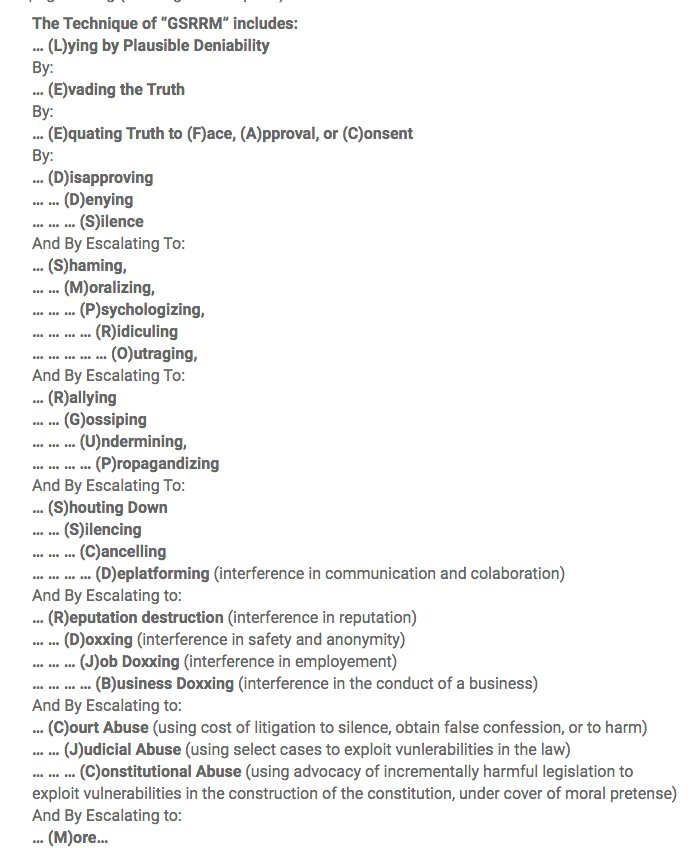
  • Science: Sex differences in perception, prediction, valuation, and of course, ex

    Science: Sex differences in perception, prediction, valuation, and of course, expression. Just as we can decompose your intelligence, personality, moral code from your use of language, we can decode the sexual bias in those expressions. I’m not stating opinion. It’s… https://t.co/hK6ijQoSUk


    Source date (UTC): 2024-11-15 17:01:05 UTC

    Original post: https://twitter.com/i/web/status/1857468879603380659

    Replying to: https://twitter.com/i/web/status/1857460835796365558

  • re: Petty comment: No, mathematics is a paradigm, vocabulary, grammar, and logic

    re: https://www.youtube.com/watch?v=EFO5lzA_0Og
    Petty comment:

    No, mathematics is a paradigm, vocabulary, grammar, and logic of ratios. The universe can be (and must be) described with ratios.
    The universe isn’t mathematical. In fact, if anything it’s computational (discrete) and NOT…


    Source date (UTC): 2024-11-12 05:16:35 UTC

    Original post: https://twitter.com/i/web/status/1856204422659092799

  • re: Petty comment: No, mathematics is a paradigm, vocabulary, grammar, and logic

    re: https://t.co/evJGJ3CaLO
    Petty comment:

    No, mathematics is a paradigm, vocabulary, grammar, and logic of ratios. The universe can be (and must be) described with ratios.
    The universe isn’t mathematical. In fact, if anything it’s computational (discrete) and NOT mathematical (continuous).
    If you grasp that mathematics (meaning mathematical reasoning) is universally statistical, and not operational (meaning computational reasoning) then you will make fewer errors in modeling the universe. We can rather easily say that the failure of physics over the past thirty or more years is due to ‘mathiness’ (as we call it in economics) which means failing to have an operational (meaning physical) model.
    Hence, please study the quantum background. If we have the background model, the standard model, and the einsteinian model of relativity we have three models to make commensurable.
    And if it’s not obvious, that will only be possible if we begin with an operational model at the quantum background. And it’s not as though no work has been done at that subject.
    But trying to harmonize the standard model with relativity has failed largely because there is no physical model (and space time is a bit of a fudge that’s made it worse).
    CD, NLI


    Source date (UTC): 2024-11-12 05:16:35 UTC

    Original post: https://twitter.com/i/web/status/1856204422491320327

  • Oh. Yeah. I’m not one to criticize unhelpful autocorrect by the software or unhe

    Oh. Yeah. I’m not one to criticize unhelpful autocorrect by the software or unhelpful slippage in the author, since I’m a frequent offender. 😉 What I think is on the page and what is on the page are sometimes not precisely the same. 😉


    Source date (UTC): 2024-11-11 18:01:39 UTC

    Original post: https://twitter.com/i/web/status/1856034571437125831

    Reply addressees: @MeinKapitan

    Replying to: https://twitter.com/i/web/status/1856032073884291458