Even the complaint of qualia is a problem of language not experience.
Reply addressees: @SPQRIUS @SepteusT @JFGariepy @KeithWoodsYT
Theme: Grammar
-
Even the complaint of qualia is a problem of language not experience
-
Increase in clarity: So when I say P, or P-logic, P-Law, and P-Testimony provide
Increase in clarity:
So when I say P, or P-logic, P-Law, and P-Testimony provide a universally commensurable paradigm across all fields of human knowledge I mean it. That is what the Table of Grammars codifies. P-logic and P-law provide a universally commensurable language: a SYSTEM OF MEASUREMENT for human testimony (speech) just as mathematics and physics provide a system of measurement for the phsyical world that can’t recall, forcast, or act. And so P-Logic and P-Law consist of what SURVIVES the application of P-logic and P-Law. So of course we will draw from nearly every field. And since economics provides the primary langauge of psychological, and social science, we will use economic langauge rather than the pseudoscences including the pseudoscience of what we generally refer to as philosophy. So yes, it requires quite a bit of knowledge OR a certain kind of mind, to learn this particular VOCABULART, LOGIC, AND LAW. In fact, it’s closest to combining math, physics, programming, economics, and law, and at a minium a knowledge of evolutionary game theory like Axelrod’s evolution of cooperation. So yes. It’ fking hard, and no, if you can’t get into law school, economic school, engineering school, or computer science school, you are not going to have an easy time of something like P-law. It requires too much general knowledge.
Now conversely if you want to understand the FINDINGS of p-logic and p-law and p-testimony, or the explanation for european civilizational superiority then that’s something we can provide you with. And if you want to learn to argue a few significant points, then that we can do too. But no, getting really good at P is like getting really good at math or physics, and far harder than philosophy or logic, chemistry or biology.
Source date (UTC): 2020-09-17 14:40:00 UTC
-
European man institutionalized court testimony as the normative mode of speech.
European man institutionalized court testimony as the normative mode of speech. It’s the most expensive normative construction in human history. The technique (pilpul) that Paul practices is the opposite. Most fascinating subject in history: The art of institutionalizing lying.
Source date (UTC): 2020-09-14 19:13:09 UTC
Original post: https://twitter.com/i/web/status/1305585395074240512
Reply addressees: @bill_m_to @paulkrugman
Replying to: https://twitter.com/i/web/status/1305572523455787008
-
European man institutionalized court testimony as the normative mode of speech.
European man institutionalized court testimony as the normative mode of speech. It’s the most expensive normative construction in human history. The technique (pilpul) that Paul practices is the opposite. Most fascinating subject in history: The art of institutionalizing lying.
Reply addressees: @bill_m_to @paulkrugman -
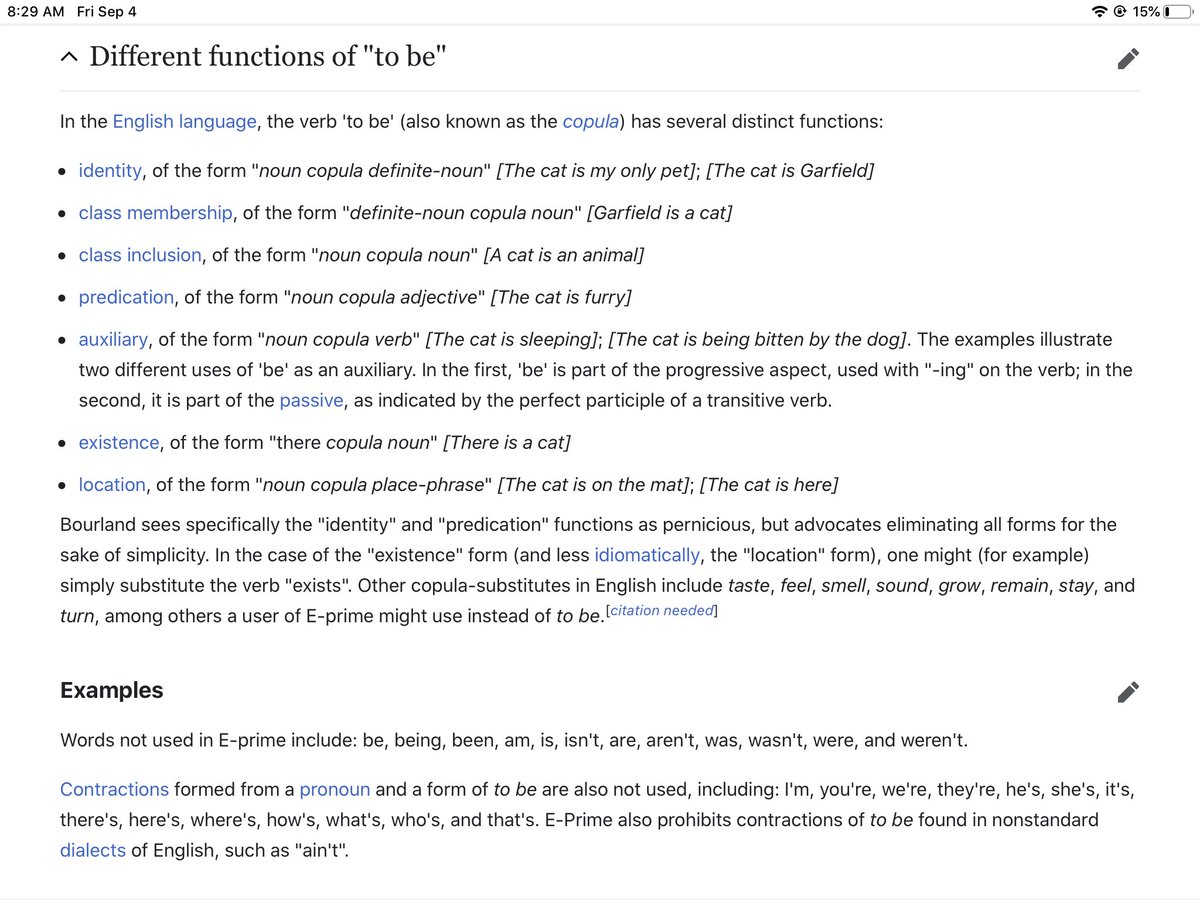
Almost all philosophical sophistry makes use of the fallacies of the verb to-be.
Almost all philosophical sophistry makes use of the fallacies of the verb to-be. (The Copula.) Is = “I don’t know the relation” and as such is the primary form of using ‘exists’ (to be) for conflation (deception). Remove the verb to-be and try to make any of your statements. https://t.co/Ufg1Jri6mI
Source date (UTC): 2020-09-04 12:33:05 UTC
Original post: https://twitter.com/i/web/status/1301860836198187008
Reply addressees: @Airmanareiks @bgaede
Replying to: https://twitter.com/i/web/status/1301793669637386240
-
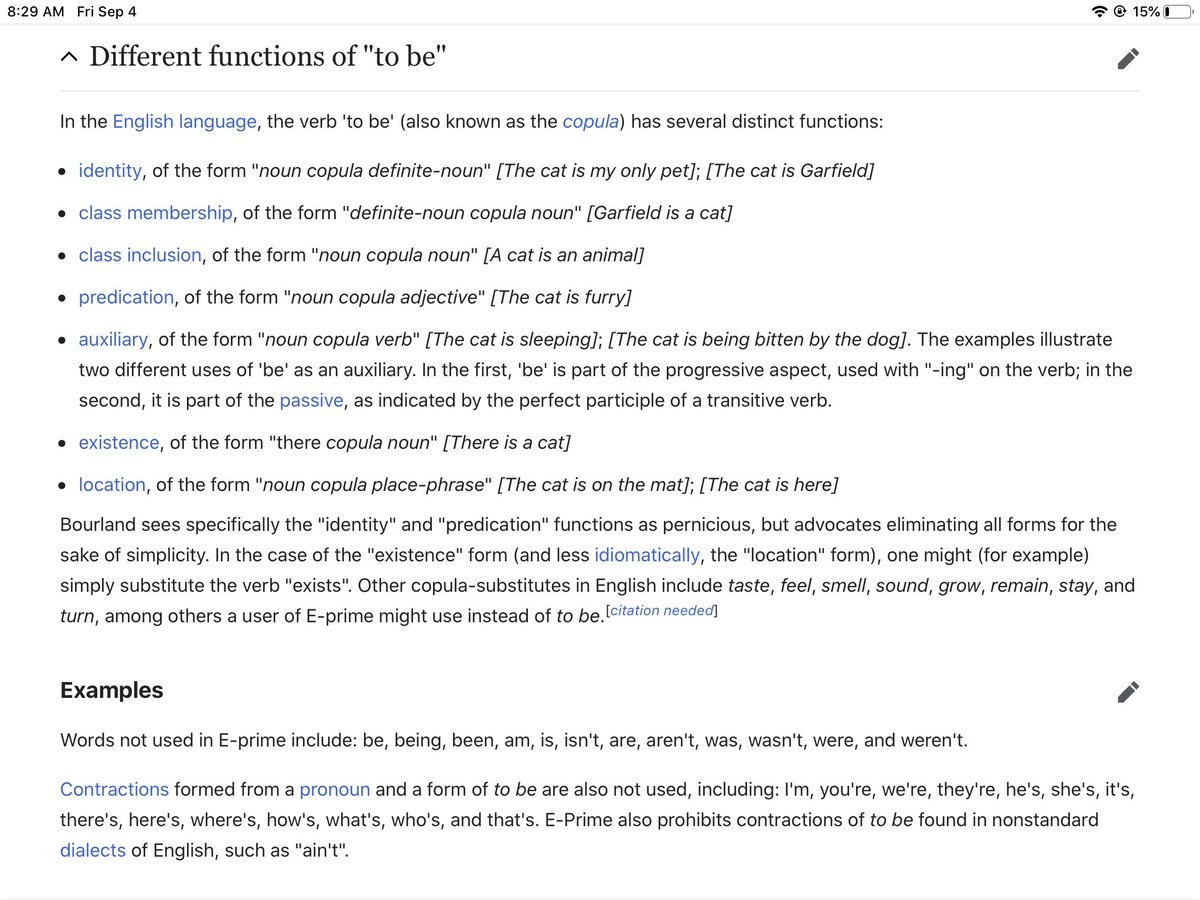
Almost all philosophical sophistry makes use of the fallacies of the verb to-be.
Almost all philosophical sophistry makes use of the fallacies of the verb to-be. (The Copula.) Is = “I don’t know the relation” and as such is the primary form of using ‘exists’ (to be) for conflation (deception). Remove the verb to-be and try to make any of your statements. https://t.co/Ufg1Jri6mI
Reply addressees: @Airmanareiks @bgaede -
Q: “What are the major differences between Eastern and Western philosophies?”
Quite a bit of research on the subject. (Suggest Huntington)
In the most reductive of terms:
Chinese langauge is unforutnately good for poetry and analogy and not for logic or precision. English is the opposite. All germanics are the opposite. indo european langauges in general are the opposite. In technical terms this means chinese is a low precision high context language, and english is a high precision low context language. Even as such we can still separate philosophy into math, science, Logic, Rationalism, Reason, literature, and Myth. And we can then add lying to those spectrum with sophistry, magic-pseudoscience, Sophistry-Idealism, and occult-theology. But assuming we avoid the topics of lying, chinese philosophy is nowhere close to Rationalism (kantian), but lies somewhere between Logic (Socrates) and Reasoning( Plato-idealism ). The difference in structure is different from differnce in objective: it’s in whether we seek to understand master and transform the world as it is, or we seek wisdom to live within the world as it is. Are we seeking conquest of the universe or accomodation. And that is the principle difference: truth vs wisdom.
Military: East Asian Delay and Deceive vs European Solve it Quickly and Openly.
Political: East Asian hierarchical family vs European (Aristocratic) Markets of Peers.
Metaphysical: Verbs(doing) and Relations vs Nouns(things) and
Decidability: harmony(non-conflict) vs adversarialism (competition)
Unstated: Seeking Stagnation vs Seeking Continuous Advantage
Character: Humility (good peasants) vs Heroism (good soldiers)
Relations: Someone is always superior and someone inferior vs We seek peerage
Man: (See their art) Asian “man is bad” (Chinese art) vs European “Man is Ideal”(Greek art)
Value of Life: They don’t vs We do.They face an unstoppable monolithic authoritarian state and humility in their place within it. We face a market competition for survival and status and lionize achievers.
This is why Christianity was successful in the west: the european tradition was martial, heroic, and aristocratic, and everyone else was ‘human domesticated animals’. Christianity made paying the high cost of adhering to extremely costly western norms virtuous and ended the problem of a two-tiered society of ‘citizens and slaves’.
-
Q: “What are the major differences between Eastern and Western philosophies?”
Quite a bit of research on the subject. (Suggest Huntington)
In the most reductive of terms:
Chinese langauge is unforutnately good for poetry and analogy and not for logic or precision. English is the opposite. All germanics are the opposite. indo european langauges in general are the opposite. In technical terms this means chinese is a low precision high context language, and english is a high precision low context language. Even as such we can still separate philosophy into math, science, Logic, Rationalism, Reason, literature, and Myth. And we can then add lying to those spectrum with sophistry, magic-pseudoscience, Sophistry-Idealism, and occult-theology. But assuming we avoid the topics of lying, chinese philosophy is nowhere close to Rationalism (kantian), but lies somewhere between Logic (Socrates) and Reasoning( Plato-idealism ). The difference in structure is different from differnce in objective: it’s in whether we seek to understand master and transform the world as it is, or we seek wisdom to live within the world as it is. Are we seeking conquest of the universe or accomodation. And that is the principle difference: truth vs wisdom.
Military: East Asian Delay and Deceive vs European Solve it Quickly and Openly.
Political: East Asian hierarchical family vs European (Aristocratic) Markets of Peers.
Metaphysical: Verbs(doing) and Relations vs Nouns(things) and
Decidability: harmony(non-conflict) vs adversarialism (competition)
Unstated: Seeking Stagnation vs Seeking Continuous Advantage
Character: Humility (good peasants) vs Heroism (good soldiers)
Relations: Someone is always superior and someone inferior vs We seek peerage
Man: (See their art) Asian “man is bad” (Chinese art) vs European “Man is Ideal”(Greek art)
Value of Life: They don’t vs We do.They face an unstoppable monolithic authoritarian state and humility in their place within it. We face a market competition for survival and status and lionize achievers.
This is why Christianity was successful in the west: the european tradition was martial, heroic, and aristocratic, and everyone else was ‘human domesticated animals’. Christianity made paying the high cost of adhering to extremely costly western norms virtuous and ended the problem of a two-tiered society of ‘citizens and slaves’.
-
First Day of A Logic Course
FIRST DAY OF A LOGIC COURSE
(from comments I made on a paper) (Purpose is to illustrate the difference between how P describes logic and how the present academy explains it.)[A] few suggestions, that give the students context where that context limits the majority of student errors not only in class but throughout life.
1) The sciences consist of the formal sciences we call the Logics, the Physical Sciences, and Social Sciences(psychology, and sociology).
- Formal Sciencies (Logics) > Physical Sciences > Human Sciences
2) Most of us are familiar of the logic of positions we call mathematics and its application to measurements; and the logic of operations, we call algorithms, programming, procedures, or the logic of sequential actions in time, and in addition, we use the general term ‘logic’ of the logic of sets applied more broadly language; So within the formal sciences that we call the logics, we use a least the logic of one property in measurement, the logic of more properties in sequences of operations, and the logic of speech using words that are unlimited, in a spectrum of increasing complexity.
- One Dimension: math (Positional Logic) > N-Limited Dimensions (Operational Logic) > N-Unlimited Dimensions (Set Logic).
3) These methodologies in formal science are possible because of the human logical facility. The human logical facility consists of neurological tests of the spectrum of relations that are constant, inconstant, contingent, potential, contradictory, and non-sensical relations that are perceivable by the spectrum of physical sensation, intuitionistic auto-association we call perception, and the sequence of thought we call dreaming, daydreaming thinking, reasoning, rationalism (“logic”), calculation (transformation of inputs into outputs), and computation.
- Human Faculties ( Physical, Intuitionistic, and Rational) > Human Logical Facility > The Sciences > Formal Sciences > Tests of {constant, inconstant, contingent, potential, contradictory, and non-sensical} relations > Using {hinking, reasoning, rationalism (“logic”), calculation (transformation of inputs into outputs), and computation.}
4) While the human brain operates in massively parallel competition for coherence between past present and future, describing our internal thoughts requires serial communication by signs or speech. When we serially communicate using signs or speech, we depend on rules we call ‘grammars’.
Humans evolved not only the logical facility by massive parallel competition, we evolved a grammar facility to organize and communicate all or part of the experience that results. This grammar vacility and what we call rules of grammar, consists of rules of continuous recursive disambiguation. We use serial language, grammatical rules of continuous recursive disambiguation, to suggest meaning to others, by causing them to continuously recursively predict what we experience (mean). The audience uses those same rules of grammar to predict what the speaker intends to convey. The audience then conveys understanding, and either asks for, or is given, further disambiguation, until both parties satisfy the need (demand) for disambiguity.
In the discipline of logic we refer to this more general term prediction as inference. And the discipline of logic as rules of inference. In this sense, with this understanding, the discipline of logic is either an extension of grammar or grammar is an extension of logic – and until the 20th century truthful speech, grammar, logic, and rhetoric (meaning argument) were taught as a continuum. (And, aside from the intentional removal of adversarialism from the curriculum in order to allow girls to compete, there is very likely a political reason you were not taught grammar, logic, and rhetoric.)
- Human Logic Facility (parallel comparison) > Human Grammar Facility (sequential disambiguation) > Grammar(organization) > Logic(tests of consistency) > Rhetoric (argument).
5) Inferences (predictions) are steps in reasoning, beginning with premises and ending with conclusions. We divide inference into the sequence: deduction, induction, and abduction. Deduction is inference that predict logical conclusions from premises known or assumed to be true. Induction is the inference (prediction) from particular premises to a universal conclusion. Abduction is the inference (prediction) to the best explanation. But that spectrum of deduction, induction, and abduction describes only the sufficiency of information we have to work with, as three points on a continuum.
- Premises > Constant Relations > Inferences (Prediction) > Conclusion
6) In this course, we are largely interested in language and we the logic of sets, with the laws of valid (not false) inference (prediction), under the general label we conventionally refer to as “logic”, using that human faculty of reason we call “rationalism”(limiting our reasoning to rules of logic).
- Logical Facility > Grammar(disambiguation) > Sets of Properties > Rules of Inference (Prediction) => “Logic”
7) We apply the logic of sets to language to test the truth, falsehood, or undecidability of propositions. When we say a statement or set of statements is false, they are inconsistent or contradictory. When we say a statement or set of statements is true, we mean the set of properties is internally consistent.
- Degree of Decidability: Undecidable > Truth Candidate > False.
When we say a statement is or set of statements is contingent, it is dependent on information external to the statement. And when we say that a statement is undecidable, the properties are insufficient to determine consistency – which means ambiguous.
- Relations: Consistent > Contingent > Inconsistent > Contradictory
8) When we say a statement or set of statements is true we mean it satisfies both the demand for disambiguity, and the demand for infallibility in the context – meaning it’s coherent with and consistent and sufficient for infallibility within the broader context.
- True: Context > Demand for Infallibility > Coherent, Consistent, and Sufficient
9) The spectrum of truth claims ranges from tautological – meaningless, to ideal – meaning the testimony we would give if we were omniscient; to testifiable – meaning that one has done due diligence against ignorance, error, bias, and deceit; to honest – meaning the promise that one does not deceive, obscure, load, frame, or fictionalize.
- True: Tautlogical > Ideal > Real (Testifiable) > Honesty
10) And people frequently make truth claims using a spectrum of paradigms using analogies to experience from the most general to the most specific:
- Theological (allegorical, supernatural)
- Fictional-Mythical (Allegorical natural-supernormal)
- Psychological (and Moral)
- Rational (Kantian)
- Historical (analogical)
- Descriptive (ordinary language).
- Empirical (observable)
- Ratio-empirical ( scientific )
- Operational (testifiable, testimony)
11) Despite the efforts of hundreds if not thousands of great thinkers, the result of the 19th and 20th-century research is that set logic applied to human speech is largely a falsificationary rather than justificationary system of thought. In other words, we tend to prove very little of consequence, but we falsify the infinity of falsehoods by ignorance, error, bias, and deceit. And this is the principle function of study of the logics: to improve our ability to identify ignorance, error, bias, and deceit, and to seek sufficiently unambiguous, sufficiently infallible, sufficiently testifiable knowledge despite the many human failings.
Empistemology: Auto Association( Possibility: Idea ) > Justification (Explanation: Hypothesis) > Falsification (Survival: Theory) > Truth Candidate
12) So this is the context of logic that we will cover in this course, and the primary benefit to you, in your life, will be the advantage of freedom from falsehoods by ignorance, error, bias and deceit.
In my understanding, logic, as it is taught in university as the logic of sets and inference, is as archaic as scriptural interpretation, textual interpretation, and legal interpretation that it evolved from. And that between mathematics and set logic we are better off studying operational logic since it is operational logic that eliminates the limits of set logic.
-
First Day of A Logic Course
FIRST DAY OF A LOGIC COURSE
(from comments I made on a paper) (Purpose is to illustrate the difference between how P describes logic and how the present academy explains it.)[A] few suggestions, that give the students context where that context limits the majority of student errors not only in class but throughout life.
1) The sciences consist of the formal sciences we call the Logics, the Physical Sciences, and Social Sciences(psychology, and sociology).
- Formal Sciencies (Logics) > Physical Sciences > Human Sciences
2) Most of us are familiar of the logic of positions we call mathematics and its application to measurements; and the logic of operations, we call algorithms, programming, procedures, or the logic of sequential actions in time, and in addition, we use the general term ‘logic’ of the logic of sets applied more broadly language; So within the formal sciences that we call the logics, we use a least the logic of one property in measurement, the logic of more properties in sequences of operations, and the logic of speech using words that are unlimited, in a spectrum of increasing complexity.
- One Dimension: math (Positional Logic) > N-Limited Dimensions (Operational Logic) > N-Unlimited Dimensions (Set Logic).
3) These methodologies in formal science are possible because of the human logical facility. The human logical facility consists of neurological tests of the spectrum of relations that are constant, inconstant, contingent, potential, contradictory, and non-sensical relations that are perceivable by the spectrum of physical sensation, intuitionistic auto-association we call perception, and the sequence of thought we call dreaming, daydreaming thinking, reasoning, rationalism (“logic”), calculation (transformation of inputs into outputs), and computation.
- Human Faculties ( Physical, Intuitionistic, and Rational) > Human Logical Facility > The Sciences > Formal Sciences > Tests of {constant, inconstant, contingent, potential, contradictory, and non-sensical} relations > Using {hinking, reasoning, rationalism (“logic”), calculation (transformation of inputs into outputs), and computation.}
4) While the human brain operates in massively parallel competition for coherence between past present and future, describing our internal thoughts requires serial communication by signs or speech. When we serially communicate using signs or speech, we depend on rules we call ‘grammars’.
Humans evolved not only the logical facility by massive parallel competition, we evolved a grammar facility to organize and communicate all or part of the experience that results. This grammar vacility and what we call rules of grammar, consists of rules of continuous recursive disambiguation. We use serial language, grammatical rules of continuous recursive disambiguation, to suggest meaning to others, by causing them to continuously recursively predict what we experience (mean). The audience uses those same rules of grammar to predict what the speaker intends to convey. The audience then conveys understanding, and either asks for, or is given, further disambiguation, until both parties satisfy the need (demand) for disambiguity.
In the discipline of logic we refer to this more general term prediction as inference. And the discipline of logic as rules of inference. In this sense, with this understanding, the discipline of logic is either an extension of grammar or grammar is an extension of logic – and until the 20th century truthful speech, grammar, logic, and rhetoric (meaning argument) were taught as a continuum. (And, aside from the intentional removal of adversarialism from the curriculum in order to allow girls to compete, there is very likely a political reason you were not taught grammar, logic, and rhetoric.)
- Human Logic Facility (parallel comparison) > Human Grammar Facility (sequential disambiguation) > Grammar(organization) > Logic(tests of consistency) > Rhetoric (argument).
5) Inferences (predictions) are steps in reasoning, beginning with premises and ending with conclusions. We divide inference into the sequence: deduction, induction, and abduction. Deduction is inference that predict logical conclusions from premises known or assumed to be true. Induction is the inference (prediction) from particular premises to a universal conclusion. Abduction is the inference (prediction) to the best explanation. But that spectrum of deduction, induction, and abduction describes only the sufficiency of information we have to work with, as three points on a continuum.
- Premises > Constant Relations > Inferences (Prediction) > Conclusion
6) In this course, we are largely interested in language and we the logic of sets, with the laws of valid (not false) inference (prediction), under the general label we conventionally refer to as “logic”, using that human faculty of reason we call “rationalism”(limiting our reasoning to rules of logic).
- Logical Facility > Grammar(disambiguation) > Sets of Properties > Rules of Inference (Prediction) => “Logic”
7) We apply the logic of sets to language to test the truth, falsehood, or undecidability of propositions. When we say a statement or set of statements is false, they are inconsistent or contradictory. When we say a statement or set of statements is true, we mean the set of properties is internally consistent.
- Degree of Decidability: Undecidable > Truth Candidate > False.
When we say a statement is or set of statements is contingent, it is dependent on information external to the statement. And when we say that a statement is undecidable, the properties are insufficient to determine consistency – which means ambiguous.
- Relations: Consistent > Contingent > Inconsistent > Contradictory
8) When we say a statement or set of statements is true we mean it satisfies both the demand for disambiguity, and the demand for infallibility in the context – meaning it’s coherent with and consistent and sufficient for infallibility within the broader context.
- True: Context > Demand for Infallibility > Coherent, Consistent, and Sufficient
9) The spectrum of truth claims ranges from tautological – meaningless, to ideal – meaning the testimony we would give if we were omniscient; to testifiable – meaning that one has done due diligence against ignorance, error, bias, and deceit; to honest – meaning the promise that one does not deceive, obscure, load, frame, or fictionalize.
- True: Tautlogical > Ideal > Real (Testifiable) > Honesty
10) And people frequently make truth claims using a spectrum of paradigms using analogies to experience from the most general to the most specific:
- Theological (allegorical, supernatural)
- Fictional-Mythical (Allegorical natural-supernormal)
- Psychological (and Moral)
- Rational (Kantian)
- Historical (analogical)
- Descriptive (ordinary language).
- Empirical (observable)
- Ratio-empirical ( scientific )
- Operational (testifiable, testimony)
11) Despite the efforts of hundreds if not thousands of great thinkers, the result of the 19th and 20th-century research is that set logic applied to human speech is largely a falsificationary rather than justificationary system of thought. In other words, we tend to prove very little of consequence, but we falsify the infinity of falsehoods by ignorance, error, bias, and deceit. And this is the principle function of study of the logics: to improve our ability to identify ignorance, error, bias, and deceit, and to seek sufficiently unambiguous, sufficiently infallible, sufficiently testifiable knowledge despite the many human failings.
Empistemology: Auto Association( Possibility: Idea ) > Justification (Explanation: Hypothesis) > Falsification (Survival: Theory) > Truth Candidate
12) So this is the context of logic that we will cover in this course, and the primary benefit to you, in your life, will be the advantage of freedom from falsehoods by ignorance, error, bias and deceit.
In my understanding, logic, as it is taught in university as the logic of sets and inference, is as archaic as scriptural interpretation, textual interpretation, and legal interpretation that it evolved from. And that between mathematics and set logic we are better off studying operational logic since it is operational logic that eliminates the limits of set logic.