via Steve Pender “The social psychologists of the future will have a number of classes of school children on whom they will try different methods of producing an unshakable conviction that snow is black. Various results will soon be arrived at. First, that the influence of home is obstructive. Second, that not much can be done unless indoctrination begins before the age of ten. Third, that verses set to music and repeatedly intoned are very effective. Fourth, that the opinion that snow is white must be held to show a morbid taste for eccentricity. But I anticipate. It is for future scientists to make these maxims precise and discover exactly how much it costs per head to make children believe that snow is black, and how much less it would cost to make them believe it is dark gray. Although this science will be diligently studied, it will be rigidly confined to the governing class. The populace will not be allowed to know how its convictions were generated.” – Bertrand Russell, “The Impact of Science on Society”
Theme: Deception
-
via Steve Pender “The social psychologists of the future will have a number of c
via Steve Pender
“The social psychologists of the future will have a number of classes of school children on whom they will try different methods of producing an unshakable conviction that snow is black. Various results will soon be arrived at. First, that the influence of home is obstructive. Second, that not much can be done unless indoctrination begins before the age of ten. Third, that verses set to music and repeatedly intoned are very effective. Fourth, that the opinion that snow is white must be held to show a morbid taste for eccentricity. But I anticipate. It is for future scientists to make these maxims precise and discover exactly how much it costs per head to make children believe that snow is black, and how much less it would cost to make them believe it is dark gray. Although this science will be diligently studied, it will be rigidly confined to the governing class. The populace will not be allowed to know how its convictions were generated.” – Bertrand Russell, “The Impact of Science on Society”
Source date (UTC): 2018-05-01 12:06:00 UTC
-
THE COST OF SOCIAL OPTIMISM by Steve Pender Extending someone the privilege of a
THE COST OF SOCIAL OPTIMISM
by Steve Pender
Extending someone the privilege of assuming them to be trustworthy is costly (risk of theft, personal harm). Not extending the privilege of trust is also costly (extra security costs, loss of trade). Granting trust to one person but not another hinges on choosing which costs you want to pay at that time. Since humans are more averse to losing what they have than losing a potential gain, humans err on the side of protecting themselves and property, that is, they more often choose to pay for costs that reduce their losses. If you want to gain privilege, you must first convince the privilege-grantor that not trusting you is more expensive than trusting you. This means you must work on reducing your perceived risk to them. If people who look like you have a much higher rate of violence, you have 3 essential choices: 1) change your look enough that you are no longer categorized with them, 2) reduce the rate of violence of those who look like you so you are no longer categorized as a risk, or 3) increase the cost for others to perceive you as a risk. This 3rd option only reinforces the idea that you are in fact a risk (someone who imposes involuntary costs), and is therefore counterproductive.
Source date (UTC): 2018-05-01 11:03:00 UTC
-
photos_and_videos/TimelinePhotos_43196237263/31563963_10156323416332264_74497462
photos_and_videos/TimelinePhotos_43196237263/31563963_10156323416332264_744974623090671616_o_10156323416322264.jpg WHAT DOES SJW “EQUITY” MEAN?
It means they are rebelling against everyone else for their low sexual, social, economic, and political market value, because of their genetic, behavioral, and aesthetic inferiority.
That’s actually the reason.
They want equality of outcome, but they mean, literally changing their social status from undesirable to desirable.Colin EverettI stopped being a leftist the instant I stopped viewing myself as being in the bottom 50% and started viewing myself as being in the top 50%.Apr 30, 2018 7:59pmWHAT DOES SJW “EQUITY” MEAN?
It means they are rebelling against everyone else for their low sexual, social, economic, and political market value, because of their genetic, behavioral, and aesthetic inferiority.
That’s actually the reason.
They want equality of outcome, but they mean, literally changing their social status from undesirable to desirable.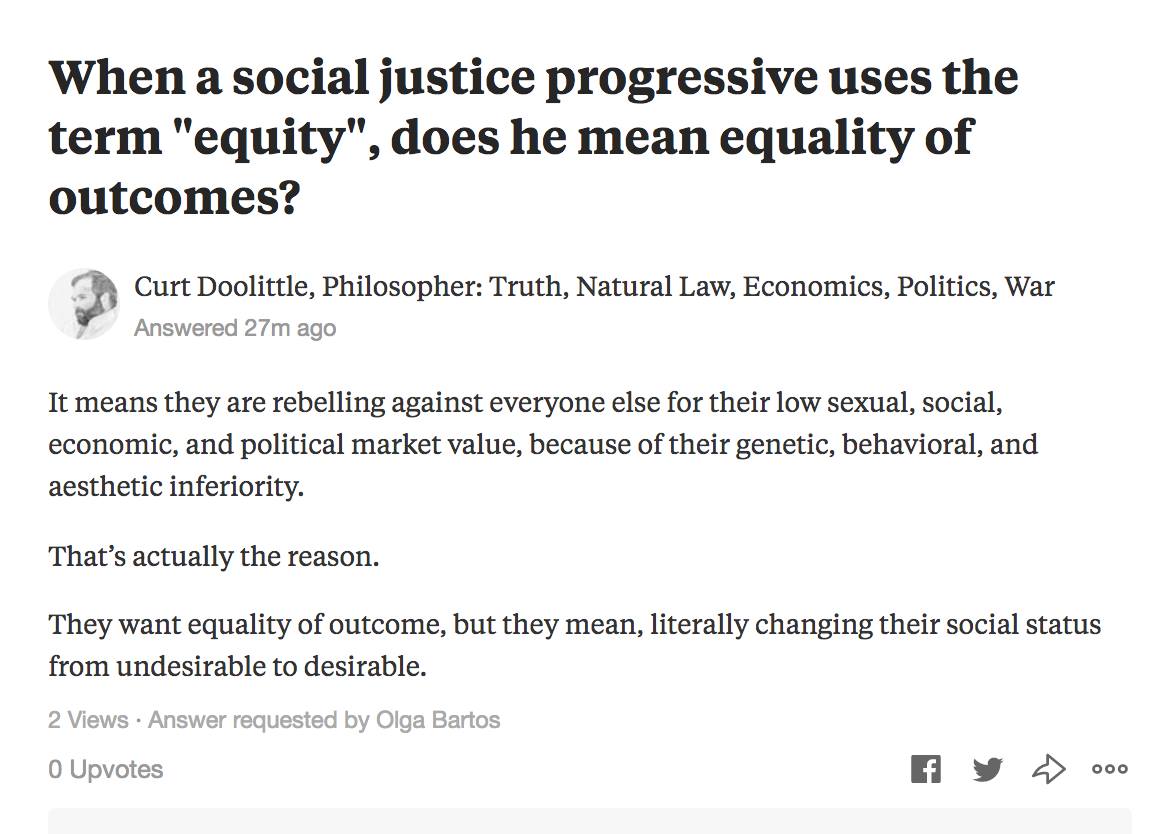
Source date (UTC): 2018-04-30 19:56:00 UTC
-
“No, I prosecute disapproval, ridicule, shaming, gossiping and rallying as an in
—“No, I prosecute disapproval, ridicule, shaming, gossiping and rallying as an infantile substitute for argument – it just so happens that (as you demonstrate) women have a far higher proclivity for emoting rather than debating. Which is why women have the deserved reputation for resorting to instinctual disapproval as if their approval mattered, rather than doing the work of reason to produce truth and truth alone, regardless of their approval or disapproval – which likewise dominates male discourse. Much to the frustration of feminists everywhere who desperately try create pseudosciences and excuses for justifying worthless opinion over valuable argument.”—
CENSORED ON QUORA
Science is apparently suppressed.
Source date (UTC): 2018-04-30 19:50:00 UTC
-
The History of the Sophism of Pilpul
THE HISTORY OF PILPUL Pilpul is the Talmudic term used to describe a rhetorical process that the Sages used to formulate their legal decisions. The word is used as a verb: one engages in the process of pilpul in order to formulate a legal point. It marks the process of understanding legal ideas, texts, and interpretations. It is a catch-all term that in English is translated as “Casuistry.” (CD: Casuistry means “Sophistry” or more specifically “clever but unsound reasoning, especially in relation to moral questions”.) In order to maintain the distinction between the Written Torah — the Hebrew Bible — and the Oral Law, the Talmudic Sages conceived of the idea of pilpul as a means to join each Law to its Biblical prooftext. The Ashkenazi rabbis saw pilpul as a substantive debate over the content of the Law rather than as a simple rhetorical matter. Their understanding of Talmudic pilpul took the form of a radical reinterpretation of the Law. (CD: let’s repeat that: —“radical reinterpretation of the Law.”—) “Reinterpretation” is actually a misleading term. More accurately one should ask what led them to read the Talmud, to perceive the Talmud, in a fashion which could be construed as a justification of the status quo. (CD: let’s repeat that: —“..justification of the status quo.”— The Ashkenazi rabbis were less concerned with promulgating the Law transmitted in the Talmud than they were with molding it to suit their own needs. Pilpul was a means to justify practices already fixed in the behaviors of the community by re-reading the Talmud to justify those practices. As if this was not enough, the Tosafists instituted one more pilpul principle into Talmudic discourse. This was called the Lav Davqa method. In English we might call it the “Not Quite” way of reading a text. When a text appeared to be saying one thing, the Tosafot — in order to conform to the already-existing custom — would re-interpret it by saying that what it seemed to mean is not what it really meant! The Tosafist reading based on the Lav Davqa method completely transformed Judaism; the Ashkenazi tradition was the one that ultimately triumphed. Pilpul occurs any time the speaker is committed to “prove” his point regardless of the evidence in front of him. The casuistic aspect of this hair-splitting leads to a labyrinthine form of argument where the speaker blows enough rhetorical smoke to make his interlocutor submit. Reason is not an issue when pilpul takes over: what counts is the establishment of a fixed, immutable point that can never truly be disputed. What is thought to be the Jewish “genius” is often a mark of how pilpul is deployed. The rhetorical tricks of pilpul make true rational discussion impossible; any “discussion” is about trying to “prove” a point that has already been established. There is little use trying to argue in this context, because any points being made will be twisted and turned to validate the already-fixed position. Pilpul is the rhetorical means to mark as “true” that which cannot ever be disputed by rational means. by David Shasha Director, Center for Sephardic Heritage
-
The History of the Sophism of Pilpul
THE HISTORY OF PILPUL Pilpul is the Talmudic term used to describe a rhetorical process that the Sages used to formulate their legal decisions. The word is used as a verb: one engages in the process of pilpul in order to formulate a legal point. It marks the process of understanding legal ideas, texts, and interpretations. It is a catch-all term that in English is translated as “Casuistry.” (CD: Casuistry means “Sophistry” or more specifically “clever but unsound reasoning, especially in relation to moral questions”.) In order to maintain the distinction between the Written Torah — the Hebrew Bible — and the Oral Law, the Talmudic Sages conceived of the idea of pilpul as a means to join each Law to its Biblical prooftext. The Ashkenazi rabbis saw pilpul as a substantive debate over the content of the Law rather than as a simple rhetorical matter. Their understanding of Talmudic pilpul took the form of a radical reinterpretation of the Law. (CD: let’s repeat that: —“radical reinterpretation of the Law.”—) “Reinterpretation” is actually a misleading term. More accurately one should ask what led them to read the Talmud, to perceive the Talmud, in a fashion which could be construed as a justification of the status quo. (CD: let’s repeat that: —“..justification of the status quo.”— The Ashkenazi rabbis were less concerned with promulgating the Law transmitted in the Talmud than they were with molding it to suit their own needs. Pilpul was a means to justify practices already fixed in the behaviors of the community by re-reading the Talmud to justify those practices. As if this was not enough, the Tosafists instituted one more pilpul principle into Talmudic discourse. This was called the Lav Davqa method. In English we might call it the “Not Quite” way of reading a text. When a text appeared to be saying one thing, the Tosafot — in order to conform to the already-existing custom — would re-interpret it by saying that what it seemed to mean is not what it really meant! The Tosafist reading based on the Lav Davqa method completely transformed Judaism; the Ashkenazi tradition was the one that ultimately triumphed. Pilpul occurs any time the speaker is committed to “prove” his point regardless of the evidence in front of him. The casuistic aspect of this hair-splitting leads to a labyrinthine form of argument where the speaker blows enough rhetorical smoke to make his interlocutor submit. Reason is not an issue when pilpul takes over: what counts is the establishment of a fixed, immutable point that can never truly be disputed. What is thought to be the Jewish “genius” is often a mark of how pilpul is deployed. The rhetorical tricks of pilpul make true rational discussion impossible; any “discussion” is about trying to “prove” a point that has already been established. There is little use trying to argue in this context, because any points being made will be twisted and turned to validate the already-fixed position. Pilpul is the rhetorical means to mark as “true” that which cannot ever be disputed by rational means. by David Shasha Director, Center for Sephardic Heritage
-
“What Is Your Endgame?” (Religion)
—“What is your endgame?”— A Christian Believer
I understand that believers are non rational, and un-persuadable, and over invested in a network of falsehoods, and so believers will not change except to follow an even larger and safer herd. So my objective is to use arguments to search for people in the herd who know that the mythos is false, but want a new herd to join. So I state my arguments and avoid engaging in abrahamic sophisms, and then insult those who make them to deprive them of their attempt to gain confidence and signals from their denials. My endgame is the completion of the transformation of Germanicized christianity to natural law and reciprocity, completely laundered of sophism(abrahamism), superstition, mysticism, magic, falsehoods, and lies. Truth is enough. COMMENTS Daniel Roland Anderson This just turned a light on for me. Germanized Christianity (I’m thinking of Kant trying to put logical legs under “do unto others as you’d have them do unto you” with the categorical imperative) really got pretty close to something. Reciprocity. Natural Law. I see the idea of reciprocity in Kant’s work—to the extent I can understand it. (The importance Kant places on truth telling, no matter the immediate consequence, looks very familiar.) How about Natural Law? Where do you see this principle most strongly in previous work? Curt Doolittle The common (Natural) law. Daniel Roland Anderson If I had to pick, this is my favorite thing. In law school, property class, I loved the series of cases on possession of property starting with Pierson vs. Post and the fox. Constitutionalists got in my head (my dad brought me up on the constitution) and I second guessed my love for the process of discovering the general law by looking at specific case after case and tweaking and modifying the ruling in connection with previous cases. It feels like home. It was my mother who helped me see that it isn’t judicial discretion that is bad. It’s just that you need to give discretion to the right sort of judge. We haven’t managed that. -
“What Is Your Endgame?” (Religion)
—“What is your endgame?”— A Christian Believer
I understand that believers are non rational, and un-persuadable, and over invested in a network of falsehoods, and so believers will not change except to follow an even larger and safer herd. So my objective is to use arguments to search for people in the herd who know that the mythos is false, but want a new herd to join. So I state my arguments and avoid engaging in abrahamic sophisms, and then insult those who make them to deprive them of their attempt to gain confidence and signals from their denials. My endgame is the completion of the transformation of Germanicized christianity to natural law and reciprocity, completely laundered of sophism(abrahamism), superstition, mysticism, magic, falsehoods, and lies. Truth is enough. COMMENTS Daniel Roland Anderson This just turned a light on for me. Germanized Christianity (I’m thinking of Kant trying to put logical legs under “do unto others as you’d have them do unto you” with the categorical imperative) really got pretty close to something. Reciprocity. Natural Law. I see the idea of reciprocity in Kant’s work—to the extent I can understand it. (The importance Kant places on truth telling, no matter the immediate consequence, looks very familiar.) How about Natural Law? Where do you see this principle most strongly in previous work? Curt Doolittle The common (Natural) law. Daniel Roland Anderson If I had to pick, this is my favorite thing. In law school, property class, I loved the series of cases on possession of property starting with Pierson vs. Post and the fox. Constitutionalists got in my head (my dad brought me up on the constitution) and I second guessed my love for the process of discovering the general law by looking at specific case after case and tweaking and modifying the ruling in connection with previous cases. It feels like home. It was my mother who helped me see that it isn’t judicial discretion that is bad. It’s just that you need to give discretion to the right sort of judge. We haven’t managed that. -
“How do you verify truth?”— Verification is a method of falsification not a me
—“How do you verify truth?”—
Verification is a method of falsification not a means of identifying truth. No matter how many excuses you make (justifications) that does not provide us with confidence of truth.
Instead….
You eliminate all falsehoods, and what remains is a truth candidate. You eliminate all falsehoods by attempting to falsify each dimension of actionable reality. And you do so to defend against fictionalisms (lies).
Identity (categorical consistency)
Logical (internal consistency)
Empirical (external correspondence)
Operational (existential possibility)
Rational (rational choice)
Reciprocal (reciprocally rational)
Complete (scope, limits, and parsimony)
Coherent (across all these tests)
Warranty (warranty of having performed these tests).
If all premises and arguments pass these attempts at falsification one may have a truth candidate. Otherwise one does not.
This is as certain as the laws of physics, mathematics, and logic.
It is very hard for a statement to survive these tests, to give that testimony, and to warranty it.
Source date (UTC): 2018-04-30 09:53:00 UTC