What’s the difference between Roosevelt stacking the supreme court, and Hart-Cellar stacking the Electorate? None.
Source date (UTC): 2020-02-14 11:01:00 UTC
What’s the difference between Roosevelt stacking the supreme court, and Hart-Cellar stacking the Electorate? None.
Source date (UTC): 2020-02-14 11:01:00 UTC
CD: COMBINE (holding place)
Stupid American mistakes
1) War of independence, rather than paying our debt for the french and indian war to the crown. (Beneficial outcome: writing down the common law in a constitution)
2) Not buying and paying for the repatriation of the slaves.
3) Not letting the south secede, civil war, and the catastrophe of the 14th amendment. No beneficial outcome.
4) Joining WW1 rather than letting Germany restore herself after Napoleon’s destruction of the holy roman (German) empire (France’s equivalent of the war of northern aggression)
3) The Versailles treaty granting France it’s wishes to destroy the holy roman empire and de-prussianize germanic civilization – the heart of european civilization for all of our history.
4) Joining WW2
5) Taking over rather than reinforcing and restoring the British empire, as the primary global defense of western civilization.
6) Taking over the pound as the world reserve currency
7) Not letting loose our generals Macarthur in china and Patton in Russia.
8) Not suppression the jewish postwar movements – particularly communism, marxism, cultural marxism, and postmodernism
9) Tolerating libel slander and gossiping under the pretense of free speech.
8) No fault divorce, child support and alimony, and removing liability for interference in the marraige.
Not helping Russia after the fall
Stupid British Mistakes
1) Not creating a house of the colonies)
2) allowing jews into the state, academy…
The greatest mistakes our country made were not letting the south secede, expanding the franchise to those unproductive and lacking responsibility, and the hart cellar act to open the gates to the underclasses – destroying the American experiment in a third way: middle class civ. These are followed closely by tolerating the postwar suppression of the american eugenics movement, and not brutally crushing the communist movement, marxist-postmodernist movements.
We were tolerant in greek, roman, germanic, and british civilizations.
Tolerance is a weakness not a virtue.
Source date (UTC): 2020-02-14 10:51:00 UTC
photos_and_videos/TimelinePhotos_kg5QueHwVw/84992442_207302620667899_6207573957269258240_o_207302614001233.jpg https://www.facebook.com/stella.maracarahttps://www.facebook.com/stella.maracara
Source date (UTC): 2020-02-14 09:50:00 UTC
TALKING YOU OUT OF LIBERTARIANISM
by Brandon Hayes
—“I’ve frankly been leaning towards Libertarianism…Talk me out of it?”—Connie
Good morning Connie, talk you out of Libertarianism you say… 🙂
Perhaps we can just go to the root of it.
The libertarians don’t have a plan for your protection. They rely on the NAP; which relies on people being relatively advanced (moral); people aren’t. So, you’d be relying on the same mechanisms of power and protection that we have now. Meaning the power distance remains large and chances of miscarriage of justice remains high.
The only way to ensure a sovereign nation (a libertarian nation even) is through a militia of sovereign men. P is the only political group looking to decrease power distance and increase robustness of fellow its men; we insist every man is a sheriff (part of the militia, a craftsman, a father, etc)[resiliency, ownership, and mastery].
See, it’s not so much that you ought be thinking “I’d like to be a libertarian” (be able to live freely without others imposing cost and have everyone obey the NAP [they won’t]) BUT, it’s more that you should be thinking “I want MY MEN to be Propertarians”; otherwise the choice to live a life free from imposition of cost (like a libertarian believes she ought) ceases to exist.
{hope that helps; I can answer questions}
Source date (UTC): 2020-02-14 09:47:00 UTC
SOVEREIGNTY (NATURAL LAW) VS SUBMISSION (THEOLOGY)
—“…The concept of “obeying the commandments gives ultimate freedom” was the biggest oxymoron to me for most of my life. I have my merits, it should be good enough… Maybe this is just my inner /r, I have found a level of peace as I accepted my place in the machinery of life.”—Anne Summers
It gives people an easy way of avoiding conflict over status and position so that they can work in harmony by simple rules.
We just use sovereignty in western civ (scientific and legal) and take accountability for our actions, and supernaturalists use an excuse NOT to take accountability for their actions.
In other words, sovereignty for the strong, and submission for the weak.
Source date (UTC): 2020-02-14 09:44:00 UTC
IS THIS THE SHORT DESCRIPTION OF P?
—“This the best thing I have seen as a short answer on P.”—Frank ChandlerUpdated Feb 13, 2020, 3:43 PM
Source date (UTC): 2020-02-13 15:43:00 UTC
IS PROPERTARIANISM A COMPLETION OF THE HEGELIAN PROJECT?
by Ryan Drummond
I often see P as a…completion, almost, of Hegel’s work, without the room for logical error (and the dirty path to Marxism opening as a result). His model, as you’ll see, touches on many truths. Only it is nowhere near as advanced as P, grammatically or scientifically.
Basically, Hegel made an effort to come to what might be considered a “total” understanding of philosophy and existence – much like yourself. Only he wrote using all resources available to him in the late 1700’s/early 1800’s.
So a lot of his understandings are premature, not scientifically accurate, and lie in the realm of honest speculation etc.
He had the concept that through logic, nature and human consciousness, God could be considered real but not definable. That we could know of it, but not know It. So he called God, or the universal absolute, “The Idea”.
This “Idea”, he said, could be realised through dialectic…and as dialectic occurs both in the natural realm and within the human psyche, it would be our inevitable path to eventually reach it.
This is where the problems come in – because he wrote of dialectic in such wishy-washy prose, and used language that hardly anyone could decipher accurately enough to take consistent meaning from, there were basically two schools born from his ideas, both offering an “Idea” that could be seemingly supported by varying ‘interpretations’ of his work, whereby an ideal could be theoretically reached.
One path was through what we would now call Marxism, I suppose, where equality reigns supreme…dysgenia through eugenic ideals (The false, yet morally appeasing way at odds with natural law but not at odds with human consciousness).
During Hegel’s time advocates of this kind of philosophy, later to be characterised by Marx, were known as young Hegelians. It was another example of the young generation wanting to usurp the old guard.
The other path, to me at least, appears to be very much like P – Eugenia through eugenic ideals (the true, yet sometimes morally disturbing way – not at odds with natural law, but often found to be at odds with human consciousness and what we see, at our earthly level, to be right or wrong).
Advocates of this school were the ‘gammon’ of the day, so to speak: Old Hegelians.
So from Hegelian philosophy we ended up with the two behemoths we see at war today, really – Marxism/The Left/Dysgenia proper, and it’s nemesis Fascism/The Right/Eugenia proper.
Had he written his philosophy as concisely as P, I don’t believe that there would have been room for Marxism to ever exist within it’s bounds, and gain a foothold in the minds of the population.
P is ‘essentially’ Old Hegelianism + Accurate terminology + Scientific Justification + So much more.
Had he done the job he set out to do properly (I believe he always intended his work to be interpreted the Right way, so to speak), we wouldn’t have found ourselves in the mess we are in today.
Your work basically completes his initial goal, only doesn’t use wishy-washy, unknowable language, but language of almost mathematical precision and meaning.
You finish the job he started. You’ve created the total philosophy I believe he envisaged in some way.
But creating it and applying it are two different things. Especially from the position we are in now. He often wrote of the French Revolution that humanity had taken a bright dawn and turned it into a dusk. If he witnessed a dusk, then we must exist in the early hours of the morning. It’s cold and dark.
But if we can overcome the hurdles in front of us, we will push humanity to Godhood. We will realise The Idea. We can beat the red queen, or get so damn close to it we can be proud of our efforts.
I hope that clarifies a little where I get the connections to Hegelian philosophy from.
That, and he was addicted to using trinities to explain everything. You do the same thing, really, through P, only do it all more accurately.
If Old Hegelian philosophy was the child, P is the man it could be considered to grow up to become.
Source date (UTC): 2020-02-13 15:42:00 UTC
WOMEN USING P AGAINST GSRRM
by James Dmitro Makienko
My wife is an aspie, and she is in a fashion industry, which is rife with GSRRM. She tried everything, until she “read Doolittle” (c) and learned some P-concepts.
Mainly she uses a meta-term “manipulation” as a catch-all for GSRRM and other feminine cognition shit they use. She calls them out on manipulation. They usually respond with more GSRRM. Then she says “you are using ORRGSM+M(manipulation) to manipulate me into going against my interests, and I am not falling for it”. Then they try it again. She repeats herself and adds “and since you use manipulation, instead of logic and reason, you are a bad person, with a dark agenda, who is trying to take me for a fool, but I am not falling for it”. She keeps repeating it until manipulators run away – when you expose them they run out of options they can use.
She also read up on dark triad traits on manipulative behaviors of sociopaths and narcissists and found things like “Framing” – (“if you are a good girl/christian/X you will do Y and go against your interests to serve my interests”) which are also used with GSRRM.
Calmly exposing manipulative tactics with a precisely defined technical term works for her to disarm those who use GSRRM.
Source date (UTC): 2020-02-13 14:38:00 UTC
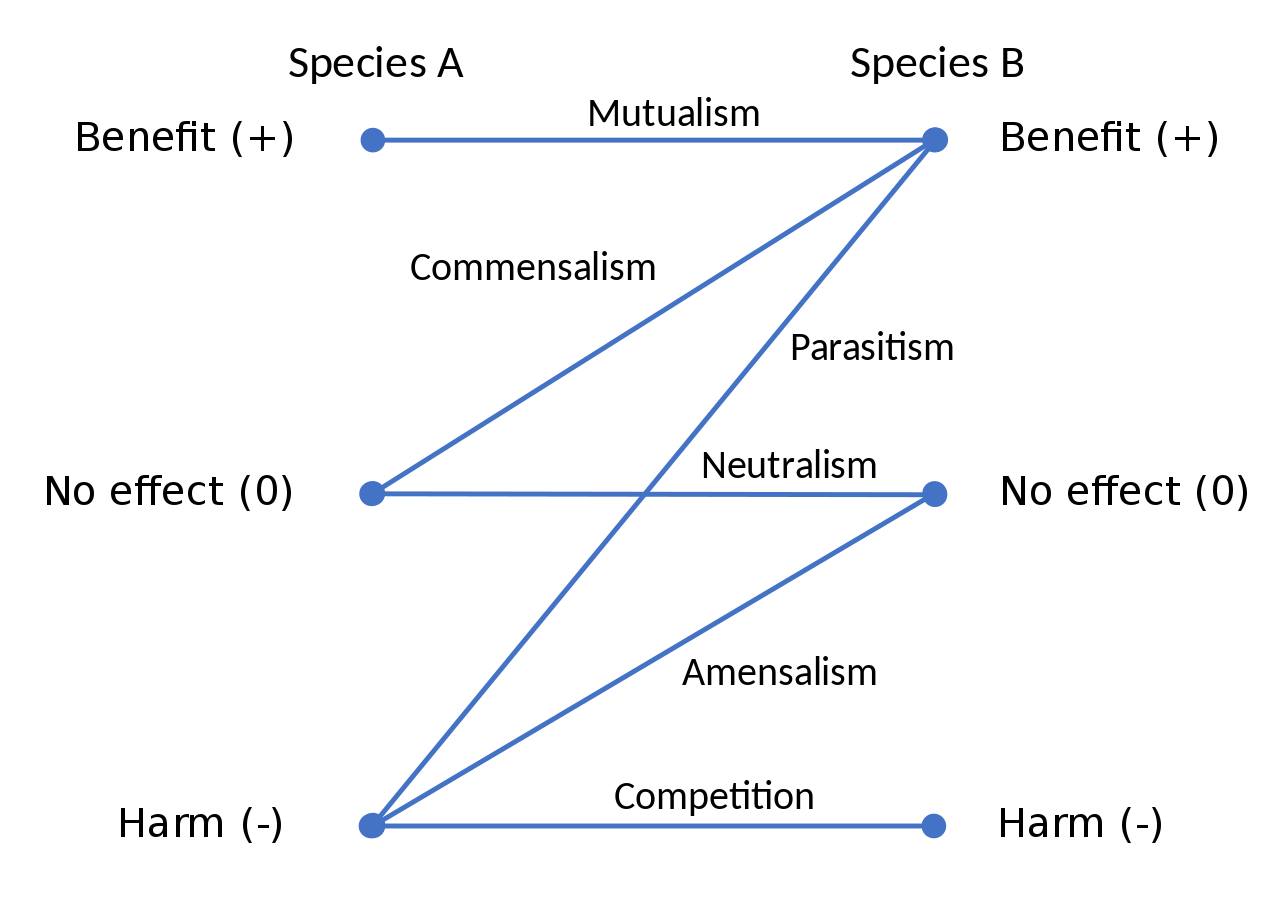
photos_and_videos/TimelinePhotos_kg5QueHwVw/84618660_206573627407465_547290356631207936_o_206573620740799.jpg PHILOSOPHY BEING MADE….
Luke Weinhagen:
As I understand it, even in a symbiotic arrangement this effect – harm to the practitioner and harm to the non-practitioner, is classified as competition –
We could use “Internecitic Religion” pulling from “internecine: destructive to both sides”. –
Internecitic Religion – harm to the practitioner and harm to the non-practitioner
And for completeness add – Neutralitic Religion – no benefit to the practitioner and no cost to the non-practitioner
Bill Joslin:
To point out the obvious, this isn’t specific to just religion but maps the calculation of reciprocity – its the algorithmic map of natural law.
Luke Weinhagen:
Yeah, it just came up in the conversation about religion so that is what I started with in its application – if it holds up I can see it being useful in many ways.
Check out the link above and read the first comment – I am trying to flesh out a bit of the scope. Help/feedback is appreciated.
Bill Joslin:
The one element that’s missing is porportionality
(man this is fantastic)
Luke Weinhagen:
Missing proportionality is part of why I am suggesting symbiosis may be a superior frame to compatibility.
The ratios/proportions are not static. Each discovery opens up new opportunities for decidability, each decision under decidability opens up new possibilities for interaction that step into what we do not know that we do not know. The interplay is always fluid at the limits.
Bill Joslin:
I was thinking something similar. initially i was gazing at the graphic wondering if disproportionate reciprocity would simply be a means falling back to another category. for example a disproportionate mutualism would be calculated as commensalism. but this doesn’t work, because the calculation would be that of opportunity cost, and we can’t calculate a foregone cost. so now I’m not sure proportionality is required. as long as the option of returning to neutralism is preserved (right of disassociation, preserve the right to defect of boycott) then market forces would naturally approximate proportionality (so there isn’t a need to calculate porportion)
Bill Joslin:
And further to that, the calculation of harm vs benefit, being one of cost benefit (whereby asymmetric benefit being benefit, and asymmetric cost being harm) would fill this calculation gap
Luke Weinhagen:
Exactly – “market forces would naturally approximate proportionality (so there isn’t a need to calculate porportion)” <- this is exactly where I was going.
Bill Joslin:
So afaics this might be a complete graph of natural law
Luke Weinhagen
Introduces graceful failure to resolving market entry and market exit
(also addresses a possible “why” people have such a strong intuition for the necessity of belief systems as it demonstrates that role in this graceful failure into and out of markets)
Bill Joslin:
Religion, from an evolutionary stand point may have been the first means by which we made these calculation – or at least religions that survived did so because it afforded an intuition on calculating reciprocity (but also maybe included ways of compensating for irreciprocity)…
So maybe the argument that humans have evolved religiosity may actually not have anything to do with religion but rather to have a system to calculate these transactions and also for systems of graceful failure, which we view as religiosity.
[image: By Ian Alexander – Own work, CC BY-SA 4.0, https://commons.wikimedia.org/w/index.php?curid=71067142]
https://www.facebook.com/luke.weinhagen/posts/10218928910706454PHILOSOPHY BEING MADE….
Luke Weinhagen:
As I understand it, even in a symbiotic arrangement this effect – harm to the practitioner and harm to the non-practitioner, is classified as competition –
We could use “Internecitic Religion” pulling from “internecine: destructive to both sides”. –
Internecitic Religion – harm to the practitioner and harm to the non-practitioner
And for completeness add – Neutralitic Religion – no benefit to the practitioner and no cost to the non-practitioner
Bill Joslin:
To point out the obvious, this isn’t specific to just religion but maps the calculation of reciprocity – its the algorithmic map of natural law.
Luke Weinhagen:
Yeah, it just came up in the conversation about religion so that is what I started with in its application – if it holds up I can see it being useful in many ways.
Check out the link above and read the first comment – I am trying to flesh out a bit of the scope. Help/feedback is appreciated.
Bill Joslin:
The one element that’s missing is porportionality
(man this is fantastic)
Luke Weinhagen:
Missing proportionality is part of why I am suggesting symbiosis may be a superior frame to compatibility.
The ratios/proportions are not static. Each discovery opens up new opportunities for decidability, each decision under decidability opens up new possibilities for interaction that step into what we do not know that we do not know. The interplay is always fluid at the limits.
Bill Joslin:
I was thinking something similar. initially i was gazing at the graphic wondering if disproportionate reciprocity would simply be a means falling back to another category. for example a disproportionate mutualism would be calculated as commensalism. but this doesn’t work, because the calculation would be that of opportunity cost, and we can’t calculate a foregone cost. so now I’m not sure proportionality is required. as long as the option of returning to neutralism is preserved (right of disassociation, preserve the right to defect of boycott) then market forces would naturally approximate proportionality (so there isn’t a need to calculate porportion)
Bill Joslin:
And further to that, the calculation of harm vs benefit, being one of cost benefit (whereby asymmetric benefit being benefit, and asymmetric cost being harm) would fill this calculation gap
Luke Weinhagen:
Exactly – “market forces would naturally approximate proportionality (so there isn’t a need to calculate porportion)” <- this is exactly where I was going.
Bill Joslin:
So afaics this might be a complete graph of natural law
Luke Weinhagen
Introduces graceful failure to resolving market entry and market exit
(also addresses a possible “why” people have such a strong intuition for the necessity of belief systems as it demonstrates that role in this graceful failure into and out of markets)
Bill Joslin:
Religion, from an evolutionary stand point may have been the first means by which we made these calculation – or at least religions that survived did so because it afforded an intuition on calculating reciprocity (but also maybe included ways of compensating for irreciprocity)…
So maybe the argument that humans have evolved religiosity may actually not have anything to do with religion but rather to have a system to calculate these transactions and also for systems of graceful failure, which we view as religiosity.
[image: By Ian Alexander – Own work, CC BY-SA 4.0, https://commons.wikimedia.org/w/index.php?curid=71067142]
Source date (UTC): 2020-02-13 14:33:00 UTC
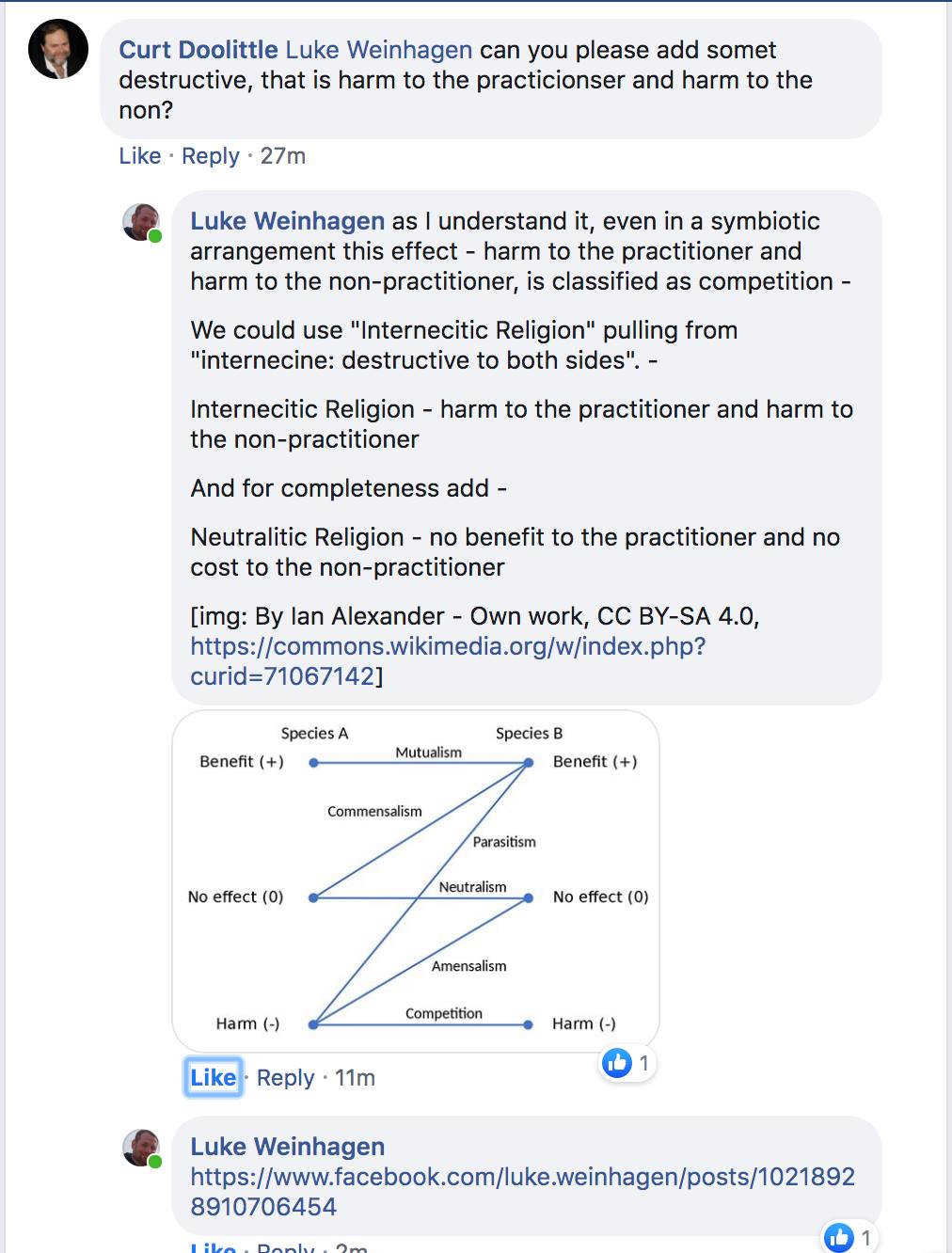
photos_and_videos/TimelinePhotos_kg5QueHwVw/85046746_206469310751230_4465482015956795392_o_206469307417897.jpg CATEGORIES OF RELIGION
By: Luke Weinhagen, via Brandon Hayes
(Core) (expanded) (added “Internecitic Religion”)
Examining the effects of belief systems from the frame of symbiosis –
Mutualitic Religion – benefit to practitioners and benefit to non-practitioners
Commensalitic Religion – benefit to practitioners with no cost to non-practitioner
Neutralitic Religion – no benefit to the practitioner and no cost to the non-practitioner
Amensalitic Religion – no benefit to the practitioner and harm to the non-practitioner
Parasitic Religion – benefit to the practitioner and harm to the non-practitioner
Internecitic Religion – harm to the practitioner and harm to the non-practitionerCATEGORIES OF RELIGION
By: Luke Weinhagen, via Brandon Hayes
(Core) (expanded) (added “Internecitic Religion”)
Examining the effects of belief systems from the frame of symbiosis –
Mutualitic Religion – benefit to practitioners and benefit to non-practitioners
Commensalitic Religion – benefit to practitioners with no cost to non-practitioner
Neutralitic Religion – no benefit to the practitioner and no cost to the non-practitioner
Amensalitic Religion – no benefit to the practitioner and harm to the non-practitioner
Parasitic Religion – benefit to the practitioner and harm to the non-practitioner
Internecitic Religion – harm to the practitioner and harm to the non-practitioner
Source date (UTC): 2020-02-13 11:55:00 UTC