Form: Outline

  • Man – Personality

    Personality

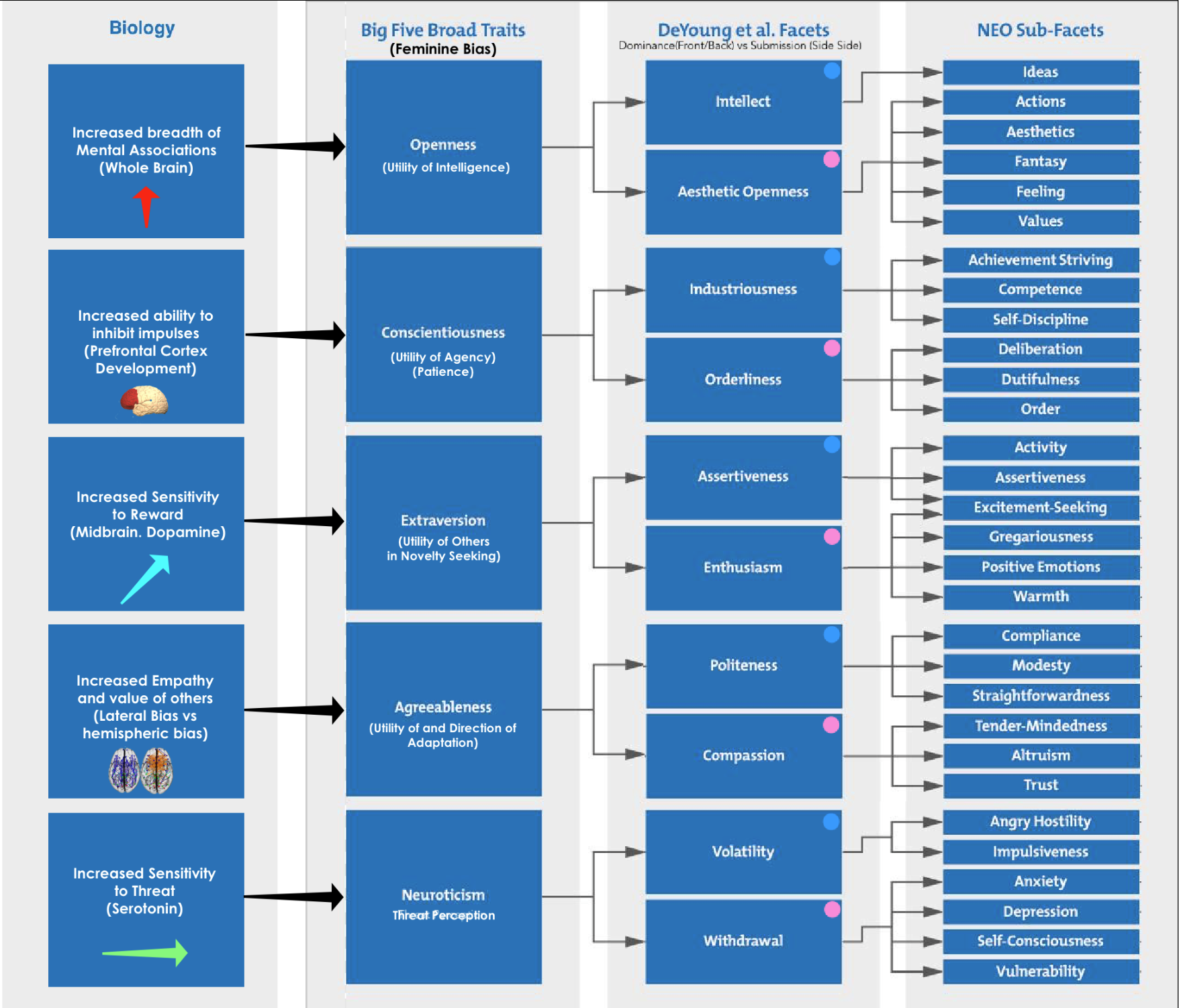
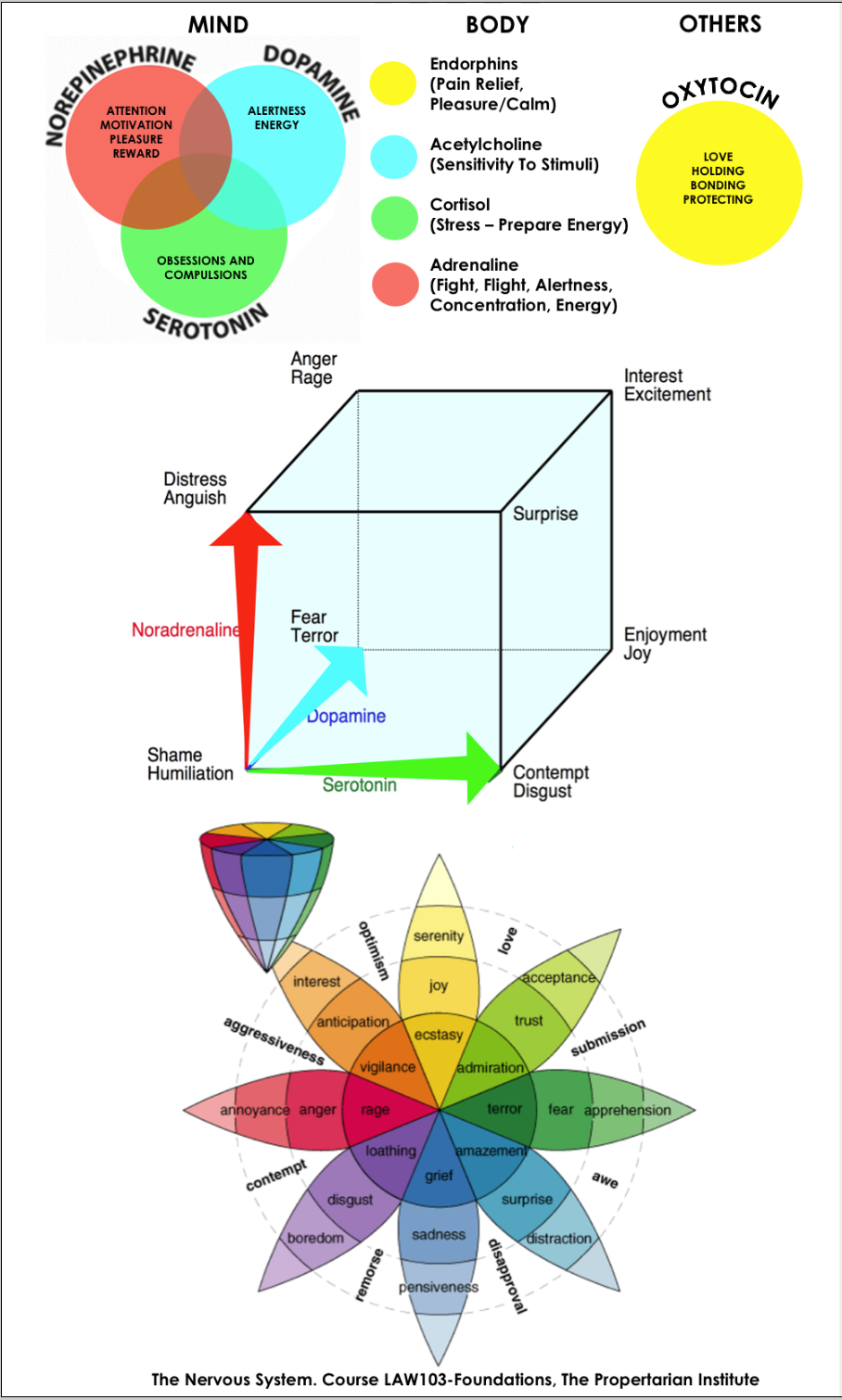
    intelligence, traits, big five personality traits   1 – Conscientiousness [the activity & in some cases overlapping into the agency dimension] (the most trainable of all the traits upwards although after 11-12 years old this becomes harder, and increasingly so into one’s 20s and 30s); Conscientiousness was associated with increased volume in the lateral prefrontal cortex, a region involved in planning and the voluntary control of behavior.   2 – Agreeableness [in some sense the agency dimension and separates men as disagreeable and women agreeable] (remarkably stable throughout life, although there are Kuhnian paradigm shifts [huge life-changing events or epiphanies usually] that slide extremely disagreeable people to the other end of the scale or vice versa I); Agreeableness was associated with increased volume in regions that process information about the intentions and mental states of other individuals.   3 – Neuroticism [the right hemisphere / threat perceiving / negative emotion dimension](immovable upwards in a similar way to IQ [we haven’t found a way other than drugs yet] and bad life events oft make neurotic people hyper-neurotic); Neuroticism was associated with increased volume of brain regions associated with threat, punishment, and negative emotions. 5 – Extraversion [the left hemisphere / opportunity perceiving / positive emotion dimension] (low-mid range trainability either way but high reversion rate so training has to be maintained); Extraversion was associated with increased volume of medial orbitofrontal cortex, a region involved in processing reward information. 4 – Openness [the creativity dimension, highly correlated with IQ] (the most interesting in that it appears people can train only toward their side of the fence…open people can ‘open the doors of perception’ [to use a Huxlian term] and closed people tend to become even more specialised as they mature, but cases of Kuhnian shifts have not been documented afaik, but there are almost always exceptions); Openness/Intellect did not have any significant correlation with the volume of any brain structures. 6 – IQ [pattern recognition] many things bring IQ down (smart professors not doing exercise for example) but nothing is known to raise it, yet. ( CD: I use male (compartmental) vs female (integrated) first. then the six dimensions that includes above, which then explains male-female difference in Factor TRAITS, including male vs female in IQ distribution as well. )   6) The underlying model of the mind is information processing not subjective experience, and while 5/6 Factor models do correspond to what we think we understand as brain structures, our understanding of those models are a REWARD system for processing information in a DISTRIBUTION, so that humans SPECIALIZE even within families, is problematic for the Diagnostic and Totalitarian thinkers (equality), and explanatory and useful for the Negotiation and Cooperative thinkers (inequality). So if we say that variations in personality reflect the necessity of using the same physical mental structure for the purpose of distributing information processing, then we describe man correctly, and we describe our industrial era norms as FALSE and DESTRUCTIVE. 7) Given my present understanding, a reframing of personality as reward system for information processing: a) Dominance(male) vs Submission (female) spectrum provides insight but it’s also so obvious that we all but ignore it. Whereas it’s contrasting dominance and submission with the other traits that provides explanatory power in why we act and feel as we do. b) Impulsivity vs patience related to patience-worry in that we can worry but not act, or worry and act, and the correlation between impulsivity and neuroticism are predictive. Why? Because it appears that neuroticism (patience/worry/obsession), is the cause of creativity. c) Conscientiousness should be reframed as reward for completing opportunities and reward for discovering new opportunities. d)Agreeableness should be desire to adapt to others vs desire to preserve context (individualism). e) Openness to Experience should be reframed as desire for adapting to information vs stress from adapting to information. f) Neuroticism should be reframed as acceptance(watching) vs worrying(excitement) vs obsession(chasing prey), where worrying is itself a time preference (living in the certain moment experiences vs projecting an uncertain future conditions, vs in pursuit of prey or idea), g) the autistic(male)-solipsistic(female) spectrum provides greater insight than all except intelligence and extroversion, and we are just beginning to understand it, and almost no one interprets it as a problem of processing information in a group of males and females with different reproductive demands. h) Intelligence is as important as extroversion in personality traits, in no small part because it appears that the limit of our minds to exhaust opportunities across these personality traits determines out resulting behavior (this is profoundly explanatory). Now, I placed the properties in that list in a particular order. That order is informative. It means that very few causal properties are involved, and we are not quite achieving our goal of understanding them. CAUSALITY a) Rate of Sexual Maturity b) Depth of Sexual Maturity c) Gender Differences d) Gender Dimorphic Differences e) Status (biological/reproductive), Demonstrated/Observed, Self Percieved f) Sense of Safety / Security g) Intelligence h) Culture h) Education and discipline   —–.     METHOD: Gender > Factor(dimension) > Trait (bias)   —–. personality aspects   —–.
    Screen Shot 2019-11-23 at 12.39.15 PM.png
    Screen Shot 2019-11-23 at 12.39.00 PM.png

    Clustering

    ( … Clustering) ASCENDENT FEMALE BIAS Average: These people score high in neuroticism and extraversion, but score low in openness. It is the most typical category, with women being more likely than men to fit into it. ASCENDENT MALE BIAS Self-Centered: These people score very high in extraversion, but score low in openness, agreeableness, and conscientiousness. Most teenage boys would fall into this category, according to Revelle, before (hopefully) maturing out of it. The number of people who fall into this category decreases dramatically with age. ESTABLISHED FEMALE BIAS Role Models: These people score high in every trait except neuroticism, and the likelihood that someone fits into this category increases dramatically as they age. “These are people who are dependable and open to new ideas,” says Amaral. “These are good people to be in charge of things.” Women are more likely than men to be role models. ESTABLISHED MALE BIAS Reserved: This type of person is stable emotionally without being especially open or neurotic. They tend to score lower on extraversion but tend to be somewhat agreeable and conscientious.  

    Intelligence

      A HIGH INTELLIGENCE (ALONE) DOESN’T MEAN YOU’RE SMART 1 – Measured Intelligence, or Intellectual Capability, is equivalent to a personality trait. There is such a high correlation between openness to experience and intelligence that this idea will go mainstream in the next decade if it has not already. Intelligence may be the most important personality trait other than conscientiousness. 2 – The remaining personality traits, (five or six factors, and ten or twelve dimensions) and their predictable gender biases, affect the application of intelligence. So like Anna Karenina’s “all healthy families are the same, and all unhealthy families are different”, or like the domestication of animals, which requires a certain combination of behaviors are present, demonstrated intelligence requires not only its presence as an ability, but the absence of traits that interfere with its expression. In other words, many things must go right, and if any of them goes wrong, we do not demonstrate that intelligence (or at least do not demonstrate it beneficially). 3) So, demonstrated intelligence depends upon the following: a) What we call ‘g’, or general intelligence (which has many components but all scale together), which is a loose measure of the rate at which you accumulate information and identify patterns – the obvious differences being the female verbal and the male spatial biases in brain structure. Despite claims as far as I know, it is not possible to alter it. b) What we call ‘Working Memory’ or ‘Short Term Memory‘ – the ability to preserve states over time. As far as I know, despite claims, it is not possible to alter it. c) General Knowledge – the totality of knowledge (information and experience) that we can draw from in identifying opportunities for patterns. (Hence why being well-read and thoroughly socialized are best things that you can do to improve your demonstrated intelligence. ) d) What we call “Personality Traits” that do not negatively interfere with the expression of one’s intellectual capacity/measured intelligence/g. The first is conscientiousness, and the second is agreeableness. e) The Preservation of Incentive to Act  (Dunning Kruger, consensus bias) ….Self Image, Guilt, Trauma, Rejection f) And the wildcard of “beliefs and wants”. One can increase the correspondence of one’s thoughts with the universe, or one can decrease the correspondence of one’s thoughts with the universe. If you want something that is impossible, or you believe something is false, you will constantly err, and accumulate errors. The more false and impossible beliefs and wants, the more error you will accumulate. g) The Polity  … “Demographic Distribution”  ( … ) h) The Genetics … “neoteny, group cog biases (feminine masculine)” i) The Culture  … Group Strategy j) The Economy ( … ) “…Degree of Development…” Our primary drive is status, whether self-image,  reputation or behavior of others toward us despite our self-image and reputation. And the majority of failures of intelligence are caused by the inability to develop, or lack of training in, the mindfulness (stoicism) to judge one’s value in the markets for communication, association, friendship, productive cooperation, reproduction(family), commons production, political production, and military production. So many of us wish the world were different, and go slightly foolish, anxious, depressed, or entirely mad, because we cannot tolerate a self-image that corresponds with reality. Meaning, we cannot develop a self-image that accurately describes our market value to others: Our Status. Otherwise, trauma causes similar dysfunctions, since trauma forces us to work constantly to avoid activating parts of our memories ( minds, brains), via association. This becomes exhausting. Which is why hallucinogens work so effectively at allowing us to observe experiences rather than feel them, and therefore create alternative pathways and weights that allow us to circumvent those traumas (land mines). 5) WHAT MEASURES WOULD I LIKE TO SEE INSTEAD? I prefer: 1) Moral biase: feminine(left) < balanced(libertarian) > masculine(conservative), 4) Gender bias: empathic-solipsistic < balanced > autistic-analytic 2) Trust: altruistic-trusting < balanced > not-trusting-selfish, 3) Relations: extraversion < balanced > introversion, 5) Discipline: rigid-organized(closing things off) < balanced > intuitive(preserving options)-irresponsible, 6) Patience: endurance-patience < balanced > frustration-impulsivity, 7) Stability; paranoia-fearfulness < balanced > confidence-steadiness, 8) Intelligence: verbal IQ in .5 std deviations from 100. (scale of -5 to +5 because more or less is irrelevant.) 9) Spatial IQ in .5 std deviations from 100.  

  • Man – Mind

    Man – Mind

    Action

    “Man Must Act” (dark forces of  need, time, and ignorance)

    |BEHAVIOR| property(acquisition/defense) > prey drive > gender drive >
     cooperation drive > personality > intuition > reason > calculation >
     computation > markets > symmetries.

    Minds

    ( … )

    Brain

    HUMAN FACULTIES 1. sense (neurons-nerves) 2. disambiguation (constant relations – cortex), 3. perception(integration-prediction – cortex), 4. intuition (auto-association-prediction) (hippocampus-cortex + valuation(emotion)) 5. attention (attention-prediction) (thalamus-hippoampus-cortex), 6. will (recursion-prediction) (prefrontal, thalamus, hippocampus, cortex) 7. and release of actions;

    Consciousness

    THE RULES OF CONSCIOUSNESS WHEREAS 1. Our attention rotates in a competition between sensation(observation and construction by prediction and reward identification), imagination (possibility by association), holding attention on a goal (possibility by continuous opportunity seizure), and releasing predicted actions (in pursuit of the goal). WHEREAS 2. We rotate between sensation (observation and construction by prediction), anticipating (goal prediction), and storing (remembering by stimulating and rehearsing), on a 1/10th of a second rotation (Theta) creating competition and choice. AND WHEREAS 3. There is no observer, other than the memory of an observation. 4. There are no observations other than sequences. 5. There is no comparison of observations other than to previous sequences. 6. There is no order in sequences other than that created by sequences. 7. There are no sequences other than those of sensations. 8. There is no existence sensed, other than those changes in time. 9. Without change we cannot sense time. THEREFORE Existence is a verb Experience is a verb Imagination is a verb Consciousness is a verb. Because Acting is a verb – and we can only act in time. AND THEREFORE Without action, we produce no existence, no experience, no sequence, no memory, no consciousness. AND THEREFORE There is no observer other than the observations (hierarchy of increasing of sequences of memories in time. AND THEREFORE We see what the camera sees. We do not record images, but sequences of related stimuli. “I AM, MEANING, I EXIST AS, THE HIERARCHY OF MY MEMORY IN MOTION”

    Arousal is not Consciousness

    Confusing Arousal with Consciousness is like confusing the light switch with the light. Just ’cause we can turn off the switch doesn’t tell us how the light is created. We can interfere with any number of parts (Colostrum) and shut down experience. That doesn’t tell us anything. The question is, how does that mushy wetware synthesize past memory present experience, and future prediction, from millions of nerves (measurements) into our rather amazing conflated experiences of past, present, and future? (cortical hierarchy, parahippocampal, perirhinal, entorhinal cortices, and subiculum.) How do we shift between narrow focus, near perception, environmental perception, self-perception, and deep introspection and imagination? (thalamus) Why is it we can react so quickly that we can hit a curveball with a bat? (basal ganglia, cerebellum, and cortical prediction) How do we Assemble memories and experience them? (Hippocampus) What is that feeling of me? (mostly, hippocampus) Why can’t we pin it down. “Cause it’s a verb not a noun”. The continuous change in state in a hierarchy of ever smaller cycles of time….

    Attention

    Neural Economy

    ( … ) Hayek’s knowledge, tradition, habits…. limiting burden of reason.

    The Will To Act

    (necessary  … preservation of the will to act … dunning kruger confidence )

  • Man – Mind

    Man – Mind

    Action

    “Man Must Act” (dark forces of  need, time, and ignorance)

    |BEHAVIOR| property(acquisition/defense) > prey drive > gender drive >
     cooperation drive > personality > intuition > reason > calculation >
     computation > markets > symmetries.

    Minds

    ( … )

    Brain

    HUMAN FACULTIES 1. sense (neurons-nerves) 2. disambiguation (constant relations – cortex), 3. perception(integration-prediction – cortex), 4. intuition (auto-association-prediction) (hippocampus-cortex + valuation(emotion)) 5. attention (attention-prediction) (thalamus-hippoampus-cortex), 6. will (recursion-prediction) (prefrontal, thalamus, hippocampus, cortex) 7. and release of actions;

    Consciousness

    THE RULES OF CONSCIOUSNESS WHEREAS 1. Our attention rotates in a competition between sensation(observation and construction by prediction and reward identification), imagination (possibility by association), holding attention on a goal (possibility by continuous opportunity seizure), and releasing predicted actions (in pursuit of the goal). WHEREAS 2. We rotate between sensation (observation and construction by prediction), anticipating (goal prediction), and storing (remembering by stimulating and rehearsing), on a 1/10th of a second rotation (Theta) creating competition and choice. AND WHEREAS 3. There is no observer, other than the memory of an observation. 4. There are no observations other than sequences. 5. There is no comparison of observations other than to previous sequences. 6. There is no order in sequences other than that created by sequences. 7. There are no sequences other than those of sensations. 8. There is no existence sensed, other than those changes in time. 9. Without change we cannot sense time. THEREFORE Existence is a verb Experience is a verb Imagination is a verb Consciousness is a verb. Because Acting is a verb – and we can only act in time. AND THEREFORE Without action, we produce no existence, no experience, no sequence, no memory, no consciousness. AND THEREFORE There is no observer other than the observations (hierarchy of increasing of sequences of memories in time. AND THEREFORE We see what the camera sees. We do not record images, but sequences of related stimuli. “I AM, MEANING, I EXIST AS, THE HIERARCHY OF MY MEMORY IN MOTION”

    Arousal is not Consciousness

    Confusing Arousal with Consciousness is like confusing the light switch with the light. Just ’cause we can turn off the switch doesn’t tell us how the light is created. We can interfere with any number of parts (Colostrum) and shut down experience. That doesn’t tell us anything. The question is, how does that mushy wetware synthesize past memory present experience, and future prediction, from millions of nerves (measurements) into our rather amazing conflated experiences of past, present, and future? (cortical hierarchy, parahippocampal, perirhinal, entorhinal cortices, and subiculum.) How do we shift between narrow focus, near perception, environmental perception, self-perception, and deep introspection and imagination? (thalamus) Why is it we can react so quickly that we can hit a curveball with a bat? (basal ganglia, cerebellum, and cortical prediction) How do we Assemble memories and experience them? (Hippocampus) What is that feeling of me? (mostly, hippocampus) Why can’t we pin it down. “Cause it’s a verb not a noun”. The continuous change in state in a hierarchy of ever smaller cycles of time….

    Attention

    Neural Economy

    ( … ) Hayek’s knowledge, tradition, habits…. limiting burden of reason.

    The Will To Act

    (necessary  … preservation of the will to act … dunning kruger confidence )

  • The Method – Knowledge

    KNOWLEDGE (EPISTEMOLOGY)

    THE RATE OF DECIDABILITY Africa (none), Islam – India (Social), China – Russia (political), Germanic West – Mediterranean West (judicial-market) ( … ) EPISTEMOLOGY Imagine two sculptors, one building up his work with clay by hand, and one removing from stone with a chisel. The sculptor with clay works by adding clay – uses the positive – or the via positiva. And the sculptor carving away stone by subtracting – uses the negative – or the via negativa. We learn by the competition between imagining, thinking, arguing, discussing with the via positiva, versus discussing, arguing, acting, observing, comparing the consequences with the via negativa. 

The inner world builds with clay of imagination, and the outer world carves away at it with experience of existence. Our brains evolved to detect constant relations, contingent relations, and inconstant or non relations between states – were states consist in the range of sensations, perceptions, experiences, states, episodes, models, and simulations.

This ability to detect constant, contingent, inconstant, and non-relations is what we refer to as the logical facility of human beings. All human consciousness, cognition, imagination, thought, reason, calculation, and computation, is dependent upon vast numbers of groups of neurons detecting the degree of relation.

So our brains work by creating a model of the world, imagining a future state of it, testing it mentally, verbally, physically, and that competition between imagination and test is mediated by our logical facility.

The physical universe doesn’t have this choice. Only we have choice. The universe cannot imagine or predict, it only seizes the first local opportunity to advance entropy by dissipating energy. 

Humans have choice. Because we have memory, and because we can predict using that memory, we can envision futures so that we can choose, and choose to maximize the seizure of opportunities to CONCENTRATE energy. Life exists because it takes advantage of entropy to defeat entropy.

But that said, humans are just extensions of the universe, that, because of a hierarchy of subatomic geometry, then particles, elements, molecules, extremely complex molecules, cells, and organs, each of which captures energy faster than it dissipates energy, manages to provide us with the ability use our memory, prediction, auto-association and imagination, to capture enough energy to pay for our big expensive brains. The primary value of these big brains is to allow us to cooperate. Cooperation is disproportionately rewarding. There isn’t really any comparison – especially over time. When we create reciprocally, we share the benefits of cooperation. But while we can cooperate, we can also free ride, cheat, or prey upon others instead of cooperate. So reciprocity functions as the logic of cooperation. It tests for the consistency of energy between, just as the human logical facility tests for the constancy, contingency, inconstancy, or non-constancy of relations.

The only reason to cooperate is if cooperation is reciprocal – cumulatively mutually more beneficial than all other available opportunities for cooperation. Likewise cooperation is so beneficial and free riding, cheating, parasitism, and predation so costly, that we instinctually pay the high cost of punishing those who free ride, cheat, engage in parasitism or predation to protect the incentive and returns on cooperation. 

We test others by tests of reciprocity – cooperative consistency, just as we test all logics by logical consistency. Because there is no difference between logic and logic of cooperation – they provide the same function. If they don’t boycott us, free ride, cheat, engage in parasitism, or predation, then they are functioning in concert with the physical laws of the universe in the defeat of entropy – they are doing it over time by choice – choice available to humans, by virtue of the multiple returns on taking advantage of entropy using our memories, minds, and ability to cooperate – instead of doing it in time, without choice, as occurs in the physical world between particles, elements, molecules, and so on.

So we learn by 

 …. ( … ) ….


(VIA POSITIVA SEQUENCE OF EPISTEMOLOGY???) ADVERSARIALISM (DEMONSTRATED) VS NEGOTIATION (PROMISED) VS JUSTIFICATION(EXCUSED) VS AUTHORITARIANISM (IGNORED) ADVERSARIALISM AS CALCULATION BY TRIAL AND ERROR ADVERSARIALISM AS EPISTEMOLOGY ADVERSARIAL CALCULATION OF VALUE ADVERSARIAL MEASUREMENT (TRIANGULATION)

    1. Adversarial Calculation physical
    2. Ordinal Calculation Rational
    3. Cardinal Calculation logical

    Social <—— Juridical ——> Political Error of Justification over Adversarialism. 1) Reciprocity is demonstrably universal by rationally, logically, and empirically. This is a via-negativa prohibition. 2) The criteria for reciprocity in any given condition varies given the portfolio of existing traditional, cultural, normative, ethical, moral, legal and institutional changes. 3) Within these portfolios all actions are decidable (and are decided) by reciprocity. 4) As such as with laws, a set of norms, matters, ethics, morals evolve as rules of thumb covering the majority of cases and questions. 5) Individuals and groups can be educated in the method of determining reciprocity within these local portfolios as well as any other portfolio they can gain sufficient general knowledge of to explain. 6) Because we begin in ignorance, and grow and learn more about the world we first imitate simple rules, come to understand general rules, and eventually in later age, come to undrestand outcomes and handle exceptions. 7) And we increasingly rely on adversarial competition in markets to test our ideas, and adversarial competition before more knowledgable ‘judges and juries’ for resolution of differences (errors, biases, deceits). 8) Some portfolios evolve to diverge from reciprocity. This does not alter the demand for reciprocity. It generates demand for the rebalancing of the portfolio so that it consist of a collection of interdependent demands for reciprocity rather than irreciprocity. Some portfolios are temporally disadvantageous but cumulatively advantageous, (western) some are temporally advantageous but cumulatively stagnating (east asian) and some are temporally advantageous but cumulatively disastrous and (jewish), some are temporally advantageous and cumulatively catastrophic (muslim). Some create capital rapidly and expand capital externally (european). Some create limited capital slowly and expand capital externally (chinese). Some create capital at the expense of others (jewish). Some consume capital at the expense of others (muslim). Justificationism was false. Falsificationism was only half of the story. It’s western Adversarialism that discovered and maintained truth in all walks of life. There is a universal via negativa. Anything that is not irreciprocal within the local portfolio of manners, ethics morals, norms, laws, traditions is ethical and moral. When conflicts occur across portfolios they are easily decided by reciprocity independent of the local portfolios of manners, ethics morals norms laws traditions. Virtues consist of cultivating knowledge and habits that (a) suppress impulse the exports costs in favor of excellence (bearing costs), (a) minimize chances of irreciprocity, (b) bias our cost neutral decisions to the benefit the commons rather than the self. As such, just as some virtues are true and false to their pretense, some are true and false in combination with others. And we can only test whether virtues are true by adversarialism: competition. Worse, virtue signaling in and over itself is the most hyper consumptive of false virtues. STRATEGIC ADVERSARIALISM 11 – The most rapid means by which man can organize the suppression of parasitism is by defining property rights as all demonstrated property, and creating a court of universal standing under the common law, under the rule of law before a jury of his peers – since any innovation in parasitism is suppressed by the creation of a new prohibition with the first suit adjudicated. (Common, organically evolutionary law most rapidly prevents expansion of demonstrated parasitic opportunities.) 12 – A market for goods and services produces consumables, but a market for commons produces non-consumables. Non-consumable goods that provide utility whether those goods be privately constructed (use by private shareholders only) or publicly constructed (use by all citizen-shareholders). Commons (whether physical, normative or institutional) provide a disproportionate return to shareholders by preventing consumption and preserving utility. 13 – Majority rule is a sufficient means of decision making for small homogenous groups who must select priorities to achieve using limited resources. Majority rule is insufficient means of decision making for large heterogeneous groups with conflicting preferences. In heterogeneous groups monopoly rule by majority rule, is merely a vehicle for justifying thefts. Homogenous groups may need to select priorities among desirable ends, but because heterogeneous groups have incompatible ends, heterogeneous groups need means of cooperation on means despite incompatible ends: agreements by which difference can be mitigated through mutually beneficial exchanges. As such the purpose of government is the construction of commons by creating a market for the contractual production of commons. 14 – Moral, and therefore non-parasitic, agreements between parties that are productive, fully informed, voluntary, and warrantied need no assent (approval) from third parties. Instead, all such agreements need only refrain from externalities: the imposition of costs on the property-en-toto of third parties. As such, in any market for the production of commons, assent is not necessary for the construction of exchanges between classes with differing interests. Instead such contracts must only survive criticism: adjudication. As such anyone can sue to invalidate a contract. But no one’s approval is necessary for such contracts. As such the construction of commons requires not ascent. Instead, the prevention of a contract requires dissent that survives adjudication. 15 – Division of Cognitive Labor– moral specialization and therefore moral blindness – exchanges as a means of calculation by trades of cooperation between specialists. 16 – The Family-Regulation of Reproduction– 17 – Division of Houses by Cognitive Labor — 13 – A condition of both interpersonal morality both forces all human action necessary for man’s survival into productive participation in the market by denying parasitism, and reduces or eliminates transaction costs (frictions due to risk), which in turn maximizes the potential economic velocity of the group. 14 – A condition of liberty is constructed when all men, including those who participate in the construction of commons – members of the government – are equally bound by the prohibition on parasitism: the common law against parasitism. (Morality is a synonym for non-parasitism. Liberty is a synonym for a moral – meaning non-parasitic – government.) 15 – If one does not engage in parasitism by doing so, the forcible increase of the suppression of others’ free riding is always by definition moral and just. This increases the possibilities of prosperity for all men. (Legal colonialism is moral. Economic colonialism is not.) (Aristocracy is obliged to increase the pool of aristocratic people whenever possible, and affordable.) There is no competitive strategy greater than the suppression of parasitism in all it’s forms. Because all human effort is limited to the market for productive ends, and all market activity is conducted under the lowest possible speculative friction. The optimum group evolutionary strategy is to suppress all parasitism, while constantly driving up it’s intelligence by suppressing the reproduction of its lower classes (non performers). This causes no harm, and produces the greatest and longest term competitive benefit.) If many groups follow this strategy, the largest group with the highest median IQ and aggression (competitive energy) will produce the most innovation. Anti parasitism is eugenic, and parasitism is dysgenic. Some groups cannot compete. So they will continue to act as parasites. (Gypsies). TRADING MASCULINE EUROPEAN ADVERSARIALISM FOR FEMININE ABRAHAMIC UNDERMINING
(important framing) The western canon consists of the study of Adversarialism: Truth(Science), Law, Politics, Economics, and War. That’s my ambition for the Propertarian Institute. The postwar doctrine consists in the eradication of Adversarialism – because women can’t compete. Without grasping that it is the foundation of our civilization. So we have replaced truthful Adversarialism with dishonest, sophomoric, and pseudoscientific feminine undermining. Why? Sexual Genetics: Truth and Systems Vs Approval and Experiences. Adversarialism: truth seeking,
Discourse: consensus seeking,
Undermining: deception seeking.

  • The Method – Knowledge

    KNOWLEDGE (EPISTEMOLOGY)

    THE RATE OF DECIDABILITY Africa (none), Islam – India (Social), China – Russia (political), Germanic West – Mediterranean West (judicial-market) ( … ) EPISTEMOLOGY Imagine two sculptors, one building up his work with clay by hand, and one removing from stone with a chisel. The sculptor with clay works by adding clay – uses the positive – or the via positiva. And the sculptor carving away stone by subtracting – uses the negative – or the via negativa. We learn by the competition between imagining, thinking, arguing, discussing with the via positiva, versus discussing, arguing, acting, observing, comparing the consequences with the via negativa. 

The inner world builds with clay of imagination, and the outer world carves away at it with experience of existence. Our brains evolved to detect constant relations, contingent relations, and inconstant or non relations between states – were states consist in the range of sensations, perceptions, experiences, states, episodes, models, and simulations.

This ability to detect constant, contingent, inconstant, and non-relations is what we refer to as the logical facility of human beings. All human consciousness, cognition, imagination, thought, reason, calculation, and computation, is dependent upon vast numbers of groups of neurons detecting the degree of relation.

So our brains work by creating a model of the world, imagining a future state of it, testing it mentally, verbally, physically, and that competition between imagination and test is mediated by our logical facility.

The physical universe doesn’t have this choice. Only we have choice. The universe cannot imagine or predict, it only seizes the first local opportunity to advance entropy by dissipating energy. 

Humans have choice. Because we have memory, and because we can predict using that memory, we can envision futures so that we can choose, and choose to maximize the seizure of opportunities to CONCENTRATE energy. Life exists because it takes advantage of entropy to defeat entropy.

But that said, humans are just extensions of the universe, that, because of a hierarchy of subatomic geometry, then particles, elements, molecules, extremely complex molecules, cells, and organs, each of which captures energy faster than it dissipates energy, manages to provide us with the ability use our memory, prediction, auto-association and imagination, to capture enough energy to pay for our big expensive brains. The primary value of these big brains is to allow us to cooperate. Cooperation is disproportionately rewarding. There isn’t really any comparison – especially over time. When we create reciprocally, we share the benefits of cooperation. But while we can cooperate, we can also free ride, cheat, or prey upon others instead of cooperate. So reciprocity functions as the logic of cooperation. It tests for the consistency of energy between, just as the human logical facility tests for the constancy, contingency, inconstancy, or non-constancy of relations.

The only reason to cooperate is if cooperation is reciprocal – cumulatively mutually more beneficial than all other available opportunities for cooperation. Likewise cooperation is so beneficial and free riding, cheating, parasitism, and predation so costly, that we instinctually pay the high cost of punishing those who free ride, cheat, engage in parasitism or predation to protect the incentive and returns on cooperation. 

We test others by tests of reciprocity – cooperative consistency, just as we test all logics by logical consistency. Because there is no difference between logic and logic of cooperation – they provide the same function. If they don’t boycott us, free ride, cheat, engage in parasitism, or predation, then they are functioning in concert with the physical laws of the universe in the defeat of entropy – they are doing it over time by choice – choice available to humans, by virtue of the multiple returns on taking advantage of entropy using our memories, minds, and ability to cooperate – instead of doing it in time, without choice, as occurs in the physical world between particles, elements, molecules, and so on.

So we learn by 

 …. ( … ) ….


(VIA POSITIVA SEQUENCE OF EPISTEMOLOGY???) ADVERSARIALISM (DEMONSTRATED) VS NEGOTIATION (PROMISED) VS JUSTIFICATION(EXCUSED) VS AUTHORITARIANISM (IGNORED) ADVERSARIALISM AS CALCULATION BY TRIAL AND ERROR ADVERSARIALISM AS EPISTEMOLOGY ADVERSARIAL CALCULATION OF VALUE ADVERSARIAL MEASUREMENT (TRIANGULATION)

    1. Adversarial Calculation physical
    2. Ordinal Calculation Rational
    3. Cardinal Calculation logical

    Social <—— Juridical ——> Political Error of Justification over Adversarialism. 1) Reciprocity is demonstrably universal by rationally, logically, and empirically. This is a via-negativa prohibition. 2) The criteria for reciprocity in any given condition varies given the portfolio of existing traditional, cultural, normative, ethical, moral, legal and institutional changes. 3) Within these portfolios all actions are decidable (and are decided) by reciprocity. 4) As such as with laws, a set of norms, matters, ethics, morals evolve as rules of thumb covering the majority of cases and questions. 5) Individuals and groups can be educated in the method of determining reciprocity within these local portfolios as well as any other portfolio they can gain sufficient general knowledge of to explain. 6) Because we begin in ignorance, and grow and learn more about the world we first imitate simple rules, come to understand general rules, and eventually in later age, come to undrestand outcomes and handle exceptions. 7) And we increasingly rely on adversarial competition in markets to test our ideas, and adversarial competition before more knowledgable ‘judges and juries’ for resolution of differences (errors, biases, deceits). 8) Some portfolios evolve to diverge from reciprocity. This does not alter the demand for reciprocity. It generates demand for the rebalancing of the portfolio so that it consist of a collection of interdependent demands for reciprocity rather than irreciprocity. Some portfolios are temporally disadvantageous but cumulatively advantageous, (western) some are temporally advantageous but cumulatively stagnating (east asian) and some are temporally advantageous but cumulatively disastrous and (jewish), some are temporally advantageous and cumulatively catastrophic (muslim). Some create capital rapidly and expand capital externally (european). Some create limited capital slowly and expand capital externally (chinese). Some create capital at the expense of others (jewish). Some consume capital at the expense of others (muslim). Justificationism was false. Falsificationism was only half of the story. It’s western Adversarialism that discovered and maintained truth in all walks of life. There is a universal via negativa. Anything that is not irreciprocal within the local portfolio of manners, ethics morals, norms, laws, traditions is ethical and moral. When conflicts occur across portfolios they are easily decided by reciprocity independent of the local portfolios of manners, ethics morals norms laws traditions. Virtues consist of cultivating knowledge and habits that (a) suppress impulse the exports costs in favor of excellence (bearing costs), (a) minimize chances of irreciprocity, (b) bias our cost neutral decisions to the benefit the commons rather than the self. As such, just as some virtues are true and false to their pretense, some are true and false in combination with others. And we can only test whether virtues are true by adversarialism: competition. Worse, virtue signaling in and over itself is the most hyper consumptive of false virtues. STRATEGIC ADVERSARIALISM 11 – The most rapid means by which man can organize the suppression of parasitism is by defining property rights as all demonstrated property, and creating a court of universal standing under the common law, under the rule of law before a jury of his peers – since any innovation in parasitism is suppressed by the creation of a new prohibition with the first suit adjudicated. (Common, organically evolutionary law most rapidly prevents expansion of demonstrated parasitic opportunities.) 12 – A market for goods and services produces consumables, but a market for commons produces non-consumables. Non-consumable goods that provide utility whether those goods be privately constructed (use by private shareholders only) or publicly constructed (use by all citizen-shareholders). Commons (whether physical, normative or institutional) provide a disproportionate return to shareholders by preventing consumption and preserving utility. 13 – Majority rule is a sufficient means of decision making for small homogenous groups who must select priorities to achieve using limited resources. Majority rule is insufficient means of decision making for large heterogeneous groups with conflicting preferences. In heterogeneous groups monopoly rule by majority rule, is merely a vehicle for justifying thefts. Homogenous groups may need to select priorities among desirable ends, but because heterogeneous groups have incompatible ends, heterogeneous groups need means of cooperation on means despite incompatible ends: agreements by which difference can be mitigated through mutually beneficial exchanges. As such the purpose of government is the construction of commons by creating a market for the contractual production of commons. 14 – Moral, and therefore non-parasitic, agreements between parties that are productive, fully informed, voluntary, and warrantied need no assent (approval) from third parties. Instead, all such agreements need only refrain from externalities: the imposition of costs on the property-en-toto of third parties. As such, in any market for the production of commons, assent is not necessary for the construction of exchanges between classes with differing interests. Instead such contracts must only survive criticism: adjudication. As such anyone can sue to invalidate a contract. But no one’s approval is necessary for such contracts. As such the construction of commons requires not ascent. Instead, the prevention of a contract requires dissent that survives adjudication. 15 – Division of Cognitive Labor– moral specialization and therefore moral blindness – exchanges as a means of calculation by trades of cooperation between specialists. 16 – The Family-Regulation of Reproduction– 17 – Division of Houses by Cognitive Labor — 13 – A condition of both interpersonal morality both forces all human action necessary for man’s survival into productive participation in the market by denying parasitism, and reduces or eliminates transaction costs (frictions due to risk), which in turn maximizes the potential economic velocity of the group. 14 – A condition of liberty is constructed when all men, including those who participate in the construction of commons – members of the government – are equally bound by the prohibition on parasitism: the common law against parasitism. (Morality is a synonym for non-parasitism. Liberty is a synonym for a moral – meaning non-parasitic – government.) 15 – If one does not engage in parasitism by doing so, the forcible increase of the suppression of others’ free riding is always by definition moral and just. This increases the possibilities of prosperity for all men. (Legal colonialism is moral. Economic colonialism is not.) (Aristocracy is obliged to increase the pool of aristocratic people whenever possible, and affordable.) There is no competitive strategy greater than the suppression of parasitism in all it’s forms. Because all human effort is limited to the market for productive ends, and all market activity is conducted under the lowest possible speculative friction. The optimum group evolutionary strategy is to suppress all parasitism, while constantly driving up it’s intelligence by suppressing the reproduction of its lower classes (non performers). This causes no harm, and produces the greatest and longest term competitive benefit.) If many groups follow this strategy, the largest group with the highest median IQ and aggression (competitive energy) will produce the most innovation. Anti parasitism is eugenic, and parasitism is dysgenic. Some groups cannot compete. So they will continue to act as parasites. (Gypsies). TRADING MASCULINE EUROPEAN ADVERSARIALISM FOR FEMININE ABRAHAMIC UNDERMINING
(important framing) The western canon consists of the study of Adversarialism: Truth(Science), Law, Politics, Economics, and War. That’s my ambition for the Propertarian Institute. The postwar doctrine consists in the eradication of Adversarialism – because women can’t compete. Without grasping that it is the foundation of our civilization. So we have replaced truthful Adversarialism with dishonest, sophomoric, and pseudoscientific feminine undermining. Why? Sexual Genetics: Truth and Systems Vs Approval and Experiences. Adversarialism: truth seeking,
Discourse: consensus seeking,
Undermining: deception seeking.

  • Tools of Deceit

    Apr 27, 2020, 12:19 PM |Falsehood -> Deceit|: … Ignorance -> Error > … … Bias->wishful_thiking > … … … Loading->framing > … … … … Suggestion->Obscurantism > … … … … … Sophistry->Idealism (verbal) > … … … … … … Magic ->Pseudoscience (physical) > … … … … … … … Occult-> Supernaturalism (imaginary) > … … … … … … … … Fiction (fabrication) > … … … … … … … … … Denial

  • Tools of Deceit

    Apr 27, 2020, 12:19 PM |Falsehood -> Deceit|: … Ignorance -> Error > … … Bias->wishful_thiking > … … … Loading->framing > … … … … Suggestion->Obscurantism > … … … … … Sophistry->Idealism (verbal) > … … … … … … Magic ->Pseudoscience (physical) > … … … … … … … Occult-> Supernaturalism (imaginary) > … … … … … … … … Fiction (fabrication) > … … … … … … … … … Denial

  • What I Learned About Revolutions

    May 2, 2020, 2:46 PM 1) I learned from napoleon that the best general does not plan for a single strategy, but plans a strategy of seizing opportunity. 2) I learned from Mao that the countryside can always and everywhere defeat the cities. 3) I learned from ISIS to move move move and resource resource, and profit profit profit, because, concentration of force is difficult, and it deprives opposition of resources, and it motivates the men. 4) I learned from the arab spring how fast revolutions spread to people with similar anxieties, and that we are in the same condition. 5) I learned from the IRA that you always win with time, especially if you use both political and military actions. 6) I learned from the past twenty years that americans cannot fight and win a fourth generation war. 7) I learned from the civil rights movement that the government caves to demands rather than face chaos. 8) I learned from the the LA, Baltimore, and KC riots – and charlottesville – that the police are only symbolically powerful – and only for as long as they aren’t outmaneuvered. 9) I learned from strategic research that the USA cannot survive power outages and road checkpoints for more than a few weeks. 10) I learned from the data that there are very few people capable of resisting a movement that originates in multiple places at once. 11) I learned from the past four years that the deep state will not ‘go’ without ‘a fight’. 12) I learned from the data that a constitutional solution will be supported by the majority of men in the military especially if accompanied by the right incentives. 13) I learned from the evidence that left and right might align on taking out the financial sector, and gutting the state if we both agree to separate. 14) I learned from the past thirty years that the left in all its forms is confident it can win and must be stopped permanently. 15) I learned that it is relatively easy to restore our place in human history and lift our people again in to a renaissance if we win. I learned a lot more too….

  • What I Learned About Revolutions

    May 2, 2020, 2:46 PM 1) I learned from napoleon that the best general does not plan for a single strategy, but plans a strategy of seizing opportunity. 2) I learned from Mao that the countryside can always and everywhere defeat the cities. 3) I learned from ISIS to move move move and resource resource, and profit profit profit, because, concentration of force is difficult, and it deprives opposition of resources, and it motivates the men. 4) I learned from the arab spring how fast revolutions spread to people with similar anxieties, and that we are in the same condition. 5) I learned from the IRA that you always win with time, especially if you use both political and military actions. 6) I learned from the past twenty years that americans cannot fight and win a fourth generation war. 7) I learned from the civil rights movement that the government caves to demands rather than face chaos. 8) I learned from the the LA, Baltimore, and KC riots – and charlottesville – that the police are only symbolically powerful – and only for as long as they aren’t outmaneuvered. 9) I learned from strategic research that the USA cannot survive power outages and road checkpoints for more than a few weeks. 10) I learned from the data that there are very few people capable of resisting a movement that originates in multiple places at once. 11) I learned from the past four years that the deep state will not ‘go’ without ‘a fight’. 12) I learned from the data that a constitutional solution will be supported by the majority of men in the military especially if accompanied by the right incentives. 13) I learned from the evidence that left and right might align on taking out the financial sector, and gutting the state if we both agree to separate. 14) I learned from the past thirty years that the left in all its forms is confident it can win and must be stopped permanently. 15) I learned that it is relatively easy to restore our place in human history and lift our people again in to a renaissance if we win. I learned a lot more too….

  • Hierarchy: Grammars, Testimonies, Metaphysics, Deceits

    May 4, 2020, 10:41 AM

    Human Language Facility:
    Grammars
    ... Paradigms
    ... ... Dimensions
    ... ... ... Vocabulary
    ... ... ... ... Referents
    ... ... ... ... ... State
    ... ... ... ... Operations
    ... ... ... Logic
    ... ... Testimonies
    ... ... ... Analytic Truth
    ... ... ... Ideal Truth
    ... ... ... Truthfulness
    ... ... ... Reasonableness
    ... ... ... Honesty
    ... ... Narrations
    ... ... ... Storytelling
    ... ... ... Fictions (analogies)
    ... ... Metaphysics <---------------------- New
    ... ... ... Fictionaisms (sophistries)
    ... ... ... Phenomenalisms (experiences)
    ... ... Deceits
    ... ... ... Deceptions

    WHY? Moved metaphysics into a fictionalism.