[W]orking with the intense-world model of autism, what we ‘aspies’ experience is a lot of localized (intense) but un-integrated phenomenon, and then we try to explain these intense phenomenon to others. Conversely, normals tend to explain the (diluted) single aggregate experience without having visibility into the (intense) localized phenomenon. It’s much easier for them to communicate the RESULTING experience that we DON”T have, than it is for us to communicate the SET of experiences we DO have. Unfortunately for them and fortunately for us, and therefore fortunately for all of us, just as we cannot inspect how we move our limbs – they just move, normals cannot inspect how they obtain those aggregates. We can inspect how we obtain those aggregates at the cost of losing the ability to communicate in aggregates. Or put differently, we speak in much higher information density with higher causal relation. They speak in lower information density with higher experiential description. One of the things I feel most proud of is giving us (intense world thinkers) a language that lets us communicate WITHOUT Experiential loading, in a language that while wordy is comprehensible both to us and to normals. Curt Doolittle The Propertarian Institute Kiev, Ukraine.
Form: Mini Essay
-
Smartness vs Genius
There is a big difference between smartness and genius. I consider quite a few people smarter than I am in this dimension or that – and I think it’s related to their ability to master things like chess, chemistry, and mathematics, using axiomatic systems to permute applications of rules within the limits of the game. In other words, those people that live in a world of proofs I consider smart.
I suppose I COULD work in that field, but axiomatic thought is a very different way of thinking from theoretic. In my world there are no rules, there is only information and order. To some degree I see all rules as errors, or contrivances, the same way I see legislation and norms.
Unlike the axiomatic mind, the theoretical mind does not work with boundaries at all, but with creating new orders in order to break through the boundaries that limit us.
This, I think, is the difference between the techniques of deviant and cunning, moral and wise, axiomatic and smart, theoretical and genius. Some of us cunningly circumvent rules, some morally work within them, some us axiomatically think of new ways to apply them, and some of us theoretically think of new organization of rules – all of us using slightly different methods of decidability.
Intelligence can be applied using cunning (immoral), moral (wise), axiomatic (smart), and theoretical (genius) methods. I think this is the correct framing of a problem where we generally confuse ourselves through conflation, and allows us to consider ethics and methods of thought as separate axis.
-
Smartness vs Genius
There is a big difference between smartness and genius. I consider quite a few people smarter than I am in this dimension or that – and I think it’s related to their ability to master things like chess, chemistry, and mathematics, using axiomatic systems to permute applications of rules within the limits of the game. In other words, those people that live in a world of proofs I consider smart.
I suppose I COULD work in that field, but axiomatic thought is a very different way of thinking from theoretic. In my world there are no rules, there is only information and order. To some degree I see all rules as errors, or contrivances, the same way I see legislation and norms.
Unlike the axiomatic mind, the theoretical mind does not work with boundaries at all, but with creating new orders in order to break through the boundaries that limit us.
This, I think, is the difference between the techniques of deviant and cunning, moral and wise, axiomatic and smart, theoretical and genius. Some of us cunningly circumvent rules, some morally work within them, some us axiomatically think of new ways to apply them, and some of us theoretically think of new organization of rules – all of us using slightly different methods of decidability.
Intelligence can be applied using cunning (immoral), moral (wise), axiomatic (smart), and theoretical (genius) methods. I think this is the correct framing of a problem where we generally confuse ourselves through conflation, and allows us to consider ethics and methods of thought as separate axis.
-
THE DIVINE, SUPERNATURAL, MORAL, AND SCIENTIFIC —“Is the universe open for fre
THE DIVINE, SUPERNATURAL, MORAL, AND SCIENTIFIC
—“Is the universe open for free actions or divine interventions or other special divine actions? Are there reasons for the impossibility claims?”—
We have not yet eliminated the possibility. We certainly cannot seem to construct any test of such things. All tests we run that would require human control of outcomes have failed – spectacularly. We cannot even find one instance. But what if only the unintended can be caused by collective imagination? In other words, if you were a divinity why would you allow access to the resource? You wouldn’t. Ever.
So the reason for the claim of impossibility is not because we know it’s impossible, it’s because we want to stop charlatans, magicians, pseudoscientists, and liars from distracting us from that divine action that we can take if we are acting in full subconsious honesty (pure faith).
It is becoming increasingly possible to imagine that by some very, very, very subtle method, we can cause a ‘god’ to form out of the information we possess, our memories, our speech, our actions, and even our imaginings. And that this god like all such gods, is not in control of the physical universe, but that it does influence our actions and ambitions in the same sense that a super-intelligent but non-sentient mind would.
–“What is a free action? Which definitions of ‘free action’ are useful and adequate? What is a divine intervention? What other kinds of divine action are there?”—
Divine intervention can be explained if and only if it is demonstrated by human behavior. Free action is necessary for the simple reason that the information necessary to make a decision in a deterministic universe, isn’t possible for a person to possess, plus given the human propensity to err bias etc, means that all choice involves quite a bit of choice. The constraint on most human action however is resources and people with whom to cooperate, more than our own desire to act.
–“Which evidence is there for the existence of free actions (of a certain kind) and of divine interventions? (An evidence-based approach.)”—
What we call synchronicity does not seem, in all cases, to be explicable. It may be that some of us are just better at picking up subtle physical markers by accident (subconsciously) but that we cannot do anything when trying (consciously). It may be that those of us exposed to similar information deterministically will pursue similar objectives and take similar actions producing similar intuitions, producing similar imaginary content, and sensing similar extremely subtle information.
I am currently stuck on the problems we find in physical science at the very lowest level, and that we seem to be only aware of a subset of the universe that’s open to inspection by our senses. But this is a very small percentage of the energy and mass in the universe.
When I combine this with the silence in space, I am troubled that we are just very primitive in our understanding of space-time and transit through it by other than EMR and crude mass.
So
(a) the reason we push back on mysticism and divinity is to protect against charlatanism not because we cannot eliminate the possibility of either. In other words it is a moral imperative that we do not have another era of ignorance and mysticism.
(b) any existent (conscious or not) divinity would prevent us from conducting conscious experiments to take advantage of the resource he made available for us.
(c) We don’t know enough to eliminate the possibility of such an information system (god). And it looks like it is possible (despite the simplicity of the universe that we do understand) that there are phenomenon that transcend the limits of the physical world as we know it – at least to the extent of providing us some information.
(d) We can’t seem to find a single case despite trying (very hard) of any divine action that is not explicable by other means.
(e) We can’t disprove, and it is more likely, that any information system (god) would not evidence itself in the physical world except through our actions, imaginations, or hallucinations. And that we are looing for the wrong kind of evidence (physical) rather than the only kind that would be possible (experiential).
Curt Doolittle
The Propertarian Institute
Source date (UTC): 2016-09-30 08:32:00 UTC
-
Why are so many scientists bashing philosophers? 1 – Philosophy has not kept up
Why are so many scientists bashing philosophers?
1 – Philosophy has not kept up with developments: in particular, the universe is saying pretty consistently “I am simple”.
2 – But it is much, much, more than this. It’s that:
…… While undergraduate, graduate, and PHD physics programs improves the general understanding of the body politic, undergraduate, and graduate, and a very substantial part of the phd philosophy programs cause HARM to the general understanding of the body politic, second only to the pseudoscience of psychology, and third only to the pseudoscience of social science. So the issue is the HARM done by teaching philosophy as the literature of justificationary utopias, rather than the incremental knowledge we obtain in testifying (ensuring we are stating truth). As far as I can tell, philosophers have done far more harm than good in the past two hundred years. And before the past two hundred years, the list of philosophers that did good (Smith, Locke, Hume, Jefferson) is quite small, while the list of scientists and mathematicians who have done good (too many to list) quite large. And the list of philosophers who have done terrible harm (Rousseau and the entire french school, Kant and the entire german school, The entire cosmopolitan school: Boaz, Marx/Keynes, Freud, Cantor, Mises, Rand/Rothbard, Adorno in particular) is nearly endless.
3 – Why are philosophers of my generation bashing philosophers as in need of the same Operationalist revolution as has been forced on Physics and Psychology?
3.1 – Does not incorporate costs.
3.2 – Does not preserve
3.3 – Does not incorporate actionability.
3.4 – Meaning (verbalism) not truth (elimination of error)
3.5 – The unknowable communal Pareto ‘Good’, rather than the knowable interpersonal Nash Optimum.
3.6 – False understanding of Truth as Binary, logical, platonic rather than as a sequence of sufficient for given purposes: True Enough For:
… – Understanding/Meaning, (Learning)
… – Communication of Meaning ( communication, teaching)
… – Opportunity Discovery, ( what most of us desire from learning )
… – Actionability, (domain of science, how is this possible)
… – Voluntary Contract/Cooperation, (economics and ethics)
… – Dispute resolution(decidability) (conflict and law)
Source date (UTC): 2016-09-30 08:04:00 UTC
-
THE ORIGIN OF THE NATION STATE The City State is a natural consequence of market
THE ORIGIN OF THE NATION STATE
The City State is a natural consequence of markets, and the enforced dominion of some set of rules in order to gain access to the benefits that market.
The Nation State is a declared, involuntary, genetic and cultural empire enforcing dominion over city states and surrounding territories. The empire is a cross genetic and cultural involuntary organization, enforcing dominion over all political orders in a territory ostensibly for the common good – and in many ways the claim is true.
Prior to the nation state, multi-ethnic, military, legislative, and commercial, empires, usually ruled by a monarch from the dominant ethnic group, were the common form of cultural, economic, political, and military organization.
As markets expanded, and wealth expanded, and ‘cognizance’ of the greater world expanded “as an inadvertent byproduct of 15th-century intellectual discoveries in political economy, capitalism, mercantilism, political geography, and geography combined together with cartography and advances in map-making technologies.” Or stated differently, accounting, record keeping, literacy, and map making made people aware of both their competitors and their economic opportunities for preserving competition against them – for preserving their sovereignty. The result was somewhat of a ‘big sort’ in europe that is currently occuring in the United States, as people in the USA re-nationalize after ‘filling up’ the new continent.
This is the positive, romantic, or ‘opportunistic’ side of the story. But the other side of the story is negative, pragmatic, and defensive.
The modern Nation State was invented by Napoleon for use in funding his invention of Total War. The Nation State evolved everywhere else in response to Napoleon’s invention of total war: either as a defense against it, or as a siezure of opportunity to replicate it.
Before Napoleon, only tropical empires could marshall the resources necessary for sustained expansionary conquest and control. Napoleon was the first European to successfully bring Oriental Despotism to Europe with the same level of mobilization of the populace as the Egyptians, Babylonians, and Chinese had been able to do, due given their relative ease of controlling irrigation by flooding of rivers and concentrated production, compared to small farms distributed over large territories with distributed production in what we call Christendom (Europa major).
The combination of Post-Templar Self-Defended Credit, in the form of Jewish-Credit Under State Protection, superior methods of record keeping (accounting), the increases in agrarian and mechanical production in Europe due to the second ‘agrarian revolution’, produced in no small part through rapid expansion of literacy and print, and the windfalls from the transfer of trade from the Mediterranean to the Atlantic, and the ability to manufacture muskets in vast numbers thereby eliminating the advantage of a professional warrior class made a Napoleon possible – but only because of the backwardness of the French Monarchy, which, like the church, had stagnated in comparison to her faster-evolving neighbors.
This combination of extremely backward governance, and extreme opportunity to mobilize is usually seen only when there is an extraordinary excesses of young males lacking opportunities for income and sex. But when combined with extraordinary credit and community license to restructure all of society by violence, the momentum of the movement created an opportunity for despotism equal to that which had been available in the ancient river empires.
As far as I know this is the origin of the second phase of the nation state: total war. The technological ability to organize distributed production under the same level of control as concentrated flood river production.
To take this further we must also address cosmopolitan universalism on the one hand(Profits for Some), and the clash of civilizations on the other (Norms for All).
Source date (UTC): 2016-09-29 03:35:00 UTC
-
I’m sorry it bothers you that I’m not a racist – I don’t hate anybody really. We
I’m sorry it bothers you that I’m not a racist – I don’t hate anybody really. Well, I hate a person or two but they deserve it.
—racialist but not racist?–
I dunno. We all have families, tribes, nations and races that we are involuntary members of. We all have cultural and religious organizations we are involuntary members of – although we can work to alter them. We all have occupational organizations we are at least partly voluntary members of if an economy is good enough. We all have territorial membership that is often open to choice given willingness to pay the price.
—“According to the academic definition of racism at Stockholm University, you have to 1) recognize the existence of discrete sub-species within Sapiens Sapiens, and 2) place the races in a hierarchy of superior and inferior, to qualify as a racist. You don’t have to hate anybody.”—
I place the races in a hierarchy of the relatives scales of their lower classes, and the ability of the upper classes to create an advanced society. That is all. I might organize them also by rate and depth of sexual maturity or success at delaying such. These two factors are as scientific as we can be at present in determining the causal differences between populations in building complex advanced prosperous societies.
—“So you’re a textbook Stockholmian racist ;)”—
I don’t qualify for point 2, which is imprecisely stated, and could suggest that all members of a race are inferior or that different races have different numbers of inferiors because of historical climate and agrarian modes of production. I state only that westerners (whites) have achieved more than any other groups, at least three times, in the prehistorical, ancient, and modern worlds, by the use of what I call ‘testimonial’ (or martial) truth, combined with the political strategy of aristocratic egalitarianism (sovereignty). And as such we were successful at profiting from the rule of and the domestication of those we ruled – including ourselves.
Now it may be that westerners possess some uniquely superior traits, and I might suggest that’s true, but whether they are meaningful is something I am pretty much questioning. (appearance, aggression, balance of verbal and spatial IQ, and some strange ability to operate as a single pack more easily possibly just because we’re calmer).
Now let me flip it around, and say that groups of people, universally, demonstrate kin selection in democratic politics. It is what it is. It’s not a subject open to debate, the evidence is universal. Someone would have to be painfully ignorant or a liar to disagree with it.
So it’s DEMOCRACY that makes Race a problem. In monarchies there is no access to power, and so the market is the only method by which groups can compete for status.
Access to political power is what creates the problem of racism.
Race isn’t the problem. Democracy (access to non-market power) is the problem. It generates conflict which in turn generates demand for the state, which in turn generates tyranny.
Source date (UTC): 2016-09-26 05:04:00 UTC
-
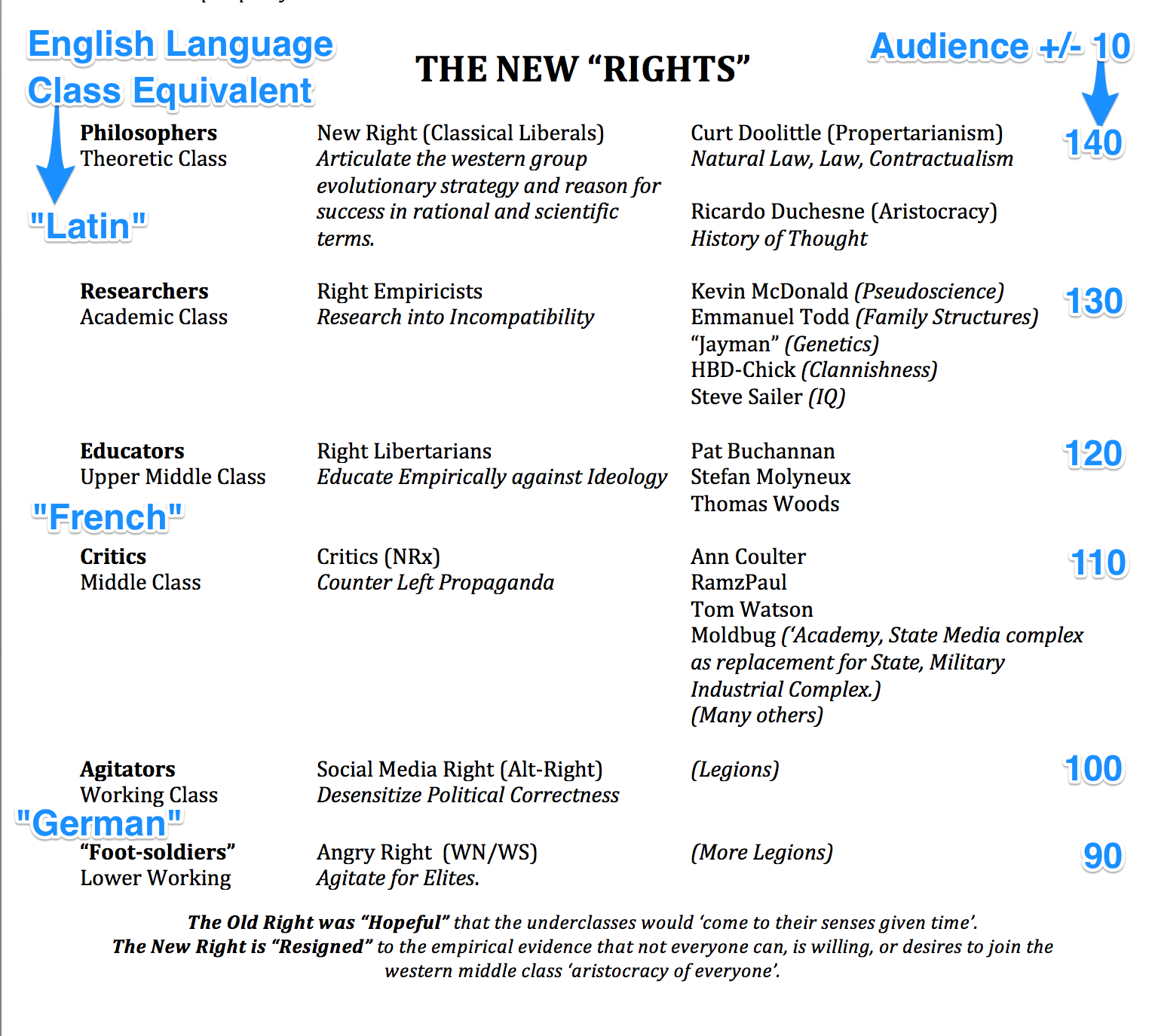
The New “Right” Class Structures
I got a lot of heat for this so I pulled it and sat on it for a week. And this morning I’ve added some notes to it for clarity. And sorry if it pisses people off, but it’s right. It is what it is.
-
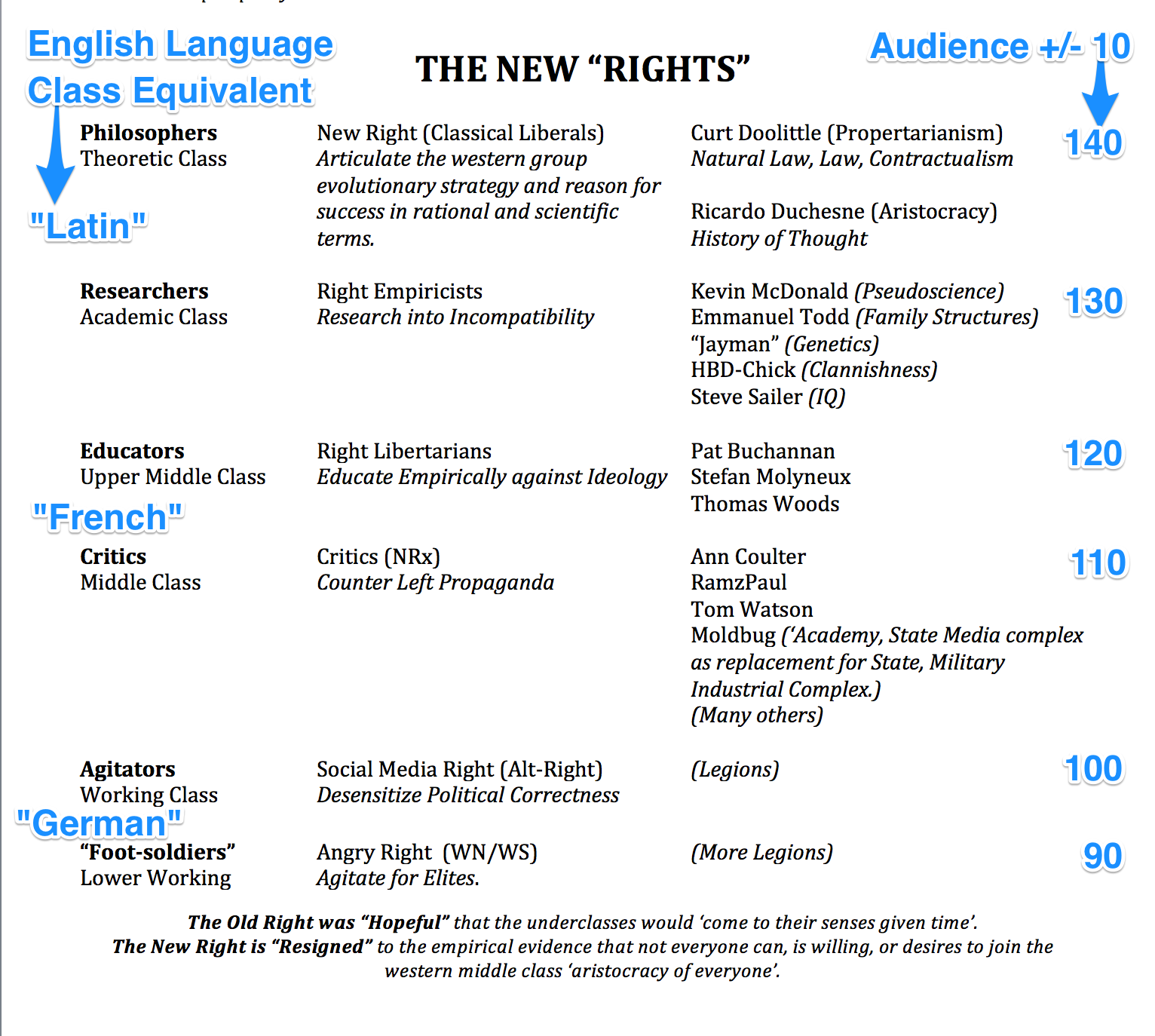
The New “Right” Class Structures
I got a lot of heat for this so I pulled it and sat on it for a week. And this morning I’ve added some notes to it for clarity. And sorry if it pisses people off, but it’s right. It is what it is.
-
WHERE TO BEGIN? —“Just show us how to begin, how we start removing error, bias
WHERE TO BEGIN?
—“Just show us how to begin, how we start removing error, bias, and deception and we will begin. Give us the nuts and bolts.”—
We begin with e-prime. I suppose I could teach that first. Although I don’t know how I have time to teach such a thing right now. It’s all available on the web anyway….
I don’t think categorical, logical, and empirical consistency are very difficult if we start with E-prime – they are all well understood and must only be stated in consistent language.
Propertarianism provides moral consistency and full accounting. I don’t think scope consistency (limits) is very hard either.
The hard part is provided by the problem of operational language exposes our ignorance.
It is very hard to learn to speak without the use of the verb to be. But this is the first step. After that, Propertarian ethics. And the rest is just practice.
Compared to mathematics?
Language ( logic ) requires we supply limits and consistency that is provided by the assumptions of consistency in mathematics.
In other words, logic of action is a shallower model, and mathematics a deeper model, but logic is more complicated than mathematics because of the inconstancy of external categories ( referents ) must be rendered commensurable by the grammar of human operations.
If we understand this we will see that we solved mathematics first because it is much more simple.
I should perhaps point out that this is the purpose of operationalism: the use of human action to produce consistent logical categories.
Thank you for allowing me an opportunity to express this important insight.
( I hope I don’t forget about this comment because it is an important insight into the grammar of truth. )
So, let us take this as a sequence for informative purposes:
LOGICS:
1 – Mathematics : commensurability provided by operational, positional, names, and mathematical operations.
2 – Physical sciences and engineering : commensurability provided by physical determinism (laws of nature).
3 – Economics : commensurability provided by operationally produced prices
4 – Politics : commensurability provided by voluntary exchanges, articulated as fully accounted transactions.
3 – Testimony : commensurability provided by all possible human actions stated objectively as operations.
Source date (UTC): 2016-09-22 05:29:00 UTC