Thought and Language. It’s entirely possible to think without language. But when we use language in our thinking we can calculate with much greater commensurability, much greater greater precision, much greater density, than we can when just imagining – just as when we use writing and symbols we can calculate with greater commensurability, greater precision, and greater density. language produces symbols in the mind that allow greater computational efficiency, just as symbols we compose in the real world produce greater computational efficiency, just as formulae and databases produce greater computational efficiency. The question is why our brains can use ‘names’ to create a stack of concepts (although very limited) that we can compare relatively accurately, the way our use of written marks (symbols) lets us reference whole stories accurately. Chomsky isn’t quite right that we can’t say anything abut thought without language. It’s that some of us can preserve greater short term state (memory) they way some of us can compose music, memorize long sets of number, practice doing mathematical calculations, memorize lines of a script or poem, than can others. Just as some of us can compose only phrases, some sentences, some arguments, and others long explanatory narratives. Thought consists, as does language, (and all grammars) of continuous recursive disambiguation, and symbols (names) allow us to compare, and language (streams of words) allow us to continuously manufacture different lengths of memory, to produce different lengths of forecasts (imagination). In computers we think of buffers. In electronics, capacitors and ballasts. In hydraulics, reservoirs. But for thoughts we use short term memory: the current context, currently revised, as new information is added, new forecasts made, in an ongoing process of continuous recursive disambiguation. What we have seen since the 1990’s is the slow replacement of the idea of computational efficiency with the introduction (thankfully, and finally) of economics – which accounts for time and effort necessary to produce a continuous stream speech in real time. We have also seen the increasing use of of ‘neural economy’, which also brings demand, supply, and time into the discourse as the (correct) replacement for efficiency.
Form: Mini Essay
-
Can We Think without Language?
Thought and Language. It’s entirely possible to think without language. But when we use language in our thinking we can calculate with much greater commensurability, much greater greater precision, much greater density, than we can when just imagining – just as when we use writing and symbols we can calculate with greater commensurability, greater precision, and greater density. language produces symbols in the mind that allow greater computational efficiency, just as symbols we compose in the real world produce greater computational efficiency, just as formulae and databases produce greater computational efficiency. The question is why our brains can use ‘names’ to create a stack of concepts (although very limited) that we can compare relatively accurately, the way our use of written marks (symbols) lets us reference whole stories accurately. Chomsky isn’t quite right that we can’t say anything abut thought without language. It’s that some of us can preserve greater short term state (memory) they way some of us can compose music, memorize long sets of number, practice doing mathematical calculations, memorize lines of a script or poem, than can others. Just as some of us can compose only phrases, some sentences, some arguments, and others long explanatory narratives. Thought consists, as does language, (and all grammars) of continuous recursive disambiguation, and symbols (names) allow us to compare, and language (streams of words) allow us to continuously manufacture different lengths of memory, to produce different lengths of forecasts (imagination). In computers we think of buffers. In electronics, capacitors and ballasts. In hydraulics, reservoirs. But for thoughts we use short term memory: the current context, currently revised, as new information is added, new forecasts made, in an ongoing process of continuous recursive disambiguation. What we have seen since the 1990’s is the slow replacement of the idea of computational efficiency with the introduction (thankfully, and finally) of economics – which accounts for time and effort necessary to produce a continuous stream speech in real time. We have also seen the increasing use of of ‘neural economy’, which also brings demand, supply, and time into the discourse as the (correct) replacement for efficiency.
-
We Can Afford to Separate, Specialize, and Speciate
Just as one of our favorite pundits explains that as we become more wealthy, and institutionally and economically equal, we tend rather dramatically to increase our gender bias expressions – also, in all cases, as we become wealthier, we seek to explore our differences and reinforce them rather than pay the cost of adaptation to a norm. Most conservative liberal conflict is over this difference in conservatives paying costs to conform vs liberals consuming to experiment or explore. With liberals objecting to paying for costs they don’t want to pay directly, and conservatives objective to absorbing costs of liberal consumption and experimentation. Now, there are two choices: conservatives oppress liberals, or liberals oppress conservatives, or we separate, specialize and speciate. In other words, somewhere around 3500 years ago we slowed speciation. In the 20th century the left has attempted to reverse it. And they are succeeding – with horridly dysgenic results. But with very little effort we can now AFFORD to return to speciation. Fortunately, this is great for conservatives who are naturally eugenic, and great for liberals in the short term who are naturally dysgenic. But in the end it means we will, in the aggregate, return to white and east asian excellence and everything between us will once again decline – until they pose a threat to us out of necessity and envy. Time to return to speciation. -
We Can Afford to Separate, Specialize, and Speciate
Just as one of our favorite pundits explains that as we become more wealthy, and institutionally and economically equal, we tend rather dramatically to increase our gender bias expressions – also, in all cases, as we become wealthier, we seek to explore our differences and reinforce them rather than pay the cost of adaptation to a norm. Most conservative liberal conflict is over this difference in conservatives paying costs to conform vs liberals consuming to experiment or explore. With liberals objecting to paying for costs they don’t want to pay directly, and conservatives objective to absorbing costs of liberal consumption and experimentation. Now, there are two choices: conservatives oppress liberals, or liberals oppress conservatives, or we separate, specialize and speciate. In other words, somewhere around 3500 years ago we slowed speciation. In the 20th century the left has attempted to reverse it. And they are succeeding – with horridly dysgenic results. But with very little effort we can now AFFORD to return to speciation. Fortunately, this is great for conservatives who are naturally eugenic, and great for liberals in the short term who are naturally dysgenic. But in the end it means we will, in the aggregate, return to white and east asian excellence and everything between us will once again decline – until they pose a threat to us out of necessity and envy. Time to return to speciation. -
Motivated Reasoning
Young men are often weak, and will seek self medication in narratives. Aristocracy = Agency = Action (Dominance)-vs-Priesthood = Justification = Inaction (Submission)–Cognitive strategy– The processes of motivated reasoning are a type of inferred justification strategy which is used to mitigate cognitive dissonance. When people form and cling to false beliefs despite overwhelming evidence, the phenomenon is labeled “motivated reasoning”. In other words, “rather than search rationally for information that either confirms or disconfirms a particular belief, people actually seek out information that confirms what they already believe”.[2] This is “a form of implicit emotion regulation in which the brain converges on judgments that minimize negative and maximize positive affect states associated with threat to or attainment of motives”.[3] –Mechanisms– Early research on the evaluation and integration of information supported a cognitive approach consistent with Bayesian probability, in which individuals weighted new information using rational calculations.[4] More recent theories endorse cognitive processes as partial explanations of motivated reasoning but have also introduced motivational[5] or affective processes[6] to further illuminate the mechanisms of the bias inherent in cases of motivated reasoning. To further complicate the issue, the first neuro-imaging study designed to test the neural circuitry of individuals engaged in motivated reasoning found that motivated reasoning “was not associated with neural activity in regions previously linked with cold reasoning tasks [Bayesian reasoning] and conscious (explicit) emotion regulation”.[3] This section focuses on two theories that elucidate the mechanisms involved in motivated reasoning. Both theories distinguish between mechanisms present when the individual is trying to reach an accurate conclusion, and those present when the individual has a directional goal. –Goal-oriented motivated reasoning– One review of the research develops the following theoretical model to explain the mechanism by which motivated reasoning results in bias.[7] The model is summarized as follows: Motivation to arrive at a desired conclusion provides a level of arousal, which acts as an initial trigger for the operation of cognitive processes. Historically, motivated reasoning theory identifies that directional goals enhance the accessibility of knowledge structures (memories, information, knowledge) that are consistent with desired conclusions. This theory endorses previous research on accessing information, but adds a procedural component in specifying that the motivation to achieve directional goals will also influence which rules (procedural structures such as inferential rules) and which beliefs are accessed to guide the search for information. In this model the beliefs and rule structures are instrumental in directing which information will be obtained to support the desired conclusion. In comparison, Milton Lodge and Charles Taber (2000) introduce an empirically supported model in which affect is intricately tied to cognition, and information processing is biased toward support for positions that the individual already holds. This model has three components: On-line processing in which when called on to make an evaluation, people instantly draw on stored information which is marked with affect; Affect is automatically activated along with the cognitive node to which it is tied;[8] A “heuristic mechanism” for evaluating new information triggers a reflection on “How do I feel?” about this topic. The result of this process results in a bias towards maintaining existing affect, even in the face of other, disconfirming information. This theory of motivated reasoning is fully developed and tested in Lodge and Taber’s The Rationalizing Voter (2013).[9] Interestingly, David Redlawsk (2002) found that the timing of when disconfirming information was introduced played a role in determining bias. When subjects encountered incongruity during an information search, the automatic assimilation and update process was interrupted. This results in one of two outcomes: subjects may enhance attitude strength in a desire to support existing affect (resulting in degradation in decision quality and potential bias) or, subjects may counter-argue existing beliefs in an attempt to integrate the new data.[10] This second outcome is consistent with the research on how processing occurs when one is tasked with accuracy goals.
-
Motivated Reasoning
Young men are often weak, and will seek self medication in narratives. Aristocracy = Agency = Action (Dominance)-vs-Priesthood = Justification = Inaction (Submission)–Cognitive strategy– The processes of motivated reasoning are a type of inferred justification strategy which is used to mitigate cognitive dissonance. When people form and cling to false beliefs despite overwhelming evidence, the phenomenon is labeled “motivated reasoning”. In other words, “rather than search rationally for information that either confirms or disconfirms a particular belief, people actually seek out information that confirms what they already believe”.[2] This is “a form of implicit emotion regulation in which the brain converges on judgments that minimize negative and maximize positive affect states associated with threat to or attainment of motives”.[3] –Mechanisms– Early research on the evaluation and integration of information supported a cognitive approach consistent with Bayesian probability, in which individuals weighted new information using rational calculations.[4] More recent theories endorse cognitive processes as partial explanations of motivated reasoning but have also introduced motivational[5] or affective processes[6] to further illuminate the mechanisms of the bias inherent in cases of motivated reasoning. To further complicate the issue, the first neuro-imaging study designed to test the neural circuitry of individuals engaged in motivated reasoning found that motivated reasoning “was not associated with neural activity in regions previously linked with cold reasoning tasks [Bayesian reasoning] and conscious (explicit) emotion regulation”.[3] This section focuses on two theories that elucidate the mechanisms involved in motivated reasoning. Both theories distinguish between mechanisms present when the individual is trying to reach an accurate conclusion, and those present when the individual has a directional goal. –Goal-oriented motivated reasoning– One review of the research develops the following theoretical model to explain the mechanism by which motivated reasoning results in bias.[7] The model is summarized as follows: Motivation to arrive at a desired conclusion provides a level of arousal, which acts as an initial trigger for the operation of cognitive processes. Historically, motivated reasoning theory identifies that directional goals enhance the accessibility of knowledge structures (memories, information, knowledge) that are consistent with desired conclusions. This theory endorses previous research on accessing information, but adds a procedural component in specifying that the motivation to achieve directional goals will also influence which rules (procedural structures such as inferential rules) and which beliefs are accessed to guide the search for information. In this model the beliefs and rule structures are instrumental in directing which information will be obtained to support the desired conclusion. In comparison, Milton Lodge and Charles Taber (2000) introduce an empirically supported model in which affect is intricately tied to cognition, and information processing is biased toward support for positions that the individual already holds. This model has three components: On-line processing in which when called on to make an evaluation, people instantly draw on stored information which is marked with affect; Affect is automatically activated along with the cognitive node to which it is tied;[8] A “heuristic mechanism” for evaluating new information triggers a reflection on “How do I feel?” about this topic. The result of this process results in a bias towards maintaining existing affect, even in the face of other, disconfirming information. This theory of motivated reasoning is fully developed and tested in Lodge and Taber’s The Rationalizing Voter (2013).[9] Interestingly, David Redlawsk (2002) found that the timing of when disconfirming information was introduced played a role in determining bias. When subjects encountered incongruity during an information search, the automatic assimilation and update process was interrupted. This results in one of two outcomes: subjects may enhance attitude strength in a desire to support existing affect (resulting in degradation in decision quality and potential bias) or, subjects may counter-argue existing beliefs in an attempt to integrate the new data.[10] This second outcome is consistent with the research on how processing occurs when one is tasked with accuracy goals.
-
Finishing up The Single Motherhood Topic
I wanted to use the single motherhood subject to test how many people rely on how little data, vs how few people went out and did more than cursory data collection. As a sensitive (controversial) topic with high causal density it’s an example of a ‘hard problem’. 1 – The data that fathers make better single parents is because single fathers are more likely to cohabitate with a woman and provide a full family. 2 – The casual problem driving externalities from single mother households is poverty, and the disproportionate number of them in the non-white underclasses which means poverty is continuous for genetic reasons. 3 – The social problem is CULTURE, in that mothers from GOOD backgrounds (Cultures, Traditions, Classes) seem to produce (largely) healthy offspring free of externalities Now, it took quite a bit of discussion for the arguments to come out. As I understand it, this is the set of incentives; 0 – In general, people are unprepared for marriage, in large part because they begin working too late, are poorly socialized, are terribly selfish because of it, have been too frustrated and made physically unfit by the education process, and are too desirous of spending money – essentially developmentally delayed and frustrated for it. Worse, they have no institutional incentives to produce a family that will somehow care for them in later life, too much taxation and interest to afford children and must pay ridiculous prices for housing for the simple reason that they cannot segregate their neighborhoods by other than housing price. In other words, you cannot live cheaply with good people, if we cannot separate by character, culture, and tribe. 1 – Divorce provides too many incentives for the woman, and too many harms to the man. This creates a dysfunctional marriage. 2 – In general, the work of a woman’s adapting to a male in the household (nest), and providing him with sufficient attention while children are young, that he will remain engaged, is greater than most women will spare, unless the male provides so much income that she doesn’t need to work. 3 – Over-control, Overprotection and Guilt – sense of being out of control. The Physical, Mental and Emotional exhaustion that exacerbates the feeling of being out of control. 4 – Tendency to replace children, especially male children, with the friendship one gets from a mate. This puts extraordinary burden on the child that manifests later in life. There is a reason for Alexander, Napoleon, and Hitler: mothers under duress. As such, again, the problem is cultural. We extend adolescence (infantilize) instead of prepare for adulthood. Families wouldn’t break if there were (a) lower or zero home interest (b) far greater tax reduction per child, (c) we brought capital to people, rather than people to capital, so that intergenerational families could provide support, thereby reducing the cost of childrearing (family production) (d) we didn’t provide incentives to divorce. Cheers
-
Finishing up The Single Motherhood Topic
I wanted to use the single motherhood subject to test how many people rely on how little data, vs how few people went out and did more than cursory data collection. As a sensitive (controversial) topic with high causal density it’s an example of a ‘hard problem’. 1 – The data that fathers make better single parents is because single fathers are more likely to cohabitate with a woman and provide a full family. 2 – The casual problem driving externalities from single mother households is poverty, and the disproportionate number of them in the non-white underclasses which means poverty is continuous for genetic reasons. 3 – The social problem is CULTURE, in that mothers from GOOD backgrounds (Cultures, Traditions, Classes) seem to produce (largely) healthy offspring free of externalities Now, it took quite a bit of discussion for the arguments to come out. As I understand it, this is the set of incentives; 0 – In general, people are unprepared for marriage, in large part because they begin working too late, are poorly socialized, are terribly selfish because of it, have been too frustrated and made physically unfit by the education process, and are too desirous of spending money – essentially developmentally delayed and frustrated for it. Worse, they have no institutional incentives to produce a family that will somehow care for them in later life, too much taxation and interest to afford children and must pay ridiculous prices for housing for the simple reason that they cannot segregate their neighborhoods by other than housing price. In other words, you cannot live cheaply with good people, if we cannot separate by character, culture, and tribe. 1 – Divorce provides too many incentives for the woman, and too many harms to the man. This creates a dysfunctional marriage. 2 – In general, the work of a woman’s adapting to a male in the household (nest), and providing him with sufficient attention while children are young, that he will remain engaged, is greater than most women will spare, unless the male provides so much income that she doesn’t need to work. 3 – Over-control, Overprotection and Guilt – sense of being out of control. The Physical, Mental and Emotional exhaustion that exacerbates the feeling of being out of control. 4 – Tendency to replace children, especially male children, with the friendship one gets from a mate. This puts extraordinary burden on the child that manifests later in life. There is a reason for Alexander, Napoleon, and Hitler: mothers under duress. As such, again, the problem is cultural. We extend adolescence (infantilize) instead of prepare for adulthood. Families wouldn’t break if there were (a) lower or zero home interest (b) far greater tax reduction per child, (c) we brought capital to people, rather than people to capital, so that intergenerational families could provide support, thereby reducing the cost of childrearing (family production) (d) we didn’t provide incentives to divorce. Cheers
-
FINISHING UP THE SINGLE MOTHERHOOD TOPIC I wanted to use the single motherhood s
FINISHING UP THE SINGLE MOTHERHOOD TOPIC
I wanted to use the single motherhood subject to test how many people rely on how little data, vs how few people went out and did more than cursory data collection.
As a sensitive (controversial) topic with high causal density it’s an example of a ‘hard problem’.
1 – The data that fathers make better single parents is because single fathers are more likely to cohabitate with a woman and provide a full family.
2 – The casual problem driving externalities from single mother households is poverty, and the disproportionate number of them in the non-white underclasses which means poverty is continuous for genetic reasons.
3 – The social problem is CULTURE, in that mothers from GOOD backgrounds (Cultures, Traditions, Classes) seem to produce (largely) healthy offspring free of externalities
Now, it took quite a bit of discussion for the arguments to come out.
As I understand it, this is the set of incentives;
0 – In general, people are unprepared for marriage, in large part because they begin working too late, are poorly socialized, are terribly selfish because of it, have been too frustrated and made physically unfit by the education process, and are too desirous of spending money – essentially developmentally delayed and frustrated for it. Worse, they have no institutional incentives to produce a family that will somehow care for them in later life, too much taxation and interest to afford children and must pay ridiculous prices for housing for the simple reason that they cannot segregate their neighborhoods by other than housing price. In other words, you cannot live cheaply with good people, if we cannot separate by character, culture, and tribe.
1 – Divorce provides too many incentives for the woman, and too many harms to the man. This creates a dysfunctional marriage.
2 – In general, the work of a woman’s adapting to a male in the household (nest), and providing him with sufficient attention while children are young, that he will remain engaged, is greater than most women will spare, unless the male provides so much income that she doesn’t need to work.
3 – Over-control, Overprotection and Guilt – sense of being out of control. The Physical, Mental and Emotional exhaustion that exacerbates the feeling of being out of control.
4 – Tendency to replace children, especially male children, with the friendship one gets from a mate. This puts extraordinary burden on the child that manifests later in life. There is a reason for Alexander, Napoleon, and Hitler: mothers under duress.
As such, again, the problem is cultural. We extend adolescence (infantilize) instead of prepare for adulthood. Families wouldn’t break if there were (a) lower or zero home interest (b) far greater tax reduction per child, (c) we brought capital to people, rather than people to capital, so that intergenerational families could provide support, thereby reducing the cost of childrearing (family production) (d) we didn’t provide incentives to divorce.
Cheers
Source date (UTC): 2018-06-21 15:39:00 UTC
-
photos_and_videos/your_posts/35922789_10156440940077264_1331565811675955200_o_10
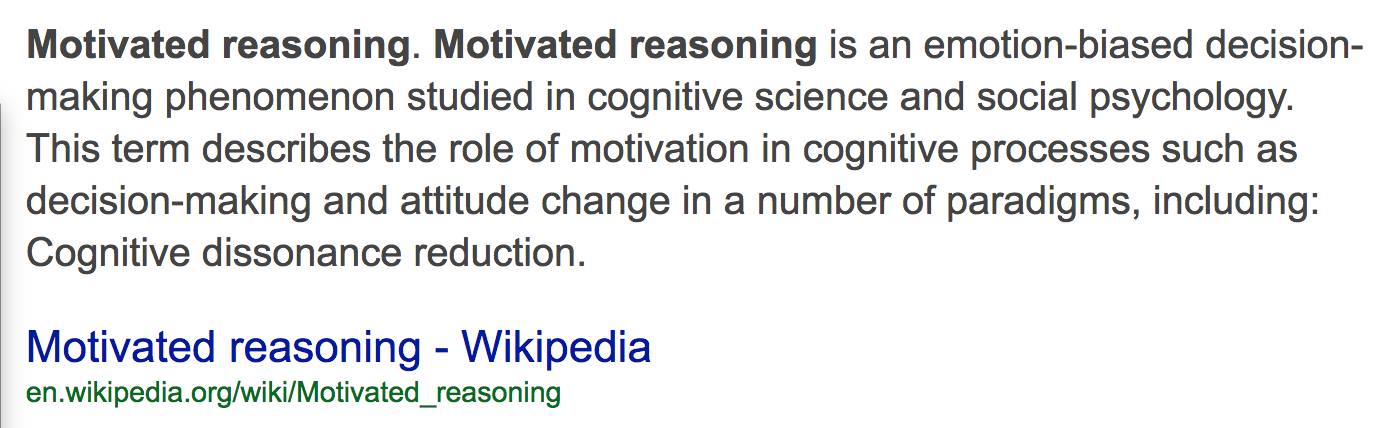
photos_and_videos/your_posts/35922789_10156440940077264_1331565811675955200_o_10156440940067264.jpg MOTIVATED REASONING
Young men are often weak, and will seek self medication in narratives.
Aristocracy = Agency = Action (Dominance)
-vs-
Priesthood = Justification = Inaction (Submission)
–Cognitive strategy–
The processes of motivated reasoning are a type of inferred justification strategy which is used to mitigate cognitive dissonance. When people form and cling to false beliefs despite overwhelming evidence, the phenomenon is labeled “motivated reasoning”. In other words, “rather than search rationally for information that either confirms or disconfirms a particular belief, people actually seek out information that confirms what they already believe”.[2] This is “a form of implicit emotion regulation in which the brain converges on judgments that minimize negative and maximize positive affect states associated with threat to or attainment of motives”.[3]
–Mechanisms–
Early research on the evaluation and integration of information supported a cognitive approach consistent with Bayesian probability, in which individuals weighted new information using rational calculations.[4] More recent theories endorse cognitive processes as partial explanations of motivated reasoning but have also introduced motivational[5] or affective processes[6] to further illuminate the mechanisms of the bias inherent in cases of motivated reasoning. To further complicate the issue, the first neuro-imaging study designed to test the neural circuitry of individuals engaged in motivated reasoning found that motivated reasoning “was not associated with neural activity in regions previously linked with cold reasoning tasks [Bayesian reasoning] and conscious (explicit) emotion regulation”.[3] This section focuses on two theories that elucidate the mechanisms involved in motivated reasoning. Both theories distinguish between mechanisms present when the individual is trying to reach an accurate conclusion, and those present when the individual has a directional goal.
–Goal-oriented motivated reasoning–
One review of the research develops the following theoretical model to explain the mechanism by which motivated reasoning results in bias.[7] The model is summarized as follows:
Motivation to arrive at a desired conclusion provides a level of arousal, which acts as an initial trigger for the operation of cognitive processes. Historically, motivated reasoning theory identifies that directional goals enhance the accessibility of knowledge structures (memories, information, knowledge) that are consistent with desired conclusions. This theory endorses previous research on accessing information, but adds a procedural component in specifying that the motivation to achieve directional goals will also influence which rules (procedural structures such as inferential rules) and which beliefs are accessed to guide the search for information. In this model the beliefs and rule structures are instrumental in directing which information will be obtained to support the desired conclusion.
In comparison, Milton Lodge and Charles Taber (2000) introduce an empirically supported model in which affect is intricately tied to cognition, and information processing is biased toward support for positions that the individual already holds.
This model has three components:
On-line processing in which when called on to make an evaluation, people instantly draw on stored information which is marked with affect;
Affect is automatically activated along with the cognitive node to which it is tied;[8]
A “heuristic mechanism” for evaluating new information triggers a reflection on “How do I feel?” about this topic. The result of this process results in a bias towards maintaining existing affect, even in the face of other, disconfirming information.
This theory of motivated reasoning is fully developed and tested in Lodge and Taber’s The Rationalizing Voter (2013).[9] Interestingly, David Redlawsk (2002) found that the timing of when disconfirming information was introduced played a role in determining bias. When subjects encountered incongruity during an information search, the automatic assimilation and update process was interrupted. This results in one of two outcomes: subjects may enhance attitude strength in a desire to support existing affect (resulting in degradation in decision quality and potential bias) or, subjects may counter-argue existing beliefs in an attempt to integrate the new data.[10] This second outcome is consistent with the research on how processing occurs when one is tasked with accuracy goals.Paul FranklinKurt, and all of you (us – me) forgive my panic and erratic thought, which seems unthought of by anyone else probably only for being asleep, but this is… important?
There is a dangerous inversion of black and white, in a popular old wives’ tale repeated by men, that if you take the ‘red pill’ things get worse for being real, as a result of your being honest, sincere? The truth -aggravatingly universal in this example – our (common) reality is both beautiful and fulfilling, not by virtue of any perversion, inversion, lens, distortion, divorce or separation, but straightforwardly.
Things are there for the taking when you wake up. And I think reality has been switched, substituted, and become a property of the subjective interpretation of the thing instead of the exact same thing.
The ‘sacrifice’ we are expected to make (heros), enjoining hardship, suffering, deprivation, and gaining brotherhood, appears only flattering to (male?) egos while selling them (us) a false ‘Zion’ (of austerity)?
Heroes will be egged on by this popular culture to turn their bullets against themselves – though perhaps, in these circumstances you can’t miss?
The main trick is to come as close to telling the whole ‘truth’ as we can, and omitting the least; or turning something’s completely upside down while pointing out how every detail is in its place, then turning the lights out… .
Btw. Only the fates of others look black to me now. And did I tell you, it’s been a great pleasure (and that goes for the rest of you)! For which and much else I must thank Mea Culba! May I wish you (and all of us) the best!
btw If I seem unfriendly it’s partly because Blue=cuddly disarmed fraternity … but you can take things too far.
Cheers!Jun 20, 2018 7:19pmPaul FranklinI was surprised to see this, I’d only thought about posting it!Jun 20, 2018 10:05pmMOTIVATED REASONING
Young men are often weak, and will seek self medication in narratives.
Aristocracy = Agency = Action (Dominance)
-vs-
Priesthood = Justification = Inaction (Submission)
–Cognitive strategy–
The processes of motivated reasoning are a type of inferred justification strategy which is used to mitigate cognitive dissonance. When people form and cling to false beliefs despite overwhelming evidence, the phenomenon is labeled “motivated reasoning”. In other words, “rather than search rationally for information that either confirms or disconfirms a particular belief, people actually seek out information that confirms what they already believe”.[2] This is “a form of implicit emotion regulation in which the brain converges on judgments that minimize negative and maximize positive affect states associated with threat to or attainment of motives”.[3]
–Mechanisms–
Early research on the evaluation and integration of information supported a cognitive approach consistent with Bayesian probability, in which individuals weighted new information using rational calculations.[4] More recent theories endorse cognitive processes as partial explanations of motivated reasoning but have also introduced motivational[5] or affective processes[6] to further illuminate the mechanisms of the bias inherent in cases of motivated reasoning. To further complicate the issue, the first neuro-imaging study designed to test the neural circuitry of individuals engaged in motivated reasoning found that motivated reasoning “was not associated with neural activity in regions previously linked with cold reasoning tasks [Bayesian reasoning] and conscious (explicit) emotion regulation”.[3] This section focuses on two theories that elucidate the mechanisms involved in motivated reasoning. Both theories distinguish between mechanisms present when the individual is trying to reach an accurate conclusion, and those present when the individual has a directional goal.
–Goal-oriented motivated reasoning–
One review of the research develops the following theoretical model to explain the mechanism by which motivated reasoning results in bias.[7] The model is summarized as follows:
Motivation to arrive at a desired conclusion provides a level of arousal, which acts as an initial trigger for the operation of cognitive processes. Historically, motivated reasoning theory identifies that directional goals enhance the accessibility of knowledge structures (memories, information, knowledge) that are consistent with desired conclusions. This theory endorses previous research on accessing information, but adds a procedural component in specifying that the motivation to achieve directional goals will also influence which rules (procedural structures such as inferential rules) and which beliefs are accessed to guide the search for information. In this model the beliefs and rule structures are instrumental in directing which information will be obtained to support the desired conclusion.
In comparison, Milton Lodge and Charles Taber (2000) introduce an empirically supported model in which affect is intricately tied to cognition, and information processing is biased toward support for positions that the individual already holds.
This model has three components:
On-line processing in which when called on to make an evaluation, people instantly draw on stored information which is marked with affect;
Affect is automatically activated along with the cognitive node to which it is tied;[8]
A “heuristic mechanism” for evaluating new information triggers a reflection on “How do I feel?” about this topic. The result of this process results in a bias towards maintaining existing affect, even in the face of other, disconfirming information.
This theory of motivated reasoning is fully developed and tested in Lodge and Taber’s The Rationalizing Voter (2013).[9] Interestingly, David Redlawsk (2002) found that the timing of when disconfirming information was introduced played a role in determining bias. When subjects encountered incongruity during an information search, the automatic assimilation and update process was interrupted. This results in one of two outcomes: subjects may enhance attitude strength in a desire to support existing affect (resulting in degradation in decision quality and potential bias) or, subjects may counter-argue existing beliefs in an attempt to integrate the new data.[10] This second outcome is consistent with the research on how processing occurs when one is tasked with accuracy goals.
Source date (UTC): 2018-06-20 18:43:00 UTC