Form: Definition

  • “How Do You Verify Truth?” (You Don’t)

    —“How do you verify truth?”— Verification is a method of falsification not a means of identifying truth. No matter how many excuses you make (justifications) that does not provide us with confidence of truth. Instead…. Survival, not Proof. You eliminate all falsehoods, and what remains is a truth candidate. You eliminate all falsehoods by attempting to falsify each dimension of actionable reality. And you do so to defend against fictionalisms (lies).

    • Identity (categorical consistency)
    • Logical (internal consistency)
    • Empirical (external correspondence)
    • Operational (existential possibility)
    • Rational (rational choice)
    • Reciprocal (reciprocally rational)
    • Complete (scope, limits, and parsimony)
    • Coherent (across all these tests)
    • Warranty (warranty of having performed these tests).

    If all premises and arguments pass these attempts at falsification one may have a truth candidate. Otherwise one does not. This is as certain as the laws of physics, mathematics, and logic. It is very hard for a statement to survive these tests, to give that testimony, and to warranty it.
  • “How Do You Verify Truth?” (You Don’t)

    —“How do you verify truth?”— Verification is a method of falsification not a means of identifying truth. No matter how many excuses you make (justifications) that does not provide us with confidence of truth. Instead…. Survival, not Proof. You eliminate all falsehoods, and what remains is a truth candidate. You eliminate all falsehoods by attempting to falsify each dimension of actionable reality. And you do so to defend against fictionalisms (lies).

    • Identity (categorical consistency)
    • Logical (internal consistency)
    • Empirical (external correspondence)
    • Operational (existential possibility)
    • Rational (rational choice)
    • Reciprocal (reciprocally rational)
    • Complete (scope, limits, and parsimony)
    • Coherent (across all these tests)
    • Warranty (warranty of having performed these tests).

    If all premises and arguments pass these attempts at falsification one may have a truth candidate. Otherwise one does not. This is as certain as the laws of physics, mathematics, and logic. It is very hard for a statement to survive these tests, to give that testimony, and to warranty it.

  • PHENOMENON noun, plural phenomena, or, especially for 3, phenomenons. 1. a fact,

    PHENOMENON

    noun, plural phenomena, or, especially for 3, phenomenons.

    1. a fact, occurrence, or circumstance observed or observable.


    Source date (UTC): 2018-04-30 13:52:00 UTC

  • THE ROMAN SAECULUM A saeculum is a length of time roughly equal to the potential

    THE ROMAN SAECULUM

    A saeculum is a length of time roughly equal to the potential lifetime of a person or the equivalent of the complete renewal of a human population.

    (four 22 year cycles)


    Source date (UTC): 2018-04-29 21:26:00 UTC

  • photos_and_videos/TimelinePhotos_43196237263/31542656_10156321367267264_29375165

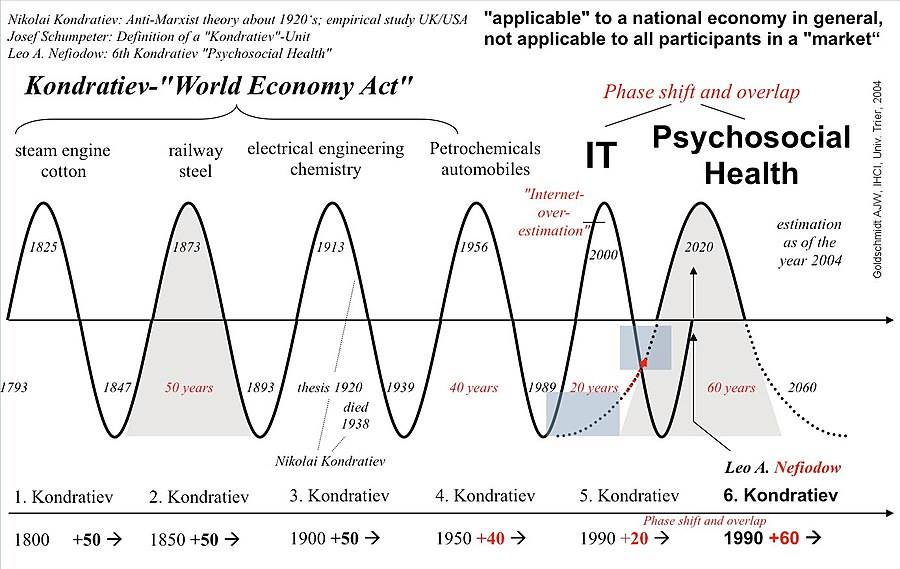
    photos_and_videos/TimelinePhotos_43196237263/31542656_10156321367267264_2937516571129544704_n_10156321367252264.jpg THE KONDRATIEV CYCLE

    https://en.wikipedia.org/wiki/Kondratiev_waveVik LiI recall seeing this in 2004…Apr 29, 2018 10:00pmSteven KolpekIs this just long-form Keynesian economics?Apr 29, 2018 10:07pmBob MoranLooks like it can be linked to the Elliot wave principle. Thoughts on this one? From mostly correct to total BS?Apr 29, 2018 11:03pmTHE KONDRATIEV CYCLE

    https://en.wikipedia.org/wiki/Kondratiev_wave


    Source date (UTC): 2018-04-29 21:22:00 UTC

  • Rights

    RIGHTS In practice, you have the property and property rights that the people around you are willing to concede that you have, and willing to help you defend and uphold. One man cannot stand alone against the world. But enough in confederation can hold hostile hordes at bay indefinitely. Property and property rights are obtained in exchange. You recognize and uphold mine and I’ll do the same for yours. The necessary standard to make property rights durable is mutual insurance, not just “respect mine and I’ll respect yours” but “DEFEND mine and I’ll DEFEND yours.” Practically speaking, you can’t have any rights without positive duties and obligations. Libertarians go wrong when they make a distinction between “positive” and “negative” rights. All rights are positive rights because NO rights can be enjoyed without enforcement and defense; and enforcement and defense must be proactive and have positive costs (although the benefits may be greater.) Any claims by libertarians that rights are “natural,” “God-given”, “innate,” “inalienable,” “selfevident,” or anything of the sort are moralistic attempts to obtain rights at a discount, without paying the full cost of asserting, maintaining, and defending them, by convincing others to PROVIDE them at their expense. But there can be no such thing, in practice, as a right not to contribute to the maintenance and defense of rights that one demands. Rights, in practice, have to be maintained and defended. Non-contribution to the maintenance and defense of rights is not conducive to their maintenance and defense. Demands for rights while refusing to enter into reciprocal duties and obligations to defend rights is a violation of reciprocity and an act of parasitism, not conducive to long term cooperation. Without cooperation, no rights can successfully be maintained and defended. Eli Harman

  • Rights

    RIGHTS In practice, you have the property and property rights that the people around you are willing to concede that you have, and willing to help you defend and uphold. One man cannot stand alone against the world. But enough in confederation can hold hostile hordes at bay indefinitely. Property and property rights are obtained in exchange. You recognize and uphold mine and I’ll do the same for yours. The necessary standard to make property rights durable is mutual insurance, not just “respect mine and I’ll respect yours” but “DEFEND mine and I’ll DEFEND yours.” Practically speaking, you can’t have any rights without positive duties and obligations. Libertarians go wrong when they make a distinction between “positive” and “negative” rights. All rights are positive rights because NO rights can be enjoyed without enforcement and defense; and enforcement and defense must be proactive and have positive costs (although the benefits may be greater.) Any claims by libertarians that rights are “natural,” “God-given”, “innate,” “inalienable,” “selfevident,” or anything of the sort are moralistic attempts to obtain rights at a discount, without paying the full cost of asserting, maintaining, and defending them, by convincing others to PROVIDE them at their expense. But there can be no such thing, in practice, as a right not to contribute to the maintenance and defense of rights that one demands. Rights, in practice, have to be maintained and defended. Non-contribution to the maintenance and defense of rights is not conducive to their maintenance and defense. Demands for rights while refusing to enter into reciprocal duties and obligations to defend rights is a violation of reciprocity and an act of parasitism, not conducive to long term cooperation. Without cooperation, no rights can successfully be maintained and defended. Eli Harman

  • The Key To Understanding Propertarianism

    KEY TO UNDERSTANDING PROPERTARIANISM by Luke Weinhagen Understanding this: —-“There exist only three possible relations (avoidance, cooperation, conflict).”—- … and developing the skill to accurately identify these categories, makes everything Propertarianism is exploring understandable and in context. Where I’ve had misses in comprehension has consistently been where I’ve mis-categorized one or more of those three as another in whatever relation is being explored.

  • The Key To Understanding Propertarianism

    KEY TO UNDERSTANDING PROPERTARIANISM by Luke Weinhagen Understanding this: —-“There exist only three possible relations (avoidance, cooperation, conflict).”—- … and developing the skill to accurately identify these categories, makes everything Propertarianism is exploring understandable and in context. Where I’ve had misses in comprehension has consistently been where I’ve mis-categorized one or more of those three as another in whatever relation is being explored.

  • TODAY’S CLASS: “CONSTANT RELATIONS” OK. So lets try this. “Constant Relations”.

    TODAY’S CLASS: “CONSTANT RELATIONS”

    OK. So lets try this. “Constant Relations”.

    (And for super geeks watch what I do to logic and set theory with operationalism.)

    1) Now, what is the difference between “differences” and “constant and inconstant relations”?

    a) So neurons can identify that which is the same, that which is different and can accumulate these differences, as more correspondent or less correspondent, right?

    2) When we say “nothing” what CAN we refer to?

    Neil: “Everything”.

    Curt: “Correct, when we say ‘nothing’ we can only mean everything, and we have not selected from everything.”


    Source date (UTC): 2018-04-23 15:39:00 UTC