Form: Definition

  • CONFLATION AND DEFLATION OF … —“… Are lies beautiful, Curt?”—‎Digue Doug

    CONFLATION AND DEFLATION OF …

    —“… Are lies beautiful, Curt?”—‎Digue Doug‎

    Pleasure(Self) and Beauty(Common) are two different things. Truth(Opportunity), Beauty(Fertility), Goodness(Plenty, Morality), are goods. Whether we seek to pay the Cost of them determines whether they are preferences and pleasures of the self as well as Goods for the Commons – or not.

    Lies can be ‘elegant, sophisticated, artful’ in the sense that the human effort and ability it took to produce them demonstrates excellence, superiority, and ability. But to conflate the CRAFT (excellence), with the CONTENT (beauty) is a sophism by either fraud or error.

    ( Thought you were gonna play a word game with me? lol nope. lotsa nope. 😉 )

    hugs


    Source date (UTC): 2018-11-05 06:29:00 UTC

  • Absolutism

    —“Absolutism asserts a preference as a good and then justifies that preference with facts (fits the world around the individual). Scientific Law of Tort models the social world. With this knowledge, the polity asserts its good in the name of the state, and the individuals assert their will to power within those limits for fear of punishment.”—Nick Rosenthal

    (genius)

  • Absolutism

    —“Absolutism asserts a preference as a good and then justifies that preference with facts (fits the world around the individual). Scientific Law of Tort models the social world. With this knowledge, the polity asserts its good in the name of the state, and the individuals assert their will to power within those limits for fear of punishment.”—Nick Rosenthal

    (genius)

  • photos_and_videos/TimelinePhotos_SxeO6JU-xg/45355421_10156755388822264_364742227

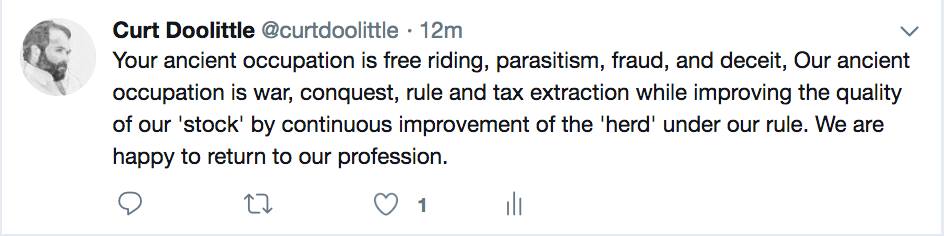
    photos_and_videos/TimelinePhotos_SxeO6JU-xg/45355421_10156755388822264_3647422270852300800_n_10156755388817264.jpg RHETORICAL AMMUNITION 1RHETORICAL AMMUNITION 1


    Source date (UTC): 2018-11-04 12:22:00 UTC

  • photos_and_videos/TimelinePhotos_SxeO6JU-xg/45340740_10156755388232264_541499197

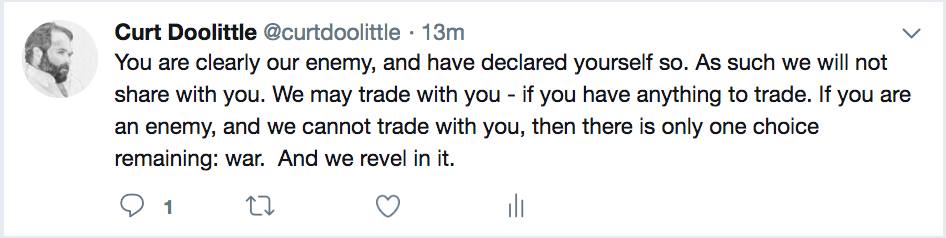
    photos_and_videos/TimelinePhotos_SxeO6JU-xg/45340740_10156755388232264_5414991975344504832_n_10156755388227264.jpg RHETORICAL AMMUNITION 2RHETORICAL AMMUNITION 2


    Source date (UTC): 2018-11-04 12:22:00 UTC

  • photos_and_videos/TimelinePhotos_SxeO6JU-xg/45365685_10156755387577264_630089230

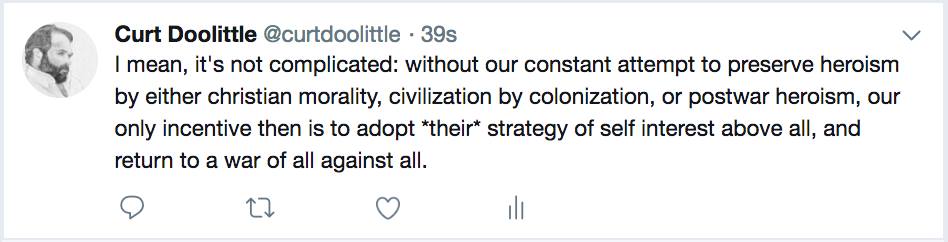
    photos_and_videos/TimelinePhotos_SxeO6JU-xg/45365685_10156755387577264_6300892300847349760_n_10156755387572264.jpg RHETORICAL AMMUNITION 3RHETORICAL AMMUNITION 3


    Source date (UTC): 2018-11-04 12:22:00 UTC

  • photos_and_videos/TimelinePhotos_SxeO6JU-xg/45353064_10156755386992264_183816712

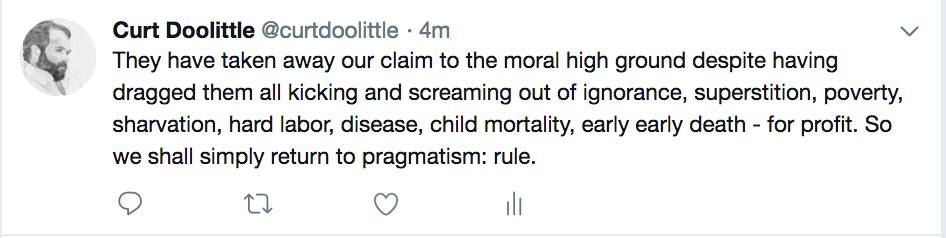
    photos_and_videos/TimelinePhotos_SxeO6JU-xg/45353064_10156755386992264_1838167125613608960_n_10156755386987264.jpg RHETORICAL AMMUNITION 4RHETORICAL AMMUNITION 4


    Source date (UTC): 2018-11-04 12:22:00 UTC

  • Post Formatting and Syntax

    “CURT: WHAT DOES YOUR |?????| >>> SYNTAX MEAN?”

    —“Can you help me understand the syntax you use? What does the vertical bar ” | ” mean? And this ” > “?”— Eric Grose

    Great Question: | DIMENSION | start limit > step > step > step > end limit. Where >, <, <-, and ->, state the direction. So you will see me use < < <, or > > >, or < < <- center -> > > depending upon the direction. It’s a “Dimension” definition, meaning an ordered range of values that are permissible for use in a property of a Class (definition). It defines the LIMITS (start and end) and COMPLETENESS (range of values), in PARSIMONIOUS FORM, thereby satisfying Testimonialism’s demand for both LIMITS and FULL ACCOUNTING for any warranty of due diligence against ignorance, error, bias, and deceit. Given a Class (Table), consisting of (a) Properties(Attributes) and their Values (data), (b) Relations (references), and (c) Methods (internal operations), and (d) functions (external operations), a Dimension provides the range of values permissible for a property. It’ is a geometric (linear, serialize) method of defining a dimension (table of values). So we convert: |TEACHING| Reading to > Lecturing > Socratic Teaching > Running a grad seminar > Running an MBA/Law course (case studies) > Running a Competitive Game > Military Training. Into: Define TEACHING: id: int, str: category. Insert TEACHING: | TEACHING | 1, Reading to 2, Lecturing 3, Socratic Teaching 4, Running a grad seminar 5, Running an MBA/Law course (case studies) 6, Running a Competitive Game 7, Military Training (a tiny bit of the relational calculus) WHY? Because the grammars allow us to produce an N-Dimensional geometry of ‘meaning’. But that is not something I am going to put into this series of the work. It’s like putting equations in to it. So I’m using the Series instead. OK? Cheers
  • Post Formatting and Syntax

    “CURT: WHAT DOES YOUR |?????| >>> SYNTAX MEAN?”

    —“Can you help me understand the syntax you use? What does the vertical bar ” | ” mean? And this ” > “?”— Eric Grose

    Great Question: | DIMENSION | start limit > step > step > step > end limit. Where >, <, <-, and ->, state the direction. So you will see me use < < <, or > > >, or < < <- center -> > > depending upon the direction. It’s a “Dimension” definition, meaning an ordered range of values that are permissible for use in a property of a Class (definition). It defines the LIMITS (start and end) and COMPLETENESS (range of values), in PARSIMONIOUS FORM, thereby satisfying Testimonialism’s demand for both LIMITS and FULL ACCOUNTING for any warranty of due diligence against ignorance, error, bias, and deceit. Given a Class (Table), consisting of (a) Properties(Attributes) and their Values (data), (b) Relations (references), and (c) Methods (internal operations), and (d) functions (external operations), a Dimension provides the range of values permissible for a property. It’ is a geometric (linear, serialize) method of defining a dimension (table of values). So we convert: |TEACHING| Reading to > Lecturing > Socratic Teaching > Running a grad seminar > Running an MBA/Law course (case studies) > Running a Competitive Game > Military Training. Into: Define TEACHING: id: int, str: category. Insert TEACHING: | TEACHING | 1, Reading to 2, Lecturing 3, Socratic Teaching 4, Running a grad seminar 5, Running an MBA/Law course (case studies) 6, Running a Competitive Game 7, Military Training (a tiny bit of the relational calculus) WHY? Because the grammars allow us to produce an N-Dimensional geometry of ‘meaning’. But that is not something I am going to put into this series of the work. It’s like putting equations in to it. So I’m using the Series instead. OK? Cheers
  • Do You Know The Difference?

    Religion Vs Ideology Vs Philosophy Vs Logic Vs Mathematics Vs Science A RELIGION consists of any set of ideas of justification which require belief in, testimony to, or action according to, one or more falsehoods as a cost of inclusion and use. AN IDEOLOGY consist of any set of ideas that agitate, motivate, or inspire achievement of political ends under majoritarian (monopoly) democracy. An ideology need not be internally consistent externally correspondent, or existentially possible. It need only motivate individuals to act in furtherance of policy. A PHILOSOPHY consists of any set of internally consistent ideas of decidability which justify pursuit of personal preferences or group goods. A LOGIC consists of any deflationary grammar of decidability that assists in the falsification by competition of one or more constant relations between states. (Note that one proves nothing logically other than internal consistency, because all premises of external correspondence are forever contingent.) MATHEMATICS consists of a deflationary grammar of decidability consisting of competition between positional names under the preservation of ratios providing a single axis of decidability: position – but in N dimensions; thereby providing commensurability between any set of positional relations of any number of dimensions. A SCIENCE consists of any set of ideas that provide decidability independent of personal preference or group goods, by the systematic elimination of ignorance, error, bias, wishful thinking, suggestion, obscurantism, fictionalism, and deceit, by the use of measurement and record of actions – demonstrations versus words. NATURAL LAW of RECIPROCITY (Tort), was produced scientifically (empirically) by trial and error, through the resolution of disputes across personal preferences, group goods, norms, traditions, and intuitions, cumulating always and everywhere that decidability is provided by property, and property consists in the demonstrated investment of human action or inaction anything whether genetic, material, behavioral, or informational.