Form: Definition

  • Involuntary Association Is Not A Market Action nor is it commensurable with the

    —Involuntary Association Is Not A Market Action nor is it commensurable with the Natural Law of Reciprocity. Nor peaceful harmonious coexistence. In other words, we cannot judge people by their character and behavior and therefore admit them to schools, neighborhoods and businesses (or politics) on that basis – so we simply put economic sorting in place which because of immigration destroys our middle and working classes.”—


    Source date (UTC): 2019-03-24 12:10:00 UTC

  • TERMS of LAW: SUMMARY EXECUTION A summary execution is an execution in which a p

    TERMS of LAW: SUMMARY EXECUTION

    A summary execution is an execution in which a person is accused of a crime and immediately killed without benefit of a full and fair trial.

    http://en.wikipedia.org/wiki/Summary_execution


    Source date (UTC): 2019-03-21 20:17:15 UTC

    Original post: https://twitter.com/i/web/status/1108824915006771200

  • TERMS of LAW: SUMMARY EXECUTION A summary execution is an execution in which a p

    TERMS of LAW: SUMMARY EXECUTION

    A summary execution is an execution in which a person is accused of a crime and immediately killed without benefit of a full and fair trial.

    en.wikipedia.org/wiki/Summary_execution http://en.wikipedia.org/wiki/Summary_execution


    Source date (UTC): 2019-03-21 16:16:00 UTC

  • QUESTION: WHAT IS THE DIFFERENCE? Corporate Government National government Confe

    QUESTION: WHAT IS THE DIFFERENCE?

    Corporate Government

    National government

    Confederation

    Federation

    Empire

    ANSWER

    Corporate: Heterogeneous, Authoritarian

    National: Homogeneous, Any Political Order

    Confederation: Homogenous, by Treaty or Alliance,

    Federation: Homogenous, Limited Legal Autonomy, division of rule.

    Empire: Heterogeneous, Limited Customary Autonomy;


    Source date (UTC): 2019-03-20 10:57:00 UTC

  • France is the only country more autarkic than the USA. — au·tar·ky [ˈôˌtärkē]

    France is the only country more autarkic than the USA.


    au·tar·ky [ˈôˌtärkē] N.

    economic independence or self-sufficiency. a country, state, or society which is economically independent.

    autarkic [ôˈtärkik] Adj.

    adjective form of autarky


    Source date (UTC): 2019-03-20 09:01:00 UTC

  • HEATHEN VS PAGAN DISAMBIGUATION —“Curt, do you see Heathen and Pagan as concur

    HEATHEN VS PAGAN DISAMBIGUATION

    —“Curt, do you see Heathen and Pagan as concurrent/overlapping or do you see one preceding the other? I thought the terms were synonyms.”—Alan Robbins

    ORDER IN TIME

    1. Heathen (hearth / spirits / nature)

    2. Pagan (family of gods / archetypes / society)

    3. Christian (one god / ruler / monopoly / politics)

    4. Science (man, heroes, universe, markets)

    DISAMBIGUATION

    The disambiguation between heathen and pagan is mine given the overlap. Pagan is a definite construction of the semitic era of organized religion. Heathen is a term that had no organized religious connotation.


    Source date (UTC): 2019-03-16 09:16:00 UTC

  • photos_and_videos/TimelinePhotos_SxeO6JU-xg/53343638_10157038577322264_148296414

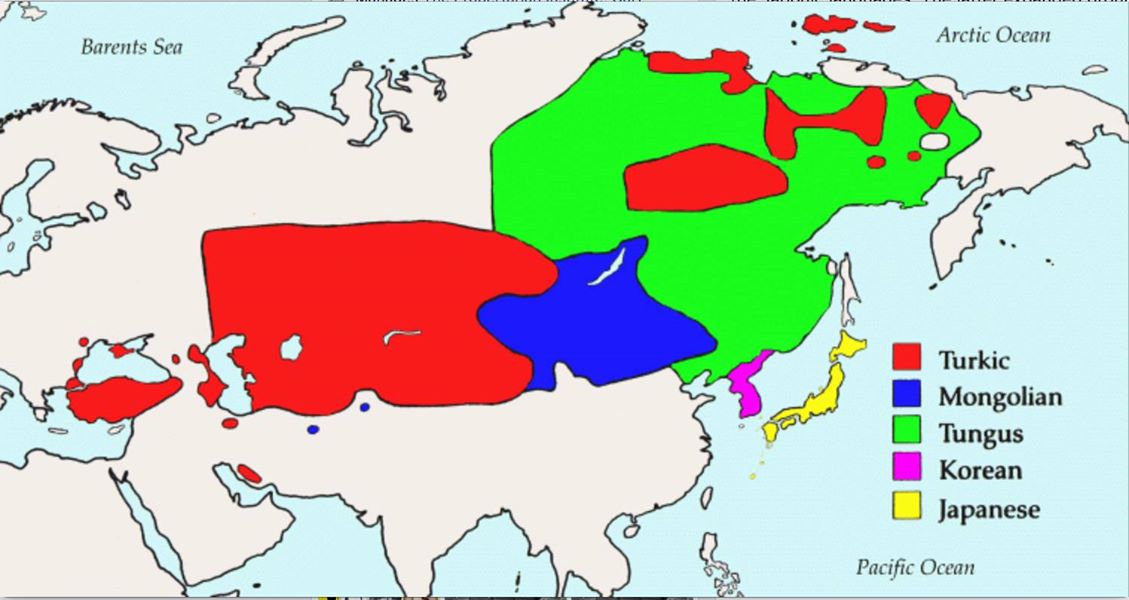
    photos_and_videos/TimelinePhotos_SxeO6JU-xg/53343638_10157038577322264_1482964147594330112_o_10157038577277264.jpg Altaic languages

    Altaic is a hypothetical language family of central Eurasia and Siberia first proposed in the 18th century, but whose existence is widely discredited among comparative linguists. The Turkic, Mongolic and Tungusic groups are invariably included in the family; some authors added Koreanic and the Japonic languages. The latter expanded grouping came to be known as “Macro-Altaic”, leading to the designation of the smaller former grouping as “Micro-Altaic” by retronymy. Most proponents of Altaic continue to support the inclusion of Korean. These languages are spoken in a wide arc stretching from Eastern Europe through Anatolia and eastern Caucasus through North Asia and Central Asia to the Korean Peninsula and Japanese archipelago in East Asia. The group is named after the Altai mountain range in the center of Asia.Altaic languages

    Altaic is a hypothetical language family of central Eurasia and Siberia first proposed in the 18th century, but whose existence is widely discredited among comparative linguists. The Turkic, Mongolic and Tungusic groups are invariably included in the family; some authors added Koreanic and the Japonic languages. The latter expanded grouping came to be known as “Macro-Altaic”, leading to the designation of the smaller former grouping as “Micro-Altaic” by retronymy. Most proponents of Altaic continue to support the inclusion of Korean. These languages are spoken in a wide arc stretching from Eastern Europe through Anatolia and eastern Caucasus through North Asia and Central Asia to the Korean Peninsula and Japanese archipelago in East Asia. The group is named after the Altai mountain range in the center of Asia.


    Source date (UTC): 2019-03-09 14:18:00 UTC

  • DEFINE: RULE OF LAW I – RULE OF LAW Among modern legal theorists, we will find t

    DEFINE: RULE OF LAW

    I – RULE OF LAW

    Among modern legal theorists, we will find that at least three common definitions of the rule of law.

    1 – Rule of Law: a “Substantive” (Skeptical) or “thick” definition that must preserve certain rights;

    2 – Rule by Law: a “Formalist“: (Optimistic) or “thin” definition, that must not preserve any such rights, and;

    3 – Rule of Man: a “Functional” (Fictional) or “ultra-thin” definition that requires neither formal process nor substantial rights be respected, and allows government officials great leeway.

    The ancient concept of rule OF law can be distinguished from rule BY law, in that, under the rule OF law, the law serves as a check against the abuse of power.

    Under rule BY law, the law is a mere tool for a government, that oppresses the population a using legislation as justification for arbitrary commands – a means of violating rights.

    Under Rule of Man, there are no checks on power to violate rights.

    Rule of Law (By Rights)

    1- Substantive (Skeptical) conceptions of the rule of law go beyond this and include certain substantive rights that are said to be based on, or derived from, the rule of law. The substantive interpretation holds that the rule of law intrinsically must protect some or all individual rights.

    Rule By Law (Rule by Legislation)

    2 – Formalist (Optimistic) definitions of the rule of law do not make a judgment about the “justness” of law itself, but define specific procedural attributes that a legal framework must have in order to be in compliance with the rule of law. The formalist interpretation holds that the rule of law has purely formal characteristics, meaning that the law must be publicly declared, with prospective application, and possess the characteristics of generality, equality, and certainty, but there are no requirements with regard to the content of the law.

    In addition, some theorists hold that democracy(majority) can circumvent both procedure and rights, or construct new rights (rather than privileges).

    Why Formalism? Formalism allows laws the pretense of claiming rule of law when rights are not protected by including countries that do not necessarily have such laws protecting democracy or individual rights in the scope of the definition of “rule of law”.

    The “formal” interpretation is more widespread than the “substantive” interpretation. Formalists hold that the law must be prospective, well-known, and have characteristics of generality, equality, and certainty. Other than that, the formal view contains no requirements as to the content of the law.

    Rule of Man (By Arbitrary Discretion)

    3 – The functional (Fictional) interpretation of the term “rule of law”, consistent with the traditional English meaning, contrasts the “rule of law” with the “rule of man.” According to the functional view, a society in which government officers have a great deal of discretion has a low degree of “rule of law”, whereas a society in which government officers have little discretion has a high degree of “rule of law”.

    Closing (Summary)

    In other words, there is only one form of rule of law under which no one can override natural rights (life, liberty, property, reciprocity, truth, and duty). Rule by legislation allows either the state, or the body politic to override those rules. And rule by man allows arbitrary discretion on the part of officials (members of the monopoly bureaucracy).


    Source date (UTC): 2019-03-08 11:21:00 UTC

  • Spectrum: “Autism Spectrum” or The Female-Male Brain spectrum: (Female) Psychoti

    Spectrum: “Autism Spectrum” or The Female-Male Brain spectrum: (Female) Psychotic < Solipsistic < Sensitive < Feminine < Balanced > Masculine > Analytic > Aspie > Autistic (Male)


    Source date (UTC): 2019-03-08 02:21:45 UTC

    Original post: https://twitter.com/i/web/status/1103843212836384769

    Reply addressees: @Cat9bx0219

    Replying to: https://twitter.com/i/web/status/1103840727161819142


    IN REPLY TO:

    @Cat9bx0219

    @curtdoolittle But did you answer me asking you about “what spectrum are you talking about”?

    Why did you say “Autistic SD =23/25, Normies 15. Ashkenazi 14. Anglican 12”?

    Original post: https://twitter.com/i/web/status/1103840727161819142

  • SCIENCE, SCIENTISM, PSEUDOSCIENCE, PSEUDO-RATIONALISM, AND LITERATURE. (worth re

    https://propertarianism.com/2018/03/29/definitions-science-scientism-pseudoscience-pseudo-rationalism-and-literature/DEFINITIONS: SCIENCE, SCIENTISM, PSEUDOSCIENCE, PSEUDO-RATIONALISM, AND LITERATURE.

    (worth repeating)

    THE DEFINITIONS

    i) SCIENCE: a warranty of due diligence against ignorance, error, bias, and deceit.

    ii) SCIENTISM : overstating empiricism (correlation), without completing the applicable scope of due diligences, or attempting to apply tests of truth in matters of preference or good.

    iii) PSEUDOSCIENCE: Testifying to the truth of statements without having performed due diligence against ignorance error, bias, and deceit.

    iv) PSEUDO-RATIONALISM: Attempts to claim closure where closure does not exist in the logics without appeal to the next higher dimension (empiricism). In other words sophisms, no matter how skilled. Contradictions proposed rarely exist, and almost all questions of philosophy are non-existent bits of fraud due to the use of poor grammar and incomplete sentences. (For example, the liar’s paradox is not operationally possible.)

    THE ARGUMENT

    (1) The sciences consist of logical and physical means of falsification in each dimension of possible human action (categorically consistent, internally consistent(logical), externally correspondent(empirical), operationally possible(existential), rational choice(voluntary), reciprocal rational choice(moral), scope-completeness/limits-defined/surviving-parsimony.)

    (2) the sciences can therefore tell us what is false, and what at present appears to be true (meaning the science allow us to testify to having performed due diligence against ignorance, error, bias, and deceit.)

    (3) For some reason, we still conflate the logics (tests of constant relations between two or more states, in a set of dimensions), including mathematics (tests of constant positional relations given scale independence) and the deducibility (‘inference’) of relations given the inviolability of those constant relations. Very little of meaning can be said of logic other than it is extremely useful in the falsification of the logical – which is how we use it. Proofs appear to have very little value since given enough time nearly anything can be justified by verbal ‘proof’).

    (4) Philosophy at present is limited to the exploration and determination of preference (personal), and good (collective). But philosophy has a tragic reputation for nearly universal falsehood outside of those choices. In fact, current philosophy consists largely of self help on one side and a catalog of human errors in intuition on the other.

    (5) Literature consists of envisioning possible and impossible worlds, for the purpose of exploration, advocacy, and criticism.

    (6) We tend to conflate literature and logic (philosophy), and conflate History (myth), law (norm), literature (parable), and pseudoscience into theology, just as we inflate literature and reason into philosophy.

    (7) So while there is value in via positive imaginings (theology, philosophy, mythology) there exists only decidability (conflict resolution) via mathematics, science, history, and reciprocity (law).

    Ergo, if we must disagree, we must resort only to decidability independent of good or preference. If we seek possibilities, we must resort to literature, myth, and philosophy.

    Truth can only be produced via-negativa, and choice only by via positiva.

    Sorry. That’s all there is to the scope of human knowledge.

    Curt Doolittle

    The Propertarian Institute

    Kiev, Ukraine

    https://propertarianism.com/2018/03/29/definitions-science-scientism-pseudoscience-pseudo-rationalism-and-literature/


    Source date (UTC): 2019-03-07 12:16:00 UTC