Tying the Universe Together in One Chart https://t.co/q93kO13etJ
Category: Science, Physics, and Philosophy of Science
-
Tying the Universe Together in One Chart
TYING THE UNIVERSE TOGETHER IN ONE CHART (example of using the grammars)
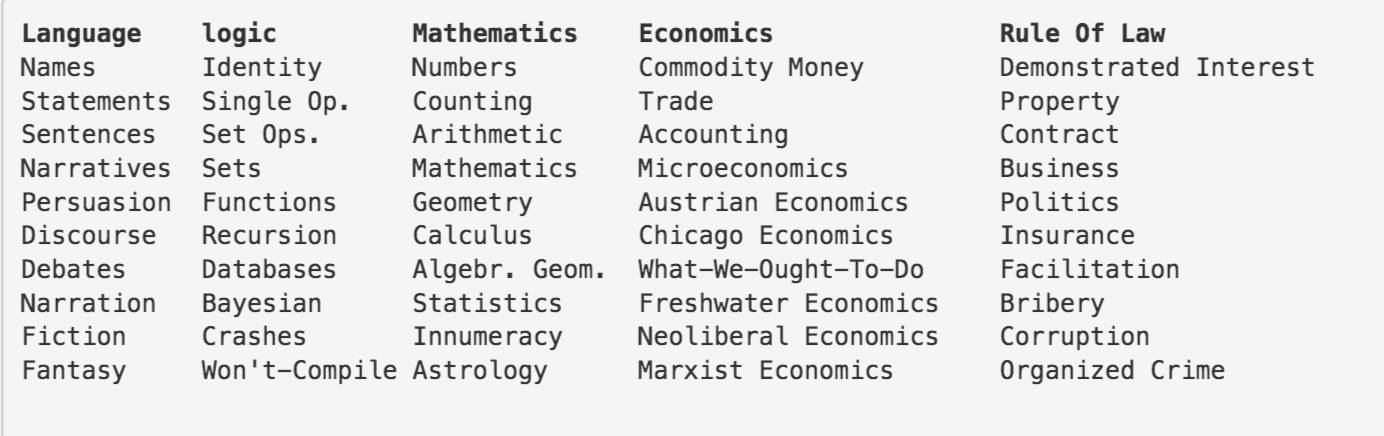
I made this to illustrate that austrian economics is simply the lowest level of economic study, using operationalism (a sequence of rational incentives) in order to circumvent the problem of a full accounting. For this reason I equate austrian economics with rule of law as the foundations of social science. So, full accounting economics under rule of law,. The purpose of which is to improve our information and understanding without interfering. Chicago Economics sought to remain within the rule of law and provide solutions to insure us from exceptions. Most macro economics is concerned largely with monetary, banking, and financial system and it has very little to do with anything other than how broken this archaic treasury, financial, banking and credit system is. Most political economics (mainstream) is an exercise in the use of maximum disinformation for the purpose of maximizing commercial, financial, and political extraction from the productive classes using the false promise of employment as a measure.
-
In other words the world wars cut the second scientific revolution and we are st
In other words the world wars cut the second scientific revolution and we are still paying for it. Yes, the initial gains were more dramatic.
IMO scientific returns are evolving upward (toward complexity) just as are violence, predation, and war. (lower gains)
Source date (UTC): 2020-05-31 14:14:23 UTC
Original post: https://twitter.com/i/web/status/1267097093384085510
Reply addressees: @MarcusDirusso @jollyheretic
Replying to: https://twitter.com/i/web/status/1267092055689269248
-
In other words the world wars cut the second scientific revolution and we are st
In other words the world wars cut the second scientific revolution and we are still paying for it. Yes, the initial gains were more dramatic.
IMO scientific returns are evolving upward (toward complexity) just as are violence, predation, and war. (lower gains)
Reply addressees: @MarcusDirusso @jollyheretic -
Is the Rate of Scientific Progress Slowing Down?
Is the Rate of Scientific Progress Slowing Down? https://propertarianism.com/2020/05/31/is-the-rate-of-scientific-progress-slowing-down/
Source date (UTC): 2020-05-31 13:50:16 UTC
Original post: https://twitter.com/i/web/status/1267091026675712001
-
Is the Rate of Scientific Progress Slowing Down?
Is the Rate of Scientific Progress Slowing Down? https://t.co/8i4mCkmJ2E
-
Is the Rate of Scientific Progress Slowing Down?
by Tyler Cowen November 18, 2019 at 1:09 am in Data Source Economics History That is the title of my new paper with Ben Southwood, here is one segment from the introduction:
Our task is simple: we will consider whether the rate of scientific progress has slowed down, and more generally what we know about the rate of scientific progress, based on these literatures and other metrics we have been investigating. This investigation will take the form of a conceptual survey of the available data. We will consider which measures are out there, what they show, and how we should best interpret them, to attempt to create the most comprehensive and wide-ranging survey of metrics for the progress of science. In particular, we integrate a number of strands in the productivity growth literature, the “science of science” literature, and various historical literatures on the nature of human progress. In our view, however, a mere reporting of different metrics does not suffice to answer the cluster of questions surrounding scientific progress. It is also necessary to ask some difficult questions about what science means, what progress means, and how the literatures on economic productivity and “science on its own terms” might connect with each other. Mostly we think scientific progress is indeed slowing down, and this is supported by a wide variety of metrics, surveyed in the paper. The gleam of optimism comes from this: And to the extent that progress in science has not been slowing down, which is indeed the case under some of our metrics, that may give us new insight into where the strengths of modern and contemporary science truly lie. For instance, our analysis stresses the distinction between per capita progress and progress in the aggregate. As we will see later, a wide variety of “per capita” measures do indeed suggest that various metrics for growth, progress and productivity are slowing down. On the other side of that coin, a no less strong variety of metrics show that measures of total, aggregate progress are usually doing quite well. So the final answer to the progress question likely depends on how we weight per capita rates of progress vs. measures of total progress in the aggregate. What do the data on productivity not tell us about scientific progress? By how much is the contribution of the internet undervalued? What can we learn from data on crop yields, life expectancy, and Moore’s Law? Might the social sciences count as an example of progress in the sciences not slowing down? Is the Solow model distinction between “once and for all changes” and “ongoing increases in the rate of innovation” sound? And much more. Your comments on this paper would be very much welcome, either on MR or through email. I will be blogging some particular ideas from the paper over the next week or two.
-
Is the Rate of Scientific Progress Slowing Down?
by Tyler Cowen November 18, 2019 at 1:09 am in Data Source Economics History That is the title of my new paper with Ben Southwood, here is one segment from the introduction:
Our task is simple: we will consider whether the rate of scientific progress has slowed down, and more generally what we know about the rate of scientific progress, based on these literatures and other metrics we have been investigating. This investigation will take the form of a conceptual survey of the available data. We will consider which measures are out there, what they show, and how we should best interpret them, to attempt to create the most comprehensive and wide-ranging survey of metrics for the progress of science. In particular, we integrate a number of strands in the productivity growth literature, the “science of science” literature, and various historical literatures on the nature of human progress. In our view, however, a mere reporting of different metrics does not suffice to answer the cluster of questions surrounding scientific progress. It is also necessary to ask some difficult questions about what science means, what progress means, and how the literatures on economic productivity and “science on its own terms” might connect with each other. Mostly we think scientific progress is indeed slowing down, and this is supported by a wide variety of metrics, surveyed in the paper. The gleam of optimism comes from this: And to the extent that progress in science has not been slowing down, which is indeed the case under some of our metrics, that may give us new insight into where the strengths of modern and contemporary science truly lie. For instance, our analysis stresses the distinction between per capita progress and progress in the aggregate. As we will see later, a wide variety of “per capita” measures do indeed suggest that various metrics for growth, progress and productivity are slowing down. On the other side of that coin, a no less strong variety of metrics show that measures of total, aggregate progress are usually doing quite well. So the final answer to the progress question likely depends on how we weight per capita rates of progress vs. measures of total progress in the aggregate. What do the data on productivity not tell us about scientific progress? By how much is the contribution of the internet undervalued? What can we learn from data on crop yields, life expectancy, and Moore’s Law? Might the social sciences count as an example of progress in the sciences not slowing down? Is the Solow model distinction between “once and for all changes” and “ongoing increases in the rate of innovation” sound? And much more. Your comments on this paper would be very much welcome, either on MR or through email. I will be blogging some particular ideas from the paper over the next week or two.
-
They have no f-king idea really
They have no f-king idea really. https://propertarianism.com/2020/05/30/they-have-no-f-king-idea-really/
Source date (UTC): 2020-05-30 22:43:32 UTC
Original post: https://twitter.com/i/web/status/1266862837013643274
-
They have no f-king idea really
They have no f-king idea really. https://t.co/545YdmIX9D