So, it is always and everywhere an open question whether one demonstrates conviction – or convenience (free riding). Pacifism and tolerance and virtue signaling are fairly easy to employ as camouflage for cowardice, free riding, and immorality.
So, it is always and everywhere an open question whether one demonstrates conviction – or convenience (free riding). Pacifism and tolerance and virtue signaling are fairly easy to employ as camouflage for cowardice, free riding, and immorality.
By claiming one is doing good, one can justify bads. But while bads are decidable and universal, goods are only preferable and particular. As such one claims he does good only as an excuse to do bad. When, one only does good if he does NO bad. Ergo, all that is not bad is good.
INHERENT RIGHTS (IDEALS) VS INHERENT DEMAND AND ASSOCIATED COSTS (REALS)
by Luke Weinhagen
(important concept)
—“Commons: Every single thing you pay for by either action, inaction,or forgone opportunity for discount or gain”—
This is another area where much of the west is operating with a categorization error in place. We have been categorizing the concept “natural rights” as an INHERENT quality of each individual, not something that has a COST.
We should be categorizing it as an available property, with a cost to gain interest in. A commons.
Because of its relationship to reciprocity. natural rights is the root commons. All other commons extend from the foundation that natural rights creates and are limited by the breadth of those rights. One must, and can only, purchase interest in that commons through the demonstration of reciprocity and sovereignty.
Failure to police this root commons, and extending it to everyone (categorization error – natural/available to all, not inherent/granted to all), creates a vulnerability (extends agency status to parasites) and exposes every derivative commons to parasitism. No correction downstream can remove this vulnerability, they are become attempts at compensation for that original flaw, just more imposed costs.
(if I am understanding [Curt] correctly, this one is going to make heads explode when the correction is put in place – though the only other outcome is system collapse)
By claiming one is doing good, one can justify bads. But while bads are decidable and universal, goods are only preferable and particular. As such one claims he does good only as an excuse to do bad. When, one only does good if he does NO bad. Ergo, all that is not bad is good.
The necessity of Reciprocity exists – because it creates and preserves the incentive to cooperate, and by cooperating produce a division of knowledge and labor, and the disproportionate returns from it.
Demand for reciprocity exists in competition with demand for preservation of parasitism and predation.
By the use of organized violence to produce traditions, norms, and laws we incrementally suppress parasitism and predation, increasing demand for reciprocity, and therefore the markets, and the returns on cooperation.
These traditions, norms, and laws consists of demands (duties) to both personally avoid parasitism and predation and personally police parasitism and predation.
The origin of laws is the prevention of retaliation cycles (feuds), and standardization of restitution and punishments, between men who policed their kin, and instead form a corporation that polices all, including retaliation cycles, thereby preventing degradation of the returns on cooperation through degradation of cooperation, through degradation of trust, because of increase in risk.
ERGO:
0) We always have the choice of predation, parasitism, cooperation, non-cooperation, and boycott. ie: Man is amoral choosing immoral (predation, parasitism), amoral (irrelevant), and moral (productive, fully informed, warrantied, voluntary exchange free of imposition upon the demonstrated interests of others by externality) as is in his interests.
1) Predation is optimum in the short term, parasitism in the medium term, and cooperation in the long term, but all tend toward equilibration as we run out of opportunities for predation, parasitism, and cooperation, and seek alternative means of survival, subsistence, prosperity.
2) Cooperation produces outsized returns as long as it is not offset by parasitism and predation.
3) Reciprocity preserves the incentive to cooperate and as a consequence, the returns of cooperation.
4) We organize the suppression of parasitism and predation (and in some cases even boycott) by the concentration of violence to do so.
5) We finance this suppression by suppression of local ‘rents’ and increasing centralization of rents. Thus giving rise to the military police and judiciary.
6) To decrease risk, transaction costs, and increase the velocity of cooperation and the returns from it, we further suppress by prior restraint, creating the insurer of last resort,: from the demand for weights and measures, and the production and defense of commons we form governments from headmen, chieftains, kings (martial class), oligarchies (middle class), and democracies (underclass), as well as churches (education) to train people into doing so.
7) But without the courts to function as a market for reciprocity with which to defend us from those within the insurer of last resort, these centralizations create a monopoly and therefore maximize the extraction of rents and maximize the defensibility of the sustainability of those rents, and do so by searching for ‘customers’ that facilitate the extraction of rents.
8) Meaning that the only solutions are restoration of markets inside that monopoly we call the insurer of last resort. As such while startup costs are often best paid by the insurer of last resort, once survivable such must be privatized, OR subject to juridical competition under universal standing.
9) The remaining question being the decision on the production of commons: which appears, aesthetically to be optimally served by the a monarchy; commercially by an oligarchy, familially by democracy, and as an insurer of last resort, a church (the outliers). As such the principle difference is organizing these markets and allocating returns on cooperation (those commissions on cooperation we call taxes) to the hierarchy so that each class may engage in trade with others for the production of desirable commons.
AS SUCH
1 – There exists a natural law (necessity), and that is non-imposition (reciprocity, sovereignty). We do not have a choice in this. It is the product of physical universe, and the necessity of a species capable of the pursuit of self interest as well as cooperation in that self interest.
2 – That necessity of natural law can be expressed positively (usefully) as a collection of rights of appeal to a court (insurer) of natural law (reciprocity, sovereignty).
3 – In that sense, we can attempt to violate natural law, or we can attempt to construct natural rights (defenses of reciprocity). While courts of the common (natural) law of tort attempt to construct natural rights under rule of law, the state attempts (constantly) to violate that natural law by the construction of legislation that violates the natural law of reciprocity.
4 – Natural rights do not exist, but instead, natural rights (specific insurances of sovereignty) are something we can seek to create through legislation (contract), that is then enforced by the courts (insurer).
5 – Natural Rights are not something that exists without our creation of them under the natural law of non-imposition, reciprocity, sovereignty. The are merely something we desire to produce within the natural law of reciprocity, as specific guarantees of those instances of property: life, liberty, property, and interests in the multitude of physical, normative, traditional, and institutional commons.
Every book Nassim has written brings him closer to the conclusion: that warranty of due diligence, and insurance of restitution (SITG) are the only defenses against Sophism, Pseudoscience, and Innumeracy. The Law not math or science, is our only defense against information fraud.
Remember when you had skin in the game and interesting things to say (instead of having re-written the book you wrote in 2001 like 4 times) and weren’t consumed by your anger @nntaleb? … Sorry bro but you’ve kind of become an intellectual-yet-idiot. https://t.co/Y48LTwdDHg
photos_and_videos/TimelinePhotos_SxeO6JU-xg/46383054_10156782266992264_6999890342711394304_o_10156782266987264.jpg FOR NEWBS: UNDERSTANDING PROPERTARIANISM AS THE EXTENSION OF THE SCIENCES
Propertarianism Consists of The Formal Logic of Natural Law: Psychology, Sociology, Politics, Group Evolutionary Strategy, as An Completion of The Laws of Nature.
Originally I called it “capitalismv3” until I realized how erroneous that title was: I was doing the law, and economics only a part of it. Then I moved to calling it propertarianism. Then, once I understood what I was doing, I correctly labeled it Natural Law. The problem is that “Natural Law” has a long history of appropriation like “liberalism” and false criticism like “national socialism”. And is framed as a philosophical justification(excuse) rather than a scientific decidability (truth). And we had already built a brand around Propertarianism.
So, we keep the ‘Brand’ Propertarianism for the simple reason that it was the ‘propertarians’ that I evolved the work out of, and the brand awareness is such that it’s hard to change at this point – and while it is only partially descriptive (referring to the unit of measure in psychology, sociology, ethics, politics and group strategy) , and could equally be called Testimonialism (truthful speech), or Vitruvianism or operationalism (universal system of measurement system by demonstrable human actions), or The Law of Conscious Beings (Any coopertting being must work by this set of decisions to survive), we retain Propertarianism and Natural Law out of situational convenience. ,
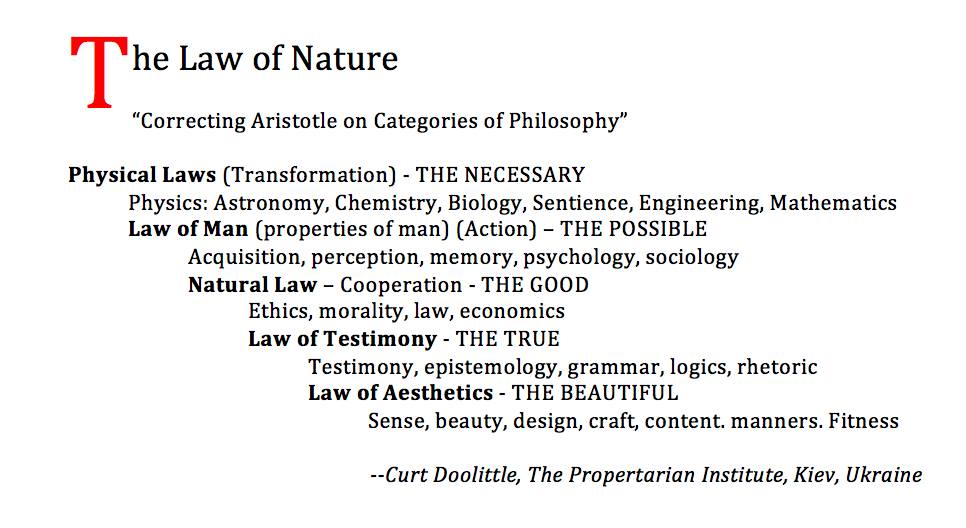
However, as this image illustrates, we have just COMPLETED the SCIENCES by expanding the scientific method into the social and psychological sciences.
PROPERTARIANISM = THE NATURAL LAW.
You should understand this then as the Application of the scientific method to the social sciences. and as such that we are learning a SCIENCE that will take you YEARS TO MASTER not a philosophy that you can read a book and add to your catalog of frames.
PHYSICAL LAW OF TRANSFORMATION (INVOLUNTARY) EVOLVES INTO THE NATURAL LAW OF COOPERATION (VOLUNTARY) AS AN EXTENSION OF THOSE SAME LAWS.
We can state these fundamental laws, Logically, Empirically, or operationally. Unfortunately, in the twentieth century, due to the ‘mathification’ of physics, and the ‘idealism’ of mathematics, due to the lack of a ‘model’, information has been LOST, that on the re-operationalizatoin of physics (undiscovered fundamental-wave, subatomic-particle, atomic, chemical, biological, sentient-cognizant, rational-calculable-computable), Psychology (Acquisitionism), Sociology (cooperation), law (decidability, organization), accounting-finance-economics (information, units of measure, measurements), is necessary to obtain the same benefits between sentient (feeling, evaluating, responding), aware (remembering, comparing), conscious (choosing), calculating (reasoning, calculating, computing) objects, as those objects that cannot detect and respond to changes in state.
In other words, due to a lack of a model, the model-less-ness of mathematical idealism has worked through logic, and physics, and now into philosophy, ethics, and politics. just as theology did in the ancient world – producing similar ignorances.
The Operational Movement (restoration of the model ) failed in the early part of the 20th century, and the postwar reaction against darwin (which is the model like it or not) and turing (which is the model, like it or not) because of eugenics (which is the optimum method of progression of human existence like it or not – just as was physics in the 17th-20th centuries, like it or not).FOR NEWBS: UNDERSTANDING PROPERTARIANISM AS THE EXTENSION OF THE SCIENCES
Propertarianism Consists of The Formal Logic of Natural Law: Psychology, Sociology, Politics, Group Evolutionary Strategy, as An Completion of The Laws of Nature.
Originally I called it “capitalismv3” until I realized how erroneous that title was: I was doing the law, and economics only a part of it. Then I moved to calling it propertarianism. Then, once I understood what I was doing, I correctly labeled it Natural Law. The problem is that “Natural Law” has a long history of appropriation like “liberalism” and false criticism like “national socialism”. And is framed as a philosophical justification(excuse) rather than a scientific decidability (truth). And we had already built a brand around Propertarianism.
So, we keep the ‘Brand’ Propertarianism for the simple reason that it was the ‘propertarians’ that I evolved the work out of, and the brand awareness is such that it’s hard to change at this point – and while it is only partially descriptive (referring to the unit of measure in psychology, sociology, ethics, politics and group strategy) , and could equally be called Testimonialism (truthful speech), or Vitruvianism or operationalism (universal system of measurement system by demonstrable human actions), or The Law of Conscious Beings (Any coopertting being must work by this set of decisions to survive), we retain Propertarianism and Natural Law out of situational convenience. ,
However, as this image illustrates, we have just COMPLETED the SCIENCES by expanding the scientific method into the social and psychological sciences.
PROPERTARIANISM = THE NATURAL LAW.
You should understand this then as the Application of the scientific method to the social sciences. and as such that we are learning a SCIENCE that will take you YEARS TO MASTER not a philosophy that you can read a book and add to your catalog of frames.
PHYSICAL LAW OF TRANSFORMATION (INVOLUNTARY) EVOLVES INTO THE NATURAL LAW OF COOPERATION (VOLUNTARY) AS AN EXTENSION OF THOSE SAME LAWS.
We can state these fundamental laws, Logically, Empirically, or operationally. Unfortunately, in the twentieth century, due to the ‘mathification’ of physics, and the ‘idealism’ of mathematics, due to the lack of a ‘model’, information has been LOST, that on the re-operationalizatoin of physics (undiscovered fundamental-wave, subatomic-particle, atomic, chemical, biological, sentient-cognizant, rational-calculable-computable), Psychology (Acquisitionism), Sociology (cooperation), law (decidability, organization), accounting-finance-economics (information, units of measure, measurements), is necessary to obtain the same benefits between sentient (feeling, evaluating, responding), aware (remembering, comparing), conscious (choosing), calculating (reasoning, calculating, computing) objects, as those objects that cannot detect and respond to changes in state.
In other words, due to a lack of a model, the model-less-ness of mathematical idealism has worked through logic, and physics, and now into philosophy, ethics, and politics. just as theology did in the ancient world – producing similar ignorances.
The Operational Movement (restoration of the model ) failed in the early part of the 20th century, and the postwar reaction against darwin (which is the model like it or not) and turing (which is the model, like it or not) because of eugenics (which is the optimum method of progression of human existence like it or not – just as was physics in the 17th-20th centuries, like it or not).
IT DOESN’T TAKE 30 YEARS TO SPEAK IN THE NATURAL LAW. IT TAKES AS LONG AS A DEGREE IN THE LAW
—“In 30 years maybe I’ll have Curt’s ability to summarise this well.”—
Regarding: ( “….No Marxist, postmodern, feminist revolution is possible because the competence structure necessary for the preservation of human standards of living cannot tolerate any other distribution than the Pareto…..”)
Just to comfort you … it takes four years on average if you try to construct and repeat the arguments. There are people who are faster and take a year or so, but only four so far.
We have pre-complied many of the arguments. We are in the process of refining them today into Definitions, Series (this>that>that-other), Aphorisms, and Maxisms, (like the quote above) that can be memorized rather than reinvented each time you want to use them.
So it depends on age (younger is easier), personality (observers, lower agreeableness), and whether you have experience in philosophy of science, programming, economics, and history, so that you either have an existing framework, or so that you are not so ‘addicted’ to analogies and literature that (really) induce a form of ignorance through imprecision.
Evidence is that if you are drawn to philosophy and theology it might be an impediment – although not always. Philosophy and theology as practiced are a significant part of the problem: fantasy literature.