Feb 13, 2020, 3:42 PM IS PROPERTARIANISM A COMPLETION OF THE HEGELIAN PROJECT? by Ryan Drummond [I] often see P as a…completion, almost, of Hegel’s work, without the room for logical error (and the dirty path to Marxism opening as a result). His model, as you’ll see, touches on many truths. Only it is nowhere near as advanced as P, grammatically or scientifically. Basically, Hegel made an effort to come to what might be considered a “total” understanding of philosophy and existence – much like yourself. Only he wrote using all resources available to him in the late 1700’s/early 1800’s. So a lot of his understandings are premature, not scientifically accurate, and lie in the realm of honest speculation etc. He had the concept that through logic, nature and human consciousness, God could be considered real but not definable. That we could know of it, but not know It. So he called God, or the universal absolute, “The Idea”. This “Idea”, he said, could be realised through dialectic…and as dialectic occurs both in the natural realm and within the human psyche, it would be our inevitable path to eventually reach it. This is where the problems come in – because he wrote of dialectic in such wishy-washy prose, and used language that hardly anyone could decipher accurately enough to take consistent meaning from, there were basically two schools born from his ideas, both offering an “Idea” that could be seemingly supported by varying ‘interpretations’ of his work, whereby an ideal could be theoretically reached. One path was through what we would now call Marxism, I suppose, where equality reigns supreme…dysgenia through eugenic ideals (The false, yet morally appeasing way at odds with natural law but not at odds with human consciousness). During Hegel’s time advocates of this kind of philosophy, later to be characterised by Marx, were known as young Hegelians. It was another example of the young generation wanting to usurp the old guard. The other path, to me at least, appears to be very much like P – Eugenia through eugenic ideals (the true, yet sometimes morally disturbing way – not at odds with natural law, but often found to be at odds with human consciousness and what we see, at our earthly level, to be right or wrong). Advocates of this school were the ‘gammon’ of the day, so to speak: Old Hegelians. So from Hegelian philosophy we ended up with the two behemoths we see at war today, really – Marxism/The Left/Dysgenia proper, and it’s nemesis Fascism/The Right/Eugenia proper. Had he written his philosophy as concisely as P, I don’t believe that there would have been room for Marxism to ever exist within it’s bounds, and gain a foothold in the minds of the population. P is ‘essentially’ Old Hegelianism + Accurate terminology + Scientific Justification + So much more. Had he done the job he set out to do properly (I believe he always intended his work to be interpreted the Right way, so to speak), we wouldn’t have found ourselves in the mess we are in today. Your work basically completes his initial goal, only doesn’t use wishy-washy, unknowable language, but language of almost mathematical precision and meaning. You finish the job he started. You’ve created the total philosophy I believe he envisaged in some way. But creating it and applying it are two different things. Especially from the position we are in now. He often wrote of the French Revolution that humanity had taken a bright dawn and turned it into a dusk. If he witnessed a dusk, then we must exist in the early hours of the morning. It’s cold and dark. But if we can overcome the hurdles in front of us, we will push humanity to Godhood. We will realise The Idea. We can beat the red queen, or get so damn close to it we can be proud of our efforts. I hope that clarifies a little where I get the connections to Hegelian philosophy from. That, and he was addicted to using trinities to explain everything. You do the same thing, really, through P, only do it all more accurately. If Old Hegelian philosophy was the child, P is the man it could be considered to grow up to become.
Category: Epistemology and Method
-
Theology to escape choice, philosophy to choose, science to decide
Theology to escape choice, philosophy to choose, science to decide.
Source date (UTC): 2020-02-13 11:24:00 UTC
-
WHY THE THREES? —“The Propertarians are the only group that takes trinities se
WHY THE THREES?
—“The Propertarians are the only group that takes trinities seriously.”—
It takes three points to prove a line. Or conversely, it takes at least three points to falsify any other point. Or said differently, it takes at least three markets to produce and equilibrium.
It’s not a random thing – our emphasis on trifunctionalism, tripartism, and markets in everything. It’s the optimum order possible for maximizing all opportunities on one end while falsifying the maximum error, bias, irreciprocity and deceit on the other end.Updated Feb 13, 2020, 10:00 AM
Source date (UTC): 2020-02-13 10:00:00 UTC
-
THE PRESUMPTIONS IN DISCOURSE AND ARGUMENT IN THE POSITIVA AND NEGATIVA TRADITIO
THE PRESUMPTIONS IN DISCOURSE AND ARGUMENT IN THE POSITIVA AND NEGATIVA TRADITIONS
I would rather let this conversation go forward without my interjection to let the team demonstrate their skills but to save time
0) I use falsification. Falsification in science, evolved from falsification by contest (competition, adversarial) in european law. And falsification by adversarial competition in law is our oldest continuous political tradition after sovereignty.
1) I do not presume people have agency, or that they have other than the minimum consciousness and self reflection and self regulation to engage in negotiation deception, parasitism and predation to minimize the costs of obtaining wants and needs by productive voluntary exchange (people only demonstrate the minimum morality necessary to act in their interests.)
2) I do not presume that people seek truth but that people seek to justify priors, to lie, or sow social constructions for manipulation in pursuit of a discount, to engage in fraud, or to engage, or to conspire.
3) I do not presume when I dont know the answer – I say something from the spectrum “We don’t know, I don’t know yet”, or as far as I know, or “we only know x so far”, or” we only know x so far and these possibilities are consistent with what we know so far”, or as far as I know thats false, or that can’t be true – as that is the only truthful testimony I can give.
4) The history of all thought consists of the history of falsification of all causal claims other than realism naturalism under operationalism
5) All alternatives, all knowledge claims that are consistent with failure of all alternatives to realism, naturalism, under operationalism, must depend on some incentive other than “we don’t know yet, but all causality will depend upon realism, naturalization under operationalism”.
6) while we can testify to causes of real ism naturalism operationalism and empiricism including subjective testing of incentives (rational choice), we cannot possibly testify to any claim that is not dependent upon realism, naturalism, under operationalism, because we cannot claim to have that knowledge,
7) If we can identify incentive, meaning, means motive and opportunity, for giving false testimony, by claiming the untestifiable then there is nothing else to determine – the person is lying.
8) In other words, theology and philosophy, negotiation and chit chat (exchange of signals of safety) seek opportunity for agreement or consent by means motive and opportunity, while, mathematics, logic, science, and law seek opportunity for falsification or decidability in dispute resolution by means motive and opportunity.
In other words, if you can’t testify to a claim you’re starting out informing, negotiating, persuading, threatening by lying. Now, in a public forum at distance without direct physical contact I can’t engage in physical punishment for lying. But as a european man, defending the informational commons, i do the best I can in by prose.
Source date (UTC): 2020-02-12 21:16:00 UTC
-
DO PARADIGMS REALLY FALSIFY? WHAT DOES ORDER MEAN? OPERATIONALISM IN ACTION Bett
DO PARADIGMS REALLY FALSIFY? WHAT DOES ORDER MEAN? OPERATIONALISM IN ACTION
Better way of saying it: There is one most parsimonous paradigm (We call it science. Now I call it ‘P-grammar’). There is no value in false paradigms. There is only value in different attempts to solve a problem within the most parsimonious paradigm.
(Note: my position is that language is a system of measurement, and the p-grammars identify the paradigm, and that operationalism constitutions the universal grammar. That would mean the universe is always reducible to classical description.)
—“All paradigms are eventually false. :)”—Rick Paris
That’s demonstrably false. Instead, we increasingly identify limits that cause us to increase the parsimony of our theories.
All scientific paradigms appear increase in parsimony. Aristotle, Newton, and Einstein all evolve to greater precision. Take Humors (disease) and Phlogiston theory (chemistry), Einstein’s static universe(cosmology), or the expanding earth (plate tectonics). They were false but they were progress in the right direction.
Conversely there are three categories that always fail to increase in parsimony:
1) Magic -> Pseudoscience (action-physical)
2) Idealism -> Philosophy (verbal-rational)
3) Occult -> Theology (emotional-intuitionistic)
So we have deflationary grammars of Law, Science, Logic, and Mathematics that all increase in parsimony.
And we have inflationary grammars of magic(physical), idealism(verbal), and the occult(emotional) that fail all tests of parsimony.
Of course we also have the outright deceits too.
—“It is not false. The Universe is expanding, in that what is outside the current momentary paradigm is defined as the Unknown. There is always greater amounts of the Unknown shifting our perceived facts of what is known, as the Unknown is always greater < than the known. So,”No man steps into the same river twice.” is a metaphor for all physical experience. Paradigms are currently, and simply limited and only limited by belief. All paradigms are fictitious mental constructs. Attempting to measure the illogical, is useless and limited the human potential. Logic is very tedious and limits the strongest aspects of the human mind. Only the imagination (what is common sense) is the part of us that can penetrate the very fabric of the Unknown. The greatest of all human gifts is the imagination. It is the function behind all, and cannot be interpreted by logic alone .This is not based in an opinion, it is based in my own experience.”—Rick Paris
—“Curt I think I can see/agree a little with Rick. By the very nature of biology, you will always have a body of diversity, not just in capacity, but also concerns. The big fallacy is mistaking diversity for equality and/or dismissability. There will always be a need for more peasants than kings… This doesn’t mean that worker bees should rule the give (all you get is drones if such happens)… At the same time, if the king doesn’t address with reciprocity the needs of the peasants, you leave a tinder wound and a jealous rage ready to eat the rich and a cultural cancer that no longer gives a shit. Homogeny is the cultural cream that will come to the surface given time and peace (consistent enforced reciprocity).”—Anne Summers
This is a long standing debate, and it’s a matter of grammatical deficiency in our language, so we must state our meaning operationally to avoid sophistry.
ONE
Does existence persist independent of our perception? Yes.
Does the universe demonstrate regularities independent of our perception? Yes.
Do we define order as I did above as the intersection of periodicity and scale of resolution?
Or do we define order as the regularities what we might potentially identify at various periodicities and scales?
Or do we define order as dependent upon those periodicities and scales we can measure and reduce to analogy to experience?
Or do we define order as dependent upon the periodicity and scale open to our perception at human scale?
Or do we define order as those permutations of paradigms – networks of relations – that vary between humans despite relative invariance of human perception at human scale – such as the asian perception of the world as continuous motion(coherent world) or the european perception of the world as discreet objects (mechanistic world).
TWO
As for paradigms, this depends upon whether it is possible, when specifying both theory(search criteria), operations (measurement criteria) and limits (full accounting) whether we maintain progress toward the most parsimonious description or not. So, given human perception, human system of measurements, and human chosen time scale, when stating a theory, measurement, and limit, we appear to have successfully – at least in the ancient and modern worlds – slowly evolved greater precision and parsimony – in math, logic, and the sciences at least. And this is why it’s not clear than any of Aristotle, Newton, or Einstein are false at their levels of resolution. Instead it’s fairly obvious that we have just been increasing the precision of the general theory we call description of the regularities observable directly or instrumental in the universe. So if one’s definition is IDEAL then yes, theories are frequently falsified. But if one’s definition is testimonial then it certainly appears that we are continuously increasing precision and that the number of false theories is rapidly decreasing.
So, when you attempt to refute my definition, description, and proposition which definition of order are you using?
Source date (UTC): 2020-02-12 14:01:00 UTC
-
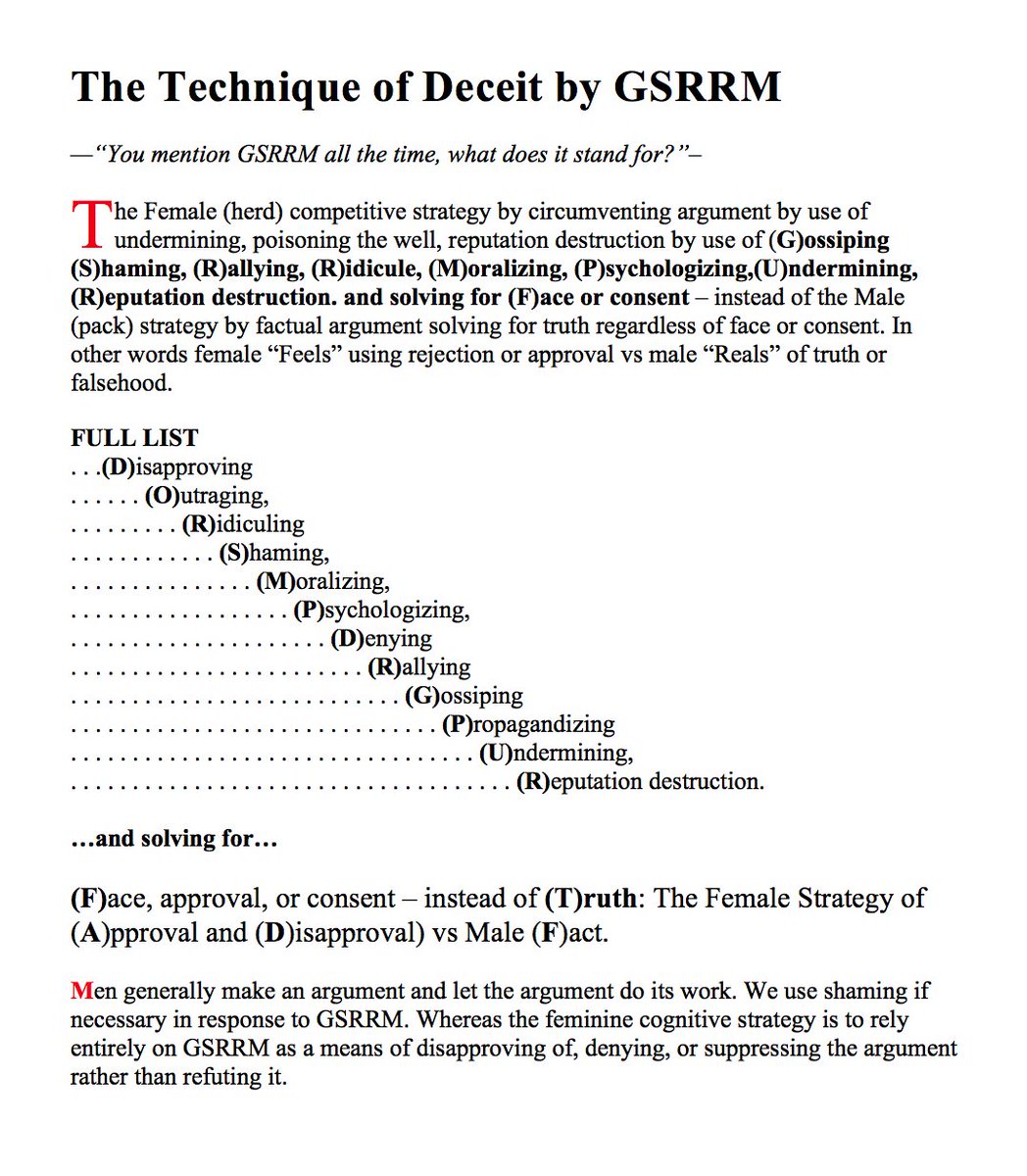
Nom I just do my civic duty which is to speak the truth regardless of cost. It’s
Nom I just do my civic duty which is to speak the truth regardless of cost. It’s called the Kantian imperative. It’s also the foundation of western civilization’s competitive advantage. You on the other hand used GSRRM, the female technique of equating disapproval with argument. https://t.co/WKszSkLSw8
Source date (UTC): 2020-02-11 21:10:46 UTC
Original post: https://twitter.com/i/web/status/1227339214905380865
Reply addressees: @jenniferpierson
Replying to: https://twitter.com/i/web/status/1227335212608126976
IN REPLY TO:
Original post on X
Original tweet unavailable — we could not load the text of the post this reply is addressing on X. That usually means the tweet was deleted, the account is protected, or X does not expose it to the account used for archiving. The Original post link below may still open if you view it in X while signed in.
Original post: https://twitter.com/i/web/status/1227335212608126976
-
IMPROVING PARSIMONY OF THE CLAIM THAT ALL THEORIES ARE EVENTUALLY FALSIFIED Bett
IMPROVING PARSIMONY OF THE CLAIM THAT ALL THEORIES ARE EVENTUALLY FALSIFIED
Better way of saying it. There is one most parsimonious paradigm (We call it science. Now I call it ‘P’ or ‘testimony’).
—“All paradigms are eventually false. :)”—
That’s demonstrably false. Instead, we increasingly identify limits that cause us to increase the parsimony of our theories.
All scientific paradigms appear increase in parsimony. Aristotle, Newton, and Einstein all evolve to greater precision. Take Humors (disease) and Phlogiston theory (chemistry), Einstein’s static universe(cosmology), or the expanding earth (plate tectonics). They were false but they were progress in the right direction.
Conversely there are three categories that always fail to increase in parsimony:
1) Magic -> Pseudoscience (action-physical)
2) Idealism -> Philosophy (verbal-rational)
3) Occult -> Theology (emotional-intuitionistic)
So we have deflationary grammars of
1) Science, 2)Logic, and 3) Mathematics that all increase in parsimony.
And we have inflationary grammars of 1) magic(physical), 2) idealism(verbal), and 3) the occult(emotional) that fail all tests of parsimony.
Of course we also have the outright deceits too.
Source date (UTC): 2020-02-11 12:19:00 UTC
-
THE FUTURE IS OURS IF WE TAKE IT I started working on a commensurable language i
THE FUTURE IS OURS IF WE TAKE IT
I started working on a commensurable language in 92. I had understood the basic problem by 2001. I started working on the european group strategy in ’06. I started the equivalent of full time in ’09-’10 on a constitution. I started ‘going public’ in ’12. Just Eli and a few others were involved (those that promoted us I do know and appreciate). I started getting traction in ’14. You can see from the videos in ’14 that the system is pretty much outlined. Since 14 it’s been incremental improvement in precision and depth every year. I can’t remember when Bill and SN started up but that group’s been how we train people. A year and a half ago in ’18-19 we got John’s help promoting us. A year ago we launched the institute – although, given the rate of acceleration, and demand for the constitution, I’m having trouble with the volume of work. Hopefully we will grow people enough to help us with it this year. Hopefully I will finish the constitution and the big book this year (please god, help me). And hopefully we will ‘launch’ this year (please god help me some more). I dunno. I’m overloaded as usual.
My point here is that if you follow Brandon Hayes’ feed, where he collects all our posts by topic, you will see what one guy can do if he works hard enough and long enough to produce value enough to interest others in the development of a new axis of agency.
This is how Marx did it, and its how we’re doing the anti-Marx restoration of western civilization with a few people slowly gaining knowledge skill and momentum.
Revolution comes.
Renaissance Comes.
The future is ours if we just take it.
Source date (UTC): 2020-02-11 09:22:00 UTC
-
DEFINE: DETERMINISM All events, including human action, are ultimately determine
DEFINE: DETERMINISM
All events, including human action, are ultimately determined by causes external to human thought (will). We categorize this limitation as constraining causality to realism (the universe exists) and naturalism (causes are independent of human thought and human thought has no influence on causality except through action). Some philosophers have taken determinism to imply that individual human beings have no free will and cannot be held morally responsible for their actions.
In science, determinism means that the universe demonstrates regularity and therefore we can identify general rules (laws of nature).
I don’t pay much attention to philosophy – it’s mostly nonsense. If you can’t say it in testimony: math, logic, science, economics or law then it’s probably nonsense.
And yeah. The vocabulary, grammar, and logic of economics includes psychology, sociology, politics, and group strategy.
Source date (UTC): 2020-02-11 07:49:00 UTC
-
If I don’t insert contrarian KOTH statements or arguments now and then the audie
If I don’t insert contrarian KOTH statements or arguments now and then the audience won’t use sufficient skepticism when reading thoughts. Bait works.
Source date (UTC): 2020-02-10 21:53:00 UTC