Agreed. I still find humans wonderful. But again, that’s the difference between philosophy and spirituality (opportunity), and science, economics, and law (scarcity). I think what I’m bothered by is the degree to which postwar myths are far worse in consequence than I’d imagined.
So you see how people who pick up P-Logic, Science, Law, end up applying it to their domains and contributing to the body of knowledge? And people outside don’t see the power of universal commensurability in identifying first causes and dimensions of any given subject.
elegant synthesis. I think… yes, I think I see how to represent that on the table of grammars, by adding problem solving on top of describing, narrating, fictionalizing.
MYTH AS MEASUREMENT -“There is a simulation, it’s called literature. You just have to decide to enter it. You have to decide in your own life, how much to re-enact these simulations. That’s how to live a rich life, juxtaposing your experience against those of great authors.”- NF.
Never, out of fear, or uncertainty, or lack of will, give the enemy visibility into your methods such that at the next opportunity they can outmaneuver them.
Want of certainty among conservatives is the equivalent of cowardice. It is the male expression of female cost aversion.
JAE: The function of all OPERATIONAL(actions) constructivist (sequence of operations reproducing a condition from first causes) is therefore falsificationary. All hypotheticals are auto-associations with any inductive process merely providing candidates for falsification
JAE: Apriorism can’t be true because just as math and logic are not closed, math and logic are just subsets of ordinary language grammar:continuous recursive disambiguation. There is no closure to infinity without realistic application of a general rule to a particular condition.
JAE: Apriorism can’t be true because just as math and logic are not closed, math and logic are just subsets of ordinary language grammar:continuous recursive disambiguation. There is no closure to infinity without realistic application of a general rule to a particular condition.
JAE: His praxeology was a primitive, operational (true) stack-logic (false), of commodity purchases (irrelevant to behavioral economics), that could explain (falsify) a subset of human behavior (rational action under incentives) when presented as empirical evidence. PERIOD.
JAE:So given we have learned that (a) there is no truth value in induction (b) no closure (c) all general rules of arbitrary precision remain arbitrary unless tautological (d) all logic is falsificationary (e)then the apriori are only hypothetical (f) and proofs falsificationary.
Jewish Austrian Econs (JAE): (an apriori) Is money neutral? Well, not quite. It turns out there is a lot of lossiness in inflationary money that ends up in unpredictable parts of the economy.
1) Grammar: (a) rules of “continuous recursive disambiguation” creating a contract for meaning, and consisting of: A Paradigm, consisting of: First Principles, Logic, Vocabulary, Syntax.
(b) Grammars can be DeflationaryInflationary, where deflationary consists of math, logic, accounting, procedures, etc, and inflationary consist of stories, fictions, fictionalisms, deceits, and denials etc.
(c) Operational grammar: operational grammar consists of complete sentences in promissory form, consisting of a sequence of subjectively testable operations producing complete transactions of changes in state. ie: ‘unambiguous measurements’.
2) Logic: the test of constant relations between properties reducible to analogy to experience, internally as identity, externally between premises and statements, or externally between statements.
(a) all statements must consist of continuously recursive disambiguation (b) there is no closure other than tautology, (c) all non-tautological tests are falsificationary. (d) falsification requires tests: internal, external, operational, rational, reciprocal, completeness.
(b) Hierarchy of Decidability: Statements are undecidable, possibly true, or certainly false. All logic is Ternary.
(c) A proof provides a test of possibility: a justification. Truth must survive falsification.
4) Justification: either (a) a moral explanation for a claim of innocence (b) a false pretense that a proof is other than a possibility (c) and an evasion of the cost of falsification. (d) a fraud constructed by the pretense of due diligency by paying the cost of falsification.
5) Sophistry: (a) General: any use of loading, framing, suggestion, obscuring, conflating, inflating, fictionalism, or denial, to claim consistency in identity, internality, externality, operationality, rationality, reciprocity, or completeness that does not exist.
(b) More specifically, the use of the three means of fictionalism: Physical: Magic to Pseudoscience, Verbal: Sophistry to idealism (philosophy), Imaginary: Occult to Supernaturalism (theology), to convey a pretense of causality or knowledge that cannot be testified to.
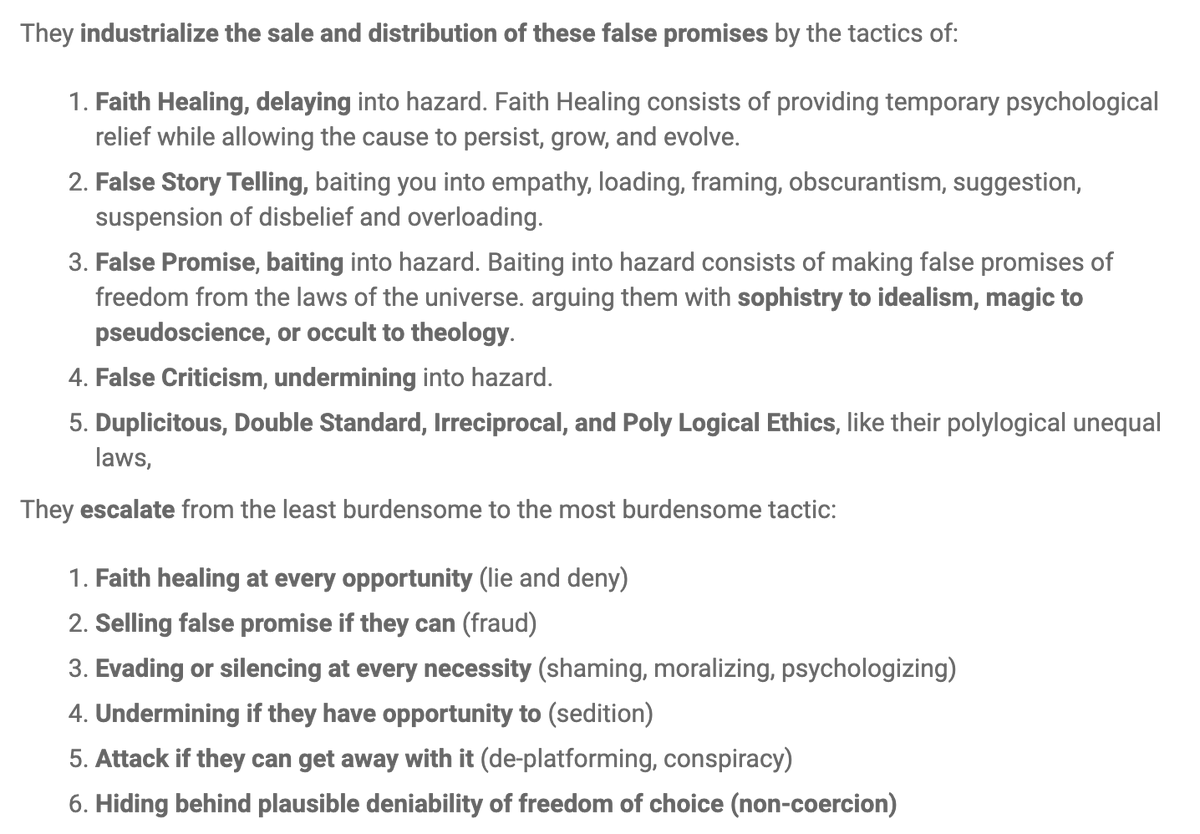
7) Pilpul: (attached) “The Positive Sell” Sophistry that implies a false promise of freedom from formal, physical, natural, or evolutionary laws by use of the following methods: (first image)
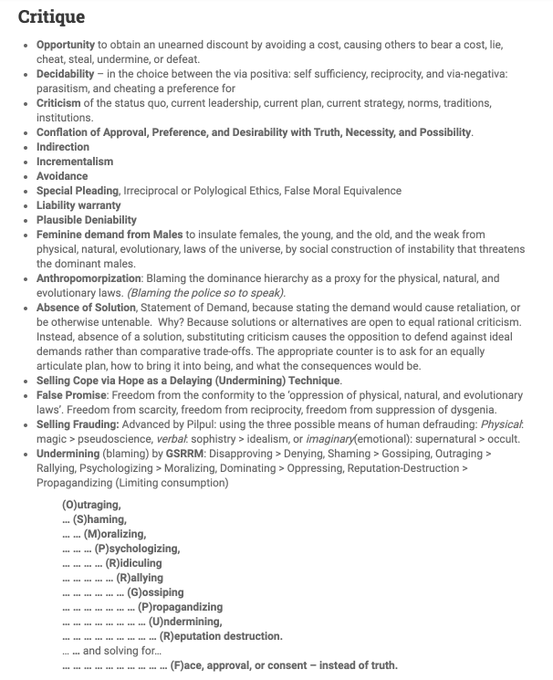
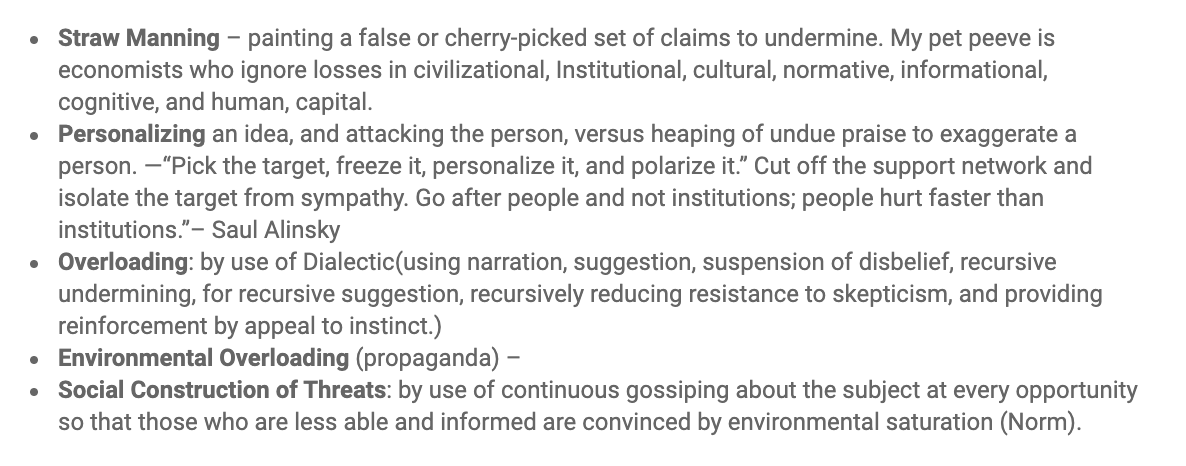
8) Critique: (attached) “The Negative Sell” (second and third images)
IOW, it sounds like English but it’s much closer to programming or mathematics. And it allows falsification of any truth claims in and across all disciplines. It’s not ideology, or philosophy. It’s a constructivist logic of falsification.Libertarians think: “praxology completed.”
@Dage90 @BobMurphyEcon @Bohm_Baller @billyj41 “The paradigm, first principles, logic, vocabulary, and grammar of P-Law produce a universally commensurable system of measurement across all disciplines at the cost of unambiguous terms, operational language, complete transactional sentences, equilibrating changes in state.”