SIGH
—“you should read….(law)…”
Terry O’Brien:
1) Yes of course i’ve read those works (see my reading list and our library). Although I tend to prefer Milsom’s treatment of the law.
2) You’re confusing errors with definitions. that’s ok.
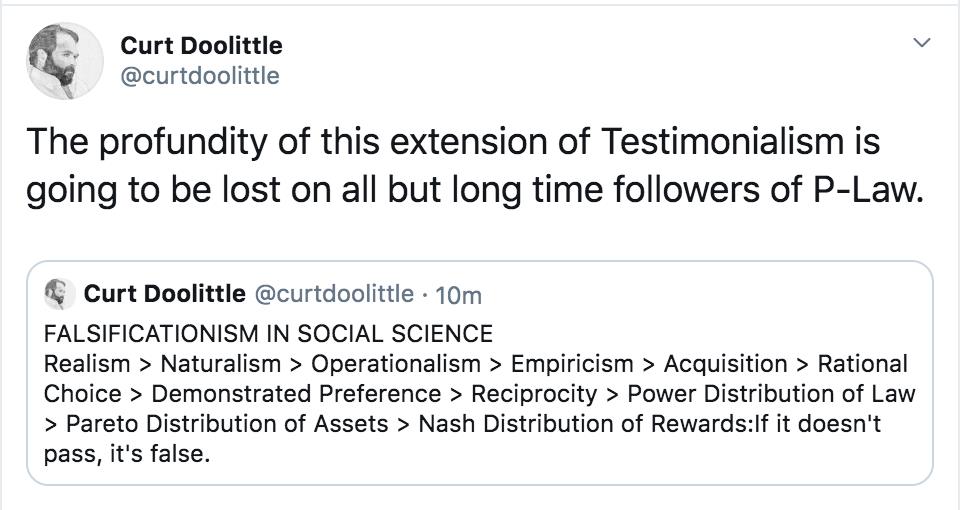
P logic and law depend on disambiguation by enumeration, operationalization, and serialization, to prevent errors of inference and categorization and this results in everting from clarification to redefinition to neologism.
We use this technique to create a value neutral universally commensurable language and logic of testimony
3) Tort means ‘trespass’ and is a violation of demonstrated interest – or what we codify as property. While all peoples vary in the degree of suppression of trespass given their division of labor, level of development, family structure, terms of inheritance, investment in commons, and level of corruption (trust), all people resolve disputes by demonstrated interests at least within the limits of defection.
4) What is the basis of decidability in Common Law (the abusive term used today that means ‘whatever we can get away with’), Common law (as etymologically evolved) in judge discovered findings of law, Traditional germanic law and its practice, ancient european traditional law, the commonalities of greek and roman law, and what we can linguistically and archeologically determine from proto-germanic west indo european law? (Sovereignty and Reciprocity, testimony and jury.)
5) Where did (western) evidentiary reason, evidentiary empiricism, and evidentiary science evolve, at what points, by what authors, in what professions?
So, if we look at vernacular, temporal, periods, ages, or across all of european history since the indo-european expansion, and compare those internal consistencies with other civilizations we winnow down the number of constant relations. This degree of resolution in traditions of decidability, just as the degree of resolution in subatomic, atomic, chemical, biochemical, cellular, expose local and continuous general rules.
Ergo the common law tradition predates greece and rome. And it is rome and napoleonic france that did it damage, just like it was christian rome, revolutionary france, and postmodern France(with help from the jewish counter-englightenment of marx, boas, freud, cantor, adorno) that undermined that law – causing the continent and the anglosphere to diverge with the anglosphere retaining the via negativa tradition, and the french-continental reverting to via-positiva and causing the failure (impossibility) of the european project.
The origin of our civilization like all civilizations especially after the Axial Age (restoration after the bronze age collapse), is captured in our group strategy and our law that must survive within it. That law and the ‘metaphysics’ (paradigms of decidability) are the origin of the commonality across time.
Why did the greeks go through the great change of socrates, plato, Aristotle, and alexander? Why did the greeks romans and the British use a different strategy from the Mesopotamians and the Chinese and the Hindus? Why did greeks work with geometry reason and divination, and why did Mesopotamians work with algebra theology and astrology?
Whatever group strategy we had, whatever social order that was required of it, and whatever traditions, customs, law and mythos that we had around 900bc at the latests, was continuously reinforced by competition with others. And there are 500 dead gods in the record for those that failed.
Sovereignty, Reciprocity, Thang, Evidence, Testimony, chieftain > Law, Jury, Senate king > Law, jury, house, senate, emperor
Because markets are the only means of cooperation and dispute resolution under sovereignty.
And because only contract is possible for people who required a voluntary entrepreneurial military, using metallurgy, wheel, horse, maneuver, to defeat superior numbers.
There is a reason for military epistemology, metallurgical epistemology, and our legal epistemology.
Our origins.
“What can I testify to under realism, naturalism, and operationalism that is internally consistent, externally correspondent, operationally possible, and narratively coherent?”
Source date (UTC): 2020-01-07 11:07:00 UTC