by Alexander Zavialov
The entire history of the East Aryans is an absolutely unfathomable tragedy. They went from being the masters of the world – inventing the wagon, the chariot and innovating in metalworking and warfare – to exogamous fools who shared their technology as frivolously as they shared their genes. By the time the West Roman Empire fell, they went extinct by their own hands.
Category: Civilization, History, and Anthropology
-
The Death Of The Eastern Aryans Through Diversity
by Alexander Zavialov The entire history of the East Aryans is an absolutely unfathomable tragedy. They went from being the masters of the world – inventing the wagon, the chariot and innovating in metalworking and warfare – to exogamous fools who shared their technology as frivolously as they shared their genes. By the time the West Roman Empire fell, they went extinct by their own hands. -
Alexander Zavialov In the end, Indo Europeans went under (were destroyed) wherev
Alexander Zavialov In the end, Indo Europeans went under (were destroyed) wherever they failed to supplant the host population; the biggest contrast being Britain – where the entire host population was wiped out – and basically all Indo-Iranian cultures – where the host population took over and kept only the religion and the languages of their former masters. IMPORTANT – DIVERSITY IS HOW YOU KILL WESTERNERS -
Alexander Zavialov In the end, Indo Europeans went under (were destroyed) wherev
Alexander Zavialov In the end, Indo Europeans went under (were destroyed) wherever they failed to supplant the host population; the biggest contrast being Britain – where the entire host population was wiped out – and basically all Indo-Iranian cultures – where the host population took over and kept only the religion and the languages of their former masters. IMPORTANT – DIVERSITY IS HOW YOU KILL WESTERNERS -
Alexander Zavialov In the end, Indo Europeans went under (were destroyed) wherev
Alexander Zavialov
In the end, Indo Europeans went under (were destroyed) wherever they failed to supplant the host population; the biggest contrast being Britain – where the entire host population was wiped out – and basically all Indo-Iranian cultures – where the host population took over and kept only the religion and the languages of their former masters.
IMPORTANT – DIVERSITY IS HOW YOU KILL WESTERNERS
Source date (UTC): 2018-02-25 13:07:00 UTC
-
So, as IE’s expand, they use religion to manage conquered people, and law to man
So, as IE’s expand, they use religion to manage conquered people, and law to manage themselves. (That’s the nut of it right there.) -
So, as IE’s expand, they use religion to manage conquered people, and law to man
So, as IE’s expand, they use religion to manage conquered people, and law to manage themselves.
(That’s the nut of it right there.)
Source date (UTC): 2018-02-25 12:50:00 UTC
-
So, as IE’s expand, they use religion to manage conquered people, and law to man
So, as IE’s expand, they use religion to manage conquered people, and law to manage themselves. (That’s the nut of it right there.) -
The History Of Our People
Indo-European migrations were the migrations of pastoral peoples speaking the Proto-Indo-European language, who departed from the Yamnaya and related cultures in the Pontic–Caspian steppe, starting at c. 4000 BCE. They spread throughout Europe and Asia, forming new cultures with the people they met on their way, including the Corded Ware culture in Northern Europe and the Vedic culture in India. Modern knowledge of these migrations is based on data from (a) linguistics, (b)archaeology, (c) anthropology and (d) genetics. a) Linguistics describes the similarities between various languages, and the linguistic laws at play in the changes in those languages. b/c) Archaeological data, describes the spread of the Proto-Indo-European language and culture in several stages from the Proto-Indo-European Eurasian homeland in the Pontic–Caspian steppe, into Western Europe and Central and South Asia, by migrations, and by language shift through elite-recruitment as described by anthropological research. d) Recent genetic research has a growing contribution to the understanding of the historical relations between various historical cultures. The Indo-European languages and cultures spread in various stages. Early migrations from c. 4200–3000 BCE brought archaic proto-Indo-European into: 1) the lower Danube valley, 2) Anatolia, and the 3) Altai region 4) Pre-Celtic and pre-Italic probably spread into Europe after new migrations into the Danube Valley, 5) While pre-Germanic and pre-Balto-Slavic developed east of the Carpathian mountains, at present-day Ukraine, moving north and spreading with the Corded Ware culture in Middle Europe (third millennium BCE). 6) The Indo-Iranian language and culture emerged at the Sintashta culture (c. 2100–1800 BCE), at the eastern border of the Yamna horizon and the Corded ware culture,growing into the Andronovo culture (c. 1800–800 BCE). 7) Indo-Aryans moved into the Bactria–Margiana Archaeological Complex (c. 2300–1700 BCE) and spread to the Levant (Mitanni), northern India (Vedic people, c. 1500 BCE), and China (Wusun). 8) The Iranian languages spread throughout the steppes with the Scyths and into Iran with the Medes, Parthians and Persians from ca. 800 BCE. (Straight from Wikipedia. This isn’t controversial. It’s just how it is.) -
Click for video: photos_and_videos/videos/30661913_435550606935110_3330923084122
Click for video: photos_and_videos/videos/30661913_435550606935110_3330923084122895673_n_10156157336557264.mp4 THE HISTORY OF OUR PEOPLE
Indo-European migrations were the migrations of pastoral peoples speaking the Proto-Indo-European language, who departed from the Yamnaya and related cultures in the Pontic–Caspian steppe, starting at c. 4000 BCE. They spread throughout Europe and Asia, forming new cultures with the people they met on their way, including the Corded Ware culture in Northern Europe and the Vedic culture in India.
Modern knowledge of these migrations is based on data from (a) linguistics, (b)archaeology, (c) anthropology and (d) genetics.
a) Linguistics describes the similarities between various languages, and the linguistic laws at play in the changes in those languages.
b/c) Archaeological data, describes the spread of the Proto-Indo-European language and culture in several stages from the Proto-Indo-European Eurasian homeland in the Pontic–Caspian steppe, into Western Europe and Central and South Asia, by migrations, and by language shift through elite-recruitment as described by anthropological research.
d) Recent genetic research has a growing contribution to the understanding of the historical relations between various historical cultures.
The Indo-European languages and cultures spread in various stages.
Early migrations from c. 4200–3000 BCE brought archaic proto-Indo-European into:
1) the lower Danube valley,
2) Anatolia, and the
3) Altai region
4) Pre-Celtic and pre-Italic probably spread into Europe after new migrations into the Danube Valley,
5) While pre-Germanic and pre-Balto-Slavic developed east of the Carpathian mountains, at present-day Ukraine, moving north and spreading with the Corded Ware culture in Middle Europe (third millennium BCE).
6) The Indo-Iranian language and culture emerged at the Sintashta culture (c. 2100–1800 BCE), at the eastern border of the Yamna horizon and the Corded ware culture,growing into the Andronovo culture (c. 1800–800 BCE).
7) Indo-Aryans moved into the Bactria–Margiana Archaeological Complex (c. 2300–1700 BCE) and spread to the Levant (Mitanni), northern India (Vedic people, c. 1500 BCE), and China (Wusun).
8) The Iranian languages spread throughout the steppes with the Scyths and into Iran with the Medes, Parthians and Persians from ca. 800 BCE.
(Straight from Wikipedia. This isn’t controversial. It’s just how it is.)Kimberly Ashberry-MoxleyINTERESTING….however, thats all about to change…Mar 28, 2018 2:32amTHE HISTORY OF OUR PEOPLE
Indo-European migrations were the migrations of pastoral peoples speaking the Proto-Indo-European language, who departed from the Yamnaya and related cultures in the Pontic–Caspian steppe, starting at c. 4000 BCE. They spread throughout Europe and Asia, forming new cultures with the people they met on their way, including the Corded Ware culture in Northern Europe and the Vedic culture in India.
Modern knowledge of these migrations is based on data from (a) linguistics, (b)archaeology, (c) anthropology and (d) genetics.
a) Linguistics describes the similarities between various languages, and the linguistic laws at play in the changes in those languages.
b/c) Archaeological data, describes the spread of the Proto-Indo-European language and culture in several stages from the Proto-Indo-European Eurasian homeland in the Pontic–Caspian steppe, into Western Europe and Central and South Asia, by migrations, and by language shift through elite-recruitment as described by anthropological research.
d) Recent genetic research has a growing contribution to the understanding of the historical relations between various historical cultures.
The Indo-European languages and cultures spread in various stages.
Early migrations from c. 4200–3000 BCE brought archaic proto-Indo-European into:
1) the lower Danube valley,
2) Anatolia, and the
3) Altai region
4) Pre-Celtic and pre-Italic probably spread into Europe after new migrations into the Danube Valley,
5) While pre-Germanic and pre-Balto-Slavic developed east of the Carpathian mountains, at present-day Ukraine, moving north and spreading with the Corded Ware culture in Middle Europe (third millennium BCE).
6) The Indo-Iranian language and culture emerged at the Sintashta culture (c. 2100–1800 BCE), at the eastern border of the Yamna horizon and the Corded ware culture,growing into the Andronovo culture (c. 1800–800 BCE).
7) Indo-Aryans moved into the Bactria–Margiana Archaeological Complex (c. 2300–1700 BCE) and spread to the Levant (Mitanni), northern India (Vedic people, c. 1500 BCE), and China (Wusun).
8) The Iranian languages spread throughout the steppes with the Scyths and into Iran with the Medes, Parthians and Persians from ca. 800 BCE.
(Straight from Wikipedia. This isn’t controversial. It’s just how it is.)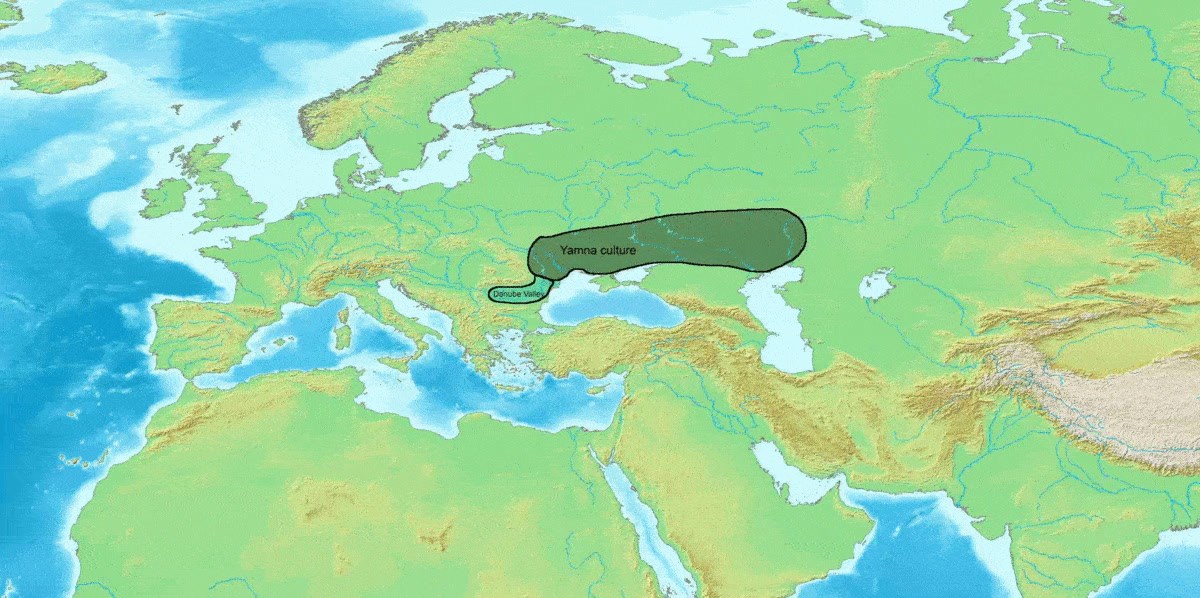
Source date (UTC): 2018-02-25 12:20:00 UTC
