I mean, wizard of earthsea, the Iliad and Odyssey, Beowulf, the hobbit and lord of the rings, the Nibelungenlied, La Morte De Artur, Ivanhoe, Frankenstein, [????], Starship Troopers, The Foundation Series, The Forever War, Dune.
I mean, wizard of earthsea, the Iliad and Odyssey, the hobbit and lord of the rings, Beowulf, the Nibelungenlied, La Morte De Artur, Ivanhoe, Frankenstein, [????], Starship Troopers, The Foundation Series, The Forever War, Dune.
That’s a pretty nice canon. I could add a few more ‘stories’ in there in between to make a nice mythology, but that’s our literature right there.
Sorry, but if you look at history genocide has an exceptionally successful and beneficial history for the victors. Which is why they’re doing to us what they did to the Itals (Romans).
Sorry, but if you look at history genocide has an exceptionally successful and beneficial history for the victors. Which is why they’re doing to us what they did to the Itals (Romans).
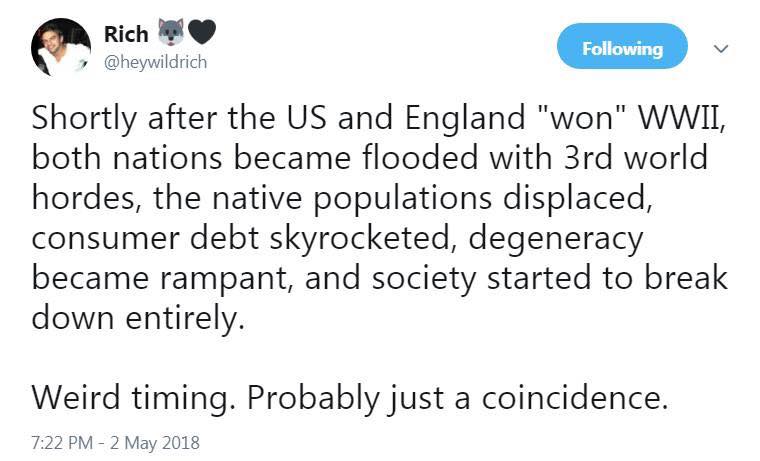
photos_and_videos/TimelinePhotos_43196237263/32072927_10156336709032264_9047984478932172800_n_10156336709027264.jpg (via steve pender)Manu AgrawalAfter England was left a wreck as a result of WW2 and it had no money to run operations in “Third World” countries, the only source of revenue for Britishers stopped, which was robbing from all over the world to feed it’s own lazy worthless population. And people who were occupied from 200 years or more were now free, they traveled to different free countries to make money. Only a third grade stupid would see a conspiracy theory here, it’s basic economics.May 06, 2018 7:19amCurt Doolittleit’s not a conspiracy theory. it’s a warning.May 06, 2018 7:22amVince ReeYou go girl! You displace those lazy worthless brits!May 06, 2018 7:44amKyle KalutkiewiczSounds like a party you throw when the parents are out of townMay 06, 2018 8:02amKen JaloonSo because the lazy, worthless people couldn’t rob the entire world any longer, occupied people traveled to “different free countries (England and Germany)” to make money (off of worthless, lazy people)? Cool story Tonto.May 06, 2018 8:07amVince ReeHow about we genocide every non white on the planet? I’m thinking mainly of the economic benefits here.May 06, 2018 8:28amEli HarmanWhat do you call a negative, negative, externality?May 06, 2018 9:00amDermot Lindleyits because when hitler died in 1945 the invisible magic force field that stopped poc coming to ypipo lands that why it only took one decade afterwards for the UK to bring in poc and two decades for the USMay 06, 2018 9:10amDermot Lindleyitt: an idiot who doesnt have any idea how the empire was ranMay 06, 2018 9:15amCurt Doolittle@[100009947915250:2048:Dermot Lindley] (Tip: “Run” not “Ran”. He ran, he was running, they ran the empire, the empire was run.)May 06, 2018 9:32amDermot Lindleyworrying about such minor mistakes is for autistic nerdsMay 06, 2018 9:34amCurt Doolittle@[100009947915250:2048:Dermot Lindley] I wasn’t worrying about it – I ask people to correct my usage all the time. And they do. The reason being that while I’m prolific I do not sight-type, and make quite a few typos, phonetic swaps, and sometimes leave incomplete sentences.May 06, 2018 9:39amWaqas AhmadCalling human hordes is primitive signMay 06, 2018 10:43amBobby ClaphamLike most Indian men Manu Agrawal has the look of a Bhenchod.May 06, 2018 10:48amJeff UrizenThe good guy always wins because it’s always the bad guys who win.May 06, 2018 10:55amCurt DoolittlelolzMay 06, 2018 10:59amChris McThis reminds me of the “yo dawg, wypipo so weak they be oppression’ us for 400 years” line of argumentation.May 06, 2018 11:23amTyler Karl LiaIt is called genocide you mud. Jews have had this planned for a long time.May 06, 2018 11:26amAsha AghaffBrits robbed their colonies to fight Germany. The empire collapsed because Churchill was a genocidal maniac. But somehow they imported people and fixed their economy? Their economy and standard of living was shit for 40 years after. All they had was middle-manning oil and such.May 06, 2018 12:10pmBjorn MoritzBritain sacrificed its whole Empire to beat the Germans. It’s almost like they weren’t fighting in their own interests.May 06, 2018 1:04pmDavid ParkerWorry about your own shit, mehmedMay 06, 2018 1:13pmWaqas AhmadDavid Parker don’t Trump slave send his dog to petroleumistan(Saudi).?May 06, 2018 1:19pmErnest HeideggerPurely cohencidence I assure you.May 06, 2018 3:00pmCraig Bland@[100000939105775:2048:Chester Keyser]May 06, 2018 3:47pmAlex KnepperOmg the Anglo nations are liberal???????May 06, 2018 5:18pmClaire Rae RandallIndustrial revolution nothing to do with European economic success, obviously.May 06, 2018 5:56pmVik Li”But free universal healthcare is worth it!”May 06, 2018 8:38pmHisayoshi HirabayashiWOW BASEDMay 06, 2018 10:01pmHisayoshi HirabayashiBIG BRAIN REDUCTIONIST JOKE, LMAO FUNNAYMay 06, 2018 10:02pmDax Rayner@[1187883882:2048:David]May 07, 2018 3:03amDermot Lindleythank you my chinese friendMay 07, 2018 3:44am(via steve pender)
You watch those Russian, Ukrainian, Belarusian crash videos, and insane drivers, and the soviet era apartment blocks, snow, and bitter cold. And you form an opinion.
But to me it invokes such love and homesickness now that it’s almost unbearable.
(And the two part key)
To create a record that represented “two sheep”, they selected two round clay tokens each having a + sign baked into it. Each token represented one sheep. Representing a hundred sheep with a hundred tokens would be impractical, so they invented different clay tokens to represent different numbers of each specific commodity, and by 4000 BC strung the tokens like beads on a string.[7] There was a token for one sheep, a different token for ten sheep, a different token for ten goats, etc. Thirty-two sheep would be represented by three ten-sheep tokens followed on the string by two one-sheep tokens.
To ensure that nobody could alter the number and type of tokens, they invented a clay envelope shaped like a hollow ball into which the tokens on a string were placed, sealed, and baked. If anybody disputed the number, they could break open the clay envelope and do a recount. To avoid unnecessary damage to the record, they pressed archaic number signs and witness seals on the outside of the envelope before it was baked, each sign similar in shape to the tokens they represented. Since there was seldom any need to break open the envelope, the signs on the outside became the first written language for writing numbers in clay. An alternative method was to seal the knot in each string of tokens with a solid oblong bulla of clay having impressed symbols, while the string of tokens dangled outside of the bulla.[8]
Beginning about 3500 BC the tokens and envelopes were replaced by numerals impressed with a round stylus at different angles in flat clay tablets which were then baked.[9] A sharp stylus was used to carve pictographs representing various tokens. Each sign represented both the commodity being counted and the quantity or volume of that commodity.
(And the two part key)
To create a record that represented “two sheep”, they selected two round clay tokens each having a + sign baked into it. Each token represented one sheep. Representing a hundred sheep with a hundred tokens would be impractical, so they invented different clay tokens to represent different numbers of each specific commodity, and by 4000 BC strung the tokens like beads on a string.[7] There was a token for one sheep, a different token for ten sheep, a different token for ten goats, etc. Thirty-two sheep would be represented by three ten-sheep tokens followed on the string by two one-sheep tokens.
To ensure that nobody could alter the number and type of tokens, they invented a clay envelope shaped like a hollow ball into which the tokens on a string were placed, sealed, and baked. If anybody disputed the number, they could break open the clay envelope and do a recount. To avoid unnecessary damage to the record, they pressed archaic number signs and witness seals on the outside of the envelope before it was baked, each sign similar in shape to the tokens they represented. Since there was seldom any need to break open the envelope, the signs on the outside became the first written language for writing numbers in clay. An alternative method was to seal the knot in each string of tokens with a solid oblong bulla of clay having impressed symbols, while the string of tokens dangled outside of the bulla.[8]
Beginning about 3500 BC the tokens and envelopes were replaced by numerals impressed with a round stylus at different angles in flat clay tablets which were then baked.[9] A sharp stylus was used to carve pictographs representing various tokens. Each sign represented both the commodity being counted and the quantity or volume of that commodity.
ARCHAIC NUMBERS > CUNEIFORM > ROMAN NUMERALS
Conversion of archaic numbers to cuneiform
The round stylus was gradually replaced by a reed stylus that had been used to press wedge shaped cuneiform signs in clay.
To represent numbers that previously had been pressed with a round stylus, these cuneiform number signs were pressed in a circular pattern and they retained the additive sign-value notation that originated with tokens on a string.
Cuneiform numerals and archaic numerals were ambiguous because they represented various numeric systems that differed depending on what was being counted.
About 2100 BC in Sumer, these proto-sexagesimal sign-value systems gradually converged on a common sexagesimal number system that was a place-value system consisting of only two impressed marks, the vertical wedge and the chevron, which could also represent fractions.[14]
This sexagesimal number system was fully developed at the beginning of the Old Babylonia period (about 1950 BC) and became standard in Babylonia.
Sexagesimal numerals were a mixed radix system that retained the alternating base 10 and base 6 in a sequence of cuneiform vertical wedges and chevrons. Sexagesimal numerals became widely used in commerce, but were also used in astronomical and other calculations.
This system was exported from Babylonia and used throughout Mesopotamia, and by every Mediterranean nation that used standard Babylonian units of measure and counting, including the Greeks, Romans and Syrians. In Arabic numerals, we still use sexagesimal to count time (minutes per hour), and angles (degrees).
-Roman numerals-
Roman numerals evolved from this primitive system of cutting notches.[15] It was once believed that they came from alphabetic symbols or from pictographs, but these theories have been disproved.[16][17]
ARCHAIC NUMBERS > CUNEIFORM > ROMAN NUMERALS
Conversion of archaic numbers to cuneiform
The round stylus was gradually replaced by a reed stylus that had been used to press wedge shaped cuneiform signs in clay.
To represent numbers that previously had been pressed with a round stylus, these cuneiform number signs were pressed in a circular pattern and they retained the additive sign-value notation that originated with tokens on a string.
Cuneiform numerals and archaic numerals were ambiguous because they represented various numeric systems that differed depending on what was being counted.
About 2100 BC in Sumer, these proto-sexagesimal sign-value systems gradually converged on a common sexagesimal number system that was a place-value system consisting of only two impressed marks, the vertical wedge and the chevron, which could also represent fractions.[14]
This sexagesimal number system was fully developed at the beginning of the Old Babylonia period (about 1950 BC) and became standard in Babylonia.
Sexagesimal numerals were a mixed radix system that retained the alternating base 10 and base 6 in a sequence of cuneiform vertical wedges and chevrons. Sexagesimal numerals became widely used in commerce, but were also used in astronomical and other calculations.
This system was exported from Babylonia and used throughout Mesopotamia, and by every Mediterranean nation that used standard Babylonian units of measure and counting, including the Greeks, Romans and Syrians. In Arabic numerals, we still use sexagesimal to count time (minutes per hour), and angles (degrees).
-Roman numerals-
Roman numerals evolved from this primitive system of cutting notches.[15] It was once believed that they came from alphabetic symbols or from pictographs, but these theories have been disproved.[16][17]