Theme: Truth

  • (FYI: Asked by Kashif to engage with this page.) REGARDING PHILOSOPHY I dunno. A

    (FYI: Asked by Kashif to engage with this page.)

    REGARDING PHILOSOPHY

    I dunno.

    As far as I know, one can practice a limited spectrum of methods of producing paradigms (networks) of decidability: occult < theology < literature < philosophy <- common law -> science > mathematics > logic.

    We do possess three faculties: intuition-emotion, reason, and physical sensation. And we depend more or less on each of those faculties in each, with law depending upon all, and others depending upon less so.

    It’s not unreasonable that some would seek to rely more on intuition, more on reason, or more on physical sense and perception, if for no other reason than intuition is cheap, reason is more difficult and therefore costly, and physical operations are the most difficult and costly of all. But conversely, intuition > reason, and > physical demonstration are decreasingly prone to error, bias, wishful thinking, suggestion, and deceit.

    I consider this a scientific, logical, and legal statement, because it has no room for, or tolerance for untestifiable fictionalisms (irreciprocity, pseudoscience, pseudo-rationalism, fiction, and the combination of those in mythology, theology and the occult.) And conversely it demands testifiability, reciprocity, existential possibility, rationality (cost), consistency, correspondence, and coherence.

    Common (traditional) Law, reasoning, and observation within that law existed before all other disciplines and exists even where there are no other disciplines, and as far as I know of all other disciplines are derivatives of the rules of resolution of conflict that we call law.

    The origin of western philosophy was largely in the circumvention of traditional law, in an effort to reform it to match the rates of innovation and changes in the scale of cooperation – in particular the learnings of mathematics.

    It’s certainly true that there has been a conflict between law, and martial authority, and law and religious authority, and even in the modern world, between law and commercial authority, or law and popular authority.

    And this is because coercion by various fictionalisms (pseudo-rational, pseudoscientific, supernatural) seek to deceive or coerce others such that they can violate the law that requires the rational, reciprocal, logical, scientific, and existential that can be testified to.

    So because philosophy is not as strong (decidable) as law, science, mathematics, because it’s scope is smaller, but does accommodate preference and good rather than decidability(truth).

    So I consider philosophy a discipline for violating law (reciprocity, volition, rational choice, costs), science, logic, and mathematics, – all of which that evolved because it was cheaper than experimentation (science).

    Or stated more simply, between Saul, Augustine, Plato, And Aristotle, Aristotle’s science won:

    Saul(Supernatural) < Augustine(Theological) < Plato(Ideal) < Aristotle(Real Empirical)

    And science won because it is more demanding of decidability – but was delayed because it’s more expensive. Philosophy was a cheap substitute prior to the development of science. And all disciplines are now subsets of science not philosophy.

    I work in the science of natural law (testimony and decidability). I only use the term ‘philosopher’ to directly compete with the discipline – which I consider, like theology, dead, and or fraud.

    (Hopefully that will stimulate a conversation). 😉


    Source date (UTC): 2018-08-11 09:46:00 UTC
  • Is All Knowledge Ideological?

    There is knowledge that is correspondent, actionable, and predictive within reality and knowledge that is non-corresponded, actionable, and non predictive, and knowledge that is non-correspondent, inactionable, and non-predictive. And all combinations thereof. KNOWLEDGE

    - Correspondent ....vs .....non correspondent (with reality)
    - Actionable .......vs .....in-actionable ....(by man)
    - Predictive .......vs .....non predictive ...(outcomes)

      If one means all knowledge consists of paradigms that assist us in producing collective cooperation on the pursuit of ends, then that makes sense to me. If one means that there is more agency in non-correspondence than correspondence that is only true in the pursuit of power – which is just pursuits of rents. It’s not true if one has to hold power by it without perpetuating rents. Rulers are tediously empirical in action, even if ideological in rhetoric. They don’t have a choice.

  • Is All Knowledge Ideological?

    There is knowledge that is correspondent, actionable, and predictive within reality and knowledge that is non-corresponded, actionable, and non predictive, and knowledge that is non-correspondent, inactionable, and non-predictive. And all combinations thereof. KNOWLEDGE

    - Correspondent ....vs .....non correspondent (with reality)
    - Actionable .......vs .....in-actionable ....(by man)
    - Predictive .......vs .....non predictive ...(outcomes)

      If one means all knowledge consists of paradigms that assist us in producing collective cooperation on the pursuit of ends, then that makes sense to me. If one means that there is more agency in non-correspondence than correspondence that is only true in the pursuit of power – which is just pursuits of rents. It’s not true if one has to hold power by it without perpetuating rents. Rulers are tediously empirical in action, even if ideological in rhetoric. They don’t have a choice.

  • The Origin of The Scandinavian Cognate for Knowledge Is a Verb – “the Process Of, or Action of Knowing”.

      Well it seems that our ancient ancestors had it right, even if the mediterraneans and medievals made it into an ideal. knowledge (n.) early 12c., cnawlece “acknowledgment of a superior, honor, worship;” for first element see know (v.). The second element is obscure, perhaps from Scandinavian and cognate with the -lock “action, process,” found in wedlock. From late 14c. as “capacity for knowing, understanding; familiarity;” also “fact or condition of knowing, awareness of a fact;” also “news, notice, information; learning; organized body of facts or teachings.” Sense of “sexual intercourse” is from c. 1400. Middle English also had a verb form, knoulechen “acknowledge” (c. 1200), later “find out about; recognize,” and “to have sexual intercourse with” (c. 1300); compare acknowledge.

  • The Origin of The Scandinavian Cognate for Knowledge Is a Verb – “the Process Of, or Action of Knowing”.

      Well it seems that our ancient ancestors had it right, even if the mediterraneans and medievals made it into an ideal. knowledge (n.) early 12c., cnawlece “acknowledgment of a superior, honor, worship;” for first element see know (v.). The second element is obscure, perhaps from Scandinavian and cognate with the -lock “action, process,” found in wedlock. From late 14c. as “capacity for knowing, understanding; familiarity;” also “fact or condition of knowing, awareness of a fact;” also “news, notice, information; learning; organized body of facts or teachings.” Sense of “sexual intercourse” is from c. 1400. Middle English also had a verb form, knoulechen “acknowledge” (c. 1200), later “find out about; recognize,” and “to have sexual intercourse with” (c. 1300); compare acknowledge.

  • They do what they do best: Gossip, Ridicule, Rally, Shame, Fictionalize, and Lie

    They do what they do best: Gossip, Ridicule, Rally, Shame, Fictionalize, and Lie. We must only do what we do best. … War. There is nothing more truthful than War. #Trump #POTUS


    Source date (UTC): 2018-08-08 16:21:14 UTC

    Original post: https://twitter.com/i/web/status/1027228250500747264

  • By which judgement? That of creating a high trust society by the institutionaliz

    By which judgement? That of creating a high trust society by the institutionalization of truth, duty, sovereignty, and piety (humility)? That their civilization is unique in successful achievement of those goals? That they created a culture that is a high trust mixed economy?


    Source date (UTC): 2018-08-07 21:48:20 UTC

    Original post: https://twitter.com/i/web/status/1026948179995099139

    Reply addressees: @Hispanogoyim

    Replying to: https://twitter.com/i/web/status/1026945599348920321


    IN REPLY TO:

    Original post on X

    Original tweet unavailable — we could not load the text of the post this reply is addressing on X. That usually means the tweet was deleted, the account is protected, or X does not expose it to the account used for archiving. The Original post link below may still open if you view it in X while signed in.

    Original post: https://twitter.com/i/web/status/1026945599348920321

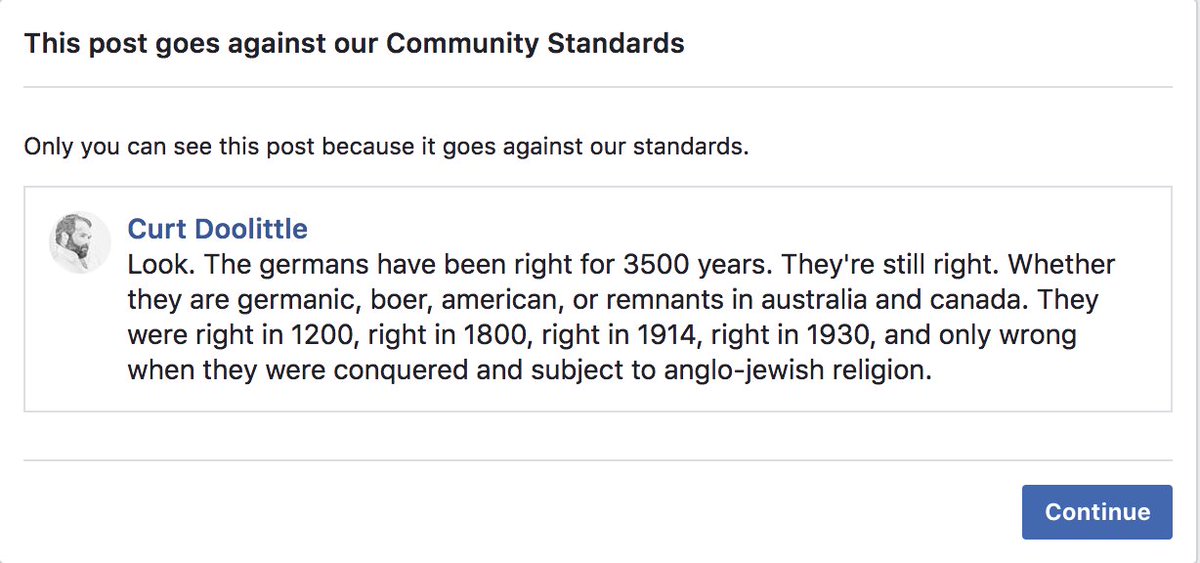
  • Will someone please explain to me how this is hate speech? I write about the dev

    Will someone please explain to me how this is hate speech? I write about the dev

    Will someone please explain to me how this is hate speech? I write about the development of truth, duty, and reciprocity, in the context of religion, tradition, norm, law and politics. And people read into it? Is that what?
    #Facebook #Censorship https://t.co/RNJ5bateao


    Source date (UTC): 2018-08-07 18:13:28 UTC

    Original post: https://twitter.com/i/web/status/1026894106696601600

  • THE ORIGIN OF THE SCANDINAVIAN COGNATE FOR KNOWLEDGE IS A VERB – “THE PROCESS OF

    THE ORIGIN OF THE SCANDINAVIAN COGNATE FOR KNOWLEDGE IS A VERB – “THE PROCESS OF, OR ACTION OF KNOWING”.

    Well it seems that our ancient ancestors had it right, even if the mediterraneans and medievals made it into an ideal.

    knowledge (n.)

    early 12c., cnawlece “acknowledgment of a superior, honor, worship;” for first element see know (v.). The second element is obscure, perhaps from Scandinavian and cognate with the -lock “action, process,” found in wedlock.

    From late 14c. as “capacity for knowing, understanding; familiarity;” also “fact or condition of knowing, awareness of a fact;” also “news, notice, information; learning; organized body of facts or teachings.” Sense of “sexual intercourse” is from c. 1400. Middle English also had a verb form, knoulechen “acknowledge” (c. 1200), later “find out about; recognize,” and “to have sexual intercourse with” (c. 1300); compare acknowledge.


    Source date (UTC): 2018-08-07 18:11:00 UTC

  • IS ALL KNOWLEDGE IDEOLOGICAL? There is knowledge that is correspondent, actionab

    IS ALL KNOWLEDGE IDEOLOGICAL?

    There is knowledge that is correspondent, actionable, and predictive within reality and knowledge that is non-corresponded, actionable, and non predictive, and knowledge that is non-correspondent, inactionable, and non-predictive. And all combinations thereof.

    KNOWLEDGE

    – Correspondent vs ….non correspondent (with reality)

    – Actionable …….vs …. in-actionable (by man)

    – Predictive ……..vs …..non predictive (outcomes)

    If one means all knowledge consists of paradigms that assist us in producing collective cooperation on the pursuit of ends, then that makes sense to me.

    If one means that there is more agency in non-correspondence than correspondence that is only true in the pursuit of power – which is just pursuits of rents.

    It’s not true if one has to hold power by it without perpetuating rents.

    Rulers are tediously empirical in action, even if ideological in rhetoric.

    They don’t have a choice.


    Source date (UTC): 2018-08-07 18:06:00 UTC