My answer to What is the difference between a fact and an objective truth? https://www.quora.com/What-is-the-difference-between-a-fact-and-an-objective-truth/answer/Curt-Doolittle?share=d0ab2062
My answer to What is the difference between a fact and an objective truth? https://www.quora.com/What-is-the-difference-between-a-fact-and-an-objective-truth/answer/Curt-Doolittle?srid=u4Qv
My answer to How can you present facts in a political conversation without sounding biased? https://www.quora.com/How-can-you-present-facts-in-a-political-conversation-without-sounding-biased/answer/Curt-Doolittle?share=5cf7edd3
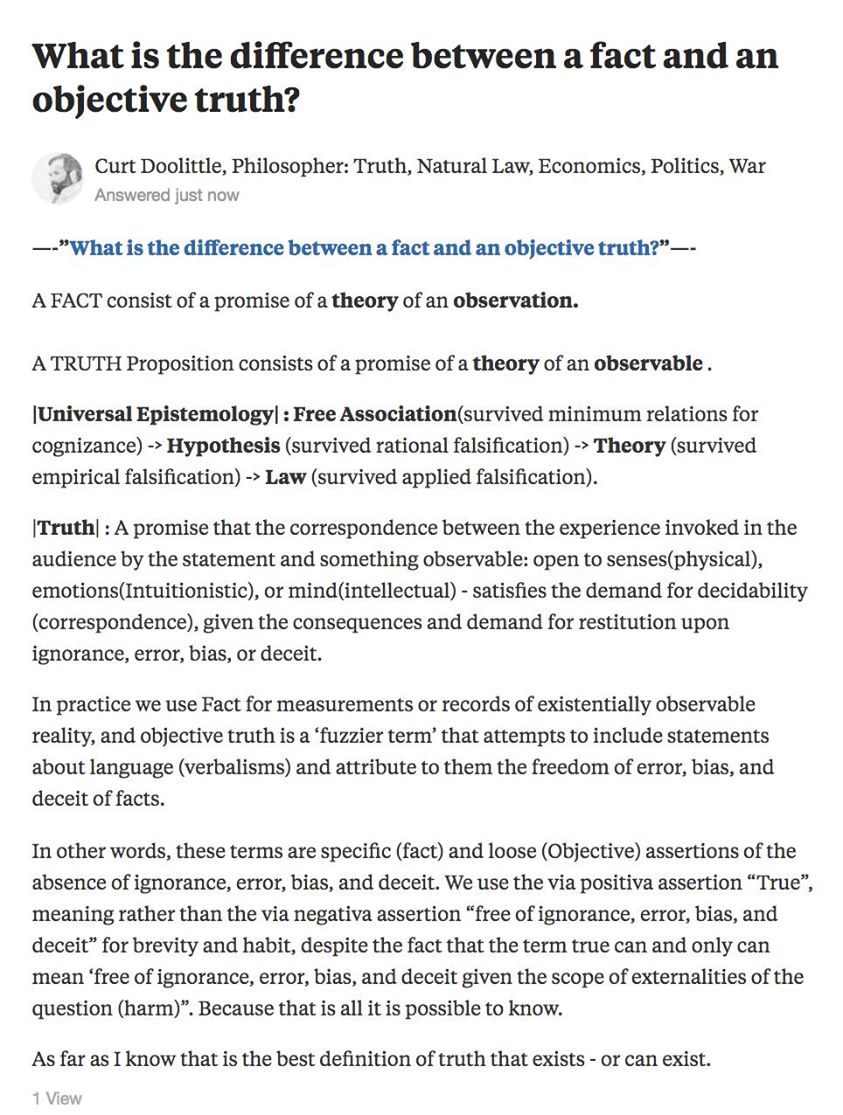
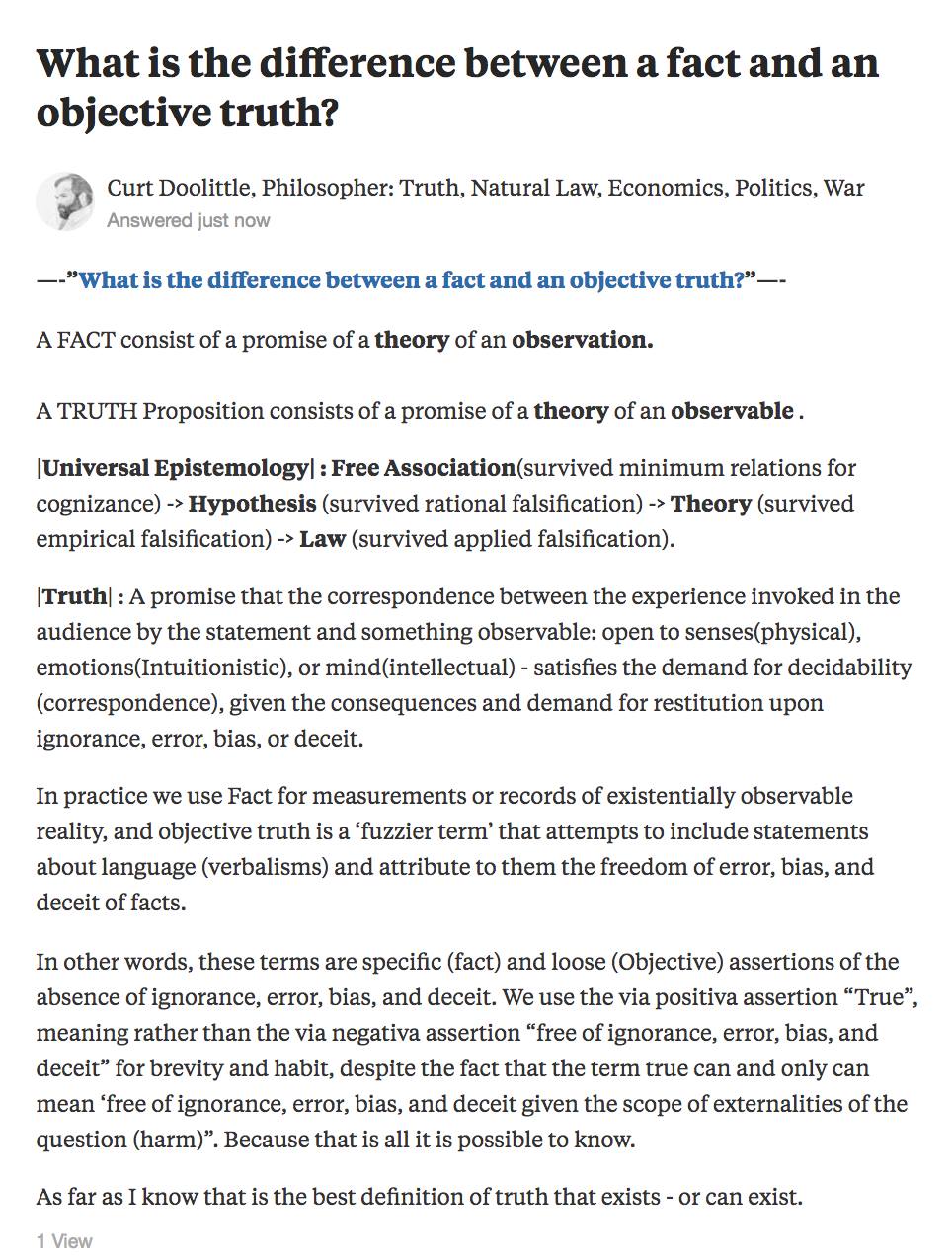
|**Truth**| : A promise that the correspondence between the experience invoked in the audience by the statement and something observable: open to senses(physical), emotions(Intuitionistic), or mind(intellectual) – satisfies the demand for decidability (correspondence), given the consequences and demand for restitution upon ignorance, error, bias, or deceit.
In practice we use Fact for measurements or records of existentially observable reality, and objective truth is a ‘fuzzier term’ that attempts to include statements about language (verbalisms) and attribute to them the freedom of error, bias, and deceit of facts.
In other words, these terms are specific (fact) and loose (Objective) assertions of the absence of ignorance, error, bias, and deceit. We use the via positiva assertion “True”, meaning rather than the via negativa assertion “free of ignorance, error, bias, and deceit” for brevity and habit, despite the fact that the term true can and only can mean ‘free of ignorance, error, bias, and deceit given the scope of externalities of the question (harm)”. Because that is all it is possible to know.
As far as I know that is the best definition of truth that exists – or can exist.FACT VS OBJECTIVE TRUTH?
—-”What is the difference between a fact and an objective truth?”—-
A FACT consists of a promise of a theory of an observation.
A TRUTH Proposition consists of a promise of a theory of an observable.
|**Truth**| : A promise that the correspondence between the experience invoked in the audience by the statement and something observable: open to senses(physical), emotions(Intuitionistic), or mind(intellectual) – satisfies the demand for decidability (correspondence), given the consequences and demand for restitution upon ignorance, error, bias, or deceit.
In practice we use Fact for measurements or records of existentially observable reality, and objective truth is a ‘fuzzier term’ that attempts to include statements about language (verbalisms) and attribute to them the freedom of error, bias, and deceit of facts.
In other words, these terms are specific (fact) and loose (Objective) assertions of the absence of ignorance, error, bias, and deceit. We use the via positiva assertion “True”, meaning rather than the via negativa assertion “free of ignorance, error, bias, and deceit” for brevity and habit, despite the fact that the term true can and only can mean ‘free of ignorance, error, bias, and deceit given the scope of externalities of the question (harm)”. Because that is all it is possible to know.
As far as I know that is the best definition of truth that exists – or can exist.
|**Truth**| : A promise that the correspondence between the experience invoked in the audience by the statement and something observable: open to senses(physical), emotions(Intuitionistic), or mind(intellectual) – satisfies the demand for decidability (correspondence), given the consequences and demand for restitution upon ignorance, error, bias, or deceit.
In practice we use Fact for measurements or records of existentially observable reality, and objective truth is a ‘fuzzier term’ that attempts to include statements about language (verbalisms) and attribute to them the freedom of error, bias, and deceit of facts.
In other words, these terms are specific (fact) and loose (Objective) assertions of the absence of ignorance, error, bias, and deceit. We use the via positiva assertion “True”, meaning rather than the via negativa assertion “free of ignorance, error, bias, and deceit” for brevity and habit, despite the fact that the term true can and only can mean ‘free of ignorance, error, bias, and deceit given the scope of externalities of the question (harm)”. Because that is all it is possible to know.
As far as I know that is the best definition of truth that exists – or can exist.FACT VS OBJECTIVE TRUTH?
—-”What is the difference between a fact and an objective truth?”—-
A FACT consists of a promise of a theory of an observation.
A TRUTH Proposition consists of a promise of a theory of an observable.
|**Truth**| : A promise that the correspondence between the experience invoked in the audience by the statement and something observable: open to senses(physical), emotions(Intuitionistic), or mind(intellectual) – satisfies the demand for decidability (correspondence), given the consequences and demand for restitution upon ignorance, error, bias, or deceit.
In practice we use Fact for measurements or records of existentially observable reality, and objective truth is a ‘fuzzier term’ that attempts to include statements about language (verbalisms) and attribute to them the freedom of error, bias, and deceit of facts.
In other words, these terms are specific (fact) and loose (Objective) assertions of the absence of ignorance, error, bias, and deceit. We use the via positiva assertion “True”, meaning rather than the via negativa assertion “free of ignorance, error, bias, and deceit” for brevity and habit, despite the fact that the term true can and only can mean ‘free of ignorance, error, bias, and deceit given the scope of externalities of the question (harm)”. Because that is all it is possible to know.
As far as I know that is the best definition of truth that exists – or can exist.
I mean, if you’re going to write science, law, and literature, then do so. But when you conflate them into pseudoscience, philosophy, and theology, you’re just selling snake oil in the language of deceit.
THE PROBLEM OF SYMBOLIC EXISTENCE
Or to quote my long time friend Frank Lovell, Knowledge of unicorns exists, even if unicorns do not exist. And even this statement depends upon how we demarcate between Knowledge with Information. We actually don’t have a vocabulary for existence as idea or information other than ‘symbol’. And symbol is often confused with ‘glyph’. So, assuming we demarcate symbol and glyph unicorns exist only symbolically while horses exist existentially.
So for existence we have grammars:
|| platonic < symbolic < constructive(operational) <- descriptive(existential) -> analogistic > literary > and fictional(isms) ||
THE PROBLEM OF SYMBOLIC EXISTENCE
Or to quote my long time friend Frank Lovell, Knowledge of unicorns exists, even if unicorns do not exist. And even this statement depends upon how we demarcate between Knowledge with Information. We actually don’t have a vocabulary for existence as idea or information other than ‘symbol’. And symbol is often confused with ‘glyph’. So, assuming we demarcate symbol and glyph unicorns exist only symbolically while horses exist existentially.
So for existence we have grammars:
|| platonic < symbolic < constructive(operational) <- descriptive(existential) -> analogistic > literary > and fictional(isms) ||
Once I’m done teaching you, you’ll understand that aryan reason and science produced a series of deflationary grammars by which we iteratively increase our truth… https://www.facebook.com/permalink.php?story_fbid=277993166130914&id=100017606988153