Theme: Truth

  • TRUTH (TESTIMONY) The Testimony We Call “Truth” The Decidability of Testimony —

    TRUTH (TESTIMONY)
    The Testimony We Call “Truth”

    The Decidability of Testimony
    —“We evolved to negotiate pragmatically not testify truthfully. The reason we need Truth is because it’s counter-intuitive – it provides decidability independent of opinion or value – and so it’s often undesirable.” —

    Deflating the word “True”.
    |Testimony| > Dishonesty(bias, deceit) > Error (ignorance, error) >
    … Meaningful (intuitionistic) > Honesty(rational) >
    … … Truthfulness(by due diligence) > Scientific (Testifiable) >
    … … … Ideal Truth (imaginary) >
    … … … … Analytic Truth (logical) >
    … … … … … Tautological Truth (linguistic).

    The etymology of the word “True” is Testimony:

    Truth (n.)
    Old English triewð (West Saxon), treowð (Mercian) “faith, faithfulness, fidelity, loyalty; veracity, quality of being true; pledge, covenant,” from Germanic abstract noun *treuwitho, from Proto-Germanic treuwaz “having or characterized by good faith,” from PIE *drew-o-, a suffixed form of the root *deru- “be firm, solid, steadfast.”, “oak” “Strong as an oak”.

    True (adj.)
    Old English triewe (West Saxon), treowe (Mercian) “faithful, trustworthy, honest, steady in adhering to promises, friends, etc.,” from Proto-Germanic *treuwaz “having or characterized by good faith” (source also of Old Frisian triuwi, Dutch getrouw, Old High German gatriuwu, German treu, Old Norse tryggr, Danish tryg, Gothic triggws “faithful, trusty”), from PIE *drew-o-, a suffixed form of the root *deru- “be firm, solid, steadfast.”

    Sense of “consistent with fact” first recorded c. 1200; that of “real, genuine, not counterfeit” is from late 14c.; that of “conformable to a certain standard” (as true north) is from c. 1550. Of artifacts, “accurately fitted or shaped” it is recorded from late 15c. True-love (n.) is Old English treowlufu. True-born (adj.) first attested 1590s. True-false (adj.) as a type of test question is recorded from 1923. To come true (of dreams, etc.) is from 1819.

    True (v.)
    Sense of correspondence. “make true in position, form, or adjustment,” 1841, from true (adj.) in the sense “agreeing with a certain standard.” Related: Trued; truing.
    (source: from the online etymology dictionary)

    An Action (Verb): We Lack a Primary Verb for “Speaking the Truth”
    While we have admittedly fuzzy definitions for true and truth, one of the frailties of English and most other IE languages is that they do not have a primary verb for “speak the truth,” as a contrast to lie and lying (v.). As we will observe repeatedly over the course of this book, the lack of a primary verb for Speaking the Truth is but one of many apparent confusions that are cause us so many problems of grammar and vocabulary.

    In order to solve the problem of the ‘missing term’ we will use the terms “truthful”, “truthfulness”. For example: ‘He lies’, vs. ‘He speaks truthfully’. I’m not adventurous enough with terminology to suggest we use truths and truth as in ‘He truths’, and ‘That’s a truth’, even if it’s not uncommon for us to use “True” and less frequently “Truth” as statements of agreement.

    A Term of Promise: All Statements are Promissory, With Varying Degrees of Contingency
    If I say ‘it’s raining’, I am saying “I promise it is raining”. I might say “I think/believe it is raining” which expresses contingency. I might also say “isn’t it raining?” Or “maybe it is raining” to suggest a possibility rather than state a contingency or a promise. Yet we seek to avoid that accountability.

    The Term Testimony Instead of Promise: ‘Testimonial Truth’
    In philosophical discourse the terms ‘promissory’ or ‘performative’ truth are used for similar purposes. But because we are working in the context of law not norm and because we want to distinguish our work from prior authors, we will use the term “Testimony” and “Testimonial Truth”.

    Only the Conscious (Humans) can Testify or Promise
    Only those capable of speech (testimony), possessing sentience (feeling) consciousness (reason) and agency (cognitive independence from intuitionistic interference) are cable of making such promises. And not all individuals are possessed of sufficient agency (knowledge, skill, ability) to make such promises – and unfortunately we are not ourselves aware of our own limits. For this reason honestly is insufficient for truth claims. Instead we must perform due diligence against our limitations in order to make truth claims. And to guard against deception we must demand warranty (Or as Taleb argues, ‘skin in the game’.) Not simply because people are deceptive, but because they often lack the agency to speak truthfully having performed due diligence against their frailties.

    The Degree of Promise in Testimony
    So when we make a truth claim or state a truth proposition, we are constructing an intersection of three axes;
    – The demand for decidability given the context of the question we decide
    – The decidability of the testimony necessary to fulfill that demand
    – The degree of warranty of due diligence that such testimony is sufficient for decidability, and demand for infallibility

    Our testimony is sufficiently decidable and warrantied for the degree of decidability or not.

    A Term of Agreement
    In English grammar we refer to yes and no as a subtype of word we call ‘Agreement’, as in |Word| Noun > Verb > Relation > Agreement. We also use ‘true’ and ‘false’ as methods of ‘agreement’, but agreement on the correspondence of testimony (speech) with reality (existence). So when we say ‘That is true’, we mean ‘I agree with your testimony’. Or less supportively ‘I consent to your testimony’. Or “I promise you will agree with my testimony”, or ‘I cannot disagree with your testimony’. In this sense yes and no, true and false, good and bad are statements of agreement.

    |Agreement| Agree, True, Good < Undecidable > Disagree, False, Bad

    A Point of View
    We habitually conflate (a) the words uttered by the speaker, with (b) the audience’s judgment of the correspondence of those words with reality, (c) the incentives of the speaker that bias his speech with (d) the sufficiency of decidability for the speaker, (e) the sufficiency of decidability of the audience who may or may not possess the skill, and (f) sufficiency of decidability for the judge who may or must possess such a skill to do so. And in doing so we conflate point of view (speaker, audience, judge), even though those points of view possess different information and different incentives, and different objectives.

    The audience and the judge must ask, what demand for sufficient decidability is required to answer this question? What degree of due diligence is necessary to claim an answer is honest, truthful, or true – and is it warrantable? And is that degree of honesty, truthfulness or truth sufficient to provide the decidability demanded by the question? In other words, is the testimony decidable true, and is the question decidable given that degree of truth? If not then what is the scale of possible consequence (harm), and what is the possibility of restitution (correction of the error)?

    |Point of View| Speaker (Producer)(Hypothesis) < >
    Audience (Market)(Theory) > Judge (Court)(Finding of Law)

    So a speaker (voice), author (text), or craftsman (symbols or illustrations), produces a product (hypothesis), that is tested by an audience (market), and negotiated (recursively), and either agreed with (purchased), or disagreed with (boycotted – exited), or submitted to a court (fraud).

    The Act of Testimony: Copying, Describing, and Reconstructing
    Speaking Truthfully requires accurately copying (reporting on) existential reality and then representing that copy in thoughts, words, displays, and actions or other symbols, where the audience’s use of those thoughts, words, and symbols reconstructs the same perception of reality as the speaker.

    Cheers
    -CD


    Source date (UTC): 2024-01-21 04:17:20 UTC

    Original post: https://twitter.com/i/web/status/1748922703929593856
  • DECIDABILITY (ACTION) The Satisfaction of Demand For Infallibility A question (o

    DECIDABILITY (ACTION)
    The Satisfaction of Demand For Infallibility

    A question (or statement) is Decidable (true or false: consistent, correspondent, possible; good or bad, and sufficient) if (a) an algorithm (argument, or set of operations) exists within the limits of the system (domain: set of axioms, rules, theories) that one can use to produce a decision and (b) if sufficient information for the decision is present within the system such that, (c) one need not appeal to either information outside of the system, or DISCRETION (INTUITION, VALUES) to supply information necessary to DECIDE.

    Ergo, if DISCRETION (choice) is unnecessary, a proposition is DECIDABLE. If Discretion is necessary then the question may be DISCRETIONARY (subjective choice) but it is not DECIDABLE (objective).

    Or for the most reductive version: the subjective requires appeal to intuition (judgment) and the objective requires only appeal to present information.

    |Choice| Decidable > Discretionary(opinion) > Choice(preference, presumed good) > Random Selection (undecidable) > In-actionable

    The purpose of our method is to produce decidability as a means of circumventing the dependence on discretion and choice. By our diligent production of decidability we produce a value independent universal language of testimony in all subjects; but particularly in the subjects most vulnerable to discretionary impulse: cooperation, ethics, morality, and politics.

    Note: This emphasis on decidability explains the difference between rule of law (decidable) and rule by discretion (undecidable, and therefore subjective discretion or choice are required). If discretion is required, then it is rule by discretion (choice) if not, then rule of law.

    Demand For Increasingly Infallible Decidability

    In an effort to avoid the mistake of relying upon an Ideal Type, we will describe a spectrum, or ordered hierarchy of Demand for DECIDABILITY. That way we do not ask the universe to fit our definition, but that we provide a definition that corresponds to decidability in all cases we can perceive in the universe.

    Spectrum of Decidability:

    Intelligible: Decidable enough to imagine a conceptual relationship
    Reasonable: Decidable enough for me to feel confident about my decision (that it will satisfy my needs, and is not a waste of time, energy, resource )
    Actionable: Decidable enough for me to take actions that produce positive results.
    Moral: Decidable enough for me to not cause others to react negatively to me, if they have knowledge of my actions.
    Normative: Decidable enough to resolve a conflict without subjective opinion among my fellow people with similar values.
    Judicial: Decidable enough to resolve a conflict without subjective opinion across different peoples with different values.
    Scientific: Decidable regardless of all opinions or perspectives (‘True’)
    Logical(Analytic): Decidable out of physical or logical necessity
    Tautological: Decidably identical in properties (referents) if not references (terms).
    Ideal: Decidable if we possess the knowledge we do not and cannot, but wish we did. 😉

    So to borrow the one of many terms from Economics, we can see in this series (list) a market demand for increasingly infallible decidability.

    The Methods of Decidability

    We can also separate the actions of intuiting (intuition), from reasoning (all processes of the mind), from rationalism (justification), from calculation (in the wider sense – transformation of inputs into outputs) from computation (algorithm).

    |DECIDABLE| Unintelligible(Incomprehensible) > Intelligible(Comprehensible) > Possible (actionable) > Preferable > Good (Normative, Moral) > Decidable(Judicial) > True (scientific) > Analytically True (logical) > Tautologically True (Tautological)

    and

    |COGNITION| Comprehensible > Imaginable > Reasonable > Rational > Calculable > Computational > Identical

    and

    |METHOD| Experiential(emotional) > Rational (law : Social or Contractual) Theoretic (science: existential) > Axiomatic(logic: mental) >

    Each of these methods of reasoning depends upon a different degree of demand for the infallibility of decidability.

    So when we say we can decide a question, we mean it satisfies the demand for the infallibility of decidability.

    Note: This technique, where we test the satisfaction of demand for infallibility, will frame most of our thinking, and it is the principle difference between logical, philosophical, scientific, and legal thought. That is because it is the most complete of logical, philosophical, scientific, and legal thought.

    Cheers
    -CD


    Source date (UTC): 2024-01-21 04:04:47 UTC

    Original post: https://twitter.com/i/web/status/1748919545606148096

  • This is a very common tactic among overly emotional and subsequently intellectua

    This is a very common tactic among overly emotional and subsequently intellectually dishonest people, which is to “report” one thing as meaningful and “demonstrate” another. In other words, no such claims as you are making are indications of subsequent behavior, but instead are just virtue signals or rhetorical deceptions even if the deception is only a cover for emotional venting.

    So no. Your words are hollow as are all such claims.

    Reply addressees: @DC_Swamp_Drain @MaziZachary @andrewnygard @NoahBookbinder


    Source date (UTC): 2024-01-19 19:43:15 UTC

    Original post: https://twitter.com/i/web/status/1748430942681583616

    Replying to: https://twitter.com/i/web/status/1748430262029992037

  • Painful truth is my job. Sorry

    Painful truth is my job. Sorry.


    Source date (UTC): 2024-01-19 18:53:48 UTC

    Original post: https://twitter.com/i/web/status/1748418495530832288

    Reply addressees: @MaziZachary @catlawfin @TheHardMan21 @NoahBookbinder

    Replying to: https://twitter.com/i/web/status/1748416462509703575

  • That’s not an argument. It’s a pretense of one. As far as I know, and as far as

    That’s not an argument. It’s a pretense of one. As far as I know, and as far as we know, there is no surviving criticism of my work – just the opposite, it’s profound. You might disapprove of the work, and since it’s central purpose is ending lying in public to the public in matters public, that’s understandable. But such criticism just puts me in the same good company as Darwin, Galileo, and Socrates.

    Reply addressees: @GPEditor


    Source date (UTC): 2024-01-19 13:44:09 UTC

    Original post: https://twitter.com/i/web/status/1748340569602928640

    Replying to: https://twitter.com/i/web/status/1748295511621193830

  • That doesn’t mean your opinion will stand in this matter. And I’m confident it w

    That doesn’t mean your opinion will stand in this matter. And I’m confident it won’t. It doesn’t take a terribly bright person to practice law. Thankfully some terribly bright people choose to do so.

    The matter is unclear. That there was an insurrection is an opinion. That Trump favored it requires knowledge of his state of mind. That one be convicted of insurrection is necessary in such cases where it is politicized opinion not decidable without adversarial competition before the court. That bureaucrats can politicize the process depriving the people of a state of a candidate that shall b elected by the people and decided by the electoral college is quite different from a senator or representative of that state other than whether the people demonstrate an interest. That such a question given even this limited set of criteria requires a decision by SCOTUS is rather obvious.

    And that is just the beginning of the matter.

    I know we will submit an Amicus brief, and I’m sure many others will as well.

    I would be very surprised to see this court vote to politicize the presidency further, let states politicize it further, and deprive the people of their choice without the only process of exercise of that choice. And, that’s including this court’s dedication to return of sovereignty to the states and it’s intention to continue reversal of circumvention of the people by lawfare.

    So we shall see.

    Cheers

    Reply addressees: @zeidman1 @NoahBookbinder


    Source date (UTC): 2024-01-19 13:32:48 UTC

    Original post: https://twitter.com/i/web/status/1748337714653544448

    Replying to: https://twitter.com/i/web/status/1748333433569284111

  • RT @WerrellBradley: The incomprehensible nature of the lie makes believing the T

    RT @WerrellBradley: The incomprehensible nature of the lie makes believing the Truth “Incredible” (unbelievable), Mr. Bot.

    Thank you.


    Source date (UTC): 2024-01-19 03:54:01 UTC

    Original post: https://twitter.com/i/web/status/1748192061017207226

  • HIGH CIVILIZATION REQUIRES TRUTH, AND TRUTH REQUIRES IQ, AND THE DISPOSITION AND

    HIGH CIVILIZATION REQUIRES TRUTH, AND TRUTH REQUIRES IQ, AND THE DISPOSITION AND

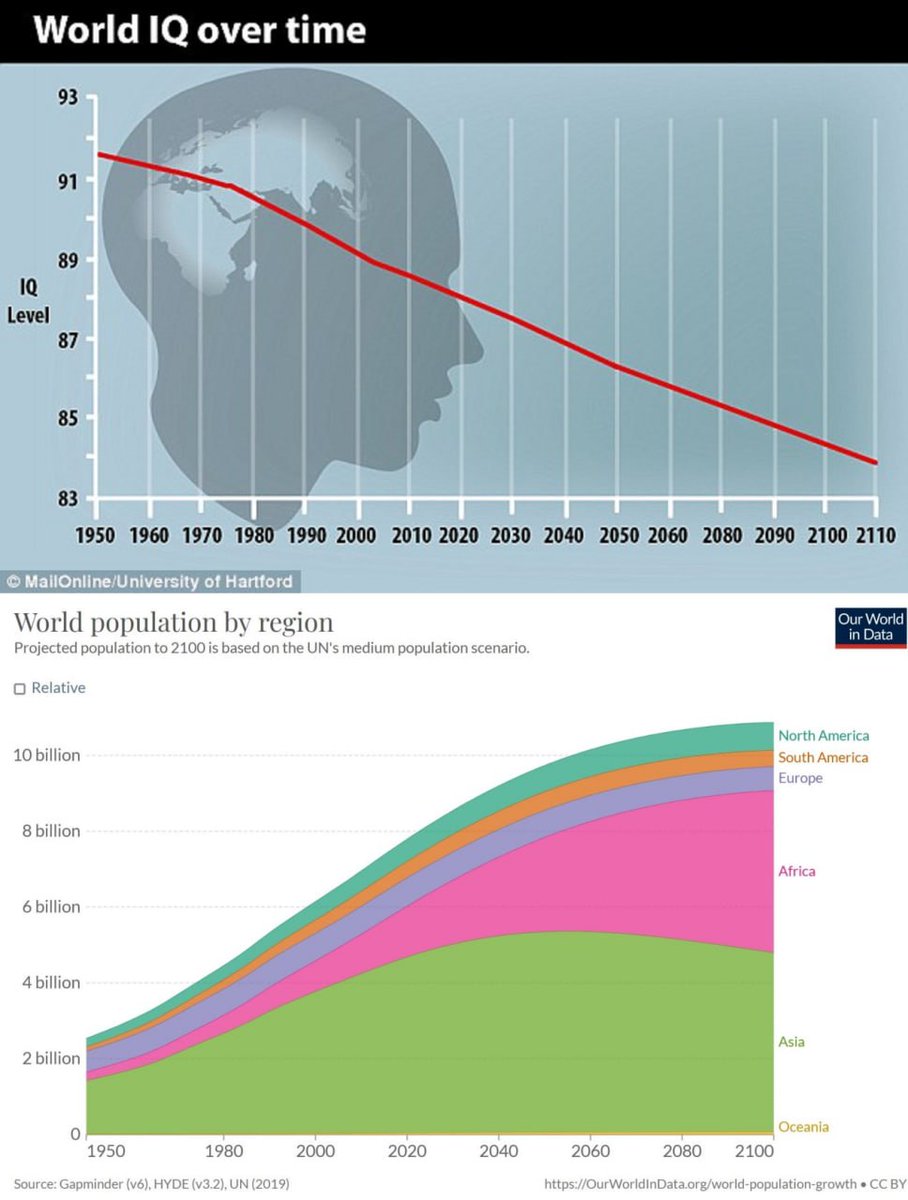
    HIGH CIVILIZATION REQUIRES TRUTH, AND TRUTH REQUIRES IQ, AND THE DISPOSITION AND ABILITY ARE RARE
    And we are getting dumber by the day. And you CAN’T ESCAPE IT. Why? You are more affected by the IQ of those around you than you are by your own. (As I counsel every african grad… https://t.co/i1JUs9nM3a


    Source date (UTC): 2024-01-19 00:37:53 UTC

    Original post: https://twitter.com/i/web/status/1748142701399134268

  • Honesty, Intelligence, and Race OpenPsych , July 17, 2023 Staying on message: 1

    Honesty, Intelligence, and Race OpenPsych , July 17, 2023 Staying on message: 1

    Honesty, Intelligence, and Race
    OpenPsych , July 17, 2023
    https://openpsych.net/paper/72/

    Staying on message:
    1 – Not all peoples are equally disposed to speak truth before face.
    2 – The lower the group’s median IQ the less likely they are able to speak truth before face.
    3 – Some… https://t.co/MCbrOmcF3m


    Source date (UTC): 2024-01-19 00:32:13 UTC

    Original post: https://twitter.com/i/web/status/1748141274010366267

  • Honesty, Intelligence, and Race OpenPsych , July 17, 2023 Staying on message: 1

    Honesty, Intelligence, and Race
    OpenPsych , July 17, 2023
    https://t.co/BgLLPZ2cFs

    Staying on message:
    1 – Not all peoples are equally disposed to speak truth before face.
    2 – The lower the group’s median IQ the less likely they are able to speak truth before face.
    3 – Some populations must rely on lying to advance their collectivist religious social and politcal systems (the abrahamic cults)
    4 – Truth before face is, aside from individual self determination (sovereignty), the single most important civilizational difference between the west (whites) and the rest.

    Why? Because every single institution we value and that provides us with such a competitive advantage, and provides such a higher standard of living and quality of life, depends on it – the origin of our law, or our empiricism of our science, arts, technoligy and medicine, especially our liberty and jurty and common concurrent law – all depend on this one foundation: truth before face regardless of cost.

    And what is the left advancing? Collectivism and Lying instead. In other words cultural suicide.

    And why are women so eager to advance collectivism face before truth and ly ing to cover it?

    Because it absolves them of responsibility for defense of the behavioral commons. And women evade responsibility as much as they pursue attention and consumption. Training women to not rely on antisocial behavior is just as important if not more important than training men not to. and that’s what we have failed to do.

    Now back to the paper:

    As if we needed more evidence. The only people on earth who speak truth before face. And the entire left’s program is meant to undermine it – as is nearly every woman in the west :(. ) It’s a paper by Kirkegaard with his usual zeal.

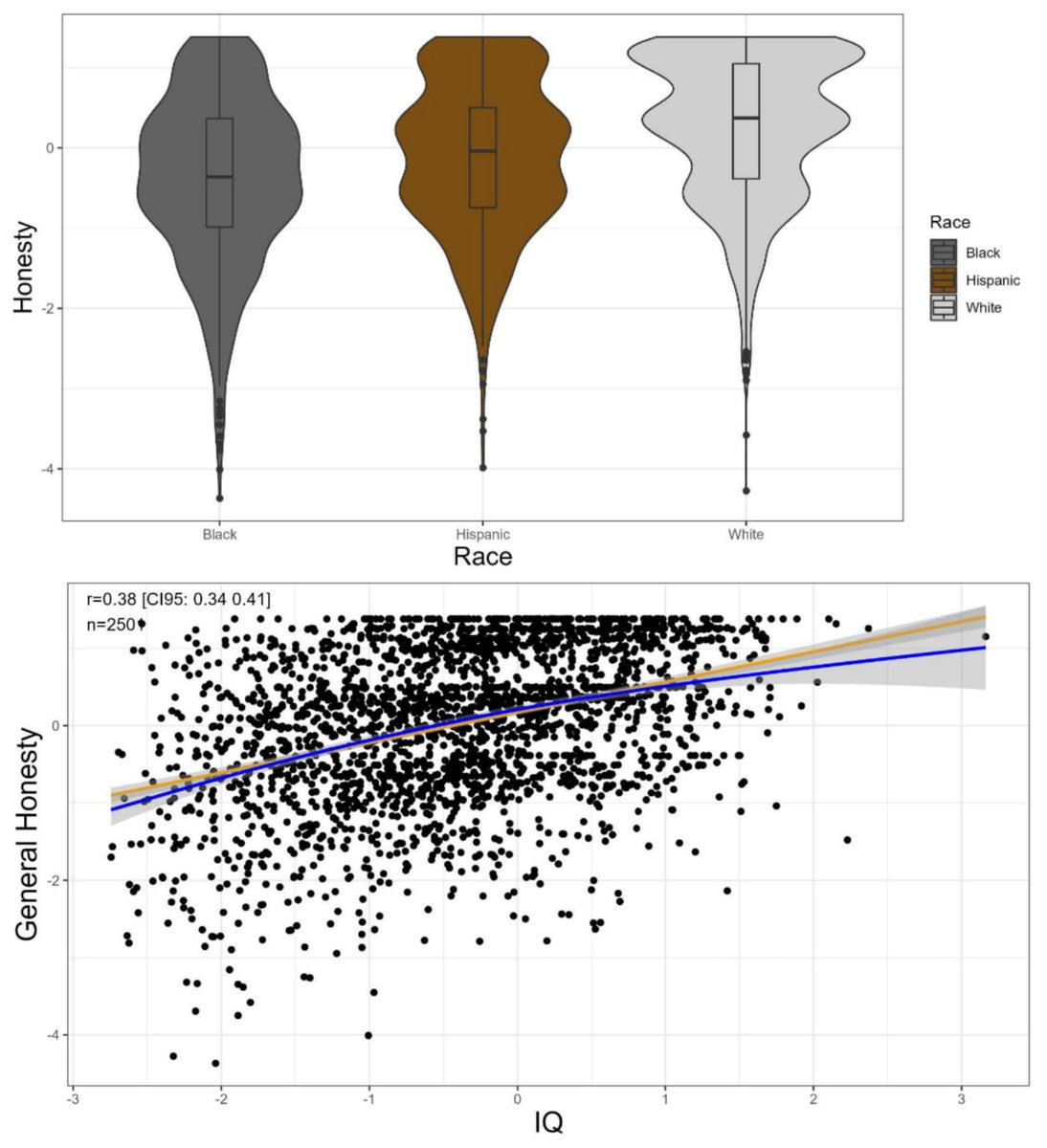
    –“Research shows that honesty correlates positively with intelligence. Similarly, there are racial differences in honesty, with Europeans being more honest than various other ethnic groups. It is currently unknown to what degree race differences in intelligence can explain the differences in honesty. …

    We replicate prior findings that honesty correlated with measures of intelligence (r = .38, 95% CI [.34, .41]) and that Blacks (d = -0.67, 95% CI [-.76, -.59]) and Hispanics (d = -0.4, 95% CI [-.50, -.31]) are less honest than Whites, and this holds whether honesty is measured by self-reports, interviewer-reports or by parent-reports.

    In addition, race differences in honesty remained between Blacks and Whites but not between Whites and Hispanics after controlling for intelligence. Differences between Blacks and Whites but not Whites and Hispanics were noticeably lower in self-reports (Blacks: d = -0.18 [-0.24, -0.11], Hispanics: d = -0.24 [-0.31, -0.17]) than parent-reports (Blacks: d = -0.43 [-0.52, -0.35], Hispanics: -0.24 [-0.33, -0.15]) and interviewer-reports (Blacks: d = -0.7 [-0.75, -0.64], Hispanics: -0.3 [-0.36, -0.25]).

    Cross-national comparisons were made using national IQ data and Hofstede’s cultural dimensions. Bayesian model averaging suggests that Hofstede’s individualism dimension (β = .64, PIP = 100%), national IQs (β = .25, PIP = 73.6%), and masculinity (β = -.35, PIP = 100%) predict differences in honesty between countries.

    (CD: Meaning? Collectivism breeds dishonesty.)

    Parking violations per diplomat were only predicted by national IQs (r = -0.28, p < .001), given that no other variable reached a posterior inclusion probability above 0% besides national IQs. Implications and theories concerning these findings are discussed.”–

    (CD: I’m going to fetch that data on parking violations per diplomat and add it to my Countries table of data.)

    Cheers
    CD


    Source date (UTC): 2024-01-19 00:32:13 UTC

    Original post: https://twitter.com/i/web/status/1748141273679073280