Theme: Truth

  • It’s a journey man. We all do our best to find the truth. There is just a lot sh

    It’s a journey man. We all do our best to find the truth. There is just a lot sh_t to sift through. -hugs


    Source date (UTC): 2015-11-08 22:02:03 UTC

    Original post: https://twitter.com/i/web/status/663476602995646464

    Reply addressees: @AllooCharas @SpiritSplice

    Replying to: https://twitter.com/i/web/status/663475930241900544


    IN REPLY TO:

    @AllooCharas

    @curtdoolittle @SpiritSplice Against my will i think i like you mate!

    Original post: https://twitter.com/i/web/status/663475930241900544

  • What is the difference between truthful testimony, the disciplines of science, a

    What is the difference between truthful testimony, the disciplines of science, and of philosophy?


    Source date (UTC): 2015-11-08 21:52:00 UTC

    Original post: https://twitter.com/i/web/status/663474073465397248

    Reply addressees: @AllooCharas @SpiritSplice

    Replying to: https://twitter.com/i/web/status/663472921264979972


    IN REPLY TO:

    @AllooCharas

    @curtdoolittle @SpiritSplice Why when you are talking political philosophy?

    Original post: https://twitter.com/i/web/status/663472921264979972

  • Q&A: “Are There Higher Psychologies Than Truth?” (whatever that means)

    —“It sounds like you’re recognizing there are higher psychologies than that of the mere scientist.”—

    [W]ell, I disagree that for the purposes of LAW and TRUTH claims, that there are ‘higher’ psychologies, but for the purpose of CREATIVITY yes, I agree. My position is that matters of creativity are the subject of aesthetics, not metaphysics, truth, epistemology, ethics, politics or war.

    I have observed the same reaction from scientists who think that they’re work is the most ‘spiritually advanced’: the critical rationalists are determined that they not be constrained, and are not responsible for the externalities produced by their failure to warranty that their work has been laundered. Why would I expect artists, authors, theists, philosophers, scientists or whatever other group that claims spiritual superiority to accept both that their desire for creativity in their frame of reference is not special in the least, that their work is not special in the least – only subject to less empirical tests of failure; or to accept accountability for their speech and action, since they themselves would say that they need no such limits, given their moral character, and desire to create not decide, not police, not punish. Except the evidence is otherwise. People want to pretend their smarter than they are, to utter nonsense, to obtain status with nonsense utterances, and not to be held accountable for that which they failed to foresee. People are ridiculous really, in all walks of life. But without such nonsensical pretenses we would not be motivated enough to get out of bed and struggle against the dark forces of time and ignorance. Given that more damage has been done by priests, philosophers, politicians, and pseudoscientists than has been done by warriors, the great plagues, and only matched by volcanic disruption of the ecosystem, it is merely prudent that the most irresponsible people warranty that they do no harm instead of escape liability for that harm they have observably done. Liars all. Particularly to ourselves. So as one who is learning, I understand the desire for creativity and experience. As one who defends civilization I also understand that we can, and must, limit the damage that can be done by those who would seek status and affirmation, and excitement, through falsehood. Curt Doolittle The Philosophy of Aristocracy The Propertarian Institute Kiev, Ukraine
  • Q&A: “Are There Higher Psychologies Than Truth?” (whatever that means)

    —“It sounds like you’re recognizing there are higher psychologies than that of the mere scientist.”—

    [W]ell, I disagree that for the purposes of LAW and TRUTH claims, that there are ‘higher’ psychologies, but for the purpose of CREATIVITY yes, I agree. My position is that matters of creativity are the subject of aesthetics, not metaphysics, truth, epistemology, ethics, politics or war.

    I have observed the same reaction from scientists who think that they’re work is the most ‘spiritually advanced’: the critical rationalists are determined that they not be constrained, and are not responsible for the externalities produced by their failure to warranty that their work has been laundered. Why would I expect artists, authors, theists, philosophers, scientists or whatever other group that claims spiritual superiority to accept both that their desire for creativity in their frame of reference is not special in the least, that their work is not special in the least – only subject to less empirical tests of failure; or to accept accountability for their speech and action, since they themselves would say that they need no such limits, given their moral character, and desire to create not decide, not police, not punish. Except the evidence is otherwise. People want to pretend their smarter than they are, to utter nonsense, to obtain status with nonsense utterances, and not to be held accountable for that which they failed to foresee. People are ridiculous really, in all walks of life. But without such nonsensical pretenses we would not be motivated enough to get out of bed and struggle against the dark forces of time and ignorance. Given that more damage has been done by priests, philosophers, politicians, and pseudoscientists than has been done by warriors, the great plagues, and only matched by volcanic disruption of the ecosystem, it is merely prudent that the most irresponsible people warranty that they do no harm instead of escape liability for that harm they have observably done. Liars all. Particularly to ourselves. So as one who is learning, I understand the desire for creativity and experience. As one who defends civilization I also understand that we can, and must, limit the damage that can be done by those who would seek status and affirmation, and excitement, through falsehood. Curt Doolittle The Philosophy of Aristocracy The Propertarian Institute Kiev, Ukraine
  • Proofs and Truths

    (important summary) [W]hen we write a proof, we demonstrate that our testimony is existentially possible. Proofs demonstrate existential possibility. But they do not necessarily demonstrate uniqueness. So a proof does not say that this particular road led one to Rome. It merely says that it is indeed possible to arrive in Rome via this road. A truth claim would have to demonstrate that the only possible way to Rome is by this road, or to demonstrate that you had indeed taken this road using incontestable evidence that you had not taken others. This is the difference between subjective and rational and objective and empirical testimony. And when we construct proofs in Propertarian language, we do not make claims of uniqueness: truth; we make claims of possibility: proofs. We prove that our testimony is possible, but not unique. That proof requires that each step in the sequence of our proof is also subjectively testable as a rational operation by a human mind, given the incentives at his disposal. Propertarianism provides the fulfillment of hte promise of praxeology, without the error that such statements are true, only that they are not false. This corrects the Misesian half-success of praxeology by merging it with the Popperian half-success of critical rationalism: the evolution of knowledge by survival of criticism, to achieve the Hayekian half-success that liberty is only obtainable through rule of law; and merging them together with the expensive commons of high trust and truth telling into Testimonialism: the epistemology of Propertarianism. Liberty results only from truth in mind, utterance, and trial by jury, under the total prohibition of parasitism, forcing all men into production of goods, services and commons. The most precious, expensive, and scarce of commons being objective truth and truth telling itself.
    Curt Doolittle The Propertarian Institute Kiev, Ukraine
  • Proofs and Truths

    (important summary) [W]hen we write a proof, we demonstrate that our testimony is existentially possible. Proofs demonstrate existential possibility. But they do not necessarily demonstrate uniqueness. So a proof does not say that this particular road led one to Rome. It merely says that it is indeed possible to arrive in Rome via this road. A truth claim would have to demonstrate that the only possible way to Rome is by this road, or to demonstrate that you had indeed taken this road using incontestable evidence that you had not taken others. This is the difference between subjective and rational and objective and empirical testimony. And when we construct proofs in Propertarian language, we do not make claims of uniqueness: truth; we make claims of possibility: proofs. We prove that our testimony is possible, but not unique. That proof requires that each step in the sequence of our proof is also subjectively testable as a rational operation by a human mind, given the incentives at his disposal. Propertarianism provides the fulfillment of hte promise of praxeology, without the error that such statements are true, only that they are not false. This corrects the Misesian half-success of praxeology by merging it with the Popperian half-success of critical rationalism: the evolution of knowledge by survival of criticism, to achieve the Hayekian half-success that liberty is only obtainable through rule of law; and merging them together with the expensive commons of high trust and truth telling into Testimonialism: the epistemology of Propertarianism. Liberty results only from truth in mind, utterance, and trial by jury, under the total prohibition of parasitism, forcing all men into production of goods, services and commons. The most precious, expensive, and scarce of commons being objective truth and truth telling itself.
    Curt Doolittle The Propertarian Institute Kiev, Ukraine
  • Communication, Argument, and Proof

    —“Communication, Argument, and Proof are different things unfortunately. I don’t really communicate. I construct arguments and proofs. My “managers” tell me to do that, and leave communication of it for others. And that seems to work best. There are already a few people that are better at communicating these ideas than I am.”—Curt

  • Communication, Argument, and Proof

    —“Communication, Argument, and Proof are different things unfortunately. I don’t really communicate. I construct arguments and proofs. My “managers” tell me to do that, and leave communication of it for others. And that seems to work best. There are already a few people that are better at communicating these ideas than I am.”—Curt

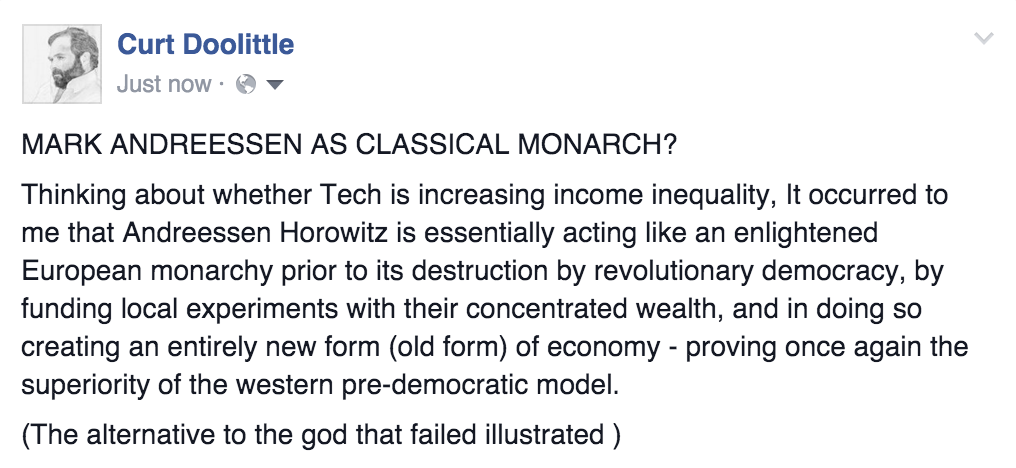
  • @pmarca #tlot #NRx #libertarian (truth in humor) 😉

    @pmarca #tlot #NRx #libertarian (truth in humor) 😉 https://t.co/bJhjpCWwEB


    Source date (UTC): 2015-11-07 18:09:26 UTC

    Original post: https://twitter.com/i/web/status/663055674658697216

  • Kantian Rationalism vs Anglo Empiricism (This is a very complex topic so it’s in

    Kantian Rationalism vs Anglo Empiricism (This is a very complex topic so it’s insufficient for tweets. Sorry.)


    Source date (UTC): 2015-11-07 18:06:49 UTC

    Original post: https://twitter.com/i/web/status/663055014840135680

    Reply addressees: @LordChaldon @ShaunWesleyWyrd

    Replying to: https://twitter.com/i/web/status/663042804956962816


    IN REPLY TO:

    Original post on X

    Original tweet unavailable — we could not load the text of the post this reply is addressing on X. That usually means the tweet was deleted, the account is protected, or X does not expose it to the account used for archiving. The Original post link below may still open if you view it in X while signed in.

    Original post: https://twitter.com/i/web/status/663042804956962816