I mean. Humans are GREAT at logic. We are not so good at discovering disruptive external correspondence instead of confirming internal consistency. We are really REALLY bad at surviving logical overloading. I mean… math is interesting simply because it is so simple, that from that trivial simplicity we can construct deterministic consequences, beyond our ability to imagine.
Theme: Truth
-
All this study of ‘logic’ has been, as far as I can tell, rather ridiculous, sin
All this study of ‘logic’ has been, as far as I can tell, rather ridiculous, since the principle problem with human reasoning is *overloading* not logic. So solving the problem of overloading requires we merely limit grammar such that overloading is all but impossible. Operational language consists of a deflationary grammar that limits logic almost entirely to first order logic – the natural logic of the humna mind. -
All this study of ‘logic’ has been, as far as I can tell, rather ridiculous, sin
All this study of ‘logic’ has been, as far as I can tell, rather ridiculous, since the principle problem with human reasoning is *overloading* not logic. So solving the problem of overloading requires we merely limit grammar such that overloading is all but impossible. Operational language consists of a deflationary grammar that limits logic almost entirely to first order logic – the natural logic of the humna mind.
Source date (UTC): 2017-11-07 11:44:00 UTC
-
All this study of ‘logic’ has been, as far as I can tell, rather ridiculous, sin
All this study of ‘logic’ has been, as far as I can tell, rather ridiculous, since the principle problem with human reasoning is *overloading* not logic. So solving the problem of overloading requires we merely limit grammar such that overloading is all but impossible. Operational language consists of a deflationary grammar that limits logic almost entirely to first order logic – the natural logic of the humna mind. -
Dimensions of reality on Y axis from upper right to bottom. Minimum to Ordinary
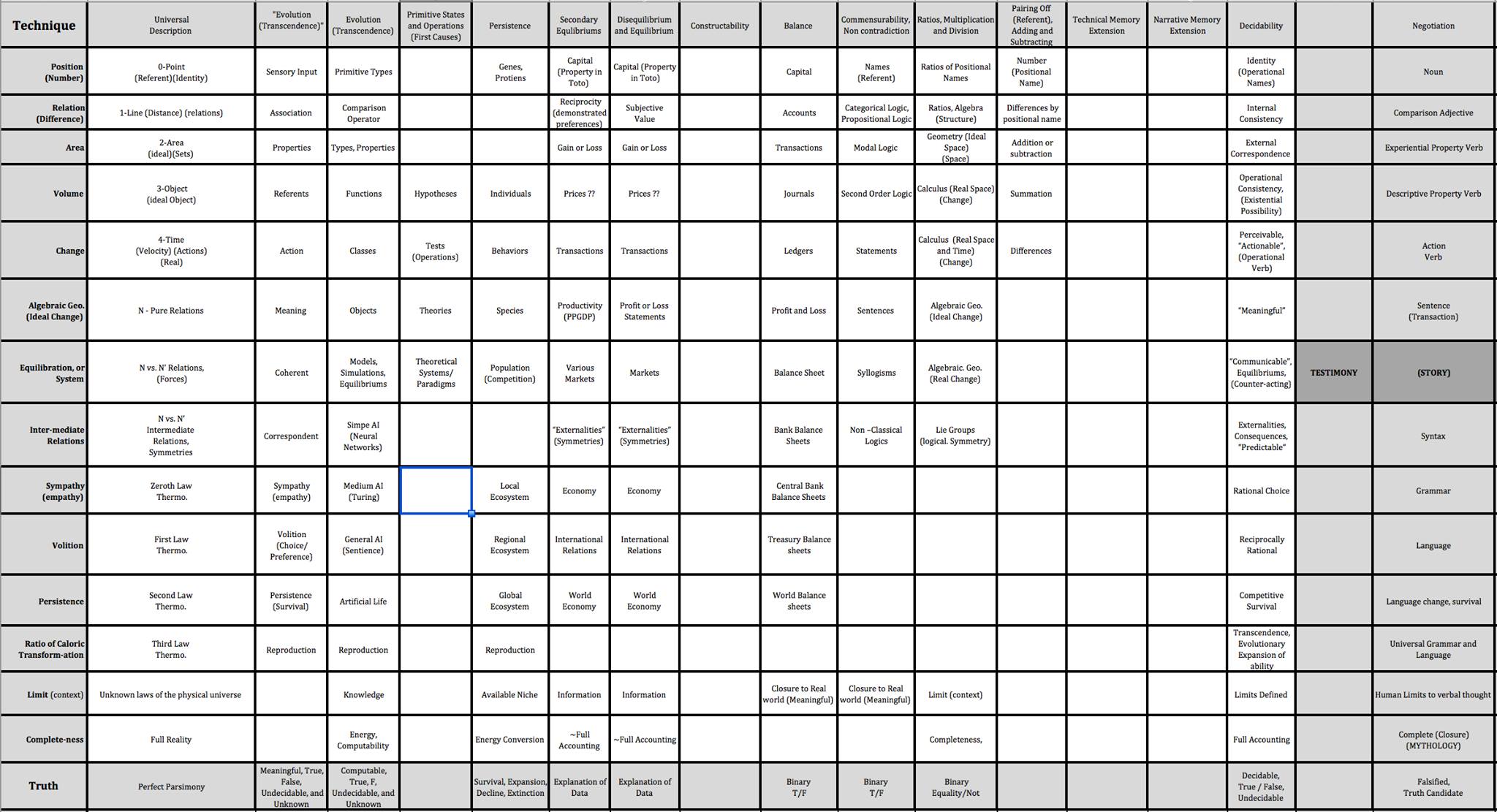
Dimensions of reality on Y axis from upper right to bottom. Minimum to Ordinary Language grammars on X upper right to left. Truth criteria along the bottom. Right most column ordinary language. So I have a lot of revision to do with this but in general, the idea is that in every deflationary ‘grammar’ we find the same sequence of constructs, and those constructs correspond to dimensions of reality. -
photos_and_videos/TimelinePhotos_43196237263/23270166_10155863047107264_34948911
photos_and_videos/TimelinePhotos_43196237263/23270166_10155863047107264_3494891149688064566_o_10155863047107264.jpg Dimensions of reality on Y axis from upper right to bottom. Minimum to Ordinary Language grammars on X upper right to left. Truth criteria along the bottom. Right most column ordinary language.
So I have a lot of revision to do with this but in general, the idea is that in every deflationary ‘grammar’ we find the same sequence of constructs, and those constructs correspond to dimensions of reality.James BrittinghamKnow you’re busy, but if you could post link to pdf or other downloadable version, would be great. Can’t read this.Nov 07, 2017 11:35amCurt DoolittleIt’s plenty large enough on desktop (it’s hi rez) but if you look at it on a mobile it will be cut down.Nov 07, 2017 11:37amBill JoslinThe thought I had when looking at this earlier was breakthroughs in human cognition followed a pattern.
Persception -> deconflation -> finding a unit of measure -> finding commensurability. Breakthroughs occur when commensurability between disperate domains are discovered, which then gives rise to better measures. Discovering the common relation reveals commensurable measure. Operational epistemology focusses on relations as primary and identity/domains as secondary (or contingent).Nov 07, 2017 11:43amCurt DoolittleExactly. although I think we find commensurability and then measure but it could be two sides of the same coin.Nov 07, 2017 11:45amJames BrittinghamOkay thanks.Nov 07, 2017 11:45amBill JoslinInhibitions to human cognition follow the inverse pattern.
Persception -> conflation -> generalization-> faked commensurabilityNov 07, 2017 11:46amBill JoslinI agree. Particular measures with in a domain which afford recognition of the common relation which reveals commensurability, which is a new or refined measure.Nov 07, 2017 11:48amBill JoslinBridgman was right – defining concepts by operations aligns better with reality, but I would take this further and say that identity names or labels a set of constant relations with in boundaries. Substantive or object based identity names by boundary and misses the constant relations. By missing the constant relations the interaction of identities becomes obscured (operations at higher orders is obscured)Nov 07, 2017 11:52amBill JoslinThis is huge and very importantNov 07, 2017 11:52amBill JoslinIdentity = bound constant relationsNov 07, 2017 11:54amCurt Doolittleoooohhh,… nice.Nov 07, 2017 12:48pmWilliam L. BengeThus allowing all items on one’s horizon to be authentically identified and identifiable, from which the actor is enabled to decipher the real relationships between each; understanding. And, from that newly obtained vantage, proceed to decipher one’s best preferred volitional action, or really interaction. A methodology or science for development of efficacy; personal or group wisdom? I do think so.Nov 07, 2017 12:49pmBryan Nova BreyOver here too @[1255416290:2048:Blake Southwood]. I think you should friend request Curt.Nov 08, 2017 2:05amDimensions of reality on Y axis from upper right to bottom. Minimum to Ordinary Language grammars on X upper right to left. Truth criteria along the bottom. Right most column ordinary language.
So I have a lot of revision to do with this but in general, the idea is that in every deflationary ‘grammar’ we find the same sequence of constructs, and those constructs correspond to dimensions of reality.
Source date (UTC): 2017-11-07 11:27:00 UTC
-
Dimensions of reality on Y axis from upper right to bottom. Minimum to Ordinary
Dimensions of reality on Y axis from upper right to bottom. Minimum to Ordinary Language grammars on X upper right to left. Truth criteria along the bottom. Right most column ordinary language. So I have a lot of revision to do with this but in general, the idea is that in every deflationary ‘grammar’ we find the same sequence of constructs, and those constructs correspond to dimensions of reality. -
I am struggling so hard with trying to simplify operational epistemology. To com
I am struggling so hard with trying to simplify operational epistemology. To communicate such an idea you have to tell a story. And that story is like an onion, with layers from the historical trends, to the available ‘technologies’ (forms of argument), to the the logics, to the three categories of epistemology, to the structure and limits of human mind, emotion, and action. And I am having such a hard time figuring out how to tell that story. Originally I told it as a battle between the english, french, german/italian, and jewish/russian. Then I decided to take it back to the ancient world as sparta, rome, athens, byzantium, Baghdad, Jerusalem, and Egypt. Then I decided to take it back to the dawn of the indo-european (aryan) expansion. (the pre-soviet russians being the closest culture to original aryanism that we can vaguely understand). Although it appears, that the original culture dissipated by ‘softening’ in the west – brecause we largely rule our own kin – and ‘integrating’ elsewhere, and then dying off everywhere else. The opposite strategy of the chinese, which was to wall off their end of eurasia as we probably should have walled off our end of eurasia at the Urals. … And I had to do this historical restatement because it allows me to demonstrate how we have been defeated in the bronze, iron, and steel ages by the same means. At that point I can discuss the failure of the enlightenment due to the multiple waves of counter-enlightenment. The french-puritan, german-italian-catholic-socialist, and jewish-russian-marxist, all trying to defeat the empirical, darwinian revolutions. … But then I have to get very serious and deal with the differences between religion, ideology, philosophy, logic, and science; then how the logics map to either necessary and scientific or arbitrary and meaningful systems (Paradigms, theories, logics, operations, grammars, vocabulary ), then the difference between axiomatic, algorithmic, and theoretic systems of argument. then the various spectrums of decidability we call ‘truth’. And then the various uses of fictionalism. And then how falsehoods are constructed through various methods of suggestion. And I have to continuously defeat our tendency to drop into the black hole of idealism – the enemy – along the way. Then I have to address grammars, vocabularies, as abstractions of logics, and then … start with operational grammar, and its applications. And then work my way through all the stuff people want answers to. And … ugh. No matter what I do I feel like I will lose the audience on that journey. Even if I start with “here is where we are going, and its a long way there”. I mean. Damn. The whole month of October on this. And one frustrating and exhausted day after another…. And no FB friends to vent to… lol. Sigh. -
I am struggling so hard with trying to simplify operational epistemology. To com
I am struggling so hard with trying to simplify operational epistemology. To communicate such an idea you have to tell a story. And that story is like an onion, with layers from the historical trends, to the available ‘technologies’ (forms of argument), to the the logics, to the three categories of epistemology, to the structure and limits of human mind, emotion, and action. And I am having such a hard time figuring out how to tell that story. Originally I told it as a battle between the english, french, german/italian, and jewish/russian. Then I decided to take it back to the ancient world as sparta, rome, athens, byzantium, Baghdad, Jerusalem, and Egypt. Then I decided to take it back to the dawn of the indo-european (aryan) expansion. (the pre-soviet russians being the closest culture to original aryanism that we can vaguely understand). Although it appears, that the original culture dissipated by ‘softening’ in the west – brecause we largely rule our own kin – and ‘integrating’ elsewhere, and then dying off everywhere else. The opposite strategy of the chinese, which was to wall off their end of eurasia as we probably should have walled off our end of eurasia at the Urals. … And I had to do this historical restatement because it allows me to demonstrate how we have been defeated in the bronze, iron, and steel ages by the same means. At that point I can discuss the failure of the enlightenment due to the multiple waves of counter-enlightenment. The french-puritan, german-italian-catholic-socialist, and jewish-russian-marxist, all trying to defeat the empirical, darwinian revolutions. … But then I have to get very serious and deal with the differences between religion, ideology, philosophy, logic, and science; then how the logics map to either necessary and scientific or arbitrary and meaningful systems (Paradigms, theories, logics, operations, grammars, vocabulary ), then the difference between axiomatic, algorithmic, and theoretic systems of argument. then the various spectrums of decidability we call ‘truth’. And then the various uses of fictionalism. And then how falsehoods are constructed through various methods of suggestion. And I have to continuously defeat our tendency to drop into the black hole of idealism – the enemy – along the way.
Then I have to address grammars, vocabularies, as abstractions of logics, and then … start with operational grammar, and its applications. And then work my way through all the stuff people want answers to.
And … ugh. No matter what I do I feel like I will lose the audience on that journey. Even if I start with “here is where we are going, and its a long way there”.
I mean. Damn. The whole month of October on this. And one frustrating and exhausted day after another….
And no FB friends to vent to… lol. Sigh.
Source date (UTC): 2017-11-06 11:51:00 UTC
-
I am struggling so hard with trying to simplify operational epistemology. To com
I am struggling so hard with trying to simplify operational epistemology. To communicate such an idea you have to tell a story. And that story is like an onion, with layers from the historical trends, to the available ‘technologies’ (forms of argument), to the the logics, to the three categories of epistemology, to the structure and limits of human mind, emotion, and action. And I am having such a hard time figuring out how to tell that story. Originally I told it as a battle between the english, french, german/italian, and jewish/russian. Then I decided to take it back to the ancient world as sparta, rome, athens, byzantium, Baghdad, Jerusalem, and Egypt. Then I decided to take it back to the dawn of the indo-european (aryan) expansion. (the pre-soviet russians being the closest culture to original aryanism that we can vaguely understand). Although it appears, that the original culture dissipated by ‘softening’ in the west – brecause we largely rule our own kin – and ‘integrating’ elsewhere, and then dying off everywhere else. The opposite strategy of the chinese, which was to wall off their end of eurasia as we probably should have walled off our end of eurasia at the Urals. … And I had to do this historical restatement because it allows me to demonstrate how we have been defeated in the bronze, iron, and steel ages by the same means. At that point I can discuss the failure of the enlightenment due to the multiple waves of counter-enlightenment. The french-puritan, german-italian-catholic-socialist, and jewish-russian-marxist, all trying to defeat the empirical, darwinian revolutions. … But then I have to get very serious and deal with the differences between religion, ideology, philosophy, logic, and science; then how the logics map to either necessary and scientific or arbitrary and meaningful systems (Paradigms, theories, logics, operations, grammars, vocabulary ), then the difference between axiomatic, algorithmic, and theoretic systems of argument. then the various spectrums of decidability we call ‘truth’. And then the various uses of fictionalism. And then how falsehoods are constructed through various methods of suggestion. And I have to continuously defeat our tendency to drop into the black hole of idealism – the enemy – along the way. Then I have to address grammars, vocabularies, as abstractions of logics, and then … start with operational grammar, and its applications. And then work my way through all the stuff people want answers to. And … ugh. No matter what I do I feel like I will lose the audience on that journey. Even if I start with “here is where we are going, and its a long way there”. I mean. Damn. The whole month of October on this. And one frustrating and exhausted day after another…. And no FB friends to vent to… lol. Sigh.