Theme: Science

  • More evidence lately that the Saan people of South Africa have the oldest contin

    More evidence lately that the Saan people of South Africa have the oldest continuous genome.

    Saan are lighter skinned. I am sure it will play out in the future data, that we got BOTH… https://www.facebook.com/permalink.php?story_fbid=287912408472323&id=100017606988153


    Source date (UTC): 2018-08-28 13:37:20 UTC

    Original post: https://twitter.com/i/web/status/1034434760985194497

  • More evidence lately that the Saan people of South Africa have the oldest contin

    More evidence lately that the Saan people of South Africa have the oldest continuous genome.

    Saan are lighter skinned. I am sure it will play out in the future data, that we got BOTH lighter and darker as climate and disease resistance warranted.

    It is very easy to see asian and pacific features in the Saan. In other words, we use caucasoid, mongoloid, australoid, and negroid, all appear to fork from the Saan’s original genome, with caucasoids being the outlier, and northern europeans being the most outlying.

    Under certain circumstances we get bigger and taller east-west africa. And Under certain we get smaller and shorter (pygmys, the lost people of island east asia) and intelligence does decrease with cranial size – contrary to the (((fantasies))) of Gould.

    We do not always evolve but also devolve. Because autraloids have not only lost technology they previously held, but it appears that they have lost cognitive parity with their ancestors (I think we will be able to measure that by the middle of this century.)


    Source date (UTC): 2018-08-28 09:37:00 UTC

  • Example of J-Critique

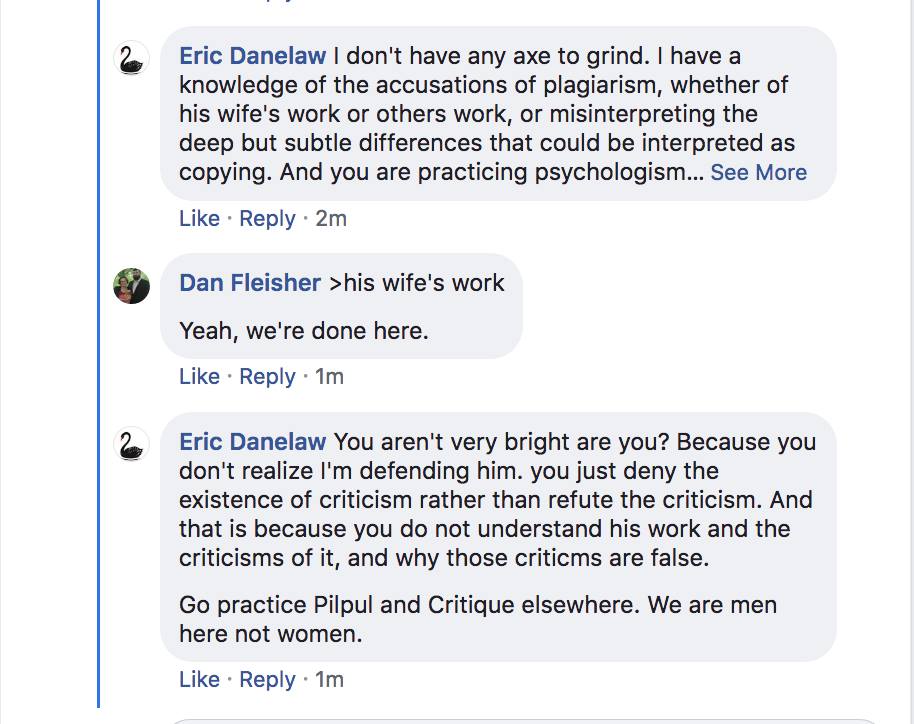
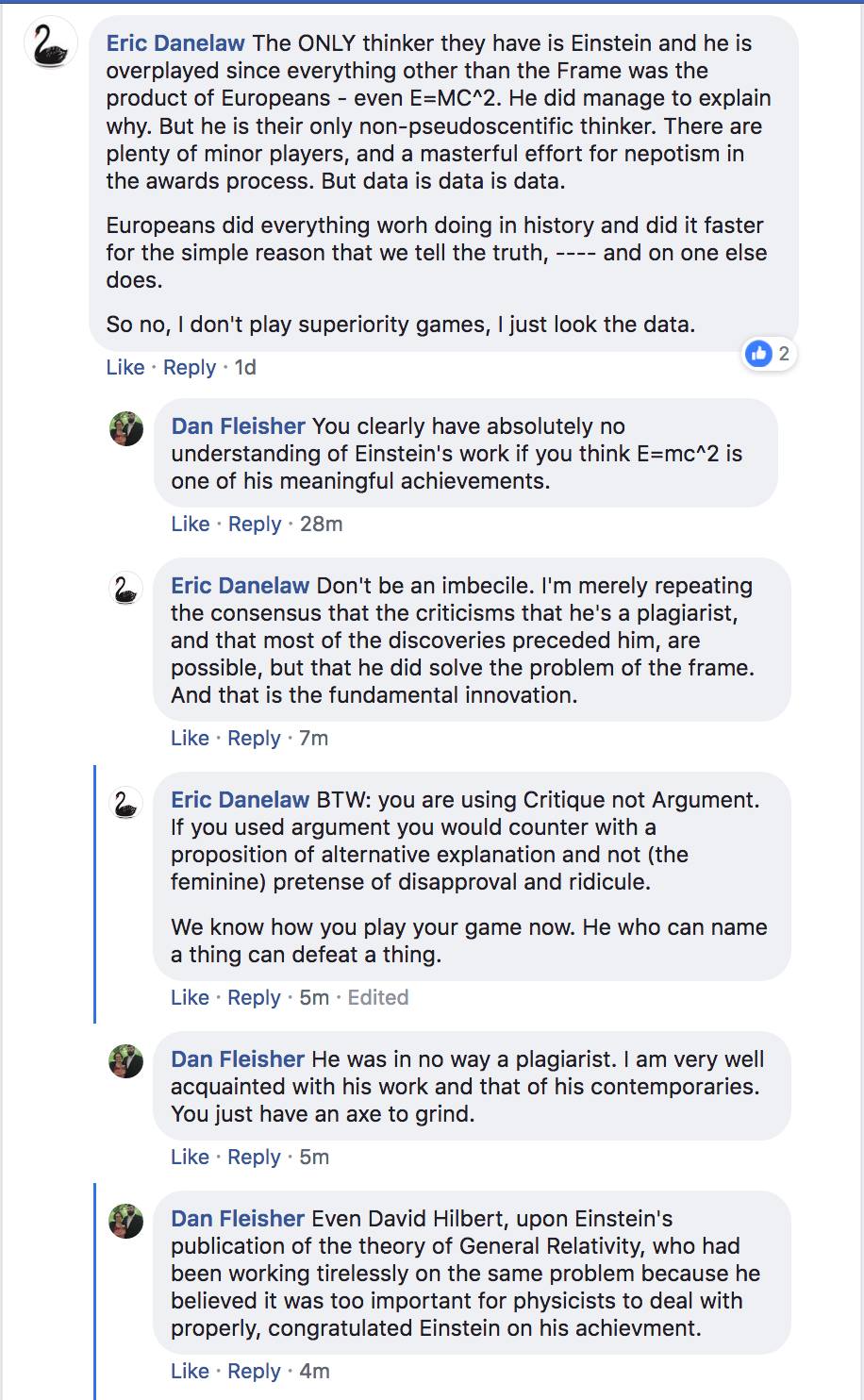
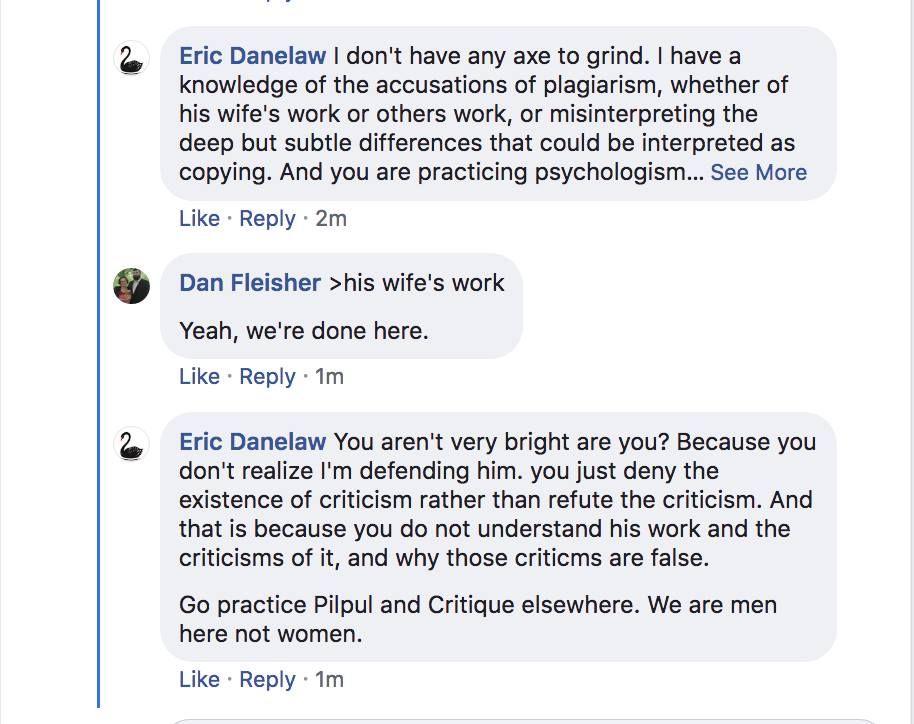
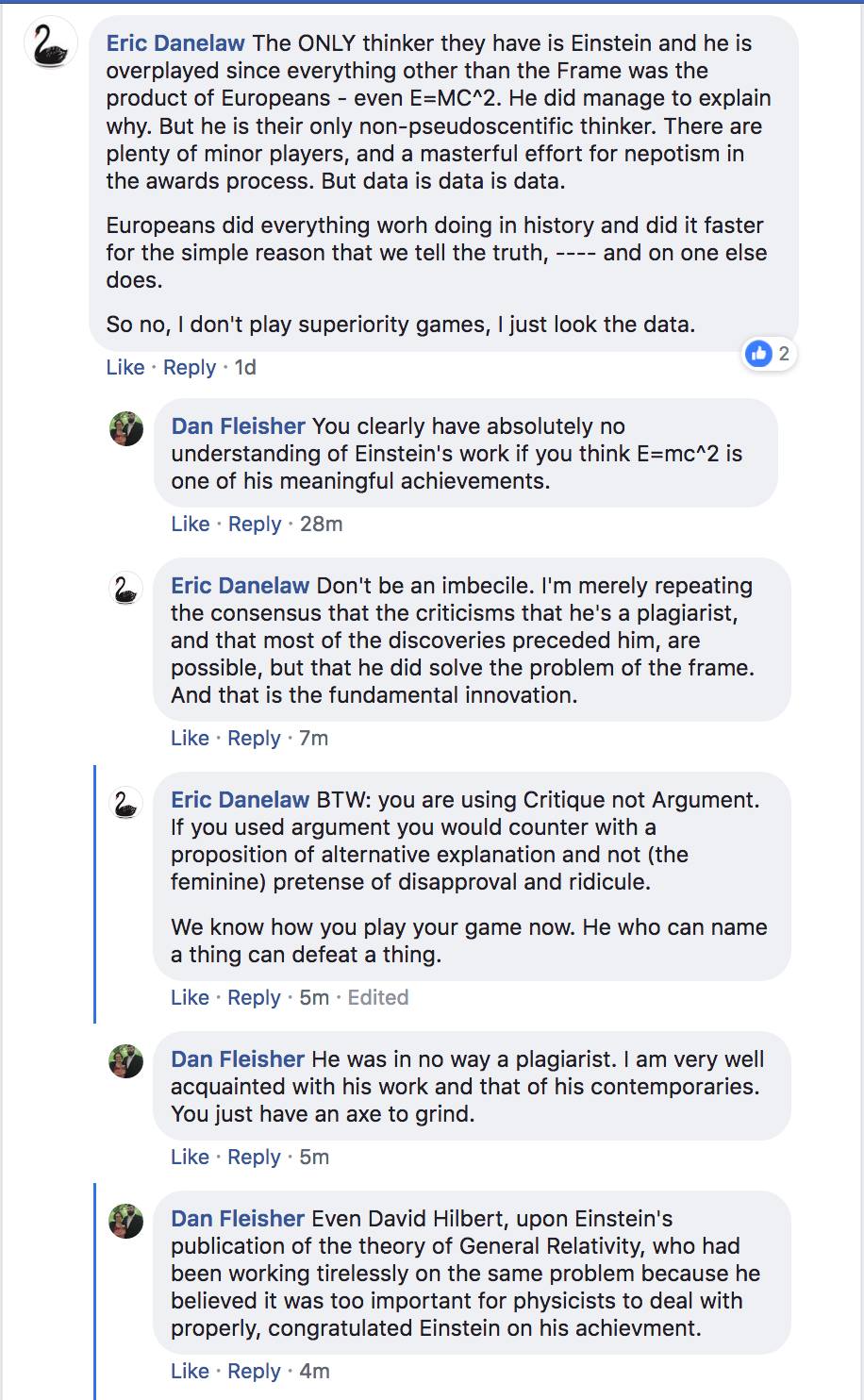
    Note that (a) I am defending Einstein. (b) he doesn’t understand that I am but is having a feminine reaction to criticism of one of her children, (c) claims expertise but only demonstrates the use of gossip (praise) rather than addressing any of the criticisms of Einstein (that are false). Once you realize their women, and you know how women cognate, then they are very simple. What I am most fascinated by, is the fact that when a pseudo-male uses feminine argument, we respond differently than if a females uses feminine argument. It demonstrates that we in fact do not take women seriously, and we take men who argue in the feminine (pilpul and critique) less seriously despite the fact that their WORDS INFLUENCE WOMEN MORE THAN OURS. WOMEN ARE OUR WEAKNESS.  

    40143670_287522638511300_2463544488811823104_o.jpg
    40263494_287522668511297_1979326457066815488_n.jpg
  • Example of J-Critique

    Note that (a) I am defending Einstein. (b) he doesn’t understand that I am but is having a feminine reaction to criticism of one of her children, (c) claims expertise but only demonstrates the use of gossip (praise) rather than addressing any of the criticisms of Einstein (that are false). Once you realize their women, and you know how women cognate, then they are very simple. What I am most fascinated by, is the fact that when a pseudo-male uses feminine argument, we respond differently than if a females uses feminine argument. It demonstrates that we in fact do not take women seriously, and we take men who argue in the feminine (pilpul and critique) less seriously despite the fact that their WORDS INFLUENCE WOMEN MORE THAN OURS. WOMEN ARE OUR WEAKNESS.  

    40143670_287522638511300_2463544488811823104_o.jpg
    40263494_287522668511297_1979326457066815488_n.jpg
  • The Standard Deviation in IQ Is Misleading

    You know, I’ve tended to follow the consensus that 15 points is a standard deviation, in intelligence, but that doesn’t help so much because group standard deviations appear to range from 11 to 13, with 12.5 as the sort of median. Secondly, I’ve followed the convention of the center being 100. Both of these are kind of obscuring value. 1 – the sort of middle between expensive to train and inexpensive to train is actually 106. (I sort of think of human potential beginning in that area.) via Lion: —“A verbal IQ of about 106 defines the cognitive lower bound of the smart fraction. And, each percentage point increase in the “smart percent” is worth about $600 (1998) to per capita GDP.”— 2 – Every six points (about half a standard deviation) rather than seven, we see fairly rapid increases in ability. 3 – They suggest average is sort of 95-105, and that’s true, but that’s the arbitrary average of the population given the population. Instead, I would say the average begins at 105 or 106 (105 for simplicity’s sake), and that we are one half standard deviation below the minimum for the upper half to compensate for the lower. And one standard deviation or 12 points below the low end of the optimum for modernity. And that this minimum will increase from 112 to 118 over the next century (or faster). 4 – Roughly speaking 1/3 of the population, meaning the vast majority of the population under 95 has to disappear over the next few hundred years.
  • The Standard Deviation in IQ Is Misleading

    You know, I’ve tended to follow the consensus that 15 points is a standard deviation, in intelligence, but that doesn’t help so much because group standard deviations appear to range from 11 to 13, with 12.5 as the sort of median. Secondly, I’ve followed the convention of the center being 100. Both of these are kind of obscuring value. 1 – the sort of middle between expensive to train and inexpensive to train is actually 106. (I sort of think of human potential beginning in that area.) via Lion: —“A verbal IQ of about 106 defines the cognitive lower bound of the smart fraction. And, each percentage point increase in the “smart percent” is worth about $600 (1998) to per capita GDP.”— 2 – Every six points (about half a standard deviation) rather than seven, we see fairly rapid increases in ability. 3 – They suggest average is sort of 95-105, and that’s true, but that’s the arbitrary average of the population given the population. Instead, I would say the average begins at 105 or 106 (105 for simplicity’s sake), and that we are one half standard deviation below the minimum for the upper half to compensate for the lower. And one standard deviation or 12 points below the low end of the optimum for modernity. And that this minimum will increase from 112 to 118 over the next century (or faster). 4 – Roughly speaking 1/3 of the population, meaning the vast majority of the population under 95 has to disappear over the next few hundred years.
  • Romanticism

    (our attempt at restoration of tradition, before the abrahamic attack on history and science) –Paganism resurfaces as a topic of fascination in 18th to 19th-century Romanticism, in particular in the context of the literary Celtic and Viking revivals, which portrayed historical Celtic and Germanic polytheists as noble savages.The 19th century also saw much scholarly interest in the reconstruction of pagan mythology from folklore or fairy tales. This was notably attempted by the Brothers Grimm, especially Jacob Grimm in his Teutonic Mythology, and Elias Lönnrot with the compilation of the Kalevala. The work of the Brothers Grimm influenced other collectors, both inspiring them to collect tales and leading them to similarly believe that the fairy tales of a country were particularly representative of it, to the neglect of cross-cultural influence. Among those influenced were the Russian Alexander Afanasyev, the Norwegians Peter Christen Asbjørnsen and Jørgen Moe, and the Englishman Joseph Jacobs.[67]Romanticist interest in non-classical antiquity coincided with the rise of Romantic nationalism and the rise of the nation state in the context of the 1848 revolutions, leading to the creation of national epics and national myths for the various newly formed states. Pagan or folkloric topics were also common in the Musical nationalism of the period.—

  • Romanticism

    (our attempt at restoration of tradition, before the abrahamic attack on history and science) –Paganism resurfaces as a topic of fascination in 18th to 19th-century Romanticism, in particular in the context of the literary Celtic and Viking revivals, which portrayed historical Celtic and Germanic polytheists as noble savages.The 19th century also saw much scholarly interest in the reconstruction of pagan mythology from folklore or fairy tales. This was notably attempted by the Brothers Grimm, especially Jacob Grimm in his Teutonic Mythology, and Elias Lönnrot with the compilation of the Kalevala. The work of the Brothers Grimm influenced other collectors, both inspiring them to collect tales and leading them to similarly believe that the fairy tales of a country were particularly representative of it, to the neglect of cross-cultural influence. Among those influenced were the Russian Alexander Afanasyev, the Norwegians Peter Christen Asbjørnsen and Jørgen Moe, and the Englishman Joseph Jacobs.[67]Romanticist interest in non-classical antiquity coincided with the rise of Romantic nationalism and the rise of the nation state in the context of the 1848 revolutions, leading to the creation of national epics and national myths for the various newly formed states. Pagan or folkloric topics were also common in the Musical nationalism of the period.—

  • Romanticism

    (our attempt at restoration of tradition, before the abrahamic attack on history and science) –Paganism resurfaces as a topic of fascination in 18th to 19th-century Romanticism, in particular in the context of the literary Celtic and Viking revivals, which portrayed historical Celtic and Germanic polytheists as noble savages.The 19th century also saw much scholarly interest in the reconstruction of pagan mythology from folklore or fairy tales. This was notably attempted by the Brothers Grimm, especially Jacob Grimm in his Teutonic Mythology, and Elias Lönnrot with the compilation of the Kalevala. The work of the Brothers Grimm influenced other collectors, both inspiring them to collect tales and leading them to similarly believe that the fairy tales of a country were particularly representative of it, to the neglect of cross-cultural influence. Among those influenced were the Russian Alexander Afanasyev, the Norwegians Peter Christen Asbjørnsen and Jørgen Moe, and the Englishman Joseph Jacobs.[67]Romanticist interest in non-classical antiquity coincided with the rise of Romantic nationalism and the rise of the nation state in the context of the 1848 revolutions, leading to the creation of national epics and national myths for the various newly formed states. Pagan or folkloric topics were also common in the Musical nationalism of the period.—

  • Romanticism

    (our attempt at restoration of tradition, before the abrahamic attack on history and science) –Paganism resurfaces as a topic of fascination in 18th to 19th-century Romanticism, in particular in the context of the literary Celtic and Viking revivals, which portrayed historical Celtic and Germanic polytheists as noble savages.The 19th century also saw much scholarly interest in the reconstruction of pagan mythology from folklore or fairy tales. This was notably attempted by the Brothers Grimm, especially Jacob Grimm in his Teutonic Mythology, and Elias Lönnrot with the compilation of the Kalevala. The work of the Brothers Grimm influenced other collectors, both inspiring them to collect tales and leading them to similarly believe that the fairy tales of a country were particularly representative of it, to the neglect of cross-cultural influence. Among those influenced were the Russian Alexander Afanasyev, the Norwegians Peter Christen Asbjørnsen and Jørgen Moe, and the Englishman Joseph Jacobs.[67]Romanticist interest in non-classical antiquity coincided with the rise of Romantic nationalism and the rise of the nation state in the context of the 1848 revolutions, leading to the creation of national epics and national myths for the various newly formed states. Pagan or folkloric topics were also common in the Musical nationalism of the period.—