Theme: Science

  • ARE HISTORIANS OR ECONOMISTS MORE RIGHT? Um…. Let me help you: OUTLIERS. Econo

    ARE HISTORIANS OR ECONOMISTS MORE RIGHT?

    Um…. Let me help you: OUTLIERS. Economists are better at explanation post hoc, and historians are better at prediction, for the simple reason that history consists of the analysis of outliers (opportunities in signal), and economics the analysis of regularities (opportunities in noise).

    At present it is painfully clear to me that we are both at the most fragile condition any empire has been in history, and we have a surplus of agitated external competitors, and a surplus of agitated internal males ready to seize the opportunity.

    If the economics profession measured ALL capital changes and incentives those changes cause, and demand for it’s reallocation, as well as rates of consumption and production, then the profession MIGHT come close to the predictive ability of historians.

    But as we have consistently seen, (which I have been measuring since 2002), the opinions of economists (confidence) vary inversely to the predictability of the conditions.

    So, it’s not an either or proposition.

    Bias Confirmation in History,

    Projection in Psychology and Sociology, and;

    Cherry Picking in Economics.

    Next time you hear an economist say ‘but we don’t try to measure that’, inform him that his position is no different from theologians saying ‘we don’t account for that’.


    Source date (UTC): 2018-11-30 13:37:00 UTC

  • photos_and_videos/TimelinePhotos_SxeO6JU-xg/46967624_10156809404697264_380706620

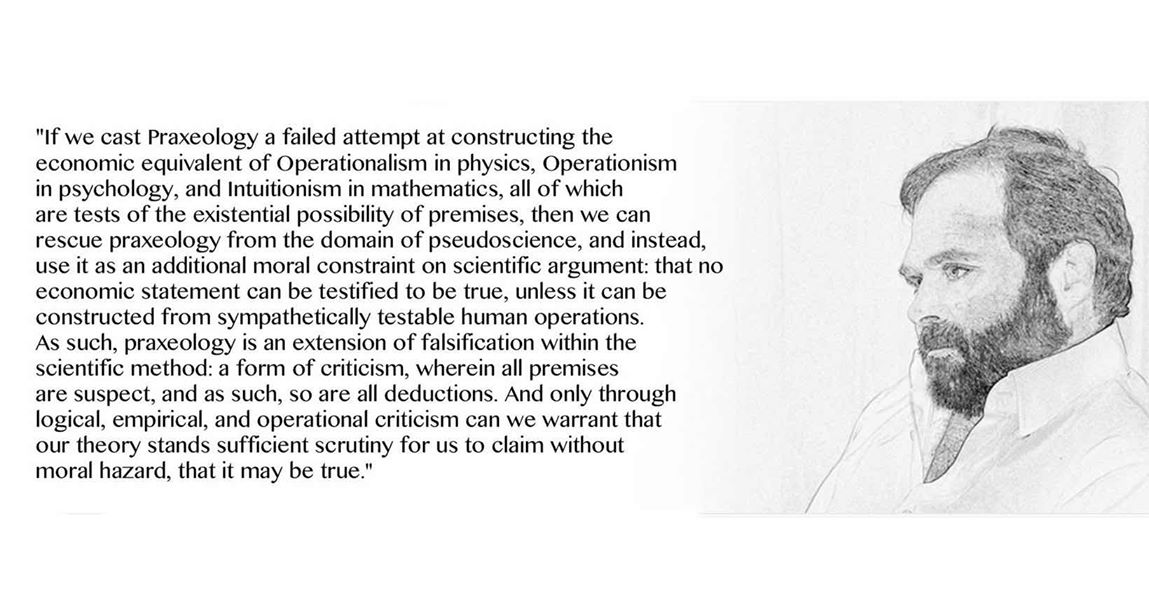
    photos_and_videos/TimelinePhotos_SxeO6JU-xg/46967624_10156809404697264_3807066200949653504_o_10156809404692264.jpg UNDERSTANDING SCIENTIFIC PRAXEOLOGY: ECONOMIC INTUITIONISMUNDERSTANDING SCIENTIFIC PRAXEOLOGY: ECONOMIC INTUITIONISM


    Source date (UTC): 2018-11-28 09:47:00 UTC

  • THE NEXT SCIENTIFIC REVOLUTION (worth repeating) This persistent ‘error’ in the

    THE NEXT SCIENTIFIC REVOLUTION

    (worth repeating)

    This persistent ‘error’ in the soft (projected) ‘sciences’, is, as far as my work goes, the central problem of thought in the 21st century. We are still trying to overcome the monopoly authoritarianism of Boas, Marx, Feud, Adorno et all, Derrida et al, and the feminists et al that sought to take advantage of the democratic novelty to obtain power.

    And the 21st century, beginning within the next decade, will consist largely of the transformation of the soft sciences into hard sciences reflecting groups rather than individuals – because the ‘individualism'(ideal) movement has failed. We evolved as a division of perceptual, cognitive, negotiative, and advocative labor across the generations, among members of kin groups functioning as an intertemporal network of ‘calculation’ of choices.

    The reason people are unhappy is the attempt to create ‘complete’ individuals instead of ‘complete’ kin groups.

    Curt Doolittle

    The Propertarian Institute


    Source date (UTC): 2018-11-28 09:44:00 UTC

  • Well, given i) faith, ii) belief, iii) theory, iv) guess. What is the difference

    Well, given i) faith, ii) belief, iii) theory, iv) guess. What is the difference between those terms?

    Supernatural faith, philosophical belief, and scientific theory, ordinary language ‘guess’.

    What’s the difference?


    Source date (UTC): 2018-11-26 20:00:38 UTC

    Original post: https://twitter.com/i/web/status/1067146129006043136

  • Well, given i) faith, ii) belief, iii) theory, iv) guess. What is the difference

    Well, given i) faith, ii) belief, iii) theory, iv) guess. What is the difference between those terms?

    Supernatural faith, philosophical belief, and scientific theory, ordinary language ‘guess’.

    What’s the difference?


    Source date (UTC): 2018-11-26 15:00:00 UTC

  • I don’t waste time on the Three Great Fictionalisms of (a) faith (supernaturalis

    I don’t waste time on the Three Great Fictionalisms of (a) faith (supernaturalism), (b) sophism (idealism) (c) pseudoscience, and I don’t make pragmatic excuses for them either. I spend my time on Education, Literature, History, Economics, Law, Science, Logics, and Mathematics.


    Source date (UTC): 2018-11-25 23:29:00 UTC

    Original post: https://twitter.com/i/web/status/1066836176550707200

    Reply addressees: @penelopeabyron @Jay_D007

    Replying to: https://twitter.com/i/web/status/1066750861504843776


    IN REPLY TO:

    Original post on X

    Original tweet unavailable — we could not load the text of the post this reply is addressing on X. That usually means the tweet was deleted, the account is protected, or X does not expose it to the account used for archiving. The Original post link below may still open if you view it in X while signed in.

    Original post: https://twitter.com/i/web/status/1066750861504843776

  • “…Have you considered debating Curt Doolittle?”— I don’t waste time on the T

    —“…Have you considered debating Curt Doolittle?”—

    I don’t waste time on the Three Great Fictionalisms of (a) faith (supernaturalism), (b) sophism (idealism) (c) pseudoscience, and I don’t make pragmatic excuses for them either. I spend my time on Education, Literature, History, Economics, Law, Science, Logics, and Mathematics.

    (not worth my time)


    Source date (UTC): 2018-11-25 19:22:00 UTC

  • I WILL EVENTUALLY OFFEND YOU Religion is “The Hard Problem Of Social Science”. I

    I WILL EVENTUALLY OFFEND YOU

    Religion is “The Hard Problem Of Social Science”. It took me longer than any other problem in social science, science proper, grammars, and logic.

    But in the end, like all problems, it was a solvable problem. And it makes everyone – including the atheists, the marxist-postmodernist-feminists, the abrahamists, and the rest of the world religions unhappy.

    There are very few of us who are fit to practice The Law, because there are few of us for whom the Truth is emotionally and intellectually tolerable – those of us with agency can be produced easily enough, but there are few of us who possess the facility by accident of circumstance in combination with our natures.

    We all have cherished falsehoods and lies that we have invested in. The truth is undesirable or we would not require it.

    It is the ultimate test of character: Can You Face The Truth?

    If you cannot face the truth, but can be a moral man, then that is Fine. But you may not serve as a Judge of the Law, or Juror of its violation. If you both cannot face the truth, and you cannot be a moral man, then we those who are moral will challenge you under the law, and those of us who can face the truth shall prosecute and convict you under it.

    As members of cults we are always in conflict over the legal systems under them, since those legal systems are arbitrary means of advocating different group evolutionary strategies of cooperation – all of which, under religion, despite their early utility, evolved to be more hinderance than good.

    As member of the Love of Man, of our Peoples, In nation-states, producing commons suitable to our needs, we are not enemies but allies in a division of labor producing the transcendence of man.

    If there is a better religion than that I do not know what it is.

    But it is the one I am proposing.

    A religion of the love and transcendence of man into gods, not into the subjects of priests and politicians, investors and industrialists.


    Source date (UTC): 2018-11-25 17:30:00 UTC

  • PROMETHEAN FIRE: ARYANS, SEMITES & SCIENCE by @[100016659043273:2048:Daniel Gurp

    PROMETHEAN FIRE: ARYANS, SEMITES & SCIENCE

    by @[100016659043273:2048:Daniel Gurpide]

    (must read – as always – by @[100016659043273:2048:Daniel Gurpide] )

    The world today is dominated by technology as never before. It is impossible to travel anywhere without seeing some manifestations of the technological wizardry that has shaped life on the planet today—particularly those innovations developed at the time of the Industrial Revolution.

    One crucial—and typically ignored—feature of this astonishing technological revolution is that the great technological innovations which have set the pace for the entire world are exclusively the product of a tiny minority of Europeans.

    One of the particular traits of Indo-European languages, already noticed in the nineteenth century by such philologists as Wilhelm von Humboldt and Ernest Renan, was their implicit capacity for abstract thought—a precondition of any sort of scientific theory and praxis.

    Renan was also the first to establish a connection between religion and ethno-geographical origin. He contrasted a ‘psyche of the desert’ found among Semites—‘the desert is monotheistic’—with a ‘psyche of the forest,’ characteristic of Indo-Europeans whose polytheism appears to be modelled on a changing nature and a diversity of seasons. He observed that the intolerance of Semitic people is an inevitable consequence of their monotheism. Indo-European peoples, before their conversion to Semitic ideas, never regarded their religion as absolute truth. This is why there is found among these peoples ‘a freedom of thought, a spirit of critical inquiry, and individual research.’

    Techne (technological development)—the appropriation and control of a surrounding environment via technology—may be considered a trait defining the ‘specifically human.’ It is inevitable companion to the progress of human knowledge; however, it also describes something that has been devised and developed in a peculiar way only in the Indo-European context: from the Battle-Axe culture war chariot to the laser and the moon rockets designed by Wernher von Braun.

    In particular, modern technology is closely linked to the West—to a culture underpinned by a ‘compromise’ between Europe and Judeo-Christianity. Following the Christianisation of Europe, paganism survived underground in several forms. It survived in folk beliefs and traditions; in ‘heretical’ trends inside or on the margins of official religion that have extended even into the present; and in a collective unconscious that finds release chiefly in music, and in science and technology.

    In this sense, science and technology may be interpreted as arising from the impact of long-standing monotheistic repression of the European collective subconscious, and from the contradictory process of secularisation and emancipation to which this repression gave rise, and which began with the Renaissance. What doesn‘t kill you, makes you stronger…Let us remember the names of the American rockets and space programs of von Braun’s times: Thor, Atlas, Titan, Jupiter, Delta, Mercury, Apollo. None was called “Jesus,” “Forgiveness and Love,” or “Holy Bible.”

    In Man and Technics, Spengler wrote: ‘To build a world oneself, to be oneself God—that is the Faustian inventor’s dream, and from it has sprung all our designing and re-designing of machines.’

    The Jewish-Christian tradition—and the ‘grand narratives’ it produced—is explicit in the rejection of the Faustian temptation. Nietzsche remarks in The Antichrist that ‘such a religion as Christianity, which does not touch reality at a single point and which goes to pieces the moment reality asserts its rights at any point, must be inevitably the deadly enemy of the wisdom of this world, which is to say, of science.’

    Man must repress his ‘pride’: he may not eat the fruits of the Tree of Knowledge, lest he create instruments competing with the perennial nature created by God. It is sacrilegious behaviour, as the myths of the Golem and the tale of Frankenstein remind us. As in the past—when opposing dissection—the Church now condemns contraception, genetic engineering, and biotechnological research in general.

    It is not difficult to see why egalitarianism is anti-Promethean. Every new advance in technology is an advance in respect of the ability of some to control others. If one considers, as in the Bible, Rousseau, or Marx, that it is an ethical duty to condemn the exercise of control or power—the domination of man by man—then it is easy to perceive that such epochal mutation as our societies are experiencing will produce new vertical division between man and man, and between society and society, just such as the Neolithic Revolution provoked: namely, (1) differentiation between the body of consociates and the aristocracies that came to exercise political power, creating cultural forms and directing community life; and (2) the fact of certain societies coming to dominate others.

    Any dream of independence and self-determination—individual or collective—any sort of political, economic, or cultural sovereignty—may be realised only through the technical means necessary for such ambition.

    Science is a domain which the European mind has monopolised, and technology a tool that can make man into a god. These must be especially valued by Europeans if they are to mount a primordial, Faustian response to life which can recapture and transcend the Indo-European outlook for post-Neolithic man.


    Source date (UTC): 2018-11-24 10:36:00 UTC
  • JUDAISM, CHRISTIANITY AND ISLAM INVENTED THE MANDATE-OF IGNORANCE AND RULE UNDER

    JUDAISM, CHRISTIANITY AND ISLAM INVENTED THE MANDATE-OF IGNORANCE AND RULE UNDER IT.

    Science is founded upon the prehistoric european tradition of legal empiricism, and it’s non-adoption of eastern irrigation-system magianism. Aristotle invents pre-scientific thought. the british empirical thought. and anglo-american-german (less so french) scientific thought. With all of the west participating by the industrial revolution. The christians made near zero progress until the middle class re-evolved after the viking conquest, and restored commercial civilization through trade, giving rise to the germanic expansionary trade system, where the church had spent its efforts on local extraction of rents, and cumulative hoarding of europe’s capital, and the expansion of corruption.

    Furthermore, the lack of success of the church to do so in the slavic lands, the secession from church rule by the germanic states, and the state eviction of the church from rule by the americans, is the reason for the catholic, germanic, anglo-scandinavian, and slavic differences in perception of the good and evil of the church.

    There is a reason france is a cancer to europe and that is that she is the central advocate or the church’s method of rule, because the french state replaced the monarchical rule with church rule, and secularized it.

    Christians accomplished almost nothing throughout the christian period – and what little they did accomplish was despite the church not because of it.

    Jews accomplished absolutely nothing other than specialization in profiting from parasitic moral hazard, and survival because of it, until converted to aristotelianism.

    Muslims accomplished nothing except the conquest of superior people, the murder of their aristocracies, the centralization of their though leadership so that they could be converted to the religion of mandatory ignorance, the expansion of their underclasses, vast slave immigration and consanguineous reproduction, and the total destruction of every great civilization land-reachable in the ancient world.


    Source date (UTC): 2018-11-23 13:03:00 UTC