Theme: Science

  • “It would also be cool to watch you debate theologians. Not pansy ones either bu

    —“It would also be cool to watch you debate theologians. Not pansy ones either but the few who are also high level scientists.”— A Friend

    It’s a very simple argument: What is a theologian claiming: Good and wisdom, or True and demonstrable? What can they testify to? How can they demonstrate it? How can they warranty it? What is their incentive? What are the costs if they lie? Why is the world of science good for man, and the world of religion devolutionary for man? Why is science of man good and the actions of god evil? Why did christians jews and muslims create a dark age? Why are the churches full of our least competent people? Why did the churches fail to reform? Why did Europe abandon christianity? Why did the evangelical movement succeed and why are Americans leaving the church and dividing half secular and half evangelical? What should the church have done when theology was continuously defeated by science and proven false? Why did the church resist literacy of the people. Why did the church resist the printing of the bible in the people’s language? Why did the monastic orders arise if not in response tot he corruption of the church? Why did the church need the vikings to fight the crusades? Was christianity adopted or was it enforced in the past as islam is still enforced today? Did the christians destroy the ancient world, it’s monuments, it’s arts and letters, its academies, its accumulated knowledge, and instead of restoring roman order, aristocracy, literacy, and greek knowledge, drag Europe and the pagan peoples into dark ages? Why is the abrahamic method of deceit used by jews, christians and muslims used again by marxists, postmodernists, and feminist to repeat the same destruction of the old world to destroy the new – this time with false promise of economic and political reward instead of life after death and political reward? Why do theologians use the same arguments as the marxists, postmodernists, and feminists who destroy this world.

    I have never found a theological argument I cannot defeat. We know too much now. Hence (a) there currently are, and have been, many gods. (b) all gods exist as information, (c) this information exists in the minds of man, (d) this information influences individual and group behavior (e) this behavior is often good, but vulnerable to conquest – which was the purpose of the church. (f) but as a consequence it produces an addiction response when threatened, and is defended by the abrahamic method of deceit rather than just the simple statement “I have faith that if I live my life by jesus’ teachings that my life, the life of those around me, the life of my polity, and of mankind, in this world, and in the next if there is one, will be better than if I did not.”

    If you must argue your faith. you have none. Faith needs no argument. That is what it means to have faith.


    Source date (UTC): 2020-02-18 16:54:00 UTC
  • “The Case Against Reality” The case for woo woo pseudoscience. This is pseudosci

    “The Case Against Reality”

    The case for woo woo pseudoscience.

    This is pseudoscientific nonsense.

    We see actionable reality at actionable scale, using some pretty amazing instrumentation.

    We ‘predict’ (imagine consequences from) our model of the world, that is not real. That’s simply a lack of discipline.

    I can and have, and others can and have, explained consciousness – and with recent work it’s not even complicated.

    I’d like to see the ‘math’ he’s talking about because I’m pretty sure he’s hand-waving.

    He’s using Truth as an undefined ‘woo woo’ term (hand waving).

    A fitness payoff (more correctly, return on cost of continuous production)

    An organism that sees the world as it is (processes unnecessary information) that models the world independent of it’s capacity for action will be out-competed by an organism that reduces the world model necessary for action to the minimum necessary for action, and just competes on what works regardless of any model of the world. Well, this is only true to the point at which organisms can voluntarily cooperate – because there are no competitors to return on cooperation.

    The camera obscura, and the camera, are a purely physical thing without consciousness. Yet we see what the camera records, without manipulating it. Sure, we can’t see all the same colors. Some of us see more than others. But that’s a difference in resolution of color not a difference in any ‘truth’ we see.

    “Space and time don’t exist independent of our perception.” Well that’s demonstrably false. Space and time are vocabulary we use to describe what we perceive through sensory information. “There are other consciousnesses out there”.

    OMG…. I would eat these morons for lunch.

    https://youtu.be/dd6CQCbk2ro


    Source date (UTC): 2020-02-18 15:17:00 UTC

  • photos_and_videos/TimelinePhotos_kg5QueHwVw/86969884_210695976995230_86050063280

    photos_and_videos/TimelinePhotos_kg5QueHwVw/86969884_210695976995230_86050063280

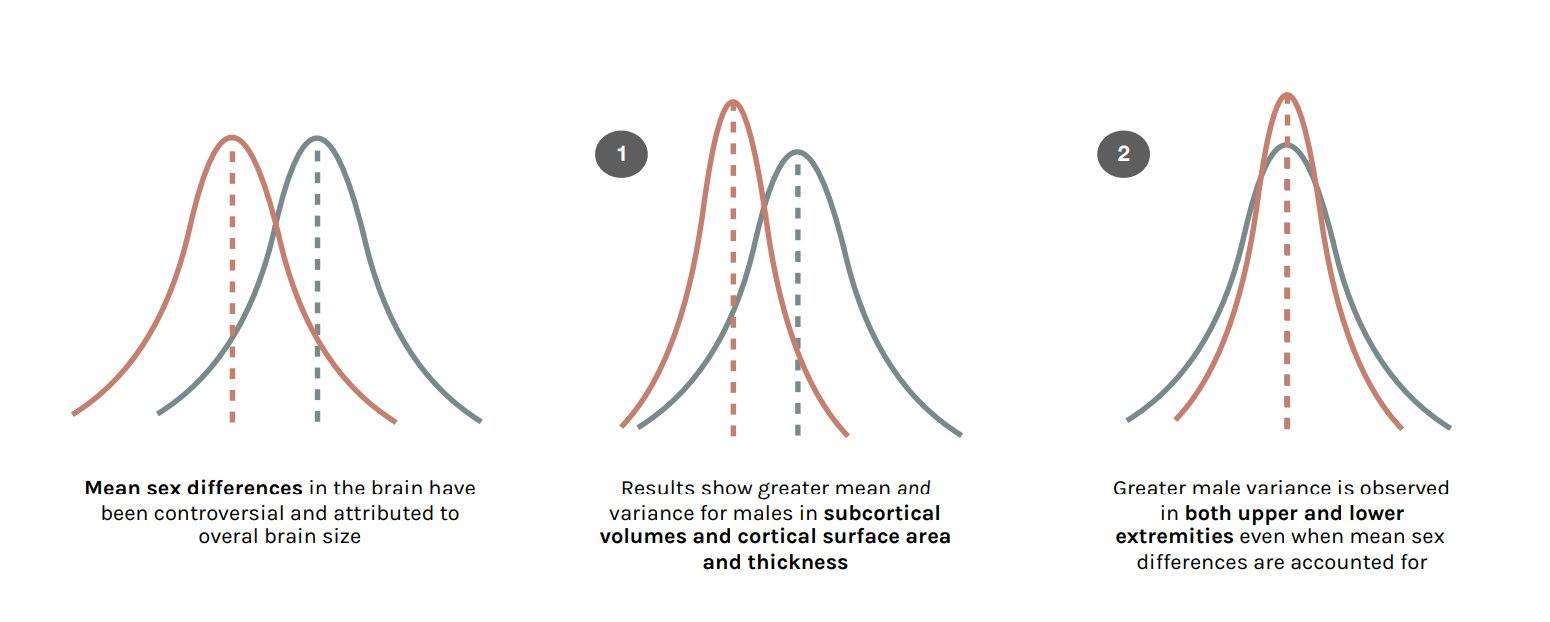
    photos_and_videos/TimelinePhotos_kg5QueHwVw/86969884_210695976995230_8605006328026365952_o_210695973661897.jpg AGAIN: MALE VARIATION IN BRAIN STRUCTURE

    By: Alexander Kruel via Brandon Hayes

    New preprint of massive study finds that there is greater variance in the brain structure of males than females, even after accounting for the mean size differences.

    This is a confirmation of results from at least two previous brain imaging studies.

    Studies:

    -https://www.biorxiv.org/content/10.1101/2020.02.17.952010v1

    -https://academic.oup.com/cercor/article/28/8/2959/4996558

    -https://academic.oup.com/cercor/article/28/8/2741/3872365

    via @Scientific_BirdAGAIN: MALE VARIATION IN BRAIN STRUCTURE

    By: Alexander Kruel via Brandon Hayes

    New preprint of massive study finds that there is greater variance in the brain structure of males than females, even after accounting for the mean size differences.

    This is a confirmation of results from at least two previous brain imaging studies.

    Studies:

    -https://www.biorxiv.org/content/10.1101/2020.02.17.952010v1

    -https://academic.oup.com/cercor/article/28/8/2959/4996558

    -https://academic.oup.com/cercor/article/28/8/2741/3872365

    via @Scientific_Bird


    Source date (UTC): 2020-02-18 13:41:00 UTC

  • RT @Steve_Sailer: @RichardDawkins @AngelaDSaini Dear @RichardDawkins: I realize

    RT @Steve_Sailer: @RichardDawkins @AngelaDSaini Dear @RichardDawkins:

    I realize you must claim to be enjoying Angela Saini’s dopey Science…


    Source date (UTC): 2020-02-18 08:30:40 UTC

    Original post: https://twitter.com/i/web/status/1229684646520270849

  • أتحدث في الرياضيات والمنطق والعلوم والقانون – وفي الفلسفة لإنهاء الفلسفة. ؛) من

    أتحدث في الرياضيات والمنطق والعلوم والقانون – وفي الفلسفة لإنهاء الفلسفة. ؛) من أجل الحقيقة: الرياضيات والعلوم من أجل الطبيعة والاقتصاد والقانون للبشرية. للاختيار: الفلسفة. للحكمة ، عندما تفشل الفلسفة والقانون والعلوم: اللاهوت. ؛)

    سلام.

    I speak in mathematics, logic, science, and law – and in philosophy to end philosophy. 😉 For truth: Math and science for nature, economics and law for mankind. For choice: Philosophy. For wisdom, when philosophy, law, and science fail: theology. 😉

    Peace.


    Source date (UTC): 2020-02-18 08:19:00 UTC

  • photos_and_videos/TimelinePhotos_kg5QueHwVw/86790915_210269200371241_80646571754

    photos_and_videos/TimelinePhotos_kg5QueHwVw/86790915_210269200371241_80646571754

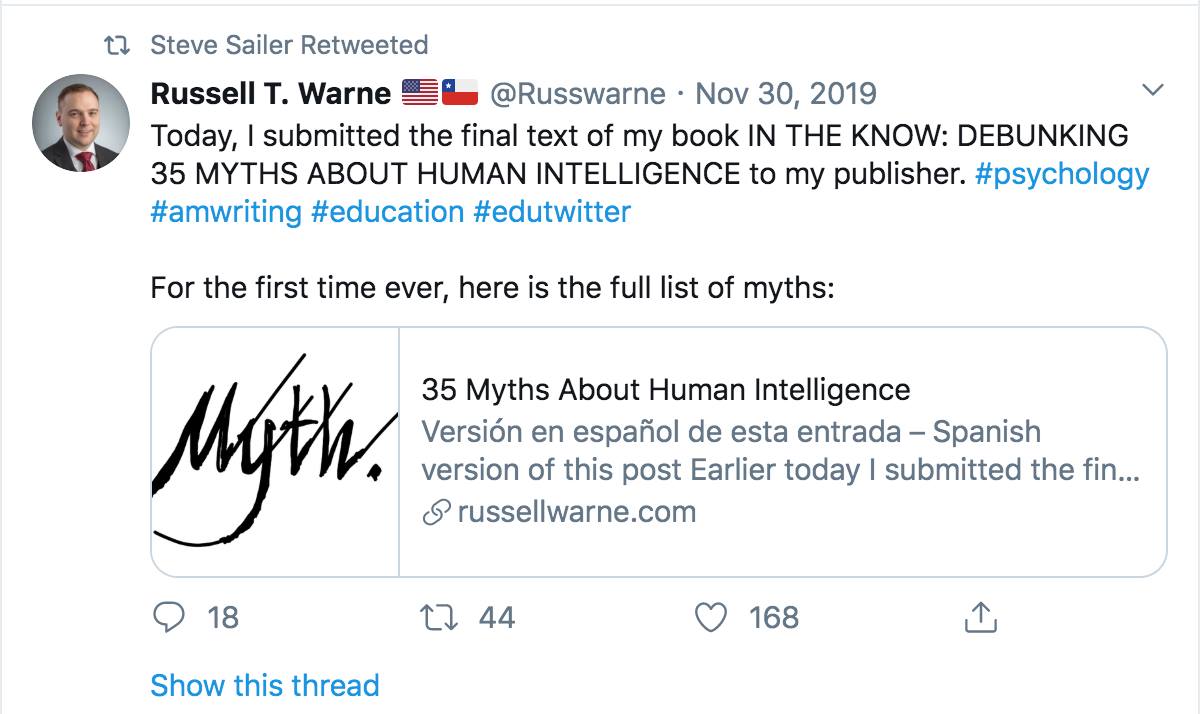
    photos_and_videos/TimelinePhotos_kg5QueHwVw/86790915_210269200371241_8064657175416406016_o_210269193704575.jpg UPCOMING BOOK ON HUMAN INTELLIGENCE

    Russell T. Warne

    Psychologist – Data Analyst – Educator

    (a book answering the science-denialists)

    Earlier today I submitted the final text for my upcoming book In the Know: Debunking 35 Myths About Human Intelligence. It feels good to have it in the hands of my publisher. There is still some work to do, but most of it is work that my publisher has to do–not me.

    The book has 35 chapters (one per myth), plus an introduction and a conclusion. The chapters are each short enough that they can be read in one sitting, and the language is as non-technical as possible. My goal was to have the book serve as a convenient reference that people could use to combat common incorrect ideas about intelligence.

    The book will be published in fall 2020. In the meantime, here are the myths that the book addresses:

    Section 1: The Nature of Intelligence

    Intelligence is whatever collection of tasks a psychologist puts on a test.

    Intelligence is too complex to summarize with one number.

    IQ does not correspond to brain anatomy or functioning.

    Intelligence is a Western concept that does not apply to non-Western cultures.

    There are multiple intelligences in the human mind.

    Practical intelligence is a real ability, separate from general intelligence.

    Fact: there are aspects of brain anatomy and functioning that correlate with IQ scores.

    Section 2: Measuring Intelligence

    Measuring intelligence is difficult.

    Content on intelligence tests is trivial and cannot measure intelligence.

    Intelligence tests are imperfect and cannot be used or trusted.

    Intelligence tests are biased against diverse populations.

    Section 3: Influences on Intelligence

    IQ only reflects a person’s socioeconomic status.

    High heritability for intelligence means that raising IQ is impossible.

    Genes are not important for determining intelligence.

    Environmentally driven changes in IQ mean that intelligence is malleable.

    Social interventions can drastically raise IQ.

    Brain training programs can raise IQ.

    Improvability of IQ means intelligence can be equalized.

    The reality is that geneticists have identified hundreds of DNA segments that are associated with intelligence. In fact, in some samples, genes have a larger impact than environment on IQ.

    Section 4: Intelligence and Education

    Every child is gifted.

    Effective schools can make every child academically proficient.

    Non-cognitive variables have powerful effects on academic achievement.

    Admissions tests are a barrier to college for underrepresented students.

    Section 5: Life Consequences of Intelligence

    IQ scores only measure how good someone is at taking intelligence tests.

    Intelligence is not important in the workplace.

    Intelligence tests are designed to create or perpetuate a false meritocracy.

    Very high intelligence is not more beneficial than moderately high intelligence.

    Emotional intelligence is a real ability that is helpful in life.

    It is a myth that schools can equalize children in their knowledge, academic skills, or intelligence.

    Section 6: Demographic Group Differences

    Males and females have the same distribution of IQ scores.

    Racial/Ethnic group IQ differences are completely environmental in origin.

    Unique influences operate on one group’s intelligence test scores.

    Stereotype threat explains score gaps among demographic groups.

    Section 7: Societal and Ethical Issues

    Controversial or unpopular ideas should be held to a higher standard of evidence.

    Past controversies taint modern research on intelligence.

    Intelligence research leads to negative social policies.

    Intelligence research undermines the fight against inequality.

    Everyone is about as smart as I am.

    https://russellwarne.com/2019/12/01/35-myths-about-human-intelligence/UPCOMING BOOK ON HUMAN INTELLIGENCE

    Russell T. Warne

    Psychologist – Data Analyst – Educator

    (a book answering the science-denialists)

    Earlier today I submitted the final text for my upcoming book In the Know: Debunking 35 Myths About Human Intelligence. It feels good to have it in the hands of my publisher. There is still some work to do, but most of it is work that my publisher has to do–not me.

    The book has 35 chapters (one per myth), plus an introduction and a conclusion. The chapters are each short enough that they can be read in one sitting, and the language is as non-technical as possible. My goal was to have the book serve as a convenient reference that people could use to combat common incorrect ideas about intelligence.

    The book will be published in fall 2020. In the meantime, here are the myths that the book addresses:

    Section 1: The Nature of Intelligence

    Intelligence is whatever collection of tasks a psychologist puts on a test.

    Intelligence is too complex to summarize with one number.

    IQ does not correspond to brain anatomy or functioning.

    Intelligence is a Western concept that does not apply to non-Western cultures.

    There are multiple intelligences in the human mind.

    Practical intelligence is a real ability, separate from general intelligence.

    Fact: there are aspects of brain anatomy and functioning that correlate with IQ scores.

    Section 2: Measuring Intelligence

    Measuring intelligence is difficult.

    Content on intelligence tests is trivial and cannot measure intelligence.

    Intelligence tests are imperfect and cannot be used or trusted.

    Intelligence tests are biased against diverse populations.

    Section 3: Influences on Intelligence

    IQ only reflects a person’s socioeconomic status.

    High heritability for intelligence means that raising IQ is impossible.

    Genes are not important for determining intelligence.

    Environmentally driven changes in IQ mean that intelligence is malleable.

    Social interventions can drastically raise IQ.

    Brain training programs can raise IQ.

    Improvability of IQ means intelligence can be equalized.

    The reality is that geneticists have identified hundreds of DNA segments that are associated with intelligence. In fact, in some samples, genes have a larger impact than environment on IQ.

    Section 4: Intelligence and Education

    Every child is gifted.

    Effective schools can make every child academically proficient.

    Non-cognitive variables have powerful effects on academic achievement.

    Admissions tests are a barrier to college for underrepresented students.

    Section 5: Life Consequences of Intelligence

    IQ scores only measure how good someone is at taking intelligence tests.

    Intelligence is not important in the workplace.

    Intelligence tests are designed to create or perpetuate a false meritocracy.

    Very high intelligence is not more beneficial than moderately high intelligence.

    Emotional intelligence is a real ability that is helpful in life.

    It is a myth that schools can equalize children in their knowledge, academic skills, or intelligence.

    Section 6: Demographic Group Differences

    Males and females have the same distribution of IQ scores.

    Racial/Ethnic group IQ differences are completely environmental in origin.

    Unique influences operate on one group’s intelligence test scores.

    Stereotype threat explains score gaps among demographic groups.

    Section 7: Societal and Ethical Issues

    Controversial or unpopular ideas should be held to a higher standard of evidence.

    Past controversies taint modern research on intelligence.

    Intelligence research leads to negative social policies.

    Intelligence research undermines the fight against inequality.

    Everyone is about as smart as I am.

    https://russellwarne.com/2019/12/01/35-myths-about-human-intelligence/


    Source date (UTC): 2020-02-18 02:40:00 UTC

  • Sorry But Science Solved Morality – Morality Is Closed

    Sorry But Science Solved Morality – Morality Is Closed. https://propertarianism.com/2020/02/17/sorry-but-science-solved-morality-morality-is-closed/


    Source date (UTC): 2020-02-17 22:27:24 UTC

    Original post: https://twitter.com/i/web/status/1229532826699210755

  • Sorry But Science Solved Morality – Morality Is Closed.

    —“so yes, science can tell us what is but not what we ought to do.”—

    [T]his is a justificationary position (sophism). |Decidability| = That which is not irreciprocal or false (negatively consequential) -> Value (personal strategy -> Positively Consequential) -> Preference (Inconsequential) [S]cience (law) tells us what we may not do (irreciprocity) – that which is unethical, and immoral. Anything that is not unethical and immoral is merely a PREFERENCE to be settled in the market competition for means and ends. What we ‘ought’ to do is anything we CAN organize voluntarily TO DO that which is not false or irreciprocal. Even so, we can just as equally test positive moral claims by the investments that you make, the externalities caused, and desired outcomes produced. All truth propositions are falsificationary. All moral claims are merely claims that one acts not immorally. All moral propositions, means, and outcomes are testable by reciprocity. All moral propositions are open to triangulation of the returns on investments (compare by ordinality if not cardinality). All moral propositions are decidable by adversarial competition in markets for voluntary production of moral outcomes, given scarcity and competition for means and outcomes. All markets produce empirical results, and as such are scientific. All epistemological questions are the result of falsification by adversarial competition. All moral questions are epistemological questions. All not-evil-immoral-unethical propositions are amoral, ethical, or good, depending upon the means of organizing their production, the structure of their production, and the returns on that production. We can make a claim to means, externalities, or ends, or all three. We can measure the claim, the means, the ends – all three, and do so scientifically. There is nothing in metaphysics, language, psychology, or sociology that cannot be expressed scientifically in these terms. That is a purely scientific statement. Conversely you cannot deny or falsify this statement. Period. If you don’t use these terms one can claim ignorance, on can claim expediency(cost), but one cannot claim anything else. As far as I know, the question of Morality is closed. You can try to create test after test but you will find no test that fails this test.

  • Sorry But Science Solved Morality – Morality Is Closed.

    —“so yes, science can tell us what is but not what we ought to do.”—

    [T]his is a justificationary position (sophism). |Decidability| = That which is not irreciprocal or false (negatively consequential) -> Value (personal strategy -> Positively Consequential) -> Preference (Inconsequential) [S]cience (law) tells us what we may not do (irreciprocity) – that which is unethical, and immoral. Anything that is not unethical and immoral is merely a PREFERENCE to be settled in the market competition for means and ends. What we ‘ought’ to do is anything we CAN organize voluntarily TO DO that which is not false or irreciprocal. Even so, we can just as equally test positive moral claims by the investments that you make, the externalities caused, and desired outcomes produced. All truth propositions are falsificationary. All moral claims are merely claims that one acts not immorally. All moral propositions, means, and outcomes are testable by reciprocity. All moral propositions are open to triangulation of the returns on investments (compare by ordinality if not cardinality). All moral propositions are decidable by adversarial competition in markets for voluntary production of moral outcomes, given scarcity and competition for means and outcomes. All markets produce empirical results, and as such are scientific. All epistemological questions are the result of falsification by adversarial competition. All moral questions are epistemological questions. All not-evil-immoral-unethical propositions are amoral, ethical, or good, depending upon the means of organizing their production, the structure of their production, and the returns on that production. We can make a claim to means, externalities, or ends, or all three. We can measure the claim, the means, the ends – all three, and do so scientifically. There is nothing in metaphysics, language, psychology, or sociology that cannot be expressed scientifically in these terms. That is a purely scientific statement. Conversely you cannot deny or falsify this statement. Period. If you don’t use these terms one can claim ignorance, on can claim expediency(cost), but one cannot claim anything else. As far as I know, the question of Morality is closed. You can try to create test after test but you will find no test that fails this test.

  • SORRY BUT SCIENCE SOLVED MORALITY – MORALITY IS CLOSED,. —“so yes, science can

    SORRY BUT SCIENCE SOLVED MORALITY – MORALITY IS CLOSED,.

    —“so yes, science can tell us what is but not what we ought to do.”—

    This is a justificationary position (sophism).

    |Decidability| = That which is not irreciprocal or false (negatively consequential) -> Value (personal strategy -> Positively Consequential) -> Preference (Inconsequential)

    Science (law) tells us what we may not do (irreciprocity) – that which is unethical, and immoral. Anything that is not unethical and immoral is merely a PREFERENCE to be settled in the market competition for means and ends.

    What we ‘ought’ to do is anything we CAN organize voluntarily TO DO that which is not false or irreciprocal.

    Even so, we can just as equally test positive moral claims by the investments that you make, the externalities caused, and desired outcomes produced.

    All truth propositions are falsificationary.

    All moral claims are merely claims that one acts not immorally.

    All moral propositions, means, and outcomes are testable by reciprocity.

    All moral propositions are open to triangulation of the returns on investments (compare by ordinality if not cardinality).

    All moral propositions are decidable by adversarial competition in markets for voluntary production of moral outcomes, given scarcity and competition for means and outcomes.

    All markets produce empirical results, and as such are scientific. All epistemological questions are the result of falsification by adversarial competition. All moral questions are epistemological questions.

    All not-evil-immoral-unethical propositions are amoral, ethical, or good, depending upon the means of organizing their production, the structure of their production, and the returns on that production.

    We can make a claim to means, externalities, or ends, or all three. We can measure the claim, the means, the ends – all three, and do so scientifically.

    There is nothing in metaphysics, language, psychology, or sociology that cannot be expressed scientifically in these terms.

    That is a purely scientific statement. Conversely you cannot deny or falsify this statement.

    Period.

    If you don’t use these terms one can claim ignorance, on can claim expediency(cost), but one cannot claim anything else.

    As far as I know, The question of Morality is closed.

    You can try to create test after test but you will find no test that fails this test.


    Source date (UTC): 2020-02-17 12:36:00 UTC