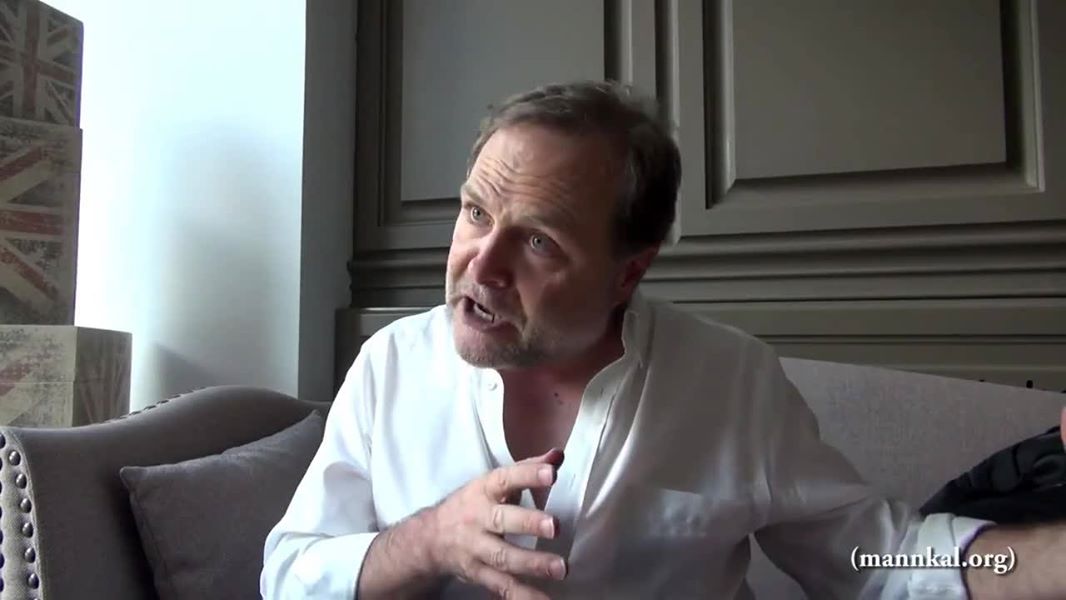
Click for video: videos/10539961_10152564978272264_1472034547_n_10152564962362264.mp4 Short video on my work on Propertarianism.

Source date (UTC): 2014-07-07 03:52:00 UTC
Click for video: videos/10539961_10152564978272264_1472034547_n_10152564962362264.mp4 Short video on my work on Propertarianism.
Source date (UTC): 2014-07-07 03:52:00 UTC
Patiently waiting for iMovie to render. I’ve split the Ron Manners interview into one on Ukraine and one on my work on Propertarianism and reforming libertarianism.
We didn’t prep for this at all. I didn’t know he would interview me (or I wouldn’t look like I just rolled out of bed after a wild night – I actually wasn’t feeling well). So it’s a natural and casual discussion.
Ron is a great guy really.
I bet he didn’t like my answer though: that resources (USA, Australian, Canada, Argentina, and Ukraine) are simply a vehicle for constructing rent seeking polities. The UK still has an incredibly rent-seeking culture, without resources, but only because they still operate as if the empire exists. And that empire exists, except that the UK is merely the swiss banking system of the Anglo American empire. That empire is coming to an end. Along with the european discount on defense, outsourced to americans.
Source date (UTC): 2014-07-07 03:33:00 UTC
CORRECTING THE LIBERTARIAN ARGUMENT AGAINST CORPORATIONS
Corporations are collections of people insured by the state in order to decrease the risk of legal attacks on one hand and increase employment, wealth and taxes on the other.
Unfortunately, for historical reasons, this legal protection and corporeal terminology evolved rather than insurance and economic terminology.
As such, most of the political rhetoric regarding corporations as analogies for people are empty verbalisms.
The correct amalogy is public-private investments in order for the state to encourage risk taking by insuring owners against legal risk.
This turns out to be useful during early capitalism, but decreesses in value as wealth increaees.
Public private partnerships are useful and necessary means of producing commons which are later fully privatized.
No populace has SURVIVED economic competition without this strategy.
The evolutionary failure is in not privatizing (uninsuring) these entities once one has a functioning economy.
This is another example of the confusion caused by conflating administrative law and insurance functions and economic policy in a single governmental body.
If instead we used insurers and insurer paid legal processes, and loser-pays we could achieve the same effect.
However, the libertarian logical fallacy is that such public private partnerships are not nevessary for the initial production of an economy and the organic development of laws that facilitate risk taking.
We are correct that this insurance should be withdrawn at some point, and that it had gone too far. But we are wrong to assume that it is not competitively necessary for a polity to generate a high trust, high velicity economy.
Westerners invented most capitalist law. But once law is invented, it can be restated and reformed without its historical linguistic and cultural baggage.
This is the problem: the empty verbalism of organic development using governments mixing functions of administrative law, insurer, producer of commons, and economic policy.
As such many if our arguments are empty verbalisms not attempts at institutional reformation.
Curt Doolittle
The Propertarian Institute
Kiev
Source date (UTC): 2014-07-07 01:09:00 UTC
OPPORTUNITY APPROACHES : ANOTHER CRASH
Political Opportunity.
Radical Political Opportunity
—…[The] cyclically adjusted price-to-earnings ratio (CAPE) … the so-called Shiller PE, is currently well above its long-term average of 17 and approaching levels that previously presaged doom for equities. Shiller has plotted CAPE going back to 1881 and notes (with some alarm) it has only been higher than current levels three times: In 1929, 2000 and 2007.”—-
I thought it would take until 2020 for another cycle to play out but I didn’t anticipate all this nonsensical flooding of the markets with cheap money. Eventually someone has to figure out that Krugman and Delong are wrong , and that Austrians are right, and that we’re running out of options.
The only choice is liquidation – of the corporations (states) that are bankrupt.
Source date (UTC): 2014-07-05 19:45:00 UTC
UNIVERSITIES AND COLLEGES SHOULD WARRANTY THEIR PRODUCTS, AND WE SHOULD SUE THEM FOR THE FAILURE OF THEIR PRODUCTS TO PERFORM. [T]he state gives the universities protection from suits. For selling non-performing products. (But then, the government is a monopoly that forces us to buy its services too.) Q: “Should a college education be offered to all people or to just a certain group of people?” “Should” is an interesting question. “College Education” is a loose term. “Offered” is a questionable term. The data suggest we send way too many people to college and way too few people to apprenticeship programs. Just statistically speaking, if it takes a 110-115 IQ to complete liberal arts education that means that we should be only educating `10-20% of the population and the rest should get vocational training rather than liberal arts training. Now that said, if colleges and universities had to warrantee their products, rather than sell non performing products, say, by getting x% of your payroll for 30 years, then we could drop tuition fees altogether, loans altogether, and let universities borrow to cover float (receiveables) themselves. This would rapidly change the university system from just another parasitic quasi-governmental bureaucracy, to a market driven organization. University costs and administrative costs would plummet, and courses woukd be outcome oriented. This is the best idea for solving the problem of parasitic but useless university degrees. We know now that we learn nothing at university if value. All they do is sort and filter the population.
UNIVERSITIES AND COLLEGES SHOULD WARRANTY THEIR PRODUCTS, AND WE SHOULD SUE THEM FOR THE FAILURE OF THEIR PRODUCTS TO PERFORM. [T]he state gives the universities protection from suits. For selling non-performing products. (But then, the government is a monopoly that forces us to buy its services too.) Q: “Should a college education be offered to all people or to just a certain group of people?” “Should” is an interesting question. “College Education” is a loose term. “Offered” is a questionable term. The data suggest we send way too many people to college and way too few people to apprenticeship programs. Just statistically speaking, if it takes a 110-115 IQ to complete liberal arts education that means that we should be only educating `10-20% of the population and the rest should get vocational training rather than liberal arts training. Now that said, if colleges and universities had to warrantee their products, rather than sell non performing products, say, by getting x% of your payroll for 30 years, then we could drop tuition fees altogether, loans altogether, and let universities borrow to cover float (receiveables) themselves. This would rapidly change the university system from just another parasitic quasi-governmental bureaucracy, to a market driven organization. University costs and administrative costs would plummet, and courses woukd be outcome oriented. This is the best idea for solving the problem of parasitic but useless university degrees. We know now that we learn nothing at university if value. All they do is sort and filter the population.
UNIVERSITIES AND COLLEGES SHOULD WARRANTY THEIR PRODUCTS, AND WE SHOULD SUE THEM FOR THE FAILURE OF THEIR PRODUCTS TO PERFORM. [T]he state gives the universities protection from suits. For selling non-performing products. (But then, the government is a monopoly that forces us to buy its services too.) Q: “Should a college education be offered to all people or to just a certain group of people?” “Should” is an interesting question. “College Education” is a loose term. “Offered” is a questionable term. The data suggest we send way too many people to college and way too few people to apprenticeship programs. Just statistically speaking, if it takes a 110-115 IQ to complete liberal arts education that means that we should be only educating `10-20% of the population and the rest should get vocational training rather than liberal arts training. Now that said, if colleges and universities had to warrantee their products, rather than sell non performing products, say, by getting x% of your payroll for 30 years, then we could drop tuition fees altogether, loans altogether, and let universities borrow to cover float (receiveables) themselves. This would rapidly change the university system from just another parasitic quasi-governmental bureaucracy, to a market driven organization. University costs and administrative costs would plummet, and courses woukd be outcome oriented. This is the best idea for solving the problem of parasitic but useless university degrees. We know now that we learn nothing at university if value. All they do is sort and filter the population.
UNIVERSITIES AND COLLEGES SHOULD WARRANTY THEIR PRODUCTS, AND WE SHOULD SUE THEM FOR THE FAILURE OF THEIR PRODUCTS TO PERFORM. [T]he state gives the universities protection from suits. For selling non-performing products. (But then, the government is a monopoly that forces us to buy its services too.) Q: “Should a college education be offered to all people or to just a certain group of people?” “Should” is an interesting question. “College Education” is a loose term. “Offered” is a questionable term. The data suggest we send way too many people to college and way too few people to apprenticeship programs. Just statistically speaking, if it takes a 110-115 IQ to complete liberal arts education that means that we should be only educating `10-20% of the population and the rest should get vocational training rather than liberal arts training. Now that said, if colleges and universities had to warrantee their products, rather than sell non performing products, say, by getting x% of your payroll for 30 years, then we could drop tuition fees altogether, loans altogether, and let universities borrow to cover float (receiveables) themselves. This would rapidly change the university system from just another parasitic quasi-governmental bureaucracy, to a market driven organization. University costs and administrative costs would plummet, and courses woukd be outcome oriented. This is the best idea for solving the problem of parasitic but useless university degrees. We know now that we learn nothing at university if value. All they do is sort and filter the population.
REFORMULATION OF “WE MUST DEVELOP POLITICAL INSTITUTIONS FOR THE PEOPLE WE HAVE, NOT THOSE WE WISH WE HAD” “Observation of individual men would never have led to the formulation of the static conceptions upon which the democratic edifice is founded, such as justice, equality, fraternity, order. These are based not on the traits of living men but upon schemes for the aggrandizement of mere thought-creations – “humanity”- “mankind.” Indeed the “characteristics of men” – are something to be explained away, something to be overcome in the interests of “mankind.”” – Dora Marsden
REFORMULATION OF “WE MUST DEVELOP POLITICAL INSTITUTIONS FOR THE PEOPLE WE HAVE, NOT THOSE WE WISH WE HAD” “Observation of individual men would never have led to the formulation of the static conceptions upon which the democratic edifice is founded, such as justice, equality, fraternity, order. These are based not on the traits of living men but upon schemes for the aggrandizement of mere thought-creations – “humanity”- “mankind.” Indeed the “characteristics of men” – are something to be explained away, something to be overcome in the interests of “mankind.”” – Dora Marsden