MIXED AND UNMIXED ECONOMIES?
0) lets look at these terms:
COMMUNISM: unorganized equalitarian production of private and commons. Collective ownership of the means of production.
(PARASITISM UPON THE INDIVIDUAL)
SOCIALISM: state (involuntary) organization of production. State ownerhship of the means of production. state ownership of the proceeds of production. state distribution of the proceeds of production to common or private ends.
(INVOLUNTARY COMMONS)
SOCIAL DEMOCRACY: state organization of some part of production. State ownership of the MEANS of production, state ownership of the PROCEEDS of production. Individual retains COMMISSION on his production for his private consumption, the remainder is held by the state for the production of commons.
(COMPETITION FOR PRIVATE AND COMMONS)
CLASSICAL LIBERALISM: individual ownership of the means of production, individual ownership of the proceeds of production. The voluntary organization of production. individuals contribute to the production of commons by majority assent.
(VOLUNTARY COMMONS)
CAPITALISM (market anarchism). Individual ownership of the means of production, individual ownership of the proceeds of production, the voluntary organization of production, and the private construction of common goods.
(PARASITISM UPON THE COMMONS)
1) EXTREMES FAIL
Neither socialism nor capitalism is possible. Hence neither exists.
2) MONOPOLIES FAIL:
Instead we develop mixed economies.
Social democracy (mixed economies) are the constant throughout history. At present the mainstream seeks to identify the maximum taxation possible without disincentivizing production. This appears to be dependent upon the homogeneity of the population.
3) MIXED WORK, BUT MORE MIXING IS BETTER
We appear to need a different economic model for each CLASS.
… Lets look at the hierarchy of labor:
– barbarian (outside the system – person is candidate or enemy)
– prisoner (owner bears risk but person is disposable)
– slave/soldiery (owner bears risk – person is tradable/releasable)
– serf (split cost of risk) (supported by own production)
– employee (full cost of risk) (supported by production returns)
– professional (burgher) (supported by trade returns)
– capitalist (landowner) (supported by management returns)
– statist (aristocracy) (supported by proceeds of taxation)
– warriors (aristocracy) (supported by proceeds of conquest)
So we do not have ENOUGH of a mixed economy.
We have no slavery, too small a military, no regiments, too small a disaster releif organization, no commons- maintenance organizations, too few syndicates and unions, and no monasteries or nunneries, and the academy functions as the only monastery. Yet we have a bloated financial sector that is clearly parasitic.
Why? Because we allowed collective bargaining, and parasitic private and public contracts to award pensions we could not afford at our rates of inflation.
We have created the worst possible mix of large homes and small expensive urban apartments, rather than large family apartments in large numbers in urban areas.
We have created an empire with constant political conflict in order to gain mobility, rather than a collection of small homogenous states with constant political satisfaction of local demands, at the expense of mobility. However, that mobility is the reason for the decline of social order and the fmaily and care for the commons, and our culture itself.
Economists are even WORSE idiots than theologians.
Curt Doolittle
The Propertarian Institute
Kiev,Ukraine
Source date (UTC): 2017-01-03 13:03:00 UTC
 1) Humans acquire at cost and defend what they have acquired at cost.
2) cooperation is disproportionately more productive than predation.
3) cooperation is only preferable to predation in the total absence of parasitism. Or, what we call free-riding.
4) Because of the disproportionate value of cooperation, Humans retaliate against free riding even if at high cost ( altruistic punishment). They protect the institution by severe policing of cheaters.
5) rules against free riding, either normative or codified in law, prohibit parasitism (free riding).
6) prohibitions that are habituated in norms or codified in law provide a means of decision making in matters of conflict.
7) prohibitions against parasitism can be positively expressed as contractual “rights”.
8) community member (shareholders in the local market) insure one another by suppressing retaliation against settlements of grievances according to norms and laws.
9) The common, organic law allows for the least time lapse between an innovation in the means of parasitism and the construction of a prohibition against this new means of parasitism expressed as new law. As such all laws are discovered. (very important)
10) high trust societies use common law to incrementally suppress all available means of free riding, leaving productive participation in the market as the only viable means of survival.
11) as a consequence, the reproduction of the lower classes is suppressed and the distribution of talents increases along with the innovations in technology. (market eugenics). Thus obviating the need for tyranny and redistribution.
Aristocracy, Egalitarianism, morality, Nomocracy, meritocracy, Science, and eugenic evolution are mutually dependent.
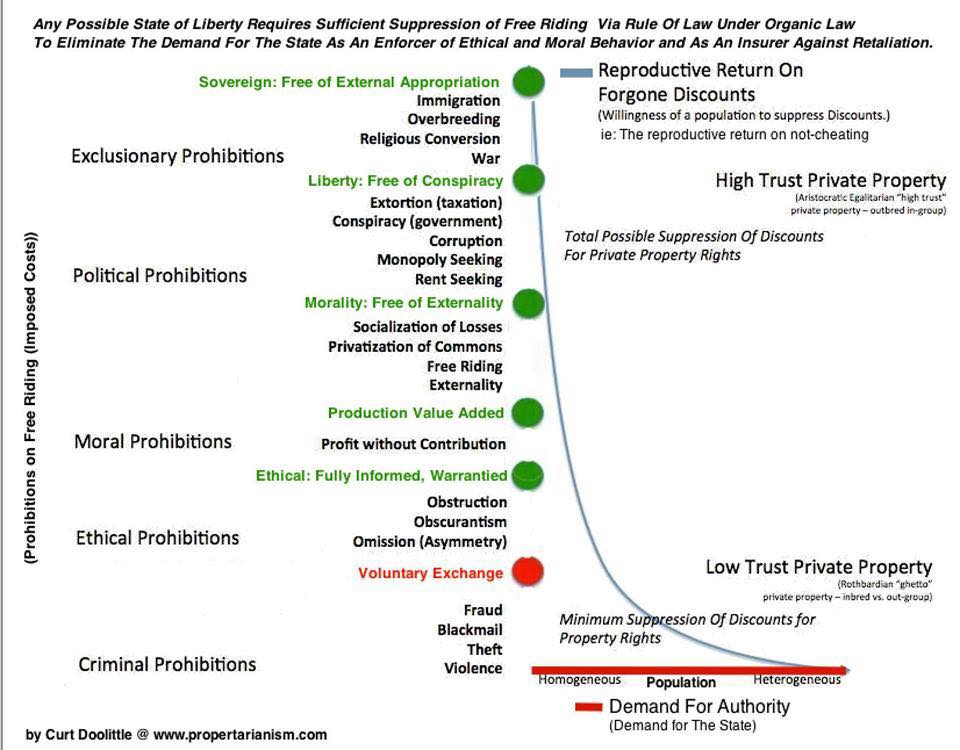
The chart below shows the incremental suppression of parasitism stating from the suppression of violence through fraud, through conspiracy, through immigration, through conquest.
Only the west succeeded in developing truth.
And without it we cannot have the jury. And without the jury no judge or common law.
Truth matters above all else.
Pseudoscience is just babylonian monotheistic mysticism in new clothes.
This emperor is naked also.
Truth is enough to rescue the west.
1) Humans acquire at cost and defend what they have acquired at cost.
2) cooperation is disproportionately more productive than predation.
3) cooperation is only preferable to predation in the total absence of parasitism. Or, what we call free-riding.
4) Because of the disproportionate value of cooperation, Humans retaliate against free riding even if at high cost ( altruistic punishment). They protect the institution by severe policing of cheaters.
5) rules against free riding, either normative or codified in law, prohibit parasitism (free riding).
6) prohibitions that are habituated in norms or codified in law provide a means of decision making in matters of conflict.
7) prohibitions against parasitism can be positively expressed as contractual “rights”.
8) community member (shareholders in the local market) insure one another by suppressing retaliation against settlements of grievances according to norms and laws.
9) The common, organic law allows for the least time lapse between an innovation in the means of parasitism and the construction of a prohibition against this new means of parasitism expressed as new law. As such all laws are discovered. (very important)
10) high trust societies use common law to incrementally suppress all available means of free riding, leaving productive participation in the market as the only viable means of survival.
11) as a consequence, the reproduction of the lower classes is suppressed and the distribution of talents increases along with the innovations in technology. (market eugenics). Thus obviating the need for tyranny and redistribution.
Aristocracy, Egalitarianism, morality, Nomocracy, meritocracy, Science, and eugenic evolution are mutually dependent.
The chart below shows the incremental suppression of parasitism stating from the suppression of violence through fraud, through conspiracy, through immigration, through conquest.
Only the west succeeded in developing truth.
And without it we cannot have the jury. And without the jury no judge or common law.
Truth matters above all else.
Pseudoscience is just babylonian monotheistic mysticism in new clothes.
This emperor is naked also.
Truth is enough to rescue the west.
 1) Humans acquire at cost and defend what they have acquired at cost.
2) cooperation is disproportionately more productive than predation.
3) cooperation is only preferable to predation in the total absence of parasitism. Or, what we call free-riding.
4) Because of the disproportionate value of cooperation, Humans retaliate against free riding even if at high cost ( altruistic punishment). They protect the institution by severe policing of cheaters.
5) rules against free riding, either normative or codified in law, prohibit parasitism (free riding).
6) prohibitions that are habituated in norms or codified in law provide a means of decision making in matters of conflict.
7) prohibitions against parasitism can be positively expressed as contractual “rights”.
8) community member (shareholders in the local market) insure one another by suppressing retaliation against settlements of grievances according to norms and laws.
9) The common, organic law allows for the least time lapse between an innovation in the means of parasitism and the construction of a prohibition against this new means of parasitism expressed as new law. As such all laws are discovered. (very important)
10) high trust societies use common law to incrementally suppress all available means of free riding, leaving productive participation in the market as the only viable means of survival.
11) as a consequence, the reproduction of the lower classes is suppressed and the distribution of talents increases along with the innovations in technology. (market eugenics). Thus obviating the need for tyranny and redistribution.
Aristocracy, Egalitarianism, morality, Nomocracy, meritocracy, Science, and eugenic evolution are mutually dependent.
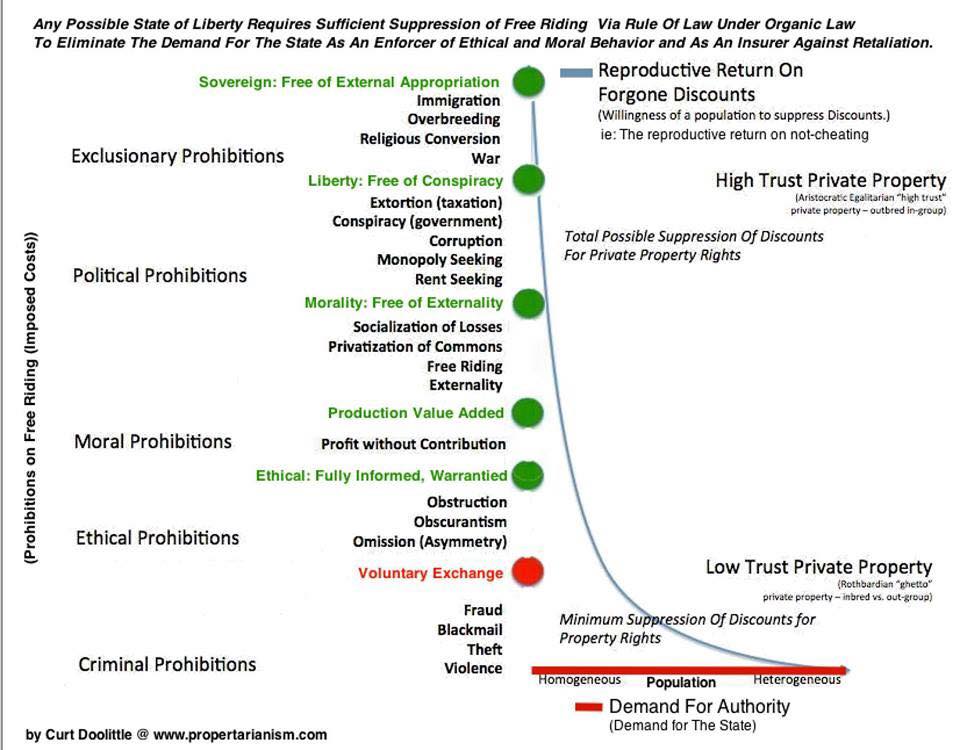
The chart below shows the incremental suppression of parasitism stating from the suppression of violence through fraud, through conspiracy, through immigration, through conquest.
Only the west succeeded in developing truth.
And without it we cannot have the jury. And without the jury no judge or common law.
Truth matters above all else.
Pseudoscience is just babylonian monotheistic mysticism in new clothes.
This emperor is naked also.
Truth is enough to rescue the west.
1) Humans acquire at cost and defend what they have acquired at cost.
2) cooperation is disproportionately more productive than predation.
3) cooperation is only preferable to predation in the total absence of parasitism. Or, what we call free-riding.
4) Because of the disproportionate value of cooperation, Humans retaliate against free riding even if at high cost ( altruistic punishment). They protect the institution by severe policing of cheaters.
5) rules against free riding, either normative or codified in law, prohibit parasitism (free riding).
6) prohibitions that are habituated in norms or codified in law provide a means of decision making in matters of conflict.
7) prohibitions against parasitism can be positively expressed as contractual “rights”.
8) community member (shareholders in the local market) insure one another by suppressing retaliation against settlements of grievances according to norms and laws.
9) The common, organic law allows for the least time lapse between an innovation in the means of parasitism and the construction of a prohibition against this new means of parasitism expressed as new law. As such all laws are discovered. (very important)
10) high trust societies use common law to incrementally suppress all available means of free riding, leaving productive participation in the market as the only viable means of survival.
11) as a consequence, the reproduction of the lower classes is suppressed and the distribution of talents increases along with the innovations in technology. (market eugenics). Thus obviating the need for tyranny and redistribution.
Aristocracy, Egalitarianism, morality, Nomocracy, meritocracy, Science, and eugenic evolution are mutually dependent.
The chart below shows the incremental suppression of parasitism stating from the suppression of violence through fraud, through conspiracy, through immigration, through conquest.
Only the west succeeded in developing truth.
And without it we cannot have the jury. And without the jury no judge or common law.
Truth matters above all else.
Pseudoscience is just babylonian monotheistic mysticism in new clothes.
This emperor is naked also.
Truth is enough to rescue the west.