September 16th, 2018 10:52 AM OWNERSHIP OF OUR LINES [W]e no longer own our children. If we owned our children still, we could influence their marriages. If we owned our government still, we could end alien immigration. We own neither and therefore no longer own self-determination of our line or our kin. As such you ask me to do what I cannot in the circumstance, and I ask you to do what we can do in the circumstance: fight to return our ownership – to create an alternative circumstance. The question is, will you fight? If you will not fight then your words are those of a woman: the ridicule of scolds is evidence of their powerlessness and lack of agency. And you are of no matter other than to be punished for your scolding.
Theme: Property
-
Ownership of Our Lines
September 16th, 2018 10:52 AM OWNERSHIP OF OUR LINES [W]e no longer own our children. If we owned our children still, we could influence their marriages. If we owned our government still, we could end alien immigration. We own neither and therefore no longer own self-determination of our line or our kin. As such you ask me to do what I cannot in the circumstance, and I ask you to do what we can do in the circumstance: fight to return our ownership – to create an alternative circumstance. The question is, will you fight? If you will not fight then your words are those of a woman: the ridicule of scolds is evidence of their powerlessness and lack of agency. And you are of no matter other than to be punished for your scolding.
-
Only Half Wrong
by Skye Stewart [D]ig a little most lefties don’t intuitively grasp Econ 101. So rich people qualitatively are those who have taken from others. Of course, opponents, forgetting there is no “pure” free market, often forget many rich people have their positions due precisely to unearned political rents to some degree. So some naturally get pissed off when they see economic inequality, and are sometimes wrong in their assumptions about its causal nature, while others do not get pissed off though they should be since it was unearned, at least economically.
-
Only Half Wrong
by Skye Stewart [D]ig a little most lefties don’t intuitively grasp Econ 101. So rich people qualitatively are those who have taken from others. Of course, opponents, forgetting there is no “pure” free market, often forget many rich people have their positions due precisely to unearned political rents to some degree. So some naturally get pissed off when they see economic inequality, and are sometimes wrong in their assumptions about its causal nature, while others do not get pissed off though they should be since it was unearned, at least economically.
-
Hayek Wasn’t Quite Right
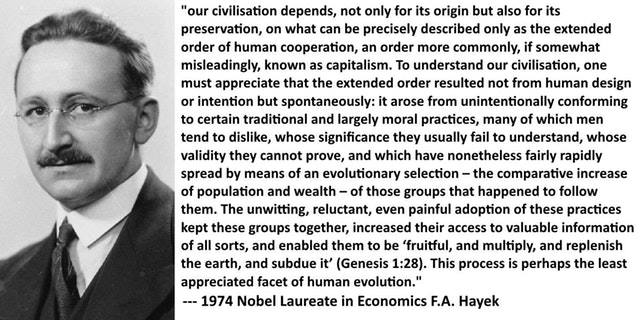
Hayek wasn’t quite right. Our civilization depends upon the rule of law by tort (natural law), the result of which CAN ONLY be ‘markets in everything’ – which he refers to as “Capitalism” by adopting the marxist criticism of financial cooperation at scale – but that I would call ‘Market-ism”: or the suppression of all involuntary parasitism and predation and forcing all peoples into the market in the service of others to survive. This zero-tolerance of non-market behavior is the result of the institutionalization of sovereignty and with sovereignty, of necessity, tort, and with tort and sovereignty we construct natural law and markets. So while, in the end, he did understand that it was Law that was the foundation of western civilization, he did not make the connection that it was law that LIMITED US to anything other than market cooperation. I call this use of tort law (natural law) “incremental suppression of free riding, parasitism, and predation”.
-
Hayek Wasn’t Quite Right
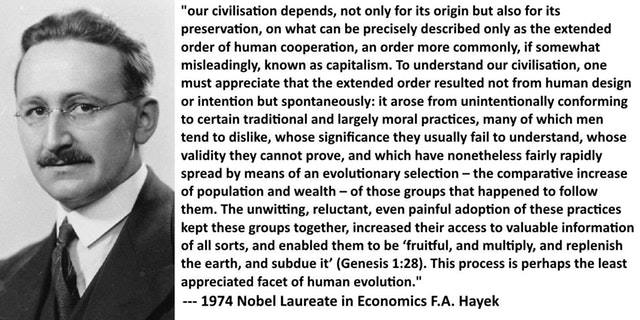
Hayek wasn’t quite right. Our civilization depends upon the rule of law by tort (natural law), the result of which CAN ONLY be ‘markets in everything’ – which he refers to as “Capitalism” by adopting the marxist criticism of financial cooperation at scale – but that I would call ‘Market-ism”: or the suppression of all involuntary parasitism and predation and forcing all peoples into the market in the service of others to survive. This zero-tolerance of non-market behavior is the result of the institutionalization of sovereignty and with sovereignty, of necessity, tort, and with tort and sovereignty we construct natural law and markets. So while, in the end, he did understand that it was Law that was the foundation of western civilization, he did not make the connection that it was law that LIMITED US to anything other than market cooperation. I call this use of tort law (natural law) “incremental suppression of free riding, parasitism, and predation”.
-
“If police investigations were run by capitalist philosophy, would the poor get
—“If police investigations were run by capitalist philosophy, would the poor get adequate justice?”—
THE CORRECT ANSWER
Police investigations already are capitalistic. They balance the… https://www.facebook.com/permalink.php?story_fbid=289010425029188&id=100017606988153
Source date (UTC): 2018-08-31 15:05:09 UTC
Original post: https://twitter.com/i/web/status/1035544022125821952
-
CAPITALIST POLICE? —“If police investigations were run by capitalist philosoph
CAPITALIST POLICE?
—“If police investigations were run by capitalist philosophy, would the poor get adequate justice?”—
THE CORRECT ANSWER
Police investigations already are capitalistic. They balance the market for tolerance with crime rates with the market for taxes to pay for the suppression, prosecution, and punishment of crimes. The cost of the externalities of physical crimes are far smaller than the cost of the externalities of clerical and informational crime. The distrust produced by physical crime is greater than the distrust created by clerical and informational crime.
The problem for the poor is that they have worse ABILITIES and worse PERSONALITIES, and even worse HABITS than their working, middle, and upper class peers, and therefore low sexual, social, economic, and political value to other people. Hence, they are poor. They have nothing to trade. And worse, even interacting with them forces others to bear the cost of doing so.
We ended the period of stagnant human capital by the middle of the last century. That is why IQ’s are declining. We are now reversing gains of modernity by increasing the rates of reproduction of the underclasses by suppressing the rates of reproduction of the middle classes through tax extraction.
Source date (UTC): 2018-08-31 11:05:00 UTC
-
—“Q: What Do You Define as Commons?”—
—“@curtdoolittle Sir, do you have a resource that you could direct me towards in which you describe your understanding of the commons? Thank you in advance.”—Prussian Blue Persuasion Every single thing you pay for by either action, inaction,or forgone opportunity for discount or gain: obeying manners, ethics, morals, laws, norms, traditions, paying taxes, common property in all its forms (territory, resources, infrastructure, buildings, monuments), maintaining your, your neighbor’s, and local and national common property in all its forms, acts of charity (by your own hand and own money), acts of voluntary and military service. Anything that isn’t privately owned, by individual partnership, or corporation, but creates an asset for the members of the polity.
-
—“Q: What Do You Define as Commons?”—
—“@curtdoolittle Sir, do you have a resource that you could direct me towards in which you describe your understanding of the commons? Thank you in advance.”—Prussian Blue Persuasion Every single thing you pay for by either action, inaction,or forgone opportunity for discount or gain: obeying manners, ethics, morals, laws, norms, traditions, paying taxes, common property in all its forms (territory, resources, infrastructure, buildings, monuments), maintaining your, your neighbor’s, and local and national common property in all its forms, acts of charity (by your own hand and own money), acts of voluntary and military service. Anything that isn’t privately owned, by individual partnership, or corporation, but creates an asset for the members of the polity.