Theme: Measurement

  • MORAL NORMS TRADITIONS AND VALUES A nit to help your precision a bit: 1) A parad

    MORAL NORMS TRADITIONS AND VALUES
    A nit to help your precision a bit:
    1) A paradigm (framework) organizes knowledge. Moral norms, traditions, and values provide weights and measures within a paradigm.
    2) Some paradigms diverge from and some converge on natural law (optimums).
    3) As such some moral norms, traditions, and values diverge from or converge on natural law (optimums).
    4) The rate of trust reflects the rate of cooperation reflects the rate of innovation, which reflects the discovery, innovation, adaptation, and evolution toward the laws of nature, which reflects the convergence or divergence from the optimum norms traditions and values from the natural law.


    Source date (UTC): 2023-04-11 15:31:48 UTC

    Original post: https://twitter.com/i/web/status/1645811895000080387

  • MORAL NORMS TRADITIONS AND VALUES A nit to help your precision a bit: 1) A parad

    MORAL NORMS TRADITIONS AND VALUES
    A nit to help your precision a bit:
    1) A paradigm (framework) organizes knowledge. Moral norms, traditions, and values provide weights and measures within a paradigm.
    2) Some paradigms diverge from and some converge on natural law (optimums).
    3) As such some moral norms, traditions, and values diverge from or converge on natural law (optimums).
    4) The rate of trust reflects the rate of cooperation reflects the rate of innovation, which reflects the discovery, innovation, adaptation, and evolution toward the laws of nature, which reflects the convergence or divergence from the optimum norms traditions and values from the natural law.


    Source date (UTC): 2023-04-11 15:31:48 UTC

    Original post: https://twitter.com/i/web/status/1645811894903619586

  • You shouldn’t make assertions when you should ask questions instead. We are all

    You shouldn’t make assertions when you should ask questions instead. We are all measures of our own ignorance. https://t.co/bUnulSK4jC


    Source date (UTC): 2023-04-10 01:04:41 UTC

    Original post: https://twitter.com/i/web/status/1645231292458450944

    Reply addressees: @ForTheLifeofTr1 @nathancofnas @TOOEdit

    Replying to: https://twitter.com/i/web/status/1645230414682898434

  • (math diary) Michael’s being a bit of a genius in DMs, explaining first principl

    (math diary)
    Michael’s being a bit of a genius in DMs, explaining first principles of perception, disambiguation, and memory in mathematical terms.

    Meanwhile my inner autist experiences an addiction response to the elegance of the order. My biz partner Jim Beebe (a mathematician) would sometimes avoid studying mathematics for the same reason: for some of us it’s heroin. 😉

    I had an early discomfort with math and logic sensing something was wrong (it was, with both). Michael on his own, or the two of us together, I hope will work on the subject – though I doubt I’ll live long enough, and I’d be surprised if a reformation of math doesn’t finally happen after the first attempt in the first third of the 20th century. (Blame the failure on cantor, einstein, and bohr, as well as the entire philosphical community).

    The problem with the foundations of math, logic, and physics is the same: idealism.


    Source date (UTC): 2023-04-09 14:59:00 UTC

    Original post: https://twitter.com/i/web/status/1645078868494016516

  • FWIW: Its more that I applied my analytic approach to art, and that it was the f

    FWIW: Its more that I applied my analytic approach to art, and that it was the first subtantive work I did, demonstrating anything can be disambiguated into first causes.
    Knowing how to analyze art is just like any other set of measurements we have produced.
    However, some of those measurements require knowledge of the technology and materials used in the producdtion, the skill of the craftsman in producing it, the time and place of that production, the movement (fashion) that it was influenced by, and whether or not its a canonical example of that movement.
    Interpreting the content and messaging does require some knowledge of history and usually of mythology. In other words some art, like some plays and some literature is conceptually dense.
    So, while we can state the science of evaluating art, and in doing so provide a map for investigating any given work, set of works, movement, etc. But it still takes a bit of work from there.
    However, like weapons training, the first 20% gets you 80% of the way there. 😉


    Source date (UTC): 2023-04-05 04:39:25 UTC

    Original post: https://twitter.com/i/web/status/1643473390311702529

    Replying to: https://twitter.com/i/web/status/1643467873543925760

  • Q: CURT: WHAT DO YOU MEAN THAT TALEB’S PROBLEM IS THAT WE DON’T HAVE A METRIC FO

    Q: CURT: WHAT DO YOU MEAN THAT TALEB’S PROBLEM IS THAT WE DON’T HAVE A METRIC FOR WHAT HE WANTS TO MEASURE?
    (the measurement problem in economics is similar but far less complex than the measurement problems in identifying outlier possibilties.) https://twitter.com/curtdoolittle/status/1643353169206865922

  • We have metrics for increases in mass, weight, volume, speed, reaction time, etc

    We have metrics for increases in mass, weight, volume, speed, reaction time, etc. But we have no metric for information necessary to cause an incremental change in state, nor the ratio between that and the possible consequences. In other words, it takes more and more information to identify a tail event (unpredictable outlier), and the tail event will have a disproportionate effect relative to it’s median. We will have this with an AI, or some proxy for it. But we have no means of doing this with the brain. As such we should develop a general rule for information necessary to identify a tail event, and as a consquence a goal of obtaining sufficient information to eliminate tail events by predicting them. This formula wil be a universal as I many other laws of nature (pareto, power etc) are universal.


    Source date (UTC): 2023-04-04 20:41:42 UTC

    Original post: https://twitter.com/i/web/status/1643353169206865922

    Replying to: https://twitter.com/i/web/status/1643351196558606339

  • We have metrics for increases in mass, weight, volume, speed, reaction time, etc

    We have metrics for increases in mass, weight, volume, speed, reaction time, etc. But we have no metric for information necessary to cause an incremental change in state, nor the ratio between that and the possible consequences. In other words, it takes more and more information to identify a tail event (unpredictable outlier), and the tail event will have a disproportionate effect relative to it’s median. We will have this with an AI, or some proxy for it. But we have no means of doing this with the brain. As such we should develop a general rule for information necessary to identify a tail event, and as a consquence a goal of obtaining sufficient information to eliminate tail events by predicting them. This formula wil be a universal as I many other laws of nature (pareto, power etc) are universal.

    Reply addressees: @MuhammadAreez10


    Source date (UTC): 2023-04-04 20:41:42 UTC

    Original post: https://twitter.com/i/web/status/1643353169047568385

    Replying to: https://twitter.com/i/web/status/1643351196558606339

  • I like that measurement ‘outrages’. 😉

    I like that measurement ‘outrages’. 😉


    Source date (UTC): 2023-04-04 03:57:35 UTC

    Original post: https://twitter.com/i/web/status/1643100476756426752

    Reply addressees: @WoodworkerBear

    Replying to: https://twitter.com/i/web/status/1643096580466302976

  • I’ll add the question then: whether your (one’s) epistemology relies on testifia

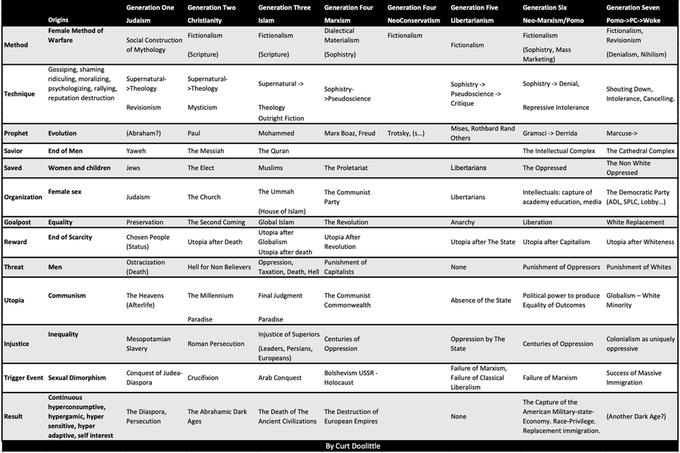
    I’ll add the question then: whether your (one’s) epistemology relies on testifiability, where testifiability requires: realism (existence), naturalism (causality, determism), identity (disambiguation), internal consistency (logic), existential possiblity (operations), external correspondence (observable evidence), bounded rational choice (rationality), bounded rational reciprocity (morality), and satisfies full accounting (limits, completeness), and is within the limits of restitutability, and whether you are willing to state testifiable truth regardless of cost.

    That’s the complete, exhaustive criterial for testifiable truth claims, with every dimension of falsification available to man.

    Under that criteria very few people speak any truth whatsoever. Instead, they speak a negotiating position or a suggestion, or a deception, or a fraud.

    I’ve done exhaustive work on testimonhy and deceit, and the most interesting science of all it turns out, is the rich study of human lying.

    We didn’t evolve for truth.
    We evolved for negotiationg cooperation
    We didn’t evolve for morality.
    We evolved for acting within the limits of immorality.

    We just try to teach each other beneficial positivas (the right way to do things). Which has the side benefit of not teaching now NOT to do things. WHich would only make matters worse.

    Economic cooperation, the commons, political systems, rates of evolution all depend on the truthfulness of the population, and it’s correspondence with the laws of the universe (which are unmerciful, really).

    Truth is a human advantage in all things.
    It’s also the most expensive and costly – especially psychologically and emotionally – commons that humans can develop. And thats why almost no one has. Except for europeans, which is rather interesting in and of itself.

    Confession, Oath, Contract, Testimony, Military Reporting.
    “truth before face regardless of cost”.

    Cheers

    Source date (UTC): 2023-04-03 15:40:02 UTC

    Original post: https://twitter.com/i/web/status/1642914863897882627

    Replying to: https://twitter.com/i/web/status/1642523147923517440