Theme: Measurement

  • Mathematics by the virtue of consisting of nothing other than positional names,

    Mathematics by the virtue of consisting of nothing other than positional names, preserves constant relations, since only constant relations are expressible.

    In language we can engage in all sorts of association by non constant relations.

    By speaking in actions we speak in constant relations.

    It has taken me far too long to simplify it down to something that digestible.


    Source date (UTC): 2017-11-08 09:21:00 UTC

  • Mathematics by the virtue of consisting of nothing other than positional names,

    Mathematics by the virtue of consisting of nothing other than positional names, preserves constant relations, since only constant relations are expressible. In language we can engage in all sorts of association by non constant relations. By speaking in actions we speak in constant relations. It has taken me far too long to simplify it down to something that digestible.
  • Mathematics by the virtue of consisting of nothing other than positional names,

    Mathematics by the virtue of consisting of nothing other than positional names, preserves constant relations, since only constant relations are expressible. In language we can engage in all sorts of association by non constant relations. By speaking in actions we speak in constant relations. It has taken me far too long to simplify it down to something that digestible.
  • WORD| > |Name(Noun)| : Proper(Person > Thing > Place > Idea > Perception(sense)

    |WORD| >

    |Name(Noun)| : Proper(Person > Thing > Place > Idea > Perception(sense) > Emotion(value)) > Common (categorical) > Compound > Pronoun > Clarifier (Determiner/Measure) > Property(adjective) >

    |State| State > Event > Action > Experience > Thought

    |Person| First > Second > Third > Abstract

    |Gender| Female < Neutral > Male.

    |Possession|- Unposessable, Possessable (‘s – “apostrophe s” in English) > Ownable > Always Owned.

    |Number|- Unique > Countable > Collection/Mass(not worth counting) > Uncountable.

    |Perception|- Concrete(observable 5 Senses) > Emotions(Feelings) > Ideas(Abstr.)

    Or: Perceivable > Experience-able > Imaginable

    Action(Verb) > Action Property(adverb) > Action Clarifier (Phrasal Verbs) >

    |Knowledge| Unknown > Believed > Known > Undeniable > Tautological

    |Ownership| Undiscovered > Unconvertible > Unconverted > “Homesteaded”(Worked) > Possessed(Fact) > Consensual Property (Agreement) > Normative Property (Habit) > Property Right (Insured by third party) > inalienable(life, memory, imagination, Emotion)

    |Possibility| Impossibility > Contingency(Might) > Possibility(Can) > Necessity(Shall).

    |Permissibility| Impermissible > Permissible(May) > Obligatory(Must).

    |Temporality| Always Been > Has been > is Currently > Will Be > Will Always Be.

    |Gain or Loss| Gain < Neutral > Loss

    |Decidability| Incommensurable > Undecidable > Preferable > Good > True.

    Relation (Preposition/Postposition) > Link (Conjunction > Copula ) >

    Agreement(yes-no) >

    Noise Words(Expletives etc.) >

    code-words(acronyms etc).

    |Speech| Word > Phrase > Clause > Sentence(Subject+Predicate=Story) > Paragraph(story) > Grammary of Science > Grammar of Narrative > Grammar of Stories(Story) > Grammar of Story > Story, all the way up.


    Source date (UTC): 2017-11-07 20:56:00 UTC

  • WORD| > |Name(Noun)| : Proper(Person > Thing > Place > Idea > Perception(sense)

    |WORD| > |Name(Noun)| : Proper(Person > Thing > Place > Idea > Perception(sense) > Emotion(value)) > Common (categorical) > Compound > Pronoun > Clarifier (Determiner/Measure) > Property(adjective) > |State| State > Event > Action > Experience > Thought |Person| First > Second > Third > Abstract |Gender| Female < Neutral > Male. |Possession|- Unposessable, Possessable (‘s – “apostrophe s” in English) > Ownable > Always Owned. |Number|- Unique > Countable > Collection/Mass(not worth counting) > Uncountable. |Perception|- Concrete(observable 5 Senses) > Emotions(Feelings) > Ideas(Abstr.) Or: Perceivable > Experience-able > Imaginable Action(Verb) > Action Property(adverb) > Action Clarifier (Phrasal Verbs) > |Knowledge| Unknown > Believed > Known > Undeniable > Tautological |Ownership| Undiscovered > Unconvertible > Unconverted > “Homesteaded”(Worked) > Possessed(Fact) > Consensual Property (Agreement) > Normative Property (Habit) > Property Right (Insured by third party) > inalienable(life, memory, imagination, Emotion) |Possibility| Impossibility > Contingency(Might) > Possibility(Can) > Necessity(Shall). |Permissibility| Impermissible > Permissible(May) > Obligatory(Must). |Temporality| Always Been > Has been > is Currently > Will Be > Will Always Be. |Gain or Loss| Gain < Neutral > Loss |Decidability| Incommensurable > Undecidable > Preferable > Good > True. Relation (Preposition/Postposition) > Link (Conjunction > Copula ) > Agreement(yes-no) > Noise Words(Expletives etc.) > code-words(acronyms etc). |Speech| Word > Phrase > Clause > Sentence(Subject+Predicate=Story) > Paragraph(story) > Grammary of Science > Grammar of Narrative > Grammar of Stories(Story) > Grammar of Story > Story, all the way up.
  • WORD| > |Name(Noun)| : Proper(Person > Thing > Place > Idea > Perception(sense)

    |WORD| > |Name(Noun)| : Proper(Person > Thing > Place > Idea > Perception(sense) > Emotion(value)) > Common (categorical) > Compound > Pronoun > Clarifier (Determiner/Measure) > Property(adjective) > |State| State > Event > Action > Experience > Thought |Person| First > Second > Third > Abstract |Gender| Female < Neutral > Male. |Possession|- Unposessable, Possessable (‘s – “apostrophe s” in English) > Ownable > Always Owned. |Number|- Unique > Countable > Collection/Mass(not worth counting) > Uncountable. |Perception|- Concrete(observable 5 Senses) > Emotions(Feelings) > Ideas(Abstr.) Or: Perceivable > Experience-able > Imaginable Action(Verb) > Action Property(adverb) > Action Clarifier (Phrasal Verbs) > |Knowledge| Unknown > Believed > Known > Undeniable > Tautological |Ownership| Undiscovered > Unconvertible > Unconverted > “Homesteaded”(Worked) > Possessed(Fact) > Consensual Property (Agreement) > Normative Property (Habit) > Property Right (Insured by third party) > inalienable(life, memory, imagination, Emotion) |Possibility| Impossibility > Contingency(Might) > Possibility(Can) > Necessity(Shall). |Permissibility| Impermissible > Permissible(May) > Obligatory(Must). |Temporality| Always Been > Has been > is Currently > Will Be > Will Always Be. |Gain or Loss| Gain < Neutral > Loss |Decidability| Incommensurable > Undecidable > Preferable > Good > True. Relation (Preposition/Postposition) > Link (Conjunction > Copula ) > Agreement(yes-no) > Noise Words(Expletives etc.) > code-words(acronyms etc). |Speech| Word > Phrase > Clause > Sentence(Subject+Predicate=Story) > Paragraph(story) > Grammary of Science > Grammar of Narrative > Grammar of Stories(Story) > Grammar of Story > Story, all the way up.
  • by Bill Joslin Inhibitions to human cognition follow the inverse pattern. Percep

    by Bill Joslin

    Inhibitions to human cognition follow the inverse pattern.

    Perception -> generalization-> conflation -> faked commensurability


    My view is that we try to reinforce paradigmatic networks bcasue it’s cheaper.


    Source date (UTC): 2017-11-07 12:50:00 UTC

  • by Bill Joslin Inhibitions to human cognition follow the inverse pattern. Percep

    by Bill Joslin Inhibitions to human cognition follow the inverse pattern. Perception -> generalization-> conflation -> faked commensurability — My view is that we try to reinforce paradigmatic networks bcasue it’s cheaper.
  • by Bill Joslin Inhibitions to human cognition follow the inverse pattern. Percep

    by Bill Joslin Inhibitions to human cognition follow the inverse pattern. Perception -> generalization-> conflation -> faked commensurability — My view is that we try to reinforce paradigmatic networks bcasue it’s cheaper.
  • photos_and_videos/TimelinePhotos_43196237263/23270166_10155863047107264_34948911

    photos_and_videos/TimelinePhotos_43196237263/23270166_10155863047107264_34948911

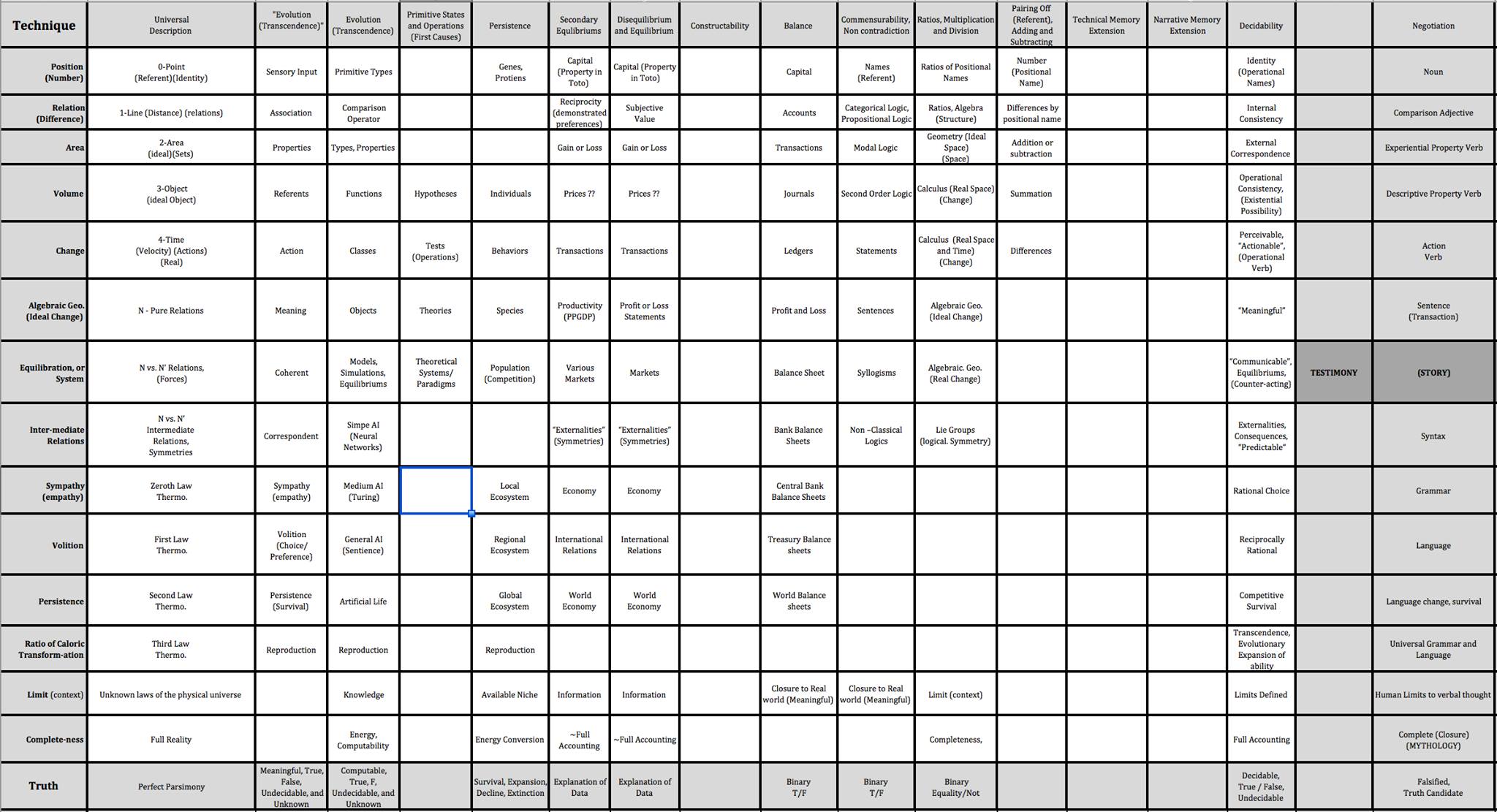
    photos_and_videos/TimelinePhotos_43196237263/23270166_10155863047107264_3494891149688064566_o_10155863047107264.jpg Dimensions of reality on Y axis from upper right to bottom. Minimum to Ordinary Language grammars on X upper right to left. Truth criteria along the bottom. Right most column ordinary language.

    So I have a lot of revision to do with this but in general, the idea is that in every deflationary ‘grammar’ we find the same sequence of constructs, and those constructs correspond to dimensions of reality.James BrittinghamKnow you’re busy, but if you could post link to pdf or other downloadable version, would be great. Can’t read this.Nov 07, 2017 11:35amCurt DoolittleIt’s plenty large enough on desktop (it’s hi rez) but if you look at it on a mobile it will be cut down.Nov 07, 2017 11:37amBill JoslinThe thought I had when looking at this earlier was breakthroughs in human cognition followed a pattern.

    Persception -> deconflation -> finding a unit of measure -> finding commensurability. Breakthroughs occur when commensurability between disperate domains are discovered, which then gives rise to better measures. Discovering the common relation reveals commensurable measure. Operational epistemology focusses on relations as primary and identity/domains as secondary (or contingent).Nov 07, 2017 11:43amCurt DoolittleExactly. although I think we find commensurability and then measure but it could be two sides of the same coin.Nov 07, 2017 11:45amJames BrittinghamOkay thanks.Nov 07, 2017 11:45amBill JoslinInhibitions to human cognition follow the inverse pattern.

    Persception -> conflation -> generalization-> faked commensurabilityNov 07, 2017 11:46amBill JoslinI agree. Particular measures with in a domain which afford recognition of the common relation which reveals commensurability, which is a new or refined measure.Nov 07, 2017 11:48amBill JoslinBridgman was right – defining concepts by operations aligns better with reality, but I would take this further and say that identity names or labels a set of constant relations with in boundaries. Substantive or object based identity names by boundary and misses the constant relations. By missing the constant relations the interaction of identities becomes obscured (operations at higher orders is obscured)Nov 07, 2017 11:52amBill JoslinThis is huge and very importantNov 07, 2017 11:52amBill JoslinIdentity = bound constant relationsNov 07, 2017 11:54amCurt Doolittleoooohhh,… nice.Nov 07, 2017 12:48pmWilliam L. BengeThus allowing all items on one’s horizon to be authentically identified and identifiable, from which the actor is enabled to decipher the real relationships between each; understanding. And, from that newly obtained vantage, proceed to decipher one’s best preferred volitional action, or really interaction. A methodology or science for development of efficacy; personal or group wisdom? I do think so.Nov 07, 2017 12:49pmBryan Nova BreyOver here too @[1255416290:2048:Blake Southwood]. I think you should friend request Curt.Nov 08, 2017 2:05amDimensions of reality on Y axis from upper right to bottom. Minimum to Ordinary Language grammars on X upper right to left. Truth criteria along the bottom. Right most column ordinary language.

    So I have a lot of revision to do with this but in general, the idea is that in every deflationary ‘grammar’ we find the same sequence of constructs, and those constructs correspond to dimensions of reality.

    Source date (UTC): 2017-11-07 11:27:00 UTC