Theme: Measurement

  • Yes it’s physically impossible. Hence why we use triangles as the unit of measur

    Yes it’s physically impossible. Hence why we use triangles as the unit of measure, and hence why even in your and my human brain, the world is effectively stored as spatial triangles and ternary logics.


    Source date (UTC): 2024-04-23 15:38:35 UTC

    Original post: https://twitter.com/i/web/status/1782796216788451686

    Reply addressees: @vertetluisant

    Replying to: https://twitter.com/i/web/status/1782795748590985409

  • CURT: DO YOU KNOW CHRIS LANGAN? POTENTIAL FOR INTERSTING CONVERSATION? Yes, but

    CURT: DO YOU KNOW CHRIS LANGAN? POTENTIAL FOR INTERSTING CONVERSATION?

    Yes, but while I can understand Chris, I do not think he does or can understand my work – partly because it is so much work to undrestand – and partly because my criticism of his framing (because there is more than a grain of truth to what he intuits) is something I don’t think he could tolerate.

    My Understanding of Our Differences:

    Curt: I disambiguate all logics from narrative to formal cognition and seek unity between them with a paradigm, vocabulary, logic and methodology of universal commensurability. A constructive logic. This ends up with a very simple description of the natural and necessary evolutionary operation of the universe where humans are but an interesting outlier at the edge of the universe’s ability, by trial and error, to compute increasing complexity in defeat of entropy.

    Chris: Chris does the opposite of trying to conflate all the logics into a single homogenous system, to make a cohere and consistent system of thought across all logics. But this system attributes agency to the universe or to god rather than necessary natural processes.

    So we are both seeking coherence across logics (or what some call wisdom literatures) but from opposite directions.

    But the difference, in other words, exists because Chris and I have opposite agendas somewhat in solving the problem of unification of the wisdom literatures and disciplines into a consistent system of thought.

    I think you would find my work has a greater capacity to suppress error, bias, deceit, fraud, evasion, denial, manipulation, projection, accusation, sedition and treason. Because that was my intention: Law.

    And this difference is largely because I set out to stop lying and false promise in public to the public in matters public particularly by the government, media, and public intellectuals, as well as finance and commerce.

    And from what I can grasp I understand Chris is setting out to assist the individual in forming a universal frame of understanding of the universe without conflict between the various logics.

    Of course I am willing to be wrong here, but I think at a high level this is about correct.

    Both of these approaches have benefits. To some degree my work demonstrates what Chris is doing and why it’s of value.

    I am not confident he could make the same assessment of mine.

    Because our criteria for provision of decidability and right action differs.

    Cheers

    Reply addressees: @JimReckoning @RealChrisLangan


    Source date (UTC): 2024-04-19 21:55:55 UTC

    Original post: https://twitter.com/i/web/status/1781441623152271360

    Replying to: https://twitter.com/i/web/status/1781433966219931668

  • Topic: Why We Know We’re Right, And Physics Finally Knows Why It’s Wrong. πŸ˜‰ To:

    Topic: Why We Know We’re Right, And Physics Finally Knows Why It’s Wrong. πŸ˜‰

    To: NLI Followers, All;

    You know, I’m doing a bit more work on the foundations of physics again (explaining the ternary logic of evolutionary computation), and the nagging little voice in the back of my head, that predicts nitwittery by critics is saying “but your not a physicist!” To which my answer would be, not really, but i’m not ignorant of physics or mathematics, and at the root of it all, I’m an epistemologist – and I don’t know of a better one living or dead. If I did I’d return to making money and living the rather exciting life I did previously.

    But I am, and the generations that follow me, are also going to be, falsificationary (really, darwinian adversarial) epistemologists. Why?

    Because just as there was a switch from justification to falsification in research as our explorations exceeded human scales of perception, the same is true for both logic itself and truth itself: all logic and all truth claims are falsificationary not justificationary: meaning what survives is a truth candidate, but falsehood is more certain that truth candidacy. As such epistemology consists not of proofs of correctness but of tests of possibility first, and tests of competitive survivability second, and hopefully tests of first causal construction third and finally. All of which only eliminate less competitive claims.

    In other words, we can catalog what errors, biases (and yes deceits) humans make in their work because they lack sufficient understanding of the foundations of the grammars from mathematics, to the disciplines, to testimony, to ordinary language, to fictions, to fictionalisms, to evasion, to denial, to deceit, to projection (reversal, reflection, accusation)… and yes, to undermining, canceling, sedition and treason.

    As such just as there exists a catalog of first causes of constructive logic of all existence there is a catalog of first causes of all existence of ignorance error, bias and deceit.

    Meaning there is a constructive logic for falsification of all truth and falsehood claims sufficient to expose whether the information necessary to make the claim is insufficient, possibly sufficient, or sufficient in its falsehood. Thus disambiguating what is known and unknown regardless of the individual or group’s claim.

    And I have, or at least Martin Stepan and I have, working together, documented them in painful detail as a formal system of ignorance, error, bias, and deceit.

    And we have even categorized them as sex differences in cognitive processing and the *reasons* for sex difference in cognitive processing that results in different success failure falsehood deceit sedition and warfare. Which of course is where we found the first principle of human variance other than in neoteny and ability: sex differences in cognition and valuation and their distribution across the population: responsibility.

    These sex differences and foundations of them, strangely enough, appear, at least to the public, to be the most interesting of the discoveries I have, and we have, produced over our more than twenty five years of effort.

    So we have in our work produced both a constructive logic of existence and a constructive logic of ignorance, error, bias, and deceit, providing near universal falsifiability of truth or possibility claims.

    Yes, really.

    And in the most illustrative examples currently facing us are in the failure of physics, and explaining the failure of physics, and the origin of that failure in physics as the Ashenazi (feminine) vs European (masculine) differences in cognitive construction (yes it’s real and substantive at the margins) where Maxwell to Hilbert could not quite come to a physical solution but Einstein and Bohr came to a verbal half-solution, but given the rapid expansion of physics in response to that discovery expanded the population and indoctrinated them into the mathematics of descriptive continuousness instead of the mathematics of causal discreteness and physical models.

    So I am pretty confident that the following things are true:
    1) Because of entrenchment (malinvestment) scientific progress proceeds with tombstones (thank you Dr Kuhn). So this transition will take some time.
    2) Because scientific funding follows convention, institutional transformation of funding may take tombstones.
    3) Because education lags innovation, theorists may lag recognition.
    4) The universe is physical, homogenous in base constitution, discrete, operational, and painfully simple. And if I’m correct most of the answers are already know at the fringes, and we could finish the foundations of physics within a decade if it was sponsored by an absurdly large reward for doing so by the state.

    And how do I know this?
    Because I know, and now we know, how and why humans demonstrate ignorance, error, bias, and deceit on one hand and the first principle of the universe from which all existence is constructed by the ternary logic of evolutionary computation. πŸ˜‰

    We stand on the shoulders of giants who came before us.. but we are closer to ‘knowing’ the unknown than we though were a century ago, only to discover were weren’t’. πŸ˜‰

    Cheers

    Curt Doolittle
    The Natural Law Institute
    The Science of Cooperation

    Source date (UTC): 2024-04-19 17:44:47 UTC

    Original post: https://twitter.com/i/web/status/1781378426307334144

  • See PP as age by quintile

    See PP as age by quintile.


    Source date (UTC): 2024-04-18 19:07:25 UTC

    Original post: https://twitter.com/i/web/status/1781036832945238138

    Reply addressees: @ltcassociates @RichardHanania

    Replying to: https://twitter.com/i/web/status/1781036200939393408

  • My work uses Constructive Operationalism, or a constructive logic of operational

    My work uses Constructive Operationalism, or a constructive logic of operational transformations – which for brevity I shorten to ‘operationalism’ and probably shouldn’t.

    Constructive operationalism is a methodology that defines concepts in terms of the specific sequence of constructive operations required to generate or instantiate them from first principles. It emphasizes the algorithmic nature of reality, viewing phenomena as the result of step-by-step processes or computations that transform inputs into outputs or one state into another.

    Key principles of constructive operationalism:

    Constructive definitions: Concepts are defined in terms of the specific sequence of constructive operations or algorithms that generate or instantiate them from first principles. These operations are grounded in physical reality and can be computationally, chemically, biologically, or cognitively realized.
    Algorithmic nature of reality: Reality is viewed as fundamentally algorithmic, with phenomena arising from the execution of specific sequences of constructive operations or state transformations.
    Step-by-step construction: Phenomena are explained by specifying the precise sequence of constructive operations that generate them, emphasizing the step-by-step nature of the process and the transformation of inputs into outputs.
    Constructed from first principles: The constructive operations are derived from a set of first principles, which serve as the foundational building blocks for generating more complex concepts and phenomena.
    Falsifiability: Constructive operational definitions are subject to rigorous falsification tests, with the ability to withstand attempts at refutation serving as a key criterion for their validity and reliability.
    Emphasis on generative mechanisms: Explanations focus on the generative mechanisms or constructive processes that give rise to phenomena, providing a causal understanding of how things come to be.
    Avoidance of abstract entities: Constructive operationalism avoids invoking abstract or Platonic entities, grounding concepts and explanations in concrete, physically realizable operations and processes.

    Constructive operationalism builds upon the insights of intuitionism and operationalism, but distinguishes itself by emphasizing the constructive, generative nature of concepts and phenomena. It goes beyond mere measurement procedures to specify the precise sequence of operations required to construct concepts from first principles.

    By grounding definitions in physical processes and subjecting them to falsification tests, constructive operationalism seeks to provide a more rigorous, causally grounded understanding of reality. It aims to reveal the algorithmic nature of phenomena and provide step-by-step explanations of how things come to be.

    Constructive operationalism has implications for various fields, including computer science, artificial intelligence, cognitive science, and philosophy of science. It provides a framework for understanding the generative mechanisms underlying phenomena and offers a principled approach to defining and explaining concepts in terms of their constructive operations.

    Overall, constructive operationalism represents a novel synthesis of intuitionist, operationalist, and falsificationist ideas, offering a powerful framework for understanding reality in terms of the constructive processes that give rise to it.


    Source date (UTC): 2024-04-18 11:07:40 UTC

    Original post: https://twitter.com/i/web/status/1780916101016137728

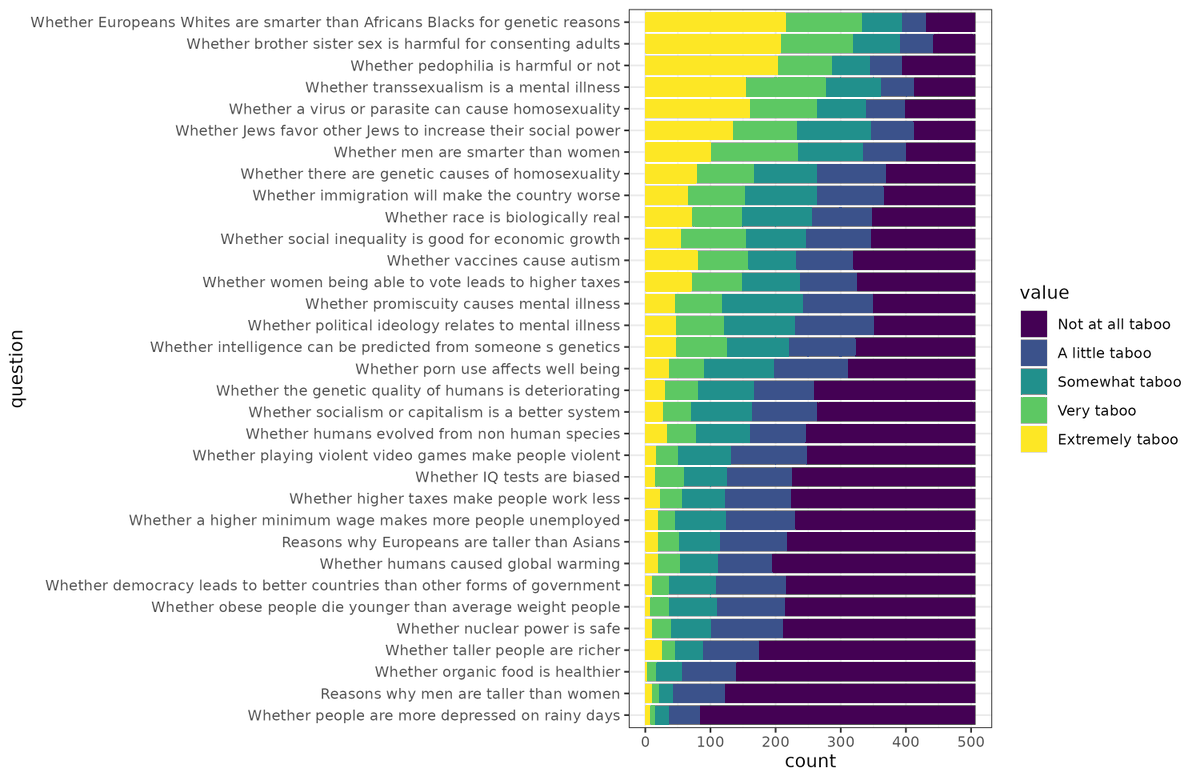
  • Measurement of Taboos (Every taboo is true)

    Measurement of Taboos (Every taboo is true)

    Measurement of Taboos
    (Every taboo is true) https://t.co/mA3m7AoEEx


    Source date (UTC): 2024-04-17 20:20:57 UTC

    Original post: https://twitter.com/i/web/status/1780692950269501945

  • “Q: Curt: What are your refutations of the arguments against operationalism?”–@

    –“Q: Curt: What are your refutations of the arguments against operationalism?”–@GiwdulBielsira;

    Great question. Thanks for asking.

    I should write a full article addressing the old issues with the various operational schools and intuitionism et al.
    Simple answer, if you understand the debate:
    (a) falsification vs justification
    (b) testifiability vs meaning
    (c) decidability vs undecidability
    (c) performative vs ideal truth
    (d) constructive vs descriptive
    (e) analogy to experience vs fictionalism
    (f) first principles vs measurements
    (g) relative completeness vs previous era ignorance
    (h) explicit incompleteness vs implicit or fictional
    (i) near impossibility of lying vs ease of lying
    (j) Bridgman/Brouwer vs interpretations
    AND;
    1) Operationalism/Intuitionism were influential in causing reform in physics, psychology, and linguistics.
    2) Utility in proportion to questions of human scale (this requires explanation) and highest in law because it is at human scale. (May require some understanding of my wok on the spectrum of grammars).
    3) Current challenge in ai revolution b/c of brute forcing via language, and subsequent awareness of embodiment and recursive falsification as necessary to solve the problem.
    SO;
    Bridgman was early. Did not and could not complete the project. He could not overcome association with positivism rather than darwinian survival (falsification).
    AFAIK I have. And no criticism has yet survived.

    Cheers


    Source date (UTC): 2024-04-17 14:55:53 UTC

    Original post: https://twitter.com/i/web/status/1780611141997076480

  • PHILOSOPHY ENDED IN THE LAST CENTURY The problem with philosophical tradition is

    PHILOSOPHY ENDED IN THE LAST CENTURY
    The problem with philosophical tradition is that it’s predicated on textual and scriptural interpretation. It’s verbal not operational.

    But words don’t mean things, people mean things and they satisfy the demand for unambiguity, consistency, correspondence, and the possibility – or they don’t.

    So the entire program seems to have ended somewhere between Godel and Kripke: The reliance on set logic rather than operations, on non-contradiction vs operational possibility, on ideals rather than distributions, and ignoring costs, rather than accounting for them.

    In other words: Performative truth can only consist of satisfaction of demand for decidability in the context (which, like math and measurement, determines the degree of precision – scale dependence).

    Continental Philosophy still survives because the continent is still trying to find a bias to human experience, rather than a scientific description of human experience that we can determine is correct given its complete explanatory power for all experience.

    I have no idea why philosphy departments still survive and I doubt they will outlast the next generation.

    But people don’t want to pay the cost of learning the sciences, so they stay with literature, which remains somewhat intuitionistic.

    It’s hard to teach people to reason (or calculate) entirely. We all want to intuit rather than reason. (avoid the cost).

    But the discount on thought results from malinvestment in what is intuitionistically accessible, (cheap to test), and creates high costs over time.

    The investment in learning independent of intuition, then using it to explain intuition, produces long-term returns.

    So the cheap route, as always, produces its own limits (ceiling).

    Cheers


    Source date (UTC): 2024-04-17 00:32:55 UTC

    Original post: https://twitter.com/i/web/status/1780393969232363520

  • RT @JayMan471: Note that (measured) measurement error is huge for political view

    RT @JayMan471: Note that (measured) measurement error is huge for political views (exceeding 0.5 for some matters), so the heritability is…


    Source date (UTC): 2024-04-16 14:25:46 UTC

    Original post: https://twitter.com/i/web/status/1780241177310101883

  • IT’S ALL WORD SALAD TO YOU? This is why my writing looks like word salad to you:

    IT’S ALL WORD SALAD TO YOU?
    This is why my writing looks like word salad to you:

    1) It’s much closer to mathematics and programmatic logic than it is to ordinary english. In fact it’s ‘a formal operational logic’ meaning a lot like programming.

    2) All technical fields prevent ambiguity and confusion by using terms specific to the context. (again, my work is much closer to programmatic logic) In effect instead of analogies, technical fields use terms as the equivalent of names or measurements.

    3) There is a presumption among ordinary people that ethical, moral, and legal language should be composed in ordinary language – despite that ordinary language is ambiguous, loaded, framed, and full of ignorance, error, bias and deceit.

    So, if instead, I wrote everything in algorithmic prose using legal document structure, then you would not assume that you would understand it.

    Can you read the law? Can you read software programs? Do you understand the foundations of mathematics? Of language and grammar? Of cognitive science? Of Economics? Of course you don’t. But do you criticize them for their ‘word salad’? Yet, I use concepts from all those fields and many others.

    But because enough people DO understand my work (our work at the institute since it’s more than just me), and because I don’t want to ‘scare people off’ by using math, formal logic, or formal operational logic (programming), I write as I do, and people either stick around to learn or they don’t.

    This strategy serves as a filtering system to keep away people who lack the capacity (and degrade the conversation) and encourages those that do (that improves the conversation).

    I’ve been a public intellectual for over a decade now, and the ‘word salad’ accusation is the equivalent of claiming calculus is false because it’s hard’. Yes my work is hard. It takes work to understand.

    So does every other scientific discipline. ‘)

    -Hugs

    Reply addressees: @PlayerJuan96


    Source date (UTC): 2024-04-15 20:57:17 UTC

    Original post: https://twitter.com/i/web/status/1779977315553890304

    Replying to: https://twitter.com/i/web/status/1779947987919356371