Theme: Measurement

  • Do so when it crosses your mind. Helps me measure how the ideas are spreading. ;

    Do so when it crosses your mind. Helps me measure how the ideas are spreading. 😉

    -hugs


    Source date (UTC): 2024-05-15 19:27:08 UTC

    Original post: https://twitter.com/i/web/status/1790826266435653796

    Reply addressees: @Tysenberg @minordissent

    Replying to: https://twitter.com/i/web/status/1790823537382494503

  • THE THREE GRAMMARS OF EXPERIENCE REQUIRE THREE DIFFERENT CRITERIA FOR EXISTENCE.

    THE THREE GRAMMARS OF EXPERIENCE REQUIRE THREE DIFFERENT CRITERIA FOR EXISTENCE.

    –“Q: Curt: How is it you have this certainty that the spiritual terms are nonsense”–

    There are three possible forms of existence: material persistence independent of us. Verbal description of experience dependent upon us but sharable. And Intuitionistic experience dependent upon the individual, both impersistent and un-sharable.

    So, do you mean scientifically as in testifiable(material), or the sense of literary and philosophical phenomenalism(verbal), in the sense of theological intuition of supernatural observation(imaginary) of alternate dimensions, or universes?

    If there is some analogy across all three of those frames (demonstrable, descriptive, and imaginary) then we can say we are referring to the same shared experience.

    If, instead, you mean that the phenomenal, or the imaginary exists other than as experience or imagination then that is neither demonstrable, testifiable, sharable, and it is false.

    At this point we know enough about the structure of the universe that any system of information transfer other than those we are aware of is impossible. And we cannot find one single example of the supernatural despite legions of people seeking to discover one, and legions of professionals determining their false every, single, time.

    I can address the spiritual, and just as a movie or novel or scripture can convey a set of imagined and felt qualia to you, it can be explained. This does not mean anything other than that these are three levels of the mind, that correspond to the hierarchy of mental processing. And that mental processing is biased toward the internal sensory(feelings), the external and internal empathic(others), or the external systemic (action).

    So, you cannot testify to the spiritual, but that does not mean the experience is irrelevant or not meaningful to you. As long as you do not engage in self harm by (addiction) to a falsehood.

    Cheers
    CD

    Reply addressees: @HakeemDemi


    Source date (UTC): 2024-05-14 00:22:03 UTC

    Original post: https://twitter.com/i/web/status/1790175710356688896

    Replying to: https://twitter.com/i/web/status/1790164454241698051

  • A math formula, a statement in formal logic, a physics equation, a chemistry ske

    A math formula, a statement in formal logic, a physics equation, a chemistry skeletal formula, an electronic circuit, an assembly language program, most economics, a set of blueprints, a balance sheet, a good portion of legislation, regulation and law, and certainly my work are ‘word salad’ to those ignorant of the skills necessary to understand them. If you interpret something as word salad you are simply identifying that which your ignorant of. 😉

    Reply addressees: @TOEwithCurt


    Source date (UTC): 2024-05-12 19:39:15 UTC

    Original post: https://twitter.com/i/web/status/1789742154002083840

    Replying to: https://twitter.com/i/web/status/1789738461789831598


    IN REPLY TO:

    Unknown author

    Chris Langan is on Curt Jaimungal’s TOE (@TOEwithCurt) today. Speaking nonsense again, and Curt isn’t capable of handling him. It’s funny that I can find some truth in what Chris says but he’s a bit of a phenomenalist and says ‘start with perception’.
    But that’s rather silly since the universe is constructed from trivial rules, everything in it is emergent from those trivial rules, including the neurons that emerge from those same principles.
    The universe consists of the defeat of entropy by the production of density that survives in persistent relations – and neurons identify sets of persistent relations.
    The only theory we need is evolutionary computation by discovery of stable relations, and the hierarchy of emergent possibilities for recombination and the possible operations they can perform, that emerge from these assemblies – what we call disciplines.
    So of course he doesn’t understand Wolfram as simply running evolutionary simulations to identify emergences.
    Consequence of combinations are are computationally (operationally reducible) but they are not computationally predictable, nor are they mathematically reducible and so cannot be mathematically predictable.
    It’s not that complicated.
    CD

    Original post: https://x.com/i/web/status/1789738461789831598

  • The Universal Grammar of Language: Measuring Existence (~750 Words) Language is

    The Universal Grammar of Language: Measuring Existence

    (~750 Words) Language is a system of measurement, made commensurable using marginal indifference in body, sense, and perception, describing all of existence that’s reducible to analogy of human experience, consisting of a sequential stream of sounds or symbols, producing increasing precision(disambiguation), that by the process of continuous recursive disambiguation(sentences) of an identity(concept, experience, scene) upon which we consent to (agree to) some degree of shared meaning (shared experience), using the universal grammar of language, of evolution, of physics, of the quantum background, of existence: Evolutionary Computation by continuous recursive disambiguation of entropy(energy, disorder) into negative entropy(mass, order), thus creating complexity by the defeat of entropy. We can describe the universe because language relies on the same logic as the universe.
    Ok so that’s high level how language works, and why it’s a sharable experience, and why we can gradually describe more of the universe with it – because it’s following the same rules as the evolution of all else in existence.
    But what ‘measurements’ does language consist of? Words. All words are names. Names of things that don’t change (nouns, pronouns, adjectives), names of things that are changing some state or other (verbs, adverbs,), names of their relations.
    How does arithmetic differs from language? Ordinary language consists of names of states, or changing states. So we can use verbs for actions(run), nouns to generalize them(movement), and adjectives that generalize temporary states (motionless).
    Vocabularies consist of words that serve the need for the totality of expression in a population in human life.
    Paradigms consist of subsets of vocabulary defining or limiting the dimensions permissible in the use of vocabulary, logic, grammar and syntax.
    Human macro-paradigms are: |Paradigmatic Evolution|: Embodiment > Anthropomorphism(counting) > Mythology(Arithmetic) > Religion(Math) > Philosophy(Geometry) > Empiricism(Algebra) > Science(Calculus) > Operationalism(Construction).
    The paradigm of Arithmetic is extremely simple. 1. All names consist of ratios to whatever identity we choose to reference. 2. All operators are +, -, *, /, =. 3. All results of operations are equal, unequal, and unequal by less than or more than.
    And the Consequences of the Vocabulary, Logic, Grammar and Syntax of Arithmetic are Very Simple
    1. Arithmetic is an extremely minimal language that consists of names (digits, glyphs of position (positional vocabulary)), phrases (positional names), verbs (operators), and agreements (unequal, equal, and modifiers, less than and more than.)
    2. The names are however context independent: they can refer to anything we choose.
    3. Positional names are unique: so they are memory, conflation, inflation, and ambiguity independent.
    4. Operations on positional names are also deterministic, operationally closed, logically closed, and ambiguity invariant, and as such arithmetic operations are interpretation independent.
    5. Positional names are unlimited in construction. So by combining unlimited construction and context independence we achieve scale independence.
    6. We perform mathematics in our minds even if we record it with tools. As such arithmetic operations are also time and cost independent.
    7. And given that it can be written, arithmetic is memory, and visualization independent.
    CLOSING
    So, while ordinary language that describes the existential world is vulnerable to context, ambiguity interpretation, scale, time, and cost variation, arithmetic REMOVES THOSE DIMENSIONS from the paradigm, with it’s simple paradigm, vocabulary, logic, and grammar. As such we have no choice but to follow simple rules of addition subtraction, multiplication and division in order to sense, perceive, and judge that which is otherwise beyond our perception, comprehension, memory, and reason.
    This is why arithmetic works.
    It’s an innovation in language and writing that extends our capacity beyond our native memory perception and reason.
    And when combined with the balance scale of double entry accounting lets us weigh and measure complex human cooperation at extraordinary scale and complexity over extraordinary time.
    Now, this is the basis of understanding all paradigms. What dimensions, terms, and agreements are necessary and which are prohibited in order to prevent human vulnerability to variations in context, ambiguity, interpretation, scale, time, and cost – and lying.
    The unification of the sciences whether formal (language and logic), physical, behavioral, or evolutionary, can be achieved through this same analysis and the disambiguation of terms such that they are universal across the sciences instead of unique to them, and the uniqueness necessary in the sciences is derived from and explain d by the universal definitions that are constructed from the first principles: evolutionary computation of the defeat of entropy by the discovery of persistency in the form of ever increasing organizations of complex mass.
    Cheers Curt Doolittle The Natural Law Institute

    Source date (UTC): 2024-05-07 04:32:39 UTC

    Original post: https://x.com/i/articles/1787702060579750122

  • (~750 Words) Language is a system of measurement, made commensurable using margi

    (~750 Words)
    Language is a system of measurement, made commensurable using marginal indifference in body, sense, and perception, describing all of existence that’s reducible to analogy of human experience, consisting of a sequential stream of sounds or symbols, producing increasing precision(disambiguation), that by the process of continuous recursive disambiguation(sentences) of an identity(concept, experience, scene) upon which we consent to (agree to) some degree of shared meaning (shared experience), using the universal grammar of language, of evolution, of physics, of the quantum background, of existence: Evolutionary Computation by continuous recursive disambiguation of entropy(energy, disorder) into negative entropy(mass, order), thus creating complexity by the defeat of entropy. We can describe the universe because language relies on the same logic as the universe.

    Ok so that’s high level how language works, and why it’s a sharable experience, and why we can gradually describe more of the universe with it – because it’s following the same rules as the evolution of all else in existence.

    But what ‘measurements’ does language consist of?
    Words. All words are names. Names of things that don’t change (nouns, pronouns, adjectives), names of things that are changing some state or other (verbs, adverbs,), names of their relations.

    How does arithmetic differs from language?
    Ordinary language consists of names of states, or changing states. So we can use verbs for actions(run), nouns to generalize them(movement), and adjectives that generalize temporary states (motionless).

    Vocabularies consist of words that serve the need for the totality of expression in a population in human life.

    Paradigms consist of subsets of vocabulary defining or limiting the dimensions permissible in the use of vocabulary, logic, grammar and syntax.

    Human macro-paradigms are:
    |Paradigmatic Evolution|: Embodiment > Anthropomorphism(counting) > Mythology(Arithmetic) > Religion(Math) > Philosophy(Geometry) > Empiricism(Algebra) > Science(Calculus) > Operationalism(Construction).

    The paradigm of Arithmetic is extremely simple.
    1. All names consist of ratios to whatever identity we choose to reference.
    2. All operators are +, -, *, /, =.
    3. All results of operations are equal, unequal, and unequal by less than or more than.

    And the Consequences of the Vocabulary, Logic, Grammar and Syntax of Arithmetic are Very Simple

    1. Arithmetic is an extremely minimal language that consists of names (digits, glyphs of position (positional vocabulary)), phrases (positional names), verbs (operators), and agreements (unequal, equal, and modifiers, less than and more than.)

    2. The names are however context independent: they can refer to anything we choose.

    3. Positional names are unique: so they are memory, conflation, inflation, and ambiguity independent.

    4. Operations on positional names are also deterministic, operationally closed, logically closed, and ambiguity invariant, and as such arithmetic operations are interpretation independent.

    5. Positional names are unlimited in construction. So by combining unlimited construction and context independence we achieve scale independence.

    6. We perform mathematics in our minds even if we record it with tools. As such arithmetic operations are also time and cost independent.

    7. And given that it can be written, arithmetic is memory, and visualization independent.

    CLOSING

    So, while ordinary language that describes the existential world is vulnerable to context, ambiguity interpretation, scale, time, and cost variation, arithmetic REMOVES THOSE DIMENSIONS from the paradigm, with it’s simple paradigm, vocabulary, logic, and grammar. As such we have no choice but to follow simple rules of addition subtraction, multiplication and division in order to sense, perceive, and judge that which is otherwise beyond our perception, comprehension, memory, and reason.

    This is why arithmetic works.

    It’s an innovation in language and writing that extends our capacity beyond our native memory perception and reason.

    And when combined with the balance scale of double entry accounting lets us weigh and measure complex human cooperation at extraordinary scale and complexity over extraordinary time.

    Now, this is the basis of understanding all paradigms. What dimensions, terms, and agreements are necessary and which are prohibited in order to prevent human vulnerability to variations in context, ambiguity, interpretation, scale, time, and cost – and lying.

    The unification of the sciences whether formal (language and logic), physical, behavioral, or evolutionary, can be achieved through this same analysis and the disambiguation of terms such that they are universal across the sciences instead of unique to them, and the uniqueness necessary in the sciences is derived from and explain d by the universal definitions that are constructed from the first principles: evolutionary computation of the defeat of entropy by the discovery of persistency in the form of ever increasing organizations of complex mass.

    Cheers
    Curt Doolittle
    The Natural Law Institute


    Source date (UTC): 2024-05-07 04:24:26 UTC

    Original post: https://x.com/i/articles/1787699993517686784

  • What Does Language Consist of And Why Does It Work? Language is a system of meas

    What Does Language Consist of And Why Does It Work?
    Language is a system of measurement, made commensurable using marginal indifference in body, sense, and perception, describing all of existence that’s reducible to analogy of human experience, consisting of a sequential stream of sounds or symbols, producing increasing precision(disambiguation), that by the process of continuous recursive disambiguation(sentences) of an identity(concept, experience, scene) upon which we consent to (agree to) some degree of shared meaning (shared experience), using the universal grammar of language, of evolution, of physics, of the quantum background, of existence: Evolutionary Computation by continuous recursive disambiguation of entropy(energy, disorder) into negative entropy(mass, order), thus creating complexity by the defeat of entropy. We can describe the universe because language relies on the same logic as the universe.

    Ok so that’s high level how language works, and why it’s a sharable experience, and why we can gradually describe more of the universe with it – because it’s following the same rules as the evolution of all else in existence.

    But what ‘measurements’ does language consist of?
    Words. All words are names. Names of things that don’t change (nouns, pronouns, adjectives), names of things that are changing some state or other (verbs, adverbs,), names of their relations

    How does arithmetic differs from language?
    Ordinary language consists of names of states, or changing states. So we can use verbs for actions(run), nouns to generalize them(movement), and adjectives that generalize temporary states (motionless).

    Vocabularies consist of words that serve the need for the totality of expression in a population in human life.

    Paradigms consist of subsets of vocabulary defining or limiting the dimensions permissible in the use of vocabulary, logic, grammar and syntax.

    Human macro-paradigms are:
    |Paradigmatic Evolution|: Embodiment > Anthropomorphism(counting) > Mythology(Arithmetic) > Religion(Math) > Philosophy(Geometry) > Empiricism(Algebra) > Science(Calculus) > Operationalism(Construction).

    The paradigm of Arithmetic is extremely simple.
    1. All names consist of ratios to whatever identity we choose to reference.
    2. All operators are +, -, *, /, =.
    3. All results of operations are equal, unequal, and unequal by less than or more than.

    And the Consequences of the Vocabulary, Grammar and Syntax are Very Simple
    1. Arithmetic is an extremely minimal language that consists of names (digits, glyps of position (positional vocabulary)), phrases (positional names), verbs (operators), and agreements (unequal, equal, and modifiers, less than and more than.)
    2. The names are however context independent: they can refer to anything we choose.
    3. Positional names are unique: so they are memory, conflation, inflation, and ambiguity independent.
    4. Operations on positional names are also deterministic, operationally closed, logically closed, and ambiguity invariant, and as such arithmetic operations are interpretation independent.
    5. Positional names are unlimited in construction. So by combining unlimited construction and context independence we achieve scale independence.
    6. We perform mathematics in our minds even if we record it with tools. As such arithmetic operations are also time and cost independent.
    7. And given that it can be written, arithmetic is memory, and visualization independent.

    CLOSING
    So, while ordinary language that describes the existential world is vulnerable to context, ambiguity interpretation, scale, time, and cost variation, arithmetic REMOVES THOSE DIMENSIONS from the paradigm, with it’s simple paradigm, vocabulary, logic, and grammar. As such we have no choice but to follow simple rules of addition subtraction, multiplication and division in order to sense, perceive, and judge that which is otherwise beyond our perception, comprehension, memory, and reason.

    This is why arithmetic works.

    It’s an innovation in language and writing that extends our capacity beyond our native memory perception and reason.

    And when combined with the balance scale of double entry accounting lets us weigh and measure complex human cooperation at extraordinary scale and complexity over extraordinary time.

    Now, this is the basis of understanding all paradigms. What dimensions, terms, and agreements are necessary and which are prohibited in order to prevent human vulnerability to variations in context, ambiguity, interpretation, scale, time, and cost – and lying.

    The unification of the sciences whether formal (language and logic), physical, behavioral, or evolutionary, can be achieved through this same analysis and the disambiguation of terms such that they are universal across the sciences instead of unique to them, and the uniqueness necessary in the sciences is derived from and explain d by the universal definitions that are constructed from the first principles: evolutionary computation of the defeat of entropy by the discovery of persistency in the form of ever increasing organizations of complex mass.

    Cheers
    Curt Doolittle
    The Natural Law Institute


    Source date (UTC): 2024-05-07 01:58:03 UTC

    Original post: https://twitter.com/i/web/status/1787663154593366016

  • (NLI Insights) Why Have We Formally Defined the Existing Sixth Sense Man Has Alw

    (NLI Insights)
    Why Have We Formally Defined the Existing Sixth Sense Man Has Always Had?
    (cognitive science, neuroscience)
    In our work over the past week we’ve separated the classical categorization of internal(interoceptive) and external(exterosensive) sensory systems into three, the third consisting of Spatial-Navigational Senses, which splits off Proprioception(position of body and limbs) and Vestibular Sense(orientation, particularly in response to gravity and present direction of movement) to join with the world model produced by the disambiguation of objects, spaces, and backgrounds (by the parietal lobe) necessary for movement, vs the disambiguation of objects with spaces necessary for manipulation, whether risk or opportunity (from the temporal lobe).

    Both of which, along with the other senses, feed into the organization of objects(action) and spaces(movement, navigation) into scenes, (the cortices that feed into the hippocampal region).

    And indexing the inputs to those scenes into episodes, storing those indexes (cumulative pattern of neural firings) creating memories of episodes and associating those episodes with other episodes (hippocampal region).

    Allowing us to predict potential consequences (futures), some of which capture our attention (thalamus), for immediate reaction by the amygdala(emotion), basal ganglia(threat), or delayed reaction by release into our prefrontal cortex (conscious control: short term memory, problem solving, goal pursuing, by recursion (feedback into the next moment of stimulation).

    Together producing the experience we call consciousness, which consists of a three dimensional body (muti-sensory system) and the dominance of a two dimensional sensory facility (vision) which it must self organize through training (repetition) into three dimensional spatial relations, and project upon it, a three dimensional approximation of objects(interests), space(navigation), and limits(backgrounds), using ‘invisible’ (intuitionistic) triangles (our facing direction), and hexagons of those triangles (bodily spaces), combined with eye direction, head direction, body direction, limb position, speed of movement, rate of turn, given internal bodily state, and together used to predict possible actions we can take in those spaces, with the bodies we have, in the condition were in, in the time we have to act given those circumstances.

    The result is another example of the universe’s use of ternary logic to gradually through hierarchies use simplicity to create extraordinary complexity through the competition between cells for coherence “neurons that fire together wire together”, so that those that ‘agree’ not only in the moment but over very short sequences (pulses) in time, that they are identifying similar stimuli extant in the real world wether internal external, or eventually, in the imaginary world of our auto association, imagination, memory, and fantasy.

    THE ARGUMENT
    Given our exteroceptive senses, our interoceptive senses, there are three interoceptive senses that reflect our homeostasis (visceroception, thermoception, and nociception), but the other two: proprioception(position) and vestibular sense(orientation) and the unstated sense that is perhaps the most important: three dimensional disambiguation in to objects, spaces, background and motion, appear to categorize a third category of related senses that we should logically separate from the historical categorizations.

    The traditional division into exteroceptive (external stimuli), interoceptive (internal state), and proprioceptive (body position) senses does capture a broad spectrum of our sensory experiences.

    Therefore, we propose to consider a separate category that specifically addresses spatial and navigational senses, because it adds clarity to the sensory processing framework, and illustrates the physical nature of the construction experience from first causes to intuitions to consciousness.

    TRADITIONAL CATEGORIES
    • Exteroceptive Senses: Detect external stimuli (e.g., vision, hearing, touch, taste, smell).
    • Interoceptive Senses: Monitor internal physiological states (e.g., hunger, thirst, the need for air, pain, internal temperature).
    • Proprioceptive Sense: Provides information about body position through receptors in the muscles, tendons, and joints.

    SUGGESTED THIRD CATEGORY:
    “Spatial-Navigational Senses”
    • Proprioception: Although traditionally categorized under proprioceptive senses, your suggestion to consider it in a separate spatial-navigational category emphasizes its role in spatial awareness rather than just body position.
    • Vestibular Sense (Balance and Orientation): Crucial for understanding body orientation in space, particularly in relation to gravitational forces.
    • Three-Dimensional Disambiguation: This involves the cognitive processing necessary to interpret and organize visual information into comprehensible structures like objects, spaces, backgrounds, and movements. It underpins our ability to navigate and interact effectively with our environment.
    (Note: we simply MUST come up with another totally incomprehensible term for this sense just so it’s consistently as obscure as the others.) 😉

    JUSTIFICATION FOR A NEW CATEGORY
    • Spatial Coherence: These senses collectively contribute to a coherent understanding of the body’s position and movement within three-dimensional space. They provide critical data not just on the body itself but on its relationship to the surroundings.
    • Cognitive and Behavioral Relevance: This grouping reflects their interconnected roles in facilitating cognitive functions such as navigation, motion perception, and spatial orientation, which are fundamental to survival and interaction with the environment.
    • Neurological Integration: These senses are deeply integrated at the neurological level, with significant interplay in areas of the brain involved in spatial memory, navigation, and motor coordination (e.g., the hippocampus, inner ear, cerebellum, and motor cortices).

    IMPLICATIONS OF THE NEW CLASSIFICATION
    • Research and Understanding: A reclassification might lead to more targeted research into how these senses interact and influence each other, potentially unveiling new insights into spatial perception and cognitive mapping.
    • Clinical Applications: Improved classification can enhance diagnostic and therapeutic approaches in neurology and rehabilitation, particularly for conditions affecting balance, movement, and spatial orientation.

    CLOSING
    By considering these senses as part of a dedicated spatial-navigational category, we could deepen our understanding of how humans interpret and maneuver through space, recognizing the complex interdependencies of these sensory systems.

    This approach respects the complexity of sensory processing and could refine our understanding of neural integration across different sensory modalities.

    Curt Doolittle
    The Natural Law Institute

    Source date (UTC): 2024-05-06 23:27:40 UTC

    Original post: https://twitter.com/i/web/status/1787625307492470785

  • RT @WalterIII: Watching @curtdoolittle offer his multidimensional model of knowl

    RT @WalterIII: Watching @curtdoolittle offer his multidimensional model of knowledge is like as if it were 1869 and you were watching Mende…


    Source date (UTC): 2024-05-05 01:32:39 UTC

    Original post: https://twitter.com/i/web/status/1786931984960249924

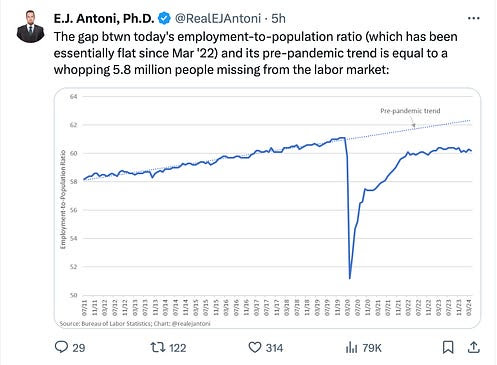
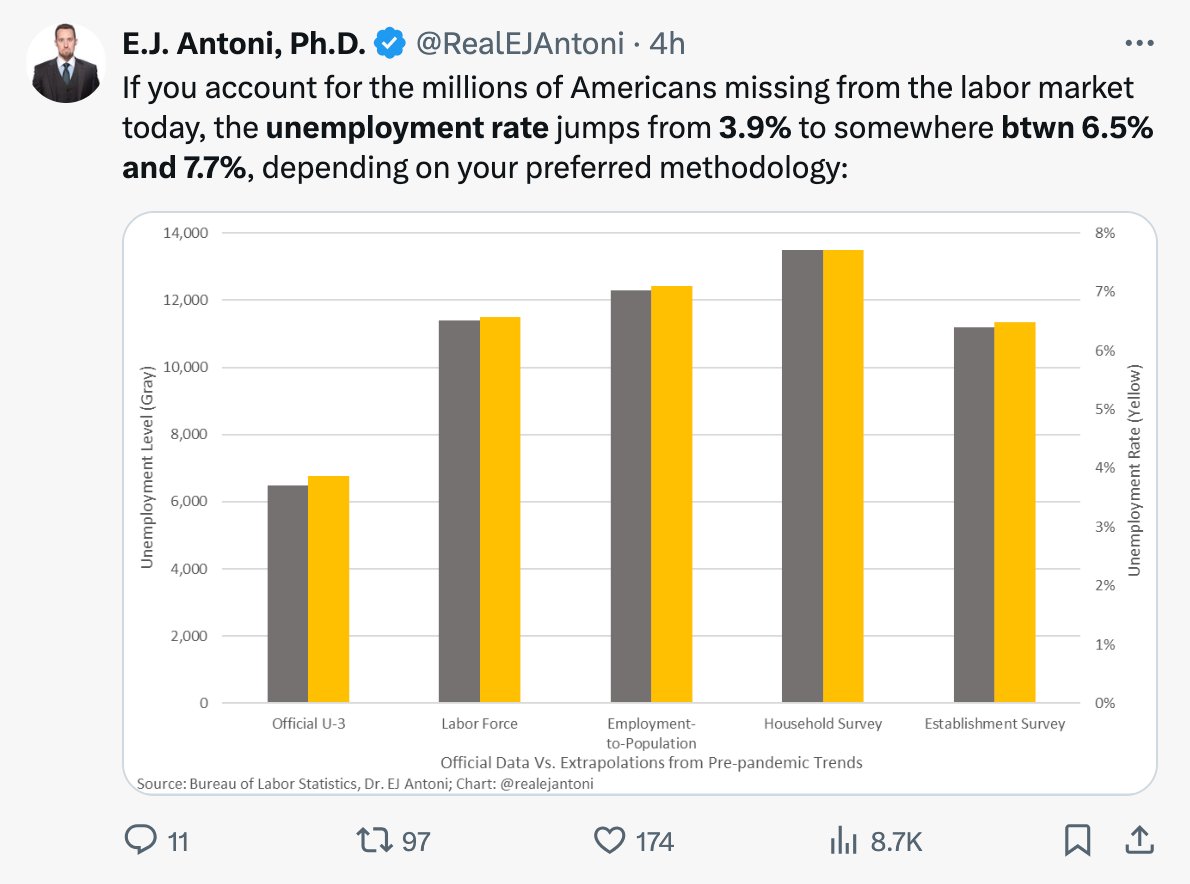
  • THE REAL UNEMPLOYMENT RATE IS 6.5-7.7% – AND THAT’S BEFORE THE REAL VS POSSIBLE

    THE REAL UNEMPLOYMENT RATE IS 6.5-7.7% – AND THAT’S BEFORE THE REAL VS POSSIBLE PARTICIPATION RATE.
    –“By the way, 3.9% unemployment rate wouldn’t be bad news if it was accurate. According to economist E.J. Antoni, the labor market is missing 5.8 million people (ie. the numbers… https://t.co/7rcx4YRbG7


    Source date (UTC): 2024-05-03 22:25:13 UTC

    Original post: https://twitter.com/i/web/status/1786522426282496372

  • Oh. Second: Smart point you made that I overlooked: 1. Authoritatively recognizi

    Oh. Second: Smart point you made that I overlooked:
    1. Authoritatively recognizing and mandating behavior (scripture) This is in fact I kind of empiricism despite that it is imprecise and evolves and reforms poorly.
    2. Debating the Good, or Seeking the Good (philosophy) which is why almost all behavioral, social, and political science failed. (justification always fails)
    3. Outlawing the Bad so that ANY and EVERY Good Remains (Science, Empiricism, Law) the only way to correct behavioral, social, and political science – as well as philosophy and theology for those who access frames by the literary (philosophy) or mythological(theology).

    Reply addressees: @WerrellBradley @SRCHicks


    Source date (UTC): 2024-05-03 20:14:39 UTC

    Original post: https://twitter.com/i/web/status/1786489567891050496

    Replying to: https://twitter.com/i/web/status/1786482372214497432