Um. You know. If i asked you “How would you go about creating a value-neutral, cross-disciplinary, fully commensurable language that could survive in court under testimony in all matters of conflict.”, I’ll bet you can’t even begin to imagine where to start and how to go about it. So yeah, that’s Propertarianism (or that’s the spectrum within Propertarianism, including vitruvianism->metaphysics, acquisitionism->psychology, compatibilism->sociology, propertarianism->ethics, testimonialism->epistemology, and algorithmic natural law->politics). And it includes reformation of every one of the grammars (disciplines). So of COURSE you aren’t going to understand THAT LANGUAGE off the bat. You aren’t going to understand how to convert from IDEAL language (pretense of knowledge) we use today to REAL language (demonstrating knowledge). Worse you are not going to understand how to convert your thinking from simple human scale justification, to post human scale via negativa falsification, and finally into well formed statements in operational language. So please don’t waste my time until you catch up to the people who HAVE done so. Ok. Yeah. Thanks. sigh…
Theme: Measurement
-
BETWEEN THE IDEAL AND THE REAL: LIMITS The difference between the ideal and the
BETWEEN THE IDEAL AND THE REAL: LIMITS
The difference between the ideal and the real, is limits. There are no infinities of morality, or charity, any more than of resources or measurements. The unlimited=the ideal, and the l limited=the real. We have a deep desire for simple rules. But simple rules without limits – including christian love – are ideals (errors), not reals (judgments).
Source date (UTC): 2018-11-05 00:29:00 UTC
-
No no no. It’s that I make, we make, a full accounting of costs. And we suppress
No no no. It’s that I make, we make, a full accounting of costs. And we suppress free riding, parasitism, fraud, duplicity, and dysgenia. LIke I said. You are thieves and we defend capital. Hyperconsumption, vs Anti Parasitism.
Source date (UTC): 2018-11-04 16:13:11 UTC
Original post: https://twitter.com/i/web/status/1059116358506557442
Reply addressees: @PRO__UNLIMITED @PopChassid
Replying to: https://twitter.com/i/web/status/1059102835198038017
IN REPLY TO:
Original post on X
Original tweet unavailable — we could not load the text of the post this reply is addressing on X. That usually means the tweet was deleted, the account is protected, or X does not expose it to the account used for archiving. The Original post link below may still open if you view it in X while signed in.
Original post: https://twitter.com/i/web/status/1059102835198038017
-
photos_and_videos/TimelinePhotos_SxeO6JU-xg/45379023_10156755438262264_542089049
photos_and_videos/TimelinePhotos_SxeO6JU-xg/45379023_10156755438262264_5420890494450270208_o_10156755438252264.jpg STEREOTYPES ARE THE NEXT “IQ” DEBATEJohn EdwardFor every individual who’s an exception to a stereotype, there’s someone who is that stereotype to the Nth degree. It balances out!Nov 4, 2018, 12:51 PMBill JoslinAnd why stereotypes are only accurate on the aggregate and not individual level.Nov 4, 2018, 12:55 PMVengefül BobmoranBy destroying the ability of various institutions to provide a more precise discrimination (degrees, diversity hires, section 8…), they are forcing us to fall back to the next best thing. Trying to push for equality increases our reliance on racial stereotypes.Nov 4, 2018, 1:41 PMCurt DoolittlesmartNov 4, 2018, 1:42 PMEthan Tricewe’re perfectly happy to accept broad generalizations like “smokers are likely to die young, therefore they have higher health insurance/life insurance premiums” or “young men are more dangerous drivers, so they have higher car insurance premiums” but as soon as you go into forbidden topics, then it’s suddenly inappropriate to generalize.Nov 4, 2018, 2:38 PMSaul SilverAddendum: for every individual who is an exception to a stereotype, there are plenty more who aren’t.Nov 4, 2018, 2:42 PMBill JoslinFor every individual who typifies one trait of a stereotype, they will deviate across other traits. It’s only across the aggregate that the stereotype fills out a definition and provides predictabilityNov 4, 2018, 2:45 PMVengefül BobmoranThey trick you into buying a universal principle, but they never adhere to it. They never reciprocate your sacrifice.
They are not against sexism.
They are not against racism.
They are not against theft.
They are not against genocide.
They are against you.Nov 4, 2018, 3:12 PMMark DossJust ask about NBA players and owners statisticsNov 4, 2018, 6:45 PMAndrew ParkerDespite making up less than half of the population….Nov 5, 2018, 11:31 AMSTEREOTYPES ARE THE NEXT “IQ” DEBATE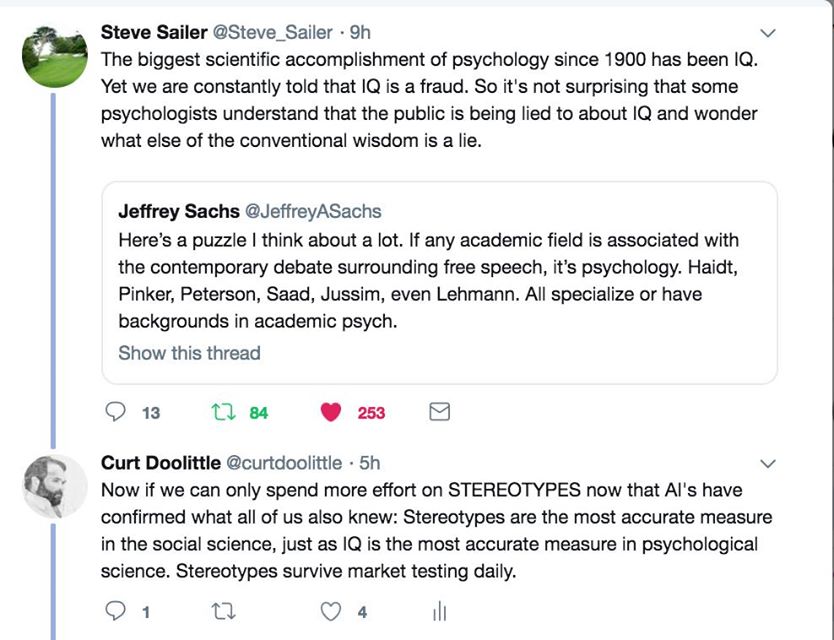
Source date (UTC): 2018-11-04 12:48:00 UTC
-
Now if we can only spend more effort on STEREOTYPES now that AI’s have confirmed
Now if we can only spend more effort on STEREOTYPES now that AI’s have confirmed what all of us also knew: Stereotypes are the most accurate measure in the social science, just as IQ is the most accurate measure in psychological science. Stereotypes survive market testing daily.
Source date (UTC): 2018-11-04 12:31:32 UTC
Original post: https://twitter.com/i/web/status/1059060577740488709
Reply addressees: @Steve_Sailer @vdare
Replying to: https://twitter.com/i/web/status/1058999484141645824
IN REPLY TO:
@Steve_Sailer
The biggest scientific accomplishment of psychology since 1900 has been IQ. Yet we are constantly told that IQ is a fraud. So it’s not surprising that some psychologists understand that the public is being lied to about IQ and wonder what else of the conventional wisdom is a lie. https://t.co/u8HX1UfQoR
Original post: https://twitter.com/i/web/status/1058999484141645824
-
RT @Steve_Sailer: The biggest scientific accomplishment of psychology since 1900
RT @Steve_Sailer: The biggest scientific accomplishment of psychology since 1900 has been IQ. Yet we are constantly told that IQ is a fraud…
Source date (UTC): 2018-11-04 12:29:31 UTC
Original post: https://twitter.com/i/web/status/1059060068048617472
-
Post Formatting and Syntax
“CURT: WHAT DOES YOUR |?????| >>> SYNTAX MEAN?”
—“Can you help me understand the syntax you use? What does the vertical bar ” | ” mean? And this ” > “?”— Eric Grose
Great Question: | DIMENSION | start limit > step > step > step > end limit. Where >, <, <-, and ->, state the direction. So you will see me use < < <, or > > >, or < < <- center -> > > depending upon the direction. It’s a “Dimension” definition, meaning an ordered range of values that are permissible for use in a property of a Class (definition). It defines the LIMITS (start and end) and COMPLETENESS (range of values), in PARSIMONIOUS FORM, thereby satisfying Testimonialism’s demand for both LIMITS and FULL ACCOUNTING for any warranty of due diligence against ignorance, error, bias, and deceit. Given a Class (Table), consisting of (a) Properties(Attributes) and their Values (data), (b) Relations (references), and (c) Methods (internal operations), and (d) functions (external operations), a Dimension provides the range of values permissible for a property. It’ is a geometric (linear, serialize) method of defining a dimension (table of values). So we convert: |TEACHING| Reading to > Lecturing > Socratic Teaching > Running a grad seminar > Running an MBA/Law course (case studies) > Running a Competitive Game > Military Training. Into: Define TEACHING: id: int, str: category. Insert TEACHING: | TEACHING | 1, Reading to 2, Lecturing 3, Socratic Teaching 4, Running a grad seminar 5, Running an MBA/Law course (case studies) 6, Running a Competitive Game 7, Military Training (a tiny bit of the relational calculus) WHY? Because the grammars allow us to produce an N-Dimensional geometry of ‘meaning’. But that is not something I am going to put into this series of the work. It’s like putting equations in to it. So I’m using the Series instead. OK? Cheers
-
Post Formatting and Syntax
“CURT: WHAT DOES YOUR |?????| >>> SYNTAX MEAN?”
—“Can you help me understand the syntax you use? What does the vertical bar ” | ” mean? And this ” > “?”— Eric Grose
Great Question: | DIMENSION | start limit > step > step > step > end limit. Where >, <, <-, and ->, state the direction. So you will see me use < < <, or > > >, or < < <- center -> > > depending upon the direction. It’s a “Dimension” definition, meaning an ordered range of values that are permissible for use in a property of a Class (definition). It defines the LIMITS (start and end) and COMPLETENESS (range of values), in PARSIMONIOUS FORM, thereby satisfying Testimonialism’s demand for both LIMITS and FULL ACCOUNTING for any warranty of due diligence against ignorance, error, bias, and deceit. Given a Class (Table), consisting of (a) Properties(Attributes) and their Values (data), (b) Relations (references), and (c) Methods (internal operations), and (d) functions (external operations), a Dimension provides the range of values permissible for a property. It’ is a geometric (linear, serialize) method of defining a dimension (table of values). So we convert: |TEACHING| Reading to > Lecturing > Socratic Teaching > Running a grad seminar > Running an MBA/Law course (case studies) > Running a Competitive Game > Military Training. Into: Define TEACHING: id: int, str: category. Insert TEACHING: | TEACHING | 1, Reading to 2, Lecturing 3, Socratic Teaching 4, Running a grad seminar 5, Running an MBA/Law course (case studies) 6, Running a Competitive Game 7, Military Training (a tiny bit of the relational calculus) WHY? Because the grammars allow us to produce an N-Dimensional geometry of ‘meaning’. But that is not something I am going to put into this series of the work. It’s like putting equations in to it. So I’m using the Series instead. OK? Cheers
-
“CURT: WHAT DOES YOUR |?????| >>> SYNTAX MEAN?” —“Can you help me understand t
“CURT: WHAT DOES YOUR |?????| >>> SYNTAX MEAN?”
—“Can you help me understand the syntax you use? What does the vertical bar ” | ” mean? And this ” > “?”— Eric Grose
Great Question:
| DIMENSION | start limit > step > step > step > end limit.
Where >, <, <-, and ->, state the direction. So you will see me use < < <, or > > >, or < < <- center -> > > depending upon the direction.
It’s a “Dimension” definition, meaning an ordered range of values that are permissible for use in a property of a Class (definition).
It defines the LIMITS (start and end) and COMPLETENESS (range of values), in PARSIMONIOUS FORM, thereby satisfying Testimonialism’s demand for both LIMITS and FULL ACCOUNTING for any warranty of due diligence against ignorance, error, bias, and deceit.
Given a Class (Table), consisting of (a) Properties(Attributes) and their Values (data), (b) Relations (references), and (c) Methods (internal operations), and (d) functions (external operations), a Dimension provides the range of values permissible for a property.
It’ is a geometric (linear, serialize) method of defining a dimension (table of values).
So we convert:
|TEACHING| Reading to > Lecturing > Socratic Teaching > Running a grad seminar > Running an MBA/Law course (case studies) > Running a Competitive Game > Military Training.
Into:
Define TEACHING: id: int, str: category.
Insert TEACHING:
| TEACHING |
1, Reading to
2, Lecturing
3, Socratic Teaching
4, Running a grad seminar
5, Running an MBA/Law course (case studies)
6, Running a Competitive Game
7, Military Training
(a tiny bit of the relational calculus)
WHY?
Because the grammars allow us to produce an N-Dimensional geometry of ‘meaning’. But that is not something I am going to put into this series of the work. It’s like putting equations in to it. So I’m using the Series instead.
OK?
Cheers
Source date (UTC): 2018-11-03 09:56:00 UTC
-
CLOSE, BUT IT”S NOT JUST MATH, BUT ALGORITHMIC (OPERATIONAL). —“My sense is th
CLOSE, BUT IT”S NOT JUST MATH, BUT ALGORITHMIC (OPERATIONAL).
—“My sense is that Curt is more mathematically and scientifically oriented than he is literarily oriented. His syntax is almost algebraic at times.”— Joel Harvey
That’s correct. I actually write in programmatic statements just like we write software. So
|PARADIGMS(GRAMMARS)| Fictional (inflationary) > Literary(Meaningful) > testimonial(descriptive) > Algorithmic (programmatic, operations) > Scientific (correlative, statistical) > Logical (sets) > Mathematical (units).
In fact, my writing looks almost identical to my pseudocode.
I was taught in the era where we wrote pseudocode (outline in english) first to think through the logic, and in doing so write documentation, then to write the code itself (transactions).
So yes, that is why you see what you see.
And it is why I understood the possibility of algorithmic language of law….
So there you go. Like I said. The reason I was able to complete Hayek’s program i is because I was born AFTER Turing and hayek was born BEFORE Turing.
Now if I could just explain to all Austrians that austrian econ is the LAW of Economics rather than economics proper, they would understand both their discipline and what I have done with it.
Source date (UTC): 2018-11-01 08:22:00 UTC